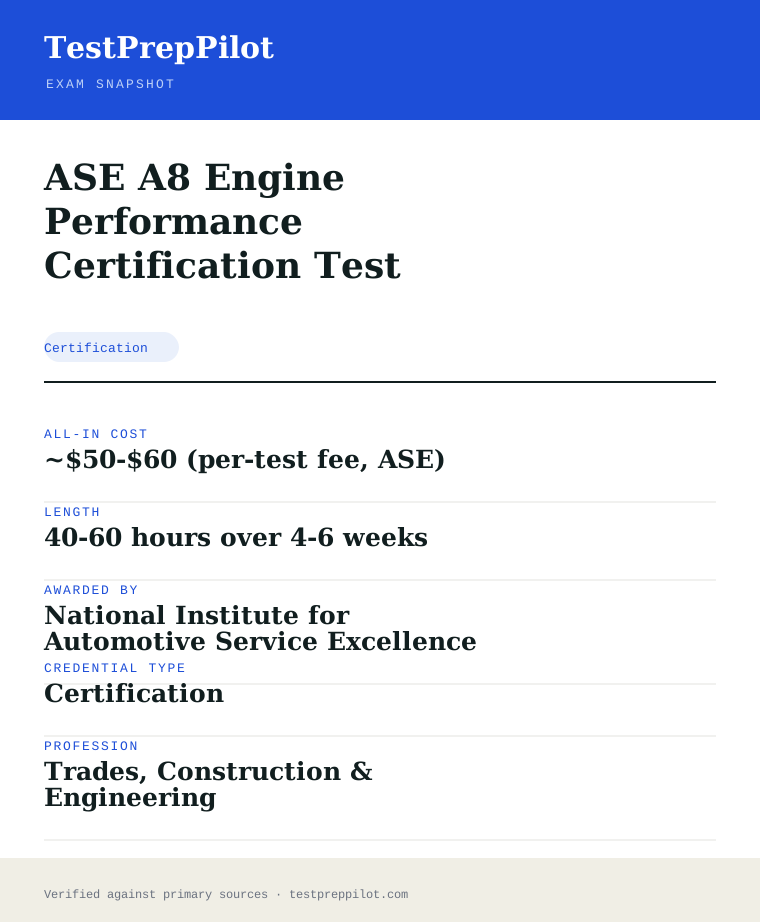
The short version
What is the ASE A8 Engine Performance Certification Test and is it worth it?
ASE A8 Engine Performance Certification Test is a professional credential administered by National Institute for Automotive Service Excellence (ASE). It validates job-ready knowledge and skills in the Trades & Construction field and is used for career entry, advancement, or compliance.
- Recognized credential from National Institute for Automotive Service Excellence (ASE)
- Demonstrates verified competence in Trades & Construction
- Supports career advancement and may satisfy licensing or employer requirements
What is it?
What exactly is the ASE A8 Engine Performance Certification Test?
ASE A8 Engine Performance Certification Test — Trades & Construction credential from National Institute for Automotive Service Excellence (ASE)
Automobile series test on driveability diagnosis, ignition, fuel, air induction, emission control and computerised engine controls. Offered by National Institute for Automotive Service Excellence (ASE), it is designed for candidates who need to demonstrate verified competence in the Trades & Construction field. The credential is commonly used for career entry, advancement, regulatory compliance, or employer requirements. Candidates should review the official handbook for eligibility, exam format, and scoring before registering.
The path in brief
- Confirm you meet any eligibility or prerequisites
- Review the official handbook and study materials
- Register and pay through the awarding body or authorized provider
- Schedule and take the exam (test center or online proctoring)
- Receive your score and, if passed, your credential
Before you book
Who is eligible to sit the ASE A8 Engine Performance Certification Test?
Eligibility varies; many credentials are open to all, while others require coursework, work experience, or sponsorship.
Who it is for: Professionals and candidates seeking to validate Trades & Construction competence.
The test itself
What is the format of the ASE A8 Engine Performance Certification Test?
The ASE A8 Engine Performance Certification Test is administered by National Institute for Automotive Service Excellence (ASE) and runs 90 minutes.
| Administered by | National Institute for Automotive Service Excellence (ASE) |
|---|---|
| Questions | ~45-65 questions |
| Time limit | 90 minutes |
| Pass mark | Passing score set by the awarding body; see the official score report |
| Exam fee | ~$50-$60 |
| Format | Proctored, computer-based (test center or online remote proctoring) |
Content outline
What topics are on the ASE A8 Engine Performance Certification Test?
The ASE A8 Engine Performance Certification Test covers 4 content domains.
Weightings come from the official exam outline. Study time is best allocated in roughly these proportions rather than evenly across domains.
- Trade fundamentals
Topic area tested on the exam; see the official blueprint for the detailed breakdown.
- Tools & materials
Topic area tested on the exam; see the official blueprint for the detailed breakdown.
- Codes & safety
Topic area tested on the exam; see the official blueprint for the detailed breakdown.
- Hands-on procedures
Topic area tested on the exam; see the official blueprint for the detailed breakdown.
The path
How do you register for the ASE A8 Engine Performance Certification Test?
- 1
Visit the awarding body’s official website and create an account
- 2
Select the credential and review its specific requirements
- 3
Complete any required eligibility (education, experience, or training)
- 4
Pay the registration fee
- 5
Schedule the exam at a test center or online
- 6
Take the exam and receive your results
The fine print
What are the retake and renewal rules for the ASE A8 Engine Performance Certification Test?
- Proctoring & delivery
- Proctored, computer-based delivery (test center or remote online proctoring), varying by exam.
- Retake policy
- Varies by credential — most bodies permit retakes after a waiting period and full or partial fee.
- Score reporting
- Scores are reported per the body’s timeline, typically electronically after the exam.
- Recertification
- Varies; many credentials require renewal every 2–3 years via continuing education or a recertification exam.
What it pays
How much does this credential pay?
$49,670 median for automotive service technicians and mechanics (BLS, May 2024) — and ASE certification is the credential that moves techs up the wage scale and into the positions dealerships require it for
ASE A8 is one test in the eight-test Automobile & Light Truck series, and it is not itself a job title, so the salary story is the occupation it certifies within: automotive service technicians and mechanics (SOC 49-3023), who earned a median of $49,670 in May 2024 per the BLS Occupational Outlook Handbook. The distribution matters more than the headline: the lowest 10 percent earned under $33,660, while the highest 10 percent earned more than $80,850, and the spread is driven largely by credential level, specialization, and employer type. Technicians working for automobile dealers — the settings that most often require ASE certification — earned a median of $58,580, well above the occupation-wide figure, while independent shops paid less. ASE certification is the industry’s standard competency credential, and employers typically pay a per-certification premium — commonly quoted at $0.50 to $1.00 per hour per certification in flat-rate shops, with Master Technician status (all eight A-series tests) bringing the largest step. The pay mechanics matter here because A8 is widely considered the hardest of the A-series tests: it covers computerized engine management, OBD-II diagnostics, fuel and ignition systems, and emission controls, and it pulls together engine mechanical knowledge (A1) and electrical knowledge (A6). BLS projects 4 percent employment growth from 2024 to 2034, about as fast as average, with roughly 70,000 openings a year driven mostly by replacement need — the industry is large and consistently hiring, but the higher-paying dealership and specialisation slots are where certification is effectively required.
| Measure | Figure | Source / note |
|---|---|---|
| Median annual wage, automotive service technicians and mechanics | $49,670 | BLS Occupational Outlook Handbook, May 2024 ($23.88/hr) |
| Lowest 10 percent | less than $33,660 | BLS OOH Pay tab, May 2024 |
| Highest 10 percent | more than $80,850 | BLS OOH Pay tab, May 2024 |
| Automobile dealers median | $58,580 | BLS OOH Pay tab, May 2024 — the setting that most often requires ASE certs |
| Employment, 2024 | 805,600 jobs | BLS OOH Quick Facts, 2024 |
| Projected annual openings | ~70,000 per year | BLS OOH Job Outlook, 2024-34 — mostly replacement need |
Job growth.4% projected change 2024-34, about as fast as average, with ~70,000 openings a year; ASE certification is the lever for the higher-paying dealership and specialisation segments.
Source: BLS Occupational Outlook Handbook — Automotive Service Technicians and Mechanics
Your odds
What are the pass rates?
ASE publishes no pass rate for A8 — but industry sources commonly cite a first-attempt pass rate around two-thirds, and the published cut is that about 70 percent of scored questions must be correct
ASE does not publish pass-rate statistics for individual tests, including A8, and its score reports deliberately avoid telling candidates the exact passing score. The industry-cited figure is that roughly two out of three technicians pass an ASE test on their first attempt — a figure that has circulated from ASE training partners for years, but it is not an official ASE statistic and it is not test-specific. What is published and more useful is the structure: A8 consists of 60 total questions, of which 50 are scored and 10 are unscored pretest items used to calibrate future tests, and you have 75 minutes. ASE’s scoring uses an approximately 70 percent bar on the scored questions, but the exact number is deliberately withheld to prevent gamesmanship, and because you cannot tell which questions are pretest items, the practical rule is to answer every question. The honest readiness signal is therefore not a rumoured pass rate but your performance on official-style practice material and the ASE study guide’s sample questions: if you are scoring reliably above 80 percent on timed practice, you are in strong shape, because the exam rewards diagnosis reasoning more than memorised facts. Candidates who fail simply retake; ASE allows retesting in later testing windows, and each registration is paid again. The one published number that shapes most candidates’ strategy is the test composition itself — 60 questions, 75 minutes, roughly 70 percent to pass — so build a plan around completing all 60 questions with time to review, and treat the 10 pretest items as a reason to answer everything rather than skip.
Read this before quoting the number.ASE publishes no official pass rates and does not disclose the exact passing score for A8. The ~70% threshold and ~two-thirds first-attempt pass figure are industry-cited approximations, not ASE-published statistics, and are labelled as such here.
Source: ASE — Automobile & Light Truck certification program
Your schedule
How long should I study for it?
40-60 hours over 6-8 weeks of focused study
Plan for six to eight weeks and 40 to 60 hours of study for ASE A8, the A-series test widely regarded as the hardest because it spans the whole drivability system — engine mechanical, fuel delivery, air induction, ignition, emission controls, and the computerised engine management that ties them together. The test is 60 questions (50 scored) in 75 minutes, scored at roughly 70 percent, and the official task list is your syllabus. The published content areas are General Engine Diagnosis, Ignition System Diagnosis, Fuel/Air Induction and Exhaust, Emission Control Systems, and Computerized Engine Controls. The critical study principle is system-level thinking: A8 does not ask about components in isolation — it asks how a failed MAF sensor changes fuel trim, how fuel trim triggers a DTC, and how a monitor becomes enabled. Weeks one through three should build each subsystem in order — general diagnosis and scan-tool data first, then ignition, then fuel and air, then emissions — with emphasis on reading live data PIDs, DTC structure, freeze-frame data, and monitor readiness, which anchor a large share of the paper. Week four should be computerized engine controls and OBD-II in depth, the largest content area. Weeks five and six should be practice-test heavy, working the official study guide’s sample questions and timed sets, and re-studying the task-list areas you miss. The final week is review of the highest-yield material: fuel trim logic, sensor signal interpretation, misfire diagnosis, and emission-monitor behaviour.
- Weeks 1-210-14 hrs
General engine diagnosis and scan-tool data
- Study the official A8 task list and map it to your existing knowledge
- Learn scan-tool live data: RPM, coolant temp, throttle position, MAF, MAP, O2 sensors, and fuel trims
- Master DTC structure, pending vs confirmed vs permanent codes, and monitor readiness
- Learn freeze-frame data and how to use it to reproduce intermittent faults
- Week 310-12 hrs
Ignition and fuel/air diagnosis
- Ignition: coil-on-plug systems, crankshaft and camshaft sensors, knock sensor operation, and misfire diagnosis
- Fuel: short-term vs long-term fuel trim, MAF vs MAP behaviour, injector pulse width, and fuel pressure testing
- Air induction and exhaust: vacuum leaks, restricted exhaust, and how they change fuel trim
- Practise reading secondary-ignition and sensor waveforms conceptually
- Week 410-12 hrs
Emission controls and computerized engine management
- Emission systems: EVAP, EGR, catalytic converter and O2 sensor monitors, PCV, and their drive-cycle conditions
- Computerized engine controls: PCM strategy, sensor inputs, actuator outputs, and adaptive learning
- Study how monitors enable and run, and what failure thresholds look like (Mode $06 concepts)
- Work scenario questions that connect a symptom to the system that causes it
- Weeks 5-610-12 hrs
Timed practice and gap closing
- Work the official study guide sample questions and multiple timed practice sets
- Re-study every task-list area where practice scores drop below 80%
- Drill fuel-trim logic, sensor interpretation, and misfire diagnosis — the highest-yield scenarios
- Take at least two full 75-minute timed exams before test day
- Week 76-8 hrs
Final review and logistics
- Final pass over fuel trim, DTC enable conditions, and monitor behaviour
- Review the question types in the official guide so the phrasing is familiar
- Confirm your eligibility documentation, testing window, and test centre
- Rest before the exam — the 75-minute clock rewards a clear head
Adjusting the pace
Master Technician candidate taking all eight A-series tests.A8 should come near the end of the sequence, after A1 (Engine Repair) and A6 (Electrical), because it assumes their content. Budget the same 6-8 weeks and lean on your recent A1/A6 study to compress subsystem review.
Working technician with daily drivability experience.Compress to 4-5 weeks and spend the recovered time on practice tests and the formal task list. The gap for working techs is usually exam vocabulary and test-taking discipline, not diagnostic skill.
Career-changer with no current shop work.Plan 10-12 weeks. You are eligible with two years of experience or a qualifying training program, but the diagnostic scenarios assume real familiarity with scan tools and live data — find lab or training time and budget extra weeks on computerized controls.
How to study
How do I prepare most effectively?
The single most important strategy for A8 is to study the engine as a closed loop — sensors, PCM strategy, actuators, and the fuel-trim and monitor responses that connect them — because the exam is explicitly system-level and punishes candidates who study components in isolation. Second, master the diagnostic anchors that carry a disproportionate share of the paper: fuel trim interpretation, MAF versus MAP signal behaviour, misfire diagnosis, and the enable-and-run conditions of emission monitors. Third, work the official ASE study guide and its sample questions rather than relying on unofficial dumps, because ASE questions are written to the official Task List and the question styles — "technician A says / technician B says" and scenario-and-cause formats — are best learned from official examples. Fourth, practise under the clock: 60 questions in 75 minutes is about a minute per question, and the pace is manageable only if you are not re-deriving answers. Fifth, build a fixed diagnostic order and apply it to every scenario question — check whether the system is running, whether the sensor is credible, whether the data says lean or rich, and what the monitor requires — because the same reasoning that diagnoses a real car answers the test. Finally, remember that recertification is a shorter test: A8 recertification is 25 questions in 45 minutes, so the five-year renewal is a much lighter lift than the initial certification.
Study the closed loop, not components
A8 asks how a failed MAF changes fuel trim, how fuel trim sets a DTC, and how a monitor enables. Trace each sensor signal through the PCM to the actuator and the monitor. Component-by-component study fails exactly the questions this test is known for.
Master the diagnostic anchors
Fuel trim interpretation, MAF vs MAP behaviour, misfire diagnosis, and emission-monitor enable conditions underpin a large share of the paper. Drill these four until they are reflex, and re-study them in the final week.
Use the official study guide and question styles
ASE publishes the task list and sample questions in its study guide. Work those samples until the phrasing is familiar — especially the technician A/B format — before touching third-party practice tests, and prefer official-style material over dumps.
Rehearse the 75-minute pace
60 questions (50 scored) in 75 minutes means roughly a minute per question. Run full timed practice exams so pacing is automatic, and answer every question — the 10 pretest items are indistinguishable from scored ones.
Apply a fixed diagnostic order to every scenario
Is the system operating? Is the sensor reading credible? Does the data say lean or rich? What must the monitor see to pass? The same disciplined order that diagnoses a car answers the scenario questions — pattern-matching to a remembered fix is how candidates drop points.
Plan the five-year recertification now
A8 certification is valid five years and renewed by the shorter recertification test (25 questions, 45 minutes). Note the expiry in your calendar at certification time so renewal is a light revision, not a full re-study.
What to buy
Which study resources are worth paying for?
A8 preparation is inexpensive relative to most certifications, and the official resources are the anchor. The ASE automobile study guide, available through ase.com, lists every task and includes sample questions for roughly $20-30, and ASE also sells official practice tests and a range of task-list products — this is the first spend because it is the only material written to the actual test content. Beyond that, third-party study guides and practice-test sites run $20-40, video courses from $15-60 during sales, and in-person or hybrid prep classes (often through community colleges and training providers) range from a few hundred dollars upward. The exam itself costs roughly $40-56 per test plus a small registration fee, with recertification tests priced the same; most candidates taking several A-series tests buy a bundle. For most working technicians, the honest budget is under $150: the official study guide, one third-party practice-test subscription, and the exam fee. The one resource that cannot be bought is scan-tool and live-data fluency, which comes from the work itself — A8 scenario questions reward real diagnostic experience, and candidates without recent drivability work should find lab time rather than spending more money. The buying rule: official study guide first, timed practice second, video courses as optional pacing aids, and avoid any source claiming real current A8 questions, which ASE does not license.
| Resource | Price | Format | Best for |
|---|---|---|---|
| ASE Automobile Study Guide (official) | ~$20-30 | PDF with task list and sample questions | The authoritative syllabus — start here |
| ASE official practice tests | ~$15-40 | Online timed practice | Format calibration against real question styles |
| A8 exam registration | ~$40-56 per test + registration | Prometric test centre, computer-based | The required step — bundles available for multiple tests |
| Third-party A8 study guides and practice tests | ~$20-40 | Print or online | Extra timed reps and structured review |
| Video courses and prep classes | ~$15-60 online; classes can run $200+ | Video or instructor-led | Structured pacing for candidates who want guided study |
| Your own shop time and scan tool | Free if working | Hands-on diagnosis | The diagnostic fluency no book provides — irreplaceable for A8 |
Prices checked 2026-08 in USD and approximate. ASE fees vary by registration method and bundle. ASE does not license its questions to third parties, so treat any seller claiming real current A8 items with suspicion. We do not rank by commission.
Avoid these
What mistakes do candidates most often make?
The most common A8 mistake is studying components in isolation when the exam asks system-level questions — a candidate who can list every sensor but cannot trace a failed MAF through fuel trim to a DTC will fail the scenario items. The second is misreading the format: A8 uses technician A/B and scenario-and-cause question styles, and candidates who have only drilled single-answer trivia lose points on phrasing. A third cluster is test-taking discipline: spending too long on hard questions when the 75-minute clock allows only about a minute per item, skipping questions (every item counts — 10 are pretest and indistinguishable), and never practising under timing. Candidates also under-prepare the computerized-controls domain, the largest content area, and rely on outdated task lists from before ASE’s revisions. Finally, many candidates misunderstand eligibility and renewal: they sit the test without the required two years of experience documentation, or they forget that A8 certification expires after five years and must be renewed with the shorter recertification test, losing the credential through lapse rather than failure.
✕Studying components in isolation
✓A8 tests the closed loop: sensor signal, PCM strategy, actuator, and monitor response. For every component, practise explaining how a failure changes fuel trim, sets a DTC, or disables a monitor — that is the question format.
✕Not learning the question styles
✓Work the official study guide’s technician A/B and scenario questions until the phrasing is automatic. Candidates who only drill single-answer facts are surprised by the format and lose points to wording rather than knowledge.
✕Poor pacing in the 75-minute window
✓60 questions in 75 minutes is about a minute each. Run full timed practice exams, skip-and-return strategically on hard items, and always answer every question — pretest items are indistinguishable and unscored guesses are harmless.
✕Under-preparing computerized engine controls
✓Computerized controls is the largest content area, covering PCM strategy, sensor inputs, actuator outputs, and adaptive learning. Give it the most study time, not the least — it is the domain that separates A8 passes from fails.
✕Using an outdated task list
✓ASE revises task lists on a schedule. Buy the current edition of the official study guide and anchor to it, rather than relying on old study material or remembered blueprints.
✕Ignoring eligibility and the five-year expiry
✓You must document two years of qualifying experience (or one year plus two years of training) to certify, and A8 lapses after five years unless renewed via the 25-question recertification test. Confirm both before registering and diary the renewal.
What you'll face
What question types will I see?
ASE A8 is a computer-based test of 60 multiple-choice questions — 50 scored and 10 unscored pretest items — completed in 75 minutes at a Prometric test centre, with a passing threshold of approximately 70 percent of the scored questions that ASE deliberately does not publish exactly. All questions are multiple choice with a single correct answer, but ASE uses distinctive question styles that candidates must learn: the "technician A says … technician B says …" format, scenario-and-cause questions that describe a symptom and ask for the cause or the next diagnostic step, and "technician, which action is most likely" questions that reward a fixed diagnostic order. The content spans five published areas — general engine diagnosis, ignition system diagnosis, fuel/air induction and exhaust, emission control systems, and computerized engine controls — and a large share of items integrate scan-tool data, fuel-trim logic, and OBD-II monitor behaviour. The samples below are editor-written illustrations of the published question styles and content, not live exam items.
Two statements about a diagnosis or repair; you determine whether A, B, both, or neither is correct. Rewards precision and punishes "both sound plausible" guessing.
A vehicle symptom plus data is described; you identify the cause or the most likely next diagnostic step. Rewards a fixed diagnostic order.
Given a concern, which test, tool, or repair step is correct — or which is NOT. Tests practical decision-making against the task list.
Component function, system operation, and OBD-II concepts presented without a live vehicle scenario.
Try these
Q1A vehicle with a plugged catalytic converter is brought in. Technician A says the plugged converter will cause high exhaust backpressure and can raise manifold vacuum readings at idle. Technician B says a plugged converter can cause the engine to stall under load. Who is correct?
Answer:C
A plugged catalytic converter restricts exhaust flow, raising exhaust backpressure. At idle this backpressure can push into the combustion chamber and produce abnormal manifold vacuum behaviour — and under load the restriction can exceed what the engine can pump against, causing stalling. Both statements are correct. The common error is doubting Technician A because "high backpressure raises vacuum" sounds counterintuitive; the exam rewards knowing that a restricted exhaust distorts vacuum readings in both directions depending on engine condition.
Q2A vehicle sets a DTC for a lean condition. Long-term fuel trim is +25 percent, short-term fuel trim is +5 percent, and the MAF sensor reads lower than expected at idle. The technician has already verified there are no vacuum leaks and fuel pressure is within specification. Which is the most likely cause?
Answer:A
Positive long-term fuel trim means the PCM is adding fuel to correct a perceived lean condition. With no vacuum leaks and fuel pressure in spec, a MAF sensor that under-reports airflow makes the PCM deliver too little fuel — producing the lean correction and matching the low MAF reading. A faulty O2 sensor reading permanently rich (B) would drive the opposite correction; a stuck-open EGR valve (C) dilutes the charge and can set lean codes but would not produce a low MAF airflow signal in this way; and low compression (D) is a mechanical condition that presents with misfire and typically different data. The scenario rewards connecting the fuel-trim direction to the sensor that feeds it.
Q3A vehicle has a single-cylinder misfire and a flashing malfunction indicator lamp. Which diagnostic step should be performed first?
Answer:B
A flashing MIL indicates a catalyst-damaging (Type A) misfire, so the correct priority is to identify the misfiring cylinder and work through the classic order — ignition, then fuel, then compression — to find the cause. The crankshaft position sensor (A) affects all cylinders, not a single one, and would not explain a single-cylinder misfire. C is wrong because the converter is damaged by the misfire, not the cause of it. D wastes time and risks converting a damaged converter into a completely destroyed one. The exam rewards the disciplined sequence over the dramatic conclusion.
Samples are editor-written illustrations of the published question styles and content areas, not live exam items.
The big day
What should I expect on exam day?
ASE A8 is taken on computer at a Prometric test centre, lasts 75 minutes, and consists of 60 multiple-choice questions (50 scored plus 10 unscored pretest items), with a passing threshold around 70 percent that ASE does not publish exactly. You must register through ase.com within the current testing window, which means your eligibility documentation — proof of the required work experience or training — must be on file before you test. Bring a valid government-issued photo ID; ASE and Prometric check it at the desk, and the name must match your registration. Leave phones, smartwatches, and study material in the locker — the test centre environment is strictly controlled. On the clock, the pacing is about a minute per question, so move deliberately, skip-and-return on items that stall you, and never leave a question unanswered, because the pretest items are indistinguishable from scored ones and a guess costs nothing. Read each question for the exact wording — technician A/B and "which is NOT correct" items punish fast reading — and apply your diagnostic order to every scenario rather than pattern-matching to a remembered fix. You receive your result on completion; ASE mails a score report, and if you passed, your A8 certification is recorded and valid for five years. Spanish-language rendering of questions is available at the test centre for eligible candidates, which is worth confirming when you register if it applies to you.
Bring
- A valid, government-issued photo ID matching your registration name
- Your ASE registration and confirmation details
- Comfortable clothing for a 75-minute computer session
- A clear picture of the test centre address, arrival time, and parking
Leave at home
- Phones, smartwatches, fitness trackers, and earbuds — locker at the centre
- All notes, study guides, and cheat sheets
- Calculators and any other electronic devices — none are needed or permitted
- The assumption that you can change your name or eligibility details at the desk — fix those before the window
How the day runs
Rules in the room
- Computer-based at a Prometric test centre; 60 questions in 75 minutes.
- 50 scored questions plus 10 unscored pretest items — indistinguishable, so answer everything.
- Passing is approximately 70% of scored questions; ASE does not publish the exact figure.
- Two years of qualifying experience (or one year plus two years of training) must be documented for certification.
- Certification is valid five years and renewed via the shorter 25-question recertification test.
- A Spanish/English side-by-side rendering option is available at the test centre for eligible candidates.
Afterwards.Your result is reported when you complete A8, and ASE follows up with a mailed score report; a pass records the A8 certification to your ASE account, valid for five years. The score report also shows your performance by task area, and even on a pass it is worth reading — it tells you which systems to shore up for the Master Technician sequence or the L1 Advanced Engine Performance test. On a pass, update your resume and your shop’s records, claim any employer certification bonus, and diary the five-year expiry immediately so renewal is a 25-question refresh rather than a full re-study. On a fail, resist the urge to retake cold: the score report identifies the weak domains, and a fortnight of targeted work on those task areas — typically computerized controls and emission monitors — is the difference between a repeat fail and a pass. Because you can take multiple A-series tests in the same window, a strong A8 result is a natural moment to schedule the remaining tests toward Master Technician status, which is where the certification begins to show meaningfully in pay.
Reference
What are the key facts about the ASE A8 Engine Performance Certification Test?
ASE A8 Engine Performance Certification Test is a certification credential; awarded by National Institute for Automotive Service Excellence (ASE); the exam fee is ~$50-$60; typical preparation is 40-60 hours over 4-6 weeks; holders typically earn $35,000-$70,000 (49-3023 median ~$51,020).
| Credential | ASE A8 Engine Performance Certification Test |
|---|---|
| Abbreviation | ASE A8 |
| Type | Certification |
| Profession | Trades, Construction & Engineering |
| Specialty | Automotive & Diesel |
| Awarded by | National Institute for Automotive Service Excellence (ASE) |
| Difficulty | Hands-on / Applied |
| Typical prep time | 40-60 hours over 4-6 weeks |
| All-in cost | ~$50-$60 (per-test fee, ASE) |
| Typical salary range | $35,000-$70,000 (49-3023 median ~$51,020) |
| Credential | ASE A8 Engine Performance Certification Test |
| Awarding body | National Institute for Automotive Service Excellence (ASE) |
| Exam format | Proctored, computer-based |
| Validity | Valid 5 years (recertification required) |
| Languages | Varies — see awarding body |
| Scope | National / Multi-state |
| Also known as | A8 |
Real questions
Frequently asked questions about the ASE A8 Engine Performance Certification Test
How do I register for the ASE A8 Engine Performance Certification Test exam?
Register through National Institute for Automotive Service Excellence (ASE)'s official portal or an authorized test provider (e.g., Pearson VUE or Prometric where applicable). Create an account, select the exam, pay the fee, and schedule a date.
How much does the exam cost?
Fees vary by location and currency. Confirm the current fee on the official registration page before scheduling.
How long is the credential valid, and how do I renew?
Validity varies by credential (commonly 2–3 years). Renewal usually requires continuing education or a recertification exam — see National Institute for Automotive Service Excellence (ASE)'s policy.
What if I do not pass?
Most bodies allow retakes after a waiting period and payment of the full or partial fee. Check National Institute for Automotive Service Excellence (ASE)'s retake policy before rescheduling.
How do I register for a National Institute for Automotive Service Excellence (ASE) credential?
Register through the official website, select your exam, pay the fee, and schedule a date.
How do I renew a credential?
Renewal policies vary by credential; check the specific program page for requirements and cycles.
In short
Is the ASE A8 Engine Performance Certification Test worth it?
- ASE A8 Engine Performance Certification Test is awarded by National Institute for Automotive Service Excellence (ASE).
- Validates job-ready competence in Trades & Construction.
- Registration is through the awarding body or an authorized test provider.
- Renewal and retake policies vary — confirm before scheduling.
Same awarding body
What other credentials does National Institute for Automotive Service Excellence (ASE) award?
Trust
Where does this information come from?
Everything above is taken from the awarding body's own published material. Fees, question counts and domain weights are revised regularly — check the official page before you pay.
Research confidence: medium · Last reviewed 2026-08