The short version
What is the Board Certified Behavior Analyst and is it worth it?
Board Certified Behavior Analyst is a professional credential administered by Behavior Analyst Certification Board. It validates job-ready knowledge and skills in the Behavioral Health field and is used for career entry, advancement, or compliance.
- Recognized credential from Behavior Analyst Certification Board
- Demonstrates verified competence in Behavioral Health
- Supports career advancement and may satisfy licensing or employer requirements
What is it?
What exactly is the Board Certified Behavior Analyst?
Board Certified Behavior Analyst — Behavioral Health credential from Behavior Analyst Certification Board
Graduate-level certification for behaviour analysts, requiring accredited coursework, supervised fieldwork and a 185-question examination. Offered by Behavior Analyst Certification Board, it is designed for candidates who need to demonstrate verified competence in the Behavioral Health field. The credential is commonly used for career entry, advancement, regulatory compliance, or employer requirements. Candidates should review the official handbook for eligibility, exam format, and scoring before registering.
The path in brief
- Confirm you meet any eligibility or prerequisites
- Review the official handbook and study materials
- Register and pay through the awarding body or authorized provider
- Schedule and take the exam (test center or online proctoring)
- Receive your score and, if passed, your credential
Before you book
Who is eligible to sit the Board Certified Behavior Analyst?
Eligibility varies; many credentials are open to all, while others require coursework, work experience, or sponsorship.
Who it is for: Professionals and candidates seeking to validate Behavioral Health competence.
The test itself
What is the format of the Board Certified Behavior Analyst?
The Board Certified Behavior Analyst is administered by Behavior Analyst Certification Board and runs 4 hours and contains 160 questions.
| Administered by | Behavior Analyst Certification Board |
|---|---|
| Questions | 160 questions |
| Time limit | 4 hours |
| Pass mark | Passing score set by the awarding body; see the official score report |
| Exam fee | ~$175 |
| Format | Proctored, computer-based (test center or online remote proctoring) |
Content outline
What topics are on the Board Certified Behavior Analyst?
The Board Certified Behavior Analyst covers 4 content domains.
Weightings come from the official exam outline. Study time is best allocated in roughly these proportions rather than evenly across domains.
- Theory & models
Topic area tested on the exam; see the official blueprint for the detailed breakdown.
- Assessment & diagnosis
Topic area tested on the exam; see the official blueprint for the detailed breakdown.
- Intervention
Topic area tested on the exam; see the official blueprint for the detailed breakdown.
- Ethics & law
Topic area tested on the exam; see the official blueprint for the detailed breakdown.
The path
How do you register for the Board Certified Behavior Analyst?
- 1
Visit the awarding body’s official website and create an account
- 2
Select the credential and review its specific requirements
- 3
Complete any required eligibility (education, experience, or training)
- 4
Pay the registration fee
- 5
Schedule the exam at a test center or online
- 6
Take the exam and receive your results
The fine print
What are the retake and renewal rules for the Board Certified Behavior Analyst?
- Proctoring & delivery
- Proctored, computer-based delivery (test center or remote online proctoring), varying by exam.
- Retake policy
- Varies by credential — most bodies permit retakes after a waiting period and full or partial fee.
- Score reporting
- Scores are reported per the body’s timeline, typically electronically after the exam.
- Recertification
- Varies; many credentials require renewal every 2–3 years via continuing education or a recertification exam.
What it pays
How much does this credential pay?
Expect behavioral-analyst pay well above the counseling median — the closest BLS occupation, substance abuse and behavioral disorder counselors, earns $59,190 (May 2024), while applied-behavior-analyst roles typically pay $75,000-100,000+
The direct answer is that the BCBA (Board Certified Behavior Analyst) certification is the professional credential for applied behavior analysis, and the closest BLS occupation, substance abuse, behavioral disorder, and mental health counselors (SOC 21-1013), earned a May 2024 median annual wage of $59,190 — but the honest framing is that BLS has no BCBA-specific code, and BCBA salaries are widely reported by industry surveys (including the BACB’s own salary reporting and third-party surveys) in the $75,000 to $100,000+ range, with clinical directors and independent practitioners earning more, driven by the high demand for ABA services in autism treatment. The credential is the gate for supervising ABA practice in most settings: the BACB certifies BCBAs who design and supervise behavior-intervention programs, and employers — especially ABA clinics and school districts — require the credential for the roles that pay the occupation’s upper range. The pathway is substantial: a master’s degree, verified coursework in behavior analysis, 1,500 supervised fieldwork hours, and the exam, followed by ongoing supervision requirements. BLS projects about 17 percent growth for substance abuse and behavioral disorder counselors from 2024 to 2034, much faster than average, reflecting the broader behavioral-health demand that drives ABA. The practical read: the BCBA is a significant professional investment — years of education and supervised hours plus a demanding exam — with a strong pay and demand profile behind it, and the credential is the standard gate for behavior-analyst careers.
| Measure | Figure | Source / note |
|---|---|---|
| Median annual wage, substance abuse & behavioral disorder counselors | $59,190 | BLS OEWS, May 2024 (SOC 21-1013) |
| Projected growth, 2024-34 | +17% | BLS Employment Projections |
| The certification itself | Professional gate | BACB credential: master’s + verified coursework + 1,500 supervised hours + exam |
Job growth.BLS projects about 17% growth for substance abuse and behavioral disorder counselors from 2024 to 2034, much faster than average.
Source: BLS OOH — Substance Abuse, Behavioral Disorder, and Mental Health Counselors
Your odds
What are the pass rates?
BACB publishes pass rates — recent BCBA exam pass rates have run around 60-70% for first-time candidates; the exam is 160 questions in 4 hours with a pass point set by the BACB
The core fact is that the BACB does publish pass rates: the Board reports quarterly and annual pass rates by exam type, and recent BCBA exam pass rates have run approximately in the 60 to 70 percent range for first-time candidates, with some variation by cohort. The exam itself is a computer-based test of 160 multiple-choice questions with 4 hours allowed, administered at Pearson VUE testing centers, with a pass point (passing score) set by the BACB through a standard-setting process; the exam covers the BCBA task list — behaviorism and philosophical foundations, concepts and principles, measurement and data analysis, experimental design, ethics, and behavior-change procedures. Eligibility requires a master’s degree, completion of verified course sequence in behavior analysis, and 1,500 hours of supervised fieldwork. The published pass-rate pattern is useful for planning: candidates who complete the verified coursework and fieldwork, then follow a structured 8-to-12-week review with practice-exam calibration, sit within the range of the published pass rates. The honest preparation implication is to treat the exam as a distinct preparation project — the task list is the syllabus, and the practice exams (including the BACB’s official practice test) are the calibration tools.
Read this before quoting the number.BACB publishes pass rates by cohort; recent first-time BCBA pass rates ~60-70%.
Source: BACB — BCBA exam pass rates
Your schedule
How long should I study for it?
120-180 study hours over 8-12 weeks of focused study
Plan for roughly 8 to 12 weeks and 120 to 180 hours of study for the BCBA exam after completing the verified coursework and supervised fieldwork, structured around the task list — concepts and principles, measurement, experimental design, behavior-change procedures, and ethics — with practice-exam calibration. The exam’s weight favours the concepts-and-principles and behavior-change-procedure content, so allocate study time there first. The most effective sequence is: first, obtain the task list and take a practice exam to baseline; second, master the concepts and principles content, the conceptual foundation; third, study measurement, data analysis, and experimental design; fourth, drill the behavior-change procedures, the largest applied block; fifth, study the ethics content; and sixth, take full-length practice exams under real timing in the final month. The highest-yield habits are the practice exams (the 160-question, 4-hour format is a stamina test) and drilling the applied scenario items, which dominate the paper. Budget the final week for light task-list review and rest. After passing, complete the supervision requirement for maintenance and plan the continuing-education cycle.
- Weeks 1-345
Baseline + concepts
- Get the task list and take a practice exam
- Study concepts and principles
- Log weak areas
- Weeks 4-760
Measurement + procedures
- Study measurement and experimental design
- Drill behavior-change procedures
- Take a second practice exam
- Weeks 8-1045
Ethics + mocks
- Study the ethics content
- Take full-length practice exams
- Re-study weak areas
- Final weeks20
Exam readiness
- Light task-list review
- Confirm exam logistics
- Rest
Adjusting the pace
BCaBA.The bachelor’s-level assistant credential, with a shorter exam and lighter eligibility.
RBT.The registered behavior technician credential for direct-service staff, requiring a shorter exam.
How to study
How do I prepare most effectively?
The strategy that reliably passes the BCBA exam is "anchor on the task list, weight concepts and behavior-change procedures, and run full-length practice exams," and the single biggest error is reviewing coursework content instead of preparing for the exam’s applied scenario format. A second proven approach is mastering the concepts-and-principles foundation, since the scenario items build on it. Third, drill the behavior-change procedure items, the largest applied block, with the scenario format. Fourth, use the full-length practice exams as the calibration tool — the 160-question, 4-hour format is a stamina test, and practice scores are the honest readiness signal. Fifth, master the ethics content, a dependable block that the BACB weighs heavily. Finally, plan the fieldwork documentation and the maintenance requirements from the start, since eligibility and renewal are part of the credential’s structure.
Anchor on the task list
The exam is built from the BCBA task list.
Weight concepts and procedures
The conceptual foundation and the largest applied block.
Drill the scenario format
Applied scenario items dominate the paper.
Run full-length practice exams
The 160-question format is a stamina test.
Master the ethics content
A dependable block the BACB weighs heavily.
What to buy
Which study resources are worth paying for?
BCBA preparation runs $400 to $1,500 depending on the package, with the task list as the free authoritative syllabus and the practice exams as the calibration tool. The comparison below separates the exam fee, official resources, and the major prep options, with prices current to this review. The buying rule is to budget for a structured prep course with full-length mocks, since the exam format rewards the mock-anchored approach.
| Resource | Price | Format | Best for |
|---|---|---|---|
| BCBA exam registration | ~$175 | Computer-based at Pearson VUE | The exam itself |
| BACB task list | Free | Official PDF | The authoritative syllabus |
| BACB official practice exam | ~$60-90 | Online practice exam | Official format calibration |
| Prep courses (e.g. BDS, FIT, Pass the Big ABA) | ~$300-1,200 | Online courses + question banks | Structured 8-12 week review |
| Verified course sequence + fieldwork | Included in master’s | Graduate coursework + supervision | The eligibility requirements |
Prices approximate and dated to this review; eligibility requires the master’s, verified coursework, and 1,500 supervised hours.
Avoid these
What mistakes do candidates most often make?
The most common mistake is reviewing coursework content instead of preparing for the exam’s applied scenario format; the second is under-weighting the concepts-and-principles foundation, which the scenario items build on. A third recurring error is being weak on the behavior-change procedure items, the largest applied block. Candidates also routinely skip full-length practice exams and fail on stamina in the 4-hour format, and many neglect the ethics content, losing a dependable block. Finally, some candidates underestimate the fieldwork documentation, discovering eligibility gaps after the exam.
✕Coursework-style review
✓Prepare for the applied scenario format with practice exams.
✕Weak concepts foundation
✓Master concepts and principles; scenarios build on them.
✕Under-drilling procedures
✓The behavior-change block is the largest applied share.
✕Skipping full-length mocks
✓The 160-question, 4-hour format is a stamina test.
✕Neglecting fieldwork documentation
✓Document the 1,500 supervised hours as you go.
What you'll face
What question types will I see?
The BCBA exam contains 160 multiple-choice questions in 4 hours, covering the task list areas — concepts and principles, measurement and data analysis, experimental design, behavior-change procedures, and ethics — with a dominant share of applied scenario items. The samples below are editor-written illustrations of the published task list, not live exam items.
Behaviorism, reinforcement, and stimulus control.
Interventions and their applications.
Data analysis and experimental design.
The ethics code and professional conduct.
The conceptual basis of ABA.
Try these
Q1A behavior increases immediately after a stimulus is removed. Which principle is demonstrated?
Answer:B
Negative reinforcement is the increase in behavior following the removal of a stimulus.
Q2Which schedule of reinforcement produces a steady rate of responding?
Answer:B
Variable-ratio schedules produce steady, high rates of responding.
Q3Which ethical consideration is paramount when designing a behavior intervention?
Answer:A
The ethics code prioritises client dignity, assent, and humane intervention.
Samples are editor-written illustrations of the published task list, not live exam items.
The big day
What should I expect on exam day?
The BCBA exam is taken on computer at a Pearson VUE testing center: 160 multiple-choice questions with 4 hours, with a pass point set by the BACB, with results typically available within a few days. The core rules: bring valid photo ID, arrive early, and follow testing-center rules. After passing, complete the certification application and plan the ongoing supervision and continuing-education requirements. The most useful exam-day habits: pace at about 1.5 minutes per question, flag and return to the scenario items, and answer every question (no penalty for guessing). If you do not pass, the BACB allows retakes after a waiting period. After certification, complete the maintenance requirements — ongoing supervision and CEUs — and consider the BCBA-D or other advanced credentials for the career path.
Bring
- Valid photo ID
- Arrival 30 minutes early
- A 4-hour sitting mindset
Leave at home
- Phone, smartwatch, and study materials (testing-center rules)
- Personal notes in the testing room
How the day runs
Rules in the room
- 160 questions, 4 hours
- Computer-based at Pearson VUE
- Pass point set by the BACB
- Supervision + CEU maintenance
Afterwards.Passing the BCBA exam plus completing the eligibility requirements earns the Board Certified Behavior Analyst credential, the standard gate for ABA practice.
Reference
What are the key facts about the Board Certified Behavior Analyst?
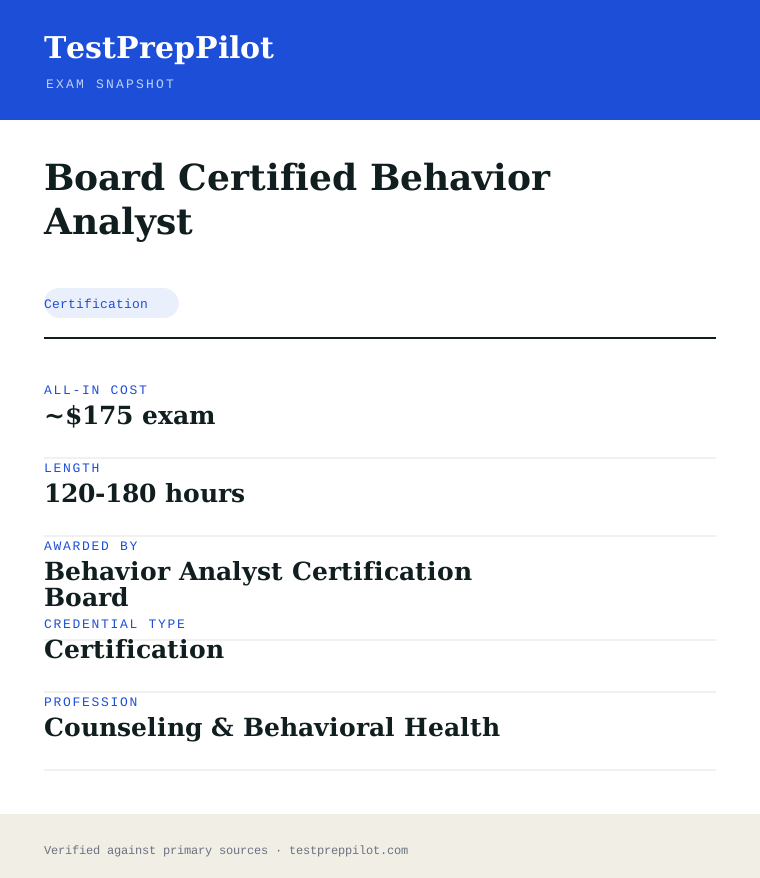
Board Certified Behavior Analyst is a certification credential; awarded by Behavior Analyst Certification Board; the exam fee is ~$175; typical preparation is 120-180 hours; holders typically earn $59,190 median, behavioral counselors (BLS May 2024).
| Credential | Board Certified Behavior Analyst |
|---|---|
| Abbreviation | BCBA |
| Type | Certification |
| Profession | Counseling & Behavioral Health |
| Specialty | Applied Behavior Analysis |
| Awarded by | Behavior Analyst Certification Board |
| Difficulty | Graduate-level |
| Typical prep time | 120-180 hours |
| All-in cost | ~$175 exam |
| Typical salary range | $59,190 median, behavioral counselors (BLS May 2024) |
| Credential | Board Certified Behavior Analyst |
| Awarding body | Behavior Analyst Certification Board |
| Exam format | Proctored, computer-based |
| Validity | Requires ongoing supervision and CEUs |
| Languages | Varies — see awarding body |
| Scope | National / Multi-state |
| Also known as | BCBA |
Real questions
Frequently asked questions about the Board Certified Behavior Analyst
How do I register for the Board Certified Behavior Analyst exam?
Register through Behavior Analyst Certification Board's official portal or an authorized test provider (e.g., Pearson VUE or Prometric where applicable). Create an account, select the exam, pay the fee, and schedule a date.
How much does the exam cost?
Fees vary by location and currency. Confirm the current fee on the official registration page before scheduling.
How long is the credential valid, and how do I renew?
Validity varies by credential (commonly 2–3 years). Renewal usually requires continuing education or a recertification exam — see Behavior Analyst Certification Board's policy.
What if I do not pass?
Most bodies allow retakes after a waiting period and payment of the full or partial fee. Check Behavior Analyst Certification Board's retake policy before rescheduling.
How do I register for a Behavior Analyst Certification Board credential?
Register through the official website, select your exam, pay the fee, and schedule a date.
How do I renew a credential?
Renewal policies vary by credential; check the specific program page for requirements and cycles.
In short
Is the Board Certified Behavior Analyst worth it?
- Board Certified Behavior Analyst is awarded by Behavior Analyst Certification Board.
- Validates job-ready competence in Behavioral Health.
- Registration is through the awarding body or an authorized test provider.
- Renewal and retake policies vary — confirm before scheduling.
Trust
Where does this information come from?
Everything above is taken from the awarding body's own published material. Fees, question counts and domain weights are revised regularly — check the official page before you pay.
- Behavior Analyst Certification Board Awarding body
Research confidence: low · Last reviewed 2026-08