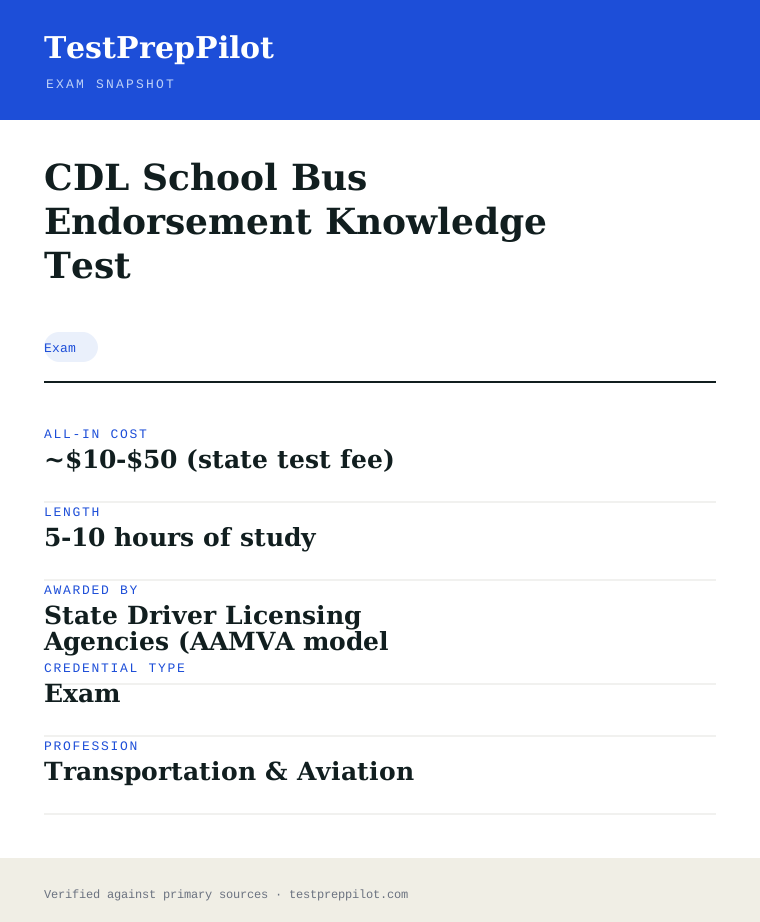
The short version
What is the CDL School Bus Endorsement Knowledge Test and is it worth it?
CDL School Bus Endorsement Knowledge Test is a professional credential administered by State Driver Licensing Agencies (AAMVA model curriculum). It validates job-ready knowledge and skills in the Transportation, Aviation & Maritime field and is used for career entry, advancement, or compliance.
- Recognized credential from State Driver Licensing Agencies (AAMVA model curriculum)
- Demonstrates verified competence in Transportation, Aviation & Maritime
- Supports career advancement and may satisfy licensing or employer requirements
What is it?
What exactly is the CDL School Bus Endorsement Knowledge Test?
CDL School Bus Endorsement Knowledge Test — Transportation, Aviation & Maritime credential from State Driver Licensing Agencies (AAMVA model curriculum)
Endorsement test on danger zones, student loading and unloading, railway crossings and evacuation procedures for school bus drivers. Offered by State Driver Licensing Agencies (AAMVA model curriculum), it is designed for candidates who need to demonstrate verified competence in the Transportation, Aviation & Maritime field. The credential is commonly used for career entry, advancement, regulatory compliance, or employer requirements. Candidates should review the official handbook for eligibility, exam format, and scoring before registering.
The path in brief
- Confirm you meet any eligibility or prerequisites
- Review the official handbook and study materials
- Register and pay through the awarding body or authorized provider
- Schedule and take the exam (test center or online proctoring)
- Receive your score and, if passed, your credential
Before you book
Who is eligible to sit the CDL School Bus Endorsement Knowledge Test?
Eligibility varies; many credentials are open to all, while others require coursework, work experience, or sponsorship.
Who it is for: Professionals and candidates seeking to validate Transportation, Aviation & Maritime competence.
The test itself
What is the format of the CDL School Bus Endorsement Knowledge Test?
The CDL School Bus Endorsement Knowledge Test is administered by State Driver Licensing Agencies (AAMVA model curriculum) and runs ~20-30 minutes.
| Administered by | State Driver Licensing Agencies (AAMVA model curriculum) |
|---|---|
| Questions | ~20 questions beyond the P endorsement |
| Time limit | ~20-30 minutes |
| Pass mark | Passing score set by the awarding body; see the official score report |
| Exam fee | State-dependent |
| Format | Proctored, computer-based (test center or online remote proctoring) |
Content outline
What topics are on the CDL School Bus Endorsement Knowledge Test?
The CDL School Bus Endorsement Knowledge Test covers 4 content domains.
Weightings come from the official exam outline. Study time is best allocated in roughly these proportions rather than evenly across domains.
- Regulations & procedures
Topic area tested on the exam; see the official blueprint for the detailed breakdown.
- Systems & operations
Topic area tested on the exam; see the official blueprint for the detailed breakdown.
- Safety & emergency
Topic area tested on the exam; see the official blueprint for the detailed breakdown.
- Navigation & logistics
Topic area tested on the exam; see the official blueprint for the detailed breakdown.
The path
How do you register for the CDL School Bus Endorsement Knowledge Test?
- 1
Visit the awarding body’s official website and create an account
- 2
Select the credential and review its specific requirements
- 3
Complete any required eligibility (education, experience, or training)
- 4
Pay the registration fee
- 5
Schedule the exam at a test center or online
- 6
Take the exam and receive your results
The fine print
What are the retake and renewal rules for the CDL School Bus Endorsement Knowledge Test?
- Proctoring & delivery
- Proctored, computer-based delivery (test center or remote online proctoring), varying by exam.
- Retake policy
- Varies by credential — most bodies permit retakes after a waiting period and full or partial fee.
- Score reporting
- Scores are reported per the body’s timeline, typically electronically after the exam.
- Recertification
- Varies; many credentials require renewal every 2–3 years via continuing education or a recertification exam.
What it pays
How much does this credential pay?
$57,440 median for bus drivers, transit and intercity — the closest-fit passenger-carrying occupation for the S endorsement (BLS, May 2024); school bus drivers are their own BLS code at a $47,040 median
The School Bus Endorsement does not create its own BLS occupation — it is an add-on to a Commercial Driver’s License that authorises you to operate a school bus and transport students, which sits on top of the Passenger Endorsement — so the salary story is the bus-driving occupation the endorsement qualifies you for. The task directs us to choose between two codes, and we use Bus Drivers, Transit and Intercity (SOC 53-3052) as the closer match because the S endorsement is about carrying passengers by bus: that occupation had a May 2024 median of $57,440, with the lowest 10 percent under $38,250 and the highest 10 percent over $82,640, and employment projected to grow about 4 percent from 2024 to 2034. The more specific code for the actual role, Bus Drivers, School (SOC 53-3051), had a lower May 2024 median of $47,040 — reflecting the part-time, school-year schedule of much school bus work — with the lowest 10 percent under $27,680 and the highest 10 percent over $63,810. Both figures should be read together: BLS classifies by job duties, not by endorsement, so no government median exists for "S-endorsed drivers" specifically, and a district or contractor pays by route and schedule, which is why school bus work is often part-time with split shifts. The endorsement matters economically for three reasons we can source directly: it is the hard requirement for school bus work, which some districts and contractors treat as a stable, benefit-bearing role; it signals to employers that the driver has cleared a federal knowledge standard, state background checks, and Entry-Level Driver Training — a screening package that many school districts require regardless; and it compounds the P endorsement, so a driver with both is qualified for the full range of passenger-carrying work. The honest framing is that the S endorsement does not appear in the BLS wage data, so treat any specific "school bus driver salary" figure as a district or aggregate estimate rather than government data, and read the $47,040 school-bus-driver median as the occupation-specific reference.
| Measure | Figure | Source / note |
|---|---|---|
| Median annual wage, bus drivers, transit and intercity (closest-fit) | $57,440 | BLS Occupational Outlook Handbook, May 2024 (SOC 53-3052) |
| Median annual wage, bus drivers, school | $47,040 | BLS OOH, May 2024 (SOC 53-3051) — the occupation-specific code |
| Lowest/highest 10 percent, school bus drivers | Under $27,680 / over $63,810 | BLS OOH Pay tab, May 2024 (SOC 53-3051) |
| The endorsement itself | No separate BLS data | BLS classifies by job duties, not endorsements; treat any dedicated "S-endorsement salary" as an employer estimate |
Job growth.BLS projects about 4% growth for bus drivers, transit and intercity from 2024 to 2034; school bus drivers are projected at roughly 0% growth with heavy replacement need, reflecting a large, high-turnover workforce.
Your odds
What are the pass rates?
FMCSA publishes the 80 percent passing standard (49 CFR 383.135) but no national pass rate for the S endorsement knowledge test — the test is commonly 20 questions in state manuals, and the school bus endorsement adds its own background-check gate
The core fact is that the School Bus Endorsement knowledge test has a published passing standard but no published pass rate: 49 CFR 383.135 requires an applicant to correctly answer at least 80 percent of the questions on each CDL knowledge test, and that 80 percent line is the only passing threshold in the federal rule — it applies per test with no curve or rounding. FMCSA does not release national knowledge-test pass statistics, and neither does any state DMV/SDLA we are aware of, so the percentages you see on commercial apps are those vendors’ own practice-test numbers, not official outcomes. What is verifiable is the structure. The S endorsement (49 CFR 383.93) requires a school bus-specific knowledge test in addition to the Passenger Endorsement knowledge test — P comes first, and S rides on top of it — and the school bus test in state manuals is commonly 20 questions, with the 80 percent floor meaning roughly 16 correct, though the exact count is state-set. The content baseline is in 49 CFR 383.123: the proper procedures for loading and unloading students, the use of the emergency exits and warning systems, and the proper procedures at highway-rail grade crossings, plus the driver’s responsibility for student safety. The S endorsement also carries a second, mandatory gate that is not a knowledge test at all: a background check required by your state — typically fingerprinting, a criminal history check, a sex offender registry check and a driving record review, with some states adding drug and alcohol testing — because transporting children is the most regulated passenger duty in the CDL system. Note also that the S endorsement triggers the federal Entry-Level Driver Training (ELDT) requirement under 49 CFR Part 380, and most states require a skills test in a school bus as well. The practical reading is that the S endorsement has two independent gates — an 80 percent knowledge standard and a background-check clearance — and neither has a published pass rate.
Read this before quoting the number.No national or state pass rate for the S endorsement knowledge test is published by FMCSA or the states. What is verifiable is the 80 percent cut score in 49 CFR 383.135, the common 20-question state test, the content baseline in 49 CFR 383.123, the state background-check requirement, and the ELDT trigger under 49 CFR Part 380; the narrative above covers those instead.
Source: eCFR — 49 CFR Part 383 (knowledge tests and endorsements)
Your schedule
How long should I study for it?
6-10 hours of focused study for the S knowledge test, plus the P endorsement, the background check, and ELDT lead time of focused study
The School Bus Endorsement Knowledge Test is a recall exam that sits on top of the Passenger Endorsement, and the study plan is short — budget 6 to 10 hours of focused study — but the endorsement itself has a longer timeline because of the background-check gate and the P-before-S structure. First, the P endorsement must be in place: S requires P, so the passenger knowledge test and its Entry-Level Driver Training obligations come before the school bus work. The federal content baseline for S is in 49 CFR 383.123: the proper procedures for loading and unloading students, the use of the emergency exits and warning systems, and the proper procedures at highway-rail grade crossings, plus the driver’s responsibility for student safety. Your state’s CDL manual covers this material in a dedicated school bus section, and the test is commonly 20 questions, with the federal 80 percent standard meaning roughly 16 correct on a typical paper. The most effective sequence is: first, read your state’s school bus chapter end to end, since the test is drawn from that manual’s wording; second, master the loading-and-unloading procedure, which is the most heavily tested and the most dangerous part of school bus operation — the danger zones around the bus, the amber and red warning lights, the stop arm, and the requirement to account for every student; third, learn the railroad-crossing procedure, which for school buses is a mandatory full stop with the window and door open, looking and listening before crossing; fourth, study the emergency-exit and evacuation procedures, including when to evacuate and how to account for all students; and fifth, drill your state’s official practice questions until you score above 80 percent consistently. In parallel, start the background check early, because fingerprinting, the criminal history and sex offender checks, and any drug testing have their own processing time and the endorsement cannot issue without clearance.
- Weeks 1-23-5 hrs/week
P endorsement foundation and school bus chapter
- Complete or confirm the P endorsement first — S requires P, and the passenger material carries over
- Read the school bus chapter of your state’s CDL manual end to end
- Start the state background check application, since fingerprinting and the registry checks have their own processing time
- Confirm the ELDT provider for the S endorsement requirement
- Weeks 3-43-5 hrs/week
School bus content and timed practice
- Master the loading-and-unloading procedure: danger zones, warning lights, stop arm, student accountability
- Learn the railroad-crossing rule: mandatory stop, window and door open, look and listen before crossing
- Study the emergency-exit and evacuation procedures, including when to evacuate and how to account for students
- Drill official practice questions until you score above 80 percent consistently, then book the test
Adjusting the pace
Already holding P and a CDL.A focused 1-2 week plan. The passenger foundation is in place; the work is the school bus chapter, the loading-and-unloading sequence, the background check, and confirming the ELDT record.
Starting from a CLP.Budget extra weeks for the full sequence: the licence knowledge tests, the P endorsement, the S endorsement, the background check, and the ELDT training all precede the school bus skills test.
Returning after a lapsed endorsement.The knowledge test is retaken when the CDL renews, and the background check must be current; re-run the chapter, re-file the background check early, and confirm the ELDT record is still valid for your state.
How to study
How do I prepare most effectively?
The School Bus Endorsement Knowledge Test is a recall exam with a hard 80 percent floor, and the strategy that pays off is narrower than candidates expect: learn your state’s school bus chapter, memorise the loading-and-unloading procedure and the danger zones, and drill timed practice until you score above 80 percent consistently. The single most common failure is treating the S test as an extension of the passenger material — the items are specific to school bus operation, and candidates who do not read the school bus chapter miss the warning-light, stop-arm and danger-zone items that dominate the paper. Second, master the loading-and-unloading procedure as a fixed sequence — the danger zone checks (the 10-foot areas around the bus), the amber-to-red warning light sequence, the stop arm, and the requirement to count and account for every student — because it is the most heavily tested and the most dangerous part of school bus operation. Third, learn the railroad-crossing rule cold: school buses must stop at all crossings, even with no train visible, opening the window and door to look and listen before crossing, and the test asks about that procedure directly. Fourth, study the emergency-exit and evacuation content, including when to evacuate and how to account for all students. Fifth, use your state’s official practice questions rather than a national app, because the bank follows your state’s manual wording and the 80 percent floor punishes exact-word traps. Finally, handle the background check and the ELDT requirement early — the background check is a mandatory gate with its own processing time, and the S endorsement triggers ELDT — so no amount of knowledge-test study substitutes for the screening.
Read the school bus chapter, not a general CDL app
The items are specific to school bus operation — warning lights, stop arm, danger zones, student loading. The passenger material is the foundation, but it will not carry the S test.
Master the loading-and-unloading sequence
The danger zones (about 10 feet around the bus), the amber-to-red warning light sequence, the stop arm, and counting every student form the most heavily tested and most dangerous procedure.
Learn the railroad-crossing rule cold
School buses stop at all crossings, even with no train visible, opening the window and door to look and listen before crossing. The test asks about this procedure directly.
Study the emergency-exit and evacuation content
When to evacuate, which exits to use, and the duty to account for all students are tested as a distinct cluster.
Use state-specific practice questions
The bank follows your state’s manual wording, and the 80 percent floor punishes exact-word traps.
Start the background check early
The S endorsement cannot issue without a state background check — fingerprinting, criminal history, sex offender registry and driving record, with drug testing in some states. It has its own processing time and is a gate no studying substitutes for.
What to buy
Which study resources are worth paying for?
The School Bus Endorsement Knowledge Test is cheap to prepare for because the authoritative source — your state’s CDL manual school bus chapter and its official practice questions — costs nothing, and the official material is the only source the test is written from, so a free study path is the complete one. The real costs sit around the test: the knowledge test fee is set by your state and is commonly in the $10 to $40 range, the state background check carries its own state-set fee of roughly $30 to $100 plus a fingerprinting cost, and the Entry-Level Driver Training requirement is a separate purchased training step — typically $100 to $500 from an FMCSA-registered provider. Because the S endorsement has multiple gates, the budget is broader than a single test fee: the background check and the ELDT training are mandatory parts of the endorsement, not optional extras, and both have processing lead times. The comparison below separates the free official material from the test, the background check, the ELDT step and the paid apps, with prices current to this review. Paid apps earn their place only as repetition engines once the official material is clean, and beware any product that quotes a "school bus pass rate," since that figure is not published by any government — the 80 percent standard in 49 CFR 383.135 is the passing rule, and there is no pass-rate statistic to compare against.
| Resource | Price | Format | Best for |
|---|---|---|---|
| Your state DMV CDL manual — school bus chapter | Free | PDF / web from the issuing state | The only source the test is written from — read it first and last |
| Your state DMV official practice questions | Free | Web or app | Wording that tracks the real question bank; do these before any paid set |
| S endorsement knowledge test | Fee set by state (often $10-40) | Computer-based at a DMV/SDLA | The test itself — 80% passing per 49 CFR 383.135 |
| State background check | ~$30-100 plus fingerprinting, state-set | Fingerprinting, criminal history, sex offender registry, driving record | Mandatory gate — the endorsement cannot issue without clearance |
| Entry-Level Driver Training (ELDT) | ~$100-500, provider-set | Online or classroom, FMCSA-registered provider | Mandatory for the S endorsement — required before the skills test |
| Commercial school bus practice apps | Free tier; ~$5-15/mo | Mobile app | Extra repetition once the official material is clean |
Prices checked 2026-08 in USD and vary by state and provider; the background-check fee and ELDT pricing are separate from the state test fee. We do not rank by commission.
Avoid these
What mistakes do candidates most often make?
Nearly every avoidable failure on the School Bus Endorsement comes from one of three roots: treating the S test as an extension of the passenger material instead of studying the school bus chapter, neglecting the background-check and ELDT lead times, or missing the 80 percent floor on a short 20-question test. The content error is the most common — candidates rely on their passenger knowledge and never read the school bus chapter, then miss the warning-light, stop-arm, danger-zone and railroad-crossing items that dominate the paper. The scheduling error is the most expensive — the S endorsement cannot issue without a state background check that has its own fee and processing time, and it triggers the ELDT requirement, so a candidate who studies but has no screening or training record is delayed by weeks. The scoring error is the most painful — on a commonly 20-question paper, 80 percent means 16 correct and a 15 is a full failure and a re-take fee. Candidates also make avoidable process errors: skipping the railroad-crossing rule, using a national app instead of the state manual’s wording, and trusting vendor "pass rates" that no government publishes. The mistakes below each carry a concrete fix, and all of them are cheaper to prevent than to re-take or re-screen.
✕Studying passenger material instead of the school bus chapter
✓The items are specific to school bus operation — warning lights, stop arm, danger zones, student loading, evacuation. Read the school bus chapter end to end; the passenger material is the foundation but will not carry the S test.
✕Forgetting the background check gate
✓The S endorsement cannot issue until the state background check clears — fingerprinting, criminal history, sex offender registry and driving record, with drug testing in some states. Start it early; it has its own fee and processing time.
✕Assuming a pass is rounded or curved
✓49 CFR 383.135 sets a flat 80 percent per knowledge test with no curve. On a 20-question paper that is 16 correct; a 15 is a fail. Bank the loading-and-unloading items and do not gamble the clock on one hard question.
✕Skipping the railroad-crossing rule
✓School buses must stop at all crossings, even with no train visible, opening the window and door to look and listen. Candidates who assume the general vehicle rule applies lose a whole cluster of items.
✕Forgetting the ELDT requirement
✓The S endorsement triggers Entry-Level Driver Training under 49 CFR Part 380, and the skills test cannot proceed without a completed record from a registered provider. Confirm your ELDT record is in place and current.
✕Using a national app that quotes a "pass rate"
✓No pass rate is published by FMCSA or any state; a vendor’s percentage is its own practice-test metric. Anchor prep to your state’s manual and official questions instead.
What you'll face
What question types will I see?
The School Bus Endorsement Knowledge Test is a multiple-choice exam administered at a state DMV/SDLA, taken after the Passenger Endorsement knowledge test, with the federal 80 percent passing standard in 49 CFR 383.135 and a question count that is commonly 20 in state manuals, set by your state. The content baseline is the school bus knowledge area in 49 CFR 383.123: the proper procedures for loading and unloading students, the use of the emergency exits and warning systems, and the proper procedures at highway-rail grade crossings, plus the driver’s responsibility for student safety. Items are single-best-answer by design, and because there is no curve, your only job is to push the correct count above the 80 percent line — on a 20-question paper that is 16 correct, so the loading-and-unloading and danger-zone items must be banked before the harder procedure questions. The loading-and-unloading procedure and the railroad-crossing rule are the largest clusters, with the emergency-exit, warning-system and student-safety items completing the paper. The samples below are editor-written illustrations of the published blueprint, not live exam items.
The danger zones around the bus, the amber-to-red warning light sequence, the stop arm, and counting and accounting for students — the most heavily tested procedure.
The mandatory full stop, the window and door open, looking and listening before crossing — tested as a distinct school bus rule.
When to evacuate, which exits to use, and the driver’s duty to account for all students.
The 8-light warning system, mirror use and adjustment, and student behaviour management.
Try these
Q1What is the most dangerous area around a school bus, which the driver must check before moving?
Answer:B
B is correct — the danger zones are the areas close to the bus on all sides (commonly about 10 feet in front, 10 feet on each side, and behind), and the area directly in front is especially dangerous because small students can be hidden from the driver’s view. A names only one of the zones, and C and D name areas that are not the defined bus danger zones. The item tests the danger-zone knowledge that anchors the loading-and-unloading cluster.
Q2When approaching a railroad crossing in a school bus, the driver must:
Answer:A
A states the correct procedure: school buses must stop at all railroad crossings, even with no train visible, and the driver opens the driver-side window and the service door, looks both directions and listens before proceeding. B and C are wrong because the stop is mandatory and is not conditional on seeing a train. D is wrong because sounding the horn does not replace the stop and the look-listen check. The item tests the school bus railroad-crossing rule directly.
Q3How should the driver use the school bus warning lights when preparing to stop to load or unload students?
Answer:A
A states the correct sequence: amber warning lights activate in advance of the stop to alert traffic, and the red warning lights and stop arm activate when the bus is fully stopped and students are loading or unloading. B is wrong because the red lights must be on during the loading or unloading, not after. C is wrong because headlights do not substitute for the warning-light system. D is wrong because deactivating the lights removes the protection the system provides. The item tests the warning-light sequence, a core school bus operation topic.
Samples are editor-written illustrations of the published blueprint (49 CFR 383.123 school bus knowledge area), not live exam items.
The big day
What should I expect on exam day?
The School Bus Endorsement Knowledge Test is taken at a state DMV/SDLA office, by computer, on the same appointment pattern as the other CDL knowledge tests, and it is passed separately under the federal 80 percent standard, on a paper commonly of 20 questions. Because the S endorsement has multiple gates, exam-day planning starts weeks earlier: the Passenger Endorsement must be in place first, the state background check must be complete or in motion, and the Entry-Level Driver Training record must be confirmed — so confirm all three before you pay for the knowledge test, because the knowledge test is only one gate and the endorsement cannot issue without the screening and the training record. Bring the same identity, residency and lawful-presence documents your DMV requires for the licence application, plus the correct fee for the endorsement test. The test itself is a short, recall-heavy multiple-choice paper focused on the school bus material — loading and unloading, danger zones, warning lights, railroad crossings, and emergency evacuation — so pace it to bank the loading-and-unloading items first, then return to the harder procedure questions; there is no curve, and on a 20-question paper a single question below the 80 percent line is a full failure. On a pass, the S endorsement is added to your CDL or CLP once the background check clears, and you can schedule the school bus skills test; on a fail, most states allow a prompt retake for a new fee, so re-read the school bus chapter and rebook rather than guessing the same material will stick.
Bring
- Proof of identity, lawful presence, Social Security number and state residency per your DMV’s document list
- Confirmation that the Passenger Endorsement is in place — S requires P first
- Confirmation that your state background check is complete or in progress — the endorsement cannot issue without clearance
- Confirmation that your Entry-Level Driver Training record is complete at a registered provider
- Correct fee for the endorsement knowledge test, set by your state
Leave at home
- Phones, smartwatches and earbuds — secured before you enter the testing area
- Notes, cheat sheets, the manual, or any printed material
- A translator or interpreter — states may offer the test in another language but not a third-party interpreter
- Any expectation of a driving component — this is a knowledge test only; the school bus skills test is separate
How the day runs
Rules in the room
- Passing standard is 80 percent on the endorsement knowledge test per 49 CFR 383.135 — a flat floor, no curve, no rounding.
- The S endorsement requires the Passenger Endorsement first (49 CFR 383.93), and a state background check must clear before the endorsement issues.
- The S endorsement triggers the federal Entry-Level Driver Training requirement under 49 CFR Part 380.
- The knowledge test is commonly 20 questions in state manuals, with the count set by your state.
- The endorsement rides on your CDL and is retested when the CDL renews.
- Retake policy, question count, background-check mechanics and fee are set by the state; verify all with your DMV.
Afterwards.On a pass, the S endorsement is added to your CDL or CLP once the state background check clears, and you can schedule the school bus skills test — because the knowledge test is only one gate, and the P-before-S structure, the ELDT record and the background clearance are the rest of the package. Diary the renewal dates immediately: the endorsement is retested when the CDL renews, and the background check must stay current, so the school bus credential quietly lapses if either is missed. On a fail, resist the urge to immediately re-sit the same material — most states allow a prompt retake for a new fee, but the cheap move is to re-read the school bus chapter and re-run official practice tests until you score above 80 percent consistently, because the floor is unforgiving and one question below the line is a full failure. Whichever way it goes, remember that the S endorsement is a multi-gate credential: the 80 percent knowledge standard is federal, the question count and background-check mechanics are state-set, and the screening — not the studying — is the gate that takes the calendar time.
Reference
What are the key facts about the CDL School Bus Endorsement Knowledge Test?
CDL School Bus Endorsement Knowledge Test is a exam credential; awarded by State Driver Licensing Agencies (AAMVA model curriculum); the exam fee is State-dependent; typical preparation is 5-10 hours of study; holders typically earn $42,000-$70,000 (53-3032) or $48,000-$75,000 (bus drivers).
| Credential | CDL School Bus Endorsement Knowledge Test |
|---|---|
| Abbreviation | S Endorsement |
| Type | Exam |
| Profession | Transportation & Aviation |
| Specialty | Commercial Driving & Road |
| Awarded by | State Driver Licensing Agencies (AAMVA model curriculum) |
| Difficulty | Regulated / Specialized |
| Typical prep time | 5-10 hours of study |
| All-in cost | ~$10-$50 (state test fee) |
| Typical salary range | $42,000-$70,000 (53-3032) or $48,000-$75,000 (bus drivers) |
| Credential | CDL School Bus Endorsement Knowledge Test |
| Awarding body | State Driver Licensing Agencies (AAMVA model curriculum) |
| Exam format | Proctored, computer-based |
| Validity | S endorsement valid with the CDL |
| Languages | Varies — see awarding body |
| Scope | National / Multi-state |
| Also known as | S endorsement |
Real questions
Frequently asked questions about the CDL School Bus Endorsement Knowledge Test
How do I register for the CDL School Bus Endorsement Knowledge Test exam?
Register through State Driver Licensing Agencies (AAMVA model curriculum)'s official portal or an authorized test provider (e.g., Pearson VUE or Prometric where applicable). Create an account, select the exam, pay the fee, and schedule a date.
How much does the exam cost?
Fees vary by location and currency. Confirm the current fee on the official registration page before scheduling.
How long is the credential valid, and how do I renew?
Validity varies by credential (commonly 2–3 years). Renewal usually requires continuing education or a recertification exam — see State Driver Licensing Agencies (AAMVA model curriculum)'s policy.
What if I do not pass?
Most bodies allow retakes after a waiting period and payment of the full or partial fee. Check State Driver Licensing Agencies (AAMVA model curriculum)'s retake policy before rescheduling.
How do I register for a State Driver Licensing Agencies (AAMVA model curriculum) credential?
Register through the official website, select your exam, pay the fee, and schedule a date.
How do I renew a credential?
Renewal policies vary by credential; check the specific program page for requirements and cycles.
In short
Is the CDL School Bus Endorsement Knowledge Test worth it?
- CDL School Bus Endorsement Knowledge Test is awarded by State Driver Licensing Agencies (AAMVA model curriculum).
- Validates job-ready competence in Transportation, Aviation & Maritime.
- Registration is through the awarding body or an authorized test provider.
- Renewal and retake policies vary — confirm before scheduling.
Same awarding body
What other credentials does State Driver Licensing Agencies (AAMVA model curriculum) award?
Worth comparing
How does the CDL School Bus Endorsement Knowledge Test compare with similar credentials?
Trust
Where does this information come from?
Everything above is taken from the awarding body's own published material. Fees, question counts and domain weights are revised regularly — check the official page before you pay.
Research confidence: low · Last reviewed 2026-08