The short version
What is the Certified Kubernetes Administrator and is it worth it?
The CKA is a two-hour, hands-on exam where you solve cluster administration tasks in a real terminal rather than answering multiple-choice questions. It costs $445 and includes one free retake; a 66% score is required to pass.
- Demonstrates genuine hands-on ability, not memorised facts
- Recognised by employers running Kubernetes in production
- Bundled free retake lowers the cost of a first attempt
- Counts toward the CKS prerequisite
- Two-year validity keeps the badge current with the project
What is it?
What exactly is the Certified Kubernetes Administrator?
Prove you can build and run a production Kubernetes cluster from a live terminal.
The Certified Kubernetes Administrator (CKA) is CNCFs flagship performance-based exam for cluster operators. Candidates complete real tasks on a live Kubernetes cluster, covering architecture, installation, workloads, networking, storage and troubleshooting. Employers treat it as the strongest hands-on signal of day-to-day cluster administration skill.
The path in brief
- Confirm terminal fluency with kubectl
- Book the CKA with bundled retake
- Practise with Killer.sh and the exam curriculum
- Pass at 66% in the live environment
- Maintain with recertification every two years
Before you book
Who is eligible to sit the Certified Kubernetes Administrator?
Who it is for: Cluster operators and platform engineers who administer Kubernetes daily.
The test itself
What is the format of the Certified Kubernetes Administrator?
The Certified Kubernetes Administrator is administered by Remote proctored (PSI) and runs 120 minutes and requires 66% to pass.
| Administered by | Remote proctored (PSI) |
|---|---|
| Questions | Performance-based tasks (no fixed count) |
| Time limit | 120 minutes |
| Pass mark | 66% |
| Exam fee | $445 (includes one free retake) |
| Format | Performance-based, live command-line terminal |
Content outline
What topics are on the Certified Kubernetes Administrator?
The Certified Kubernetes Administrator is weighted across 5 domains; the largest are Cluster Architecture, Installation & Configuration (25%), Workloads & Scheduling (15%), Services & Networking (20%).
Weightings come from the official exam outline. Study time is best allocated in roughly these proportions rather than evenly across domains.
- Cluster Architecture, Installation & Configuration 25%
kubeadm, etcd, controllers, RBAC
- Workloads & Scheduling 15%
Pods, deployments, resource limits
- Services & Networking 20%
Services, ingress, network policies
- Storage 10%
Volumes, PV/PVC, storage classes
- Troubleshooting 30%
Cluster, node and workload failure diagnosis
Money & time
How much does the Certified Kubernetes Administrator cost?
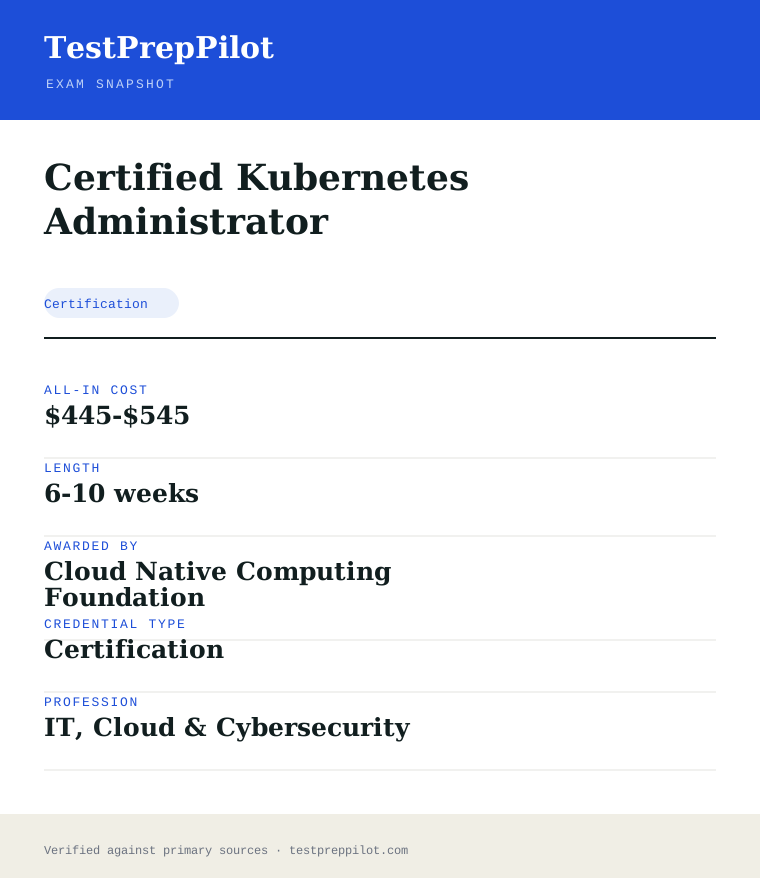
For the Certified Kubernetes Administrator, the exam fee is $445 (includes one free retake); the all-in cost is typically $445-$545; most candidates spend 6-10 weeks preparing.
Cost breakdown
| Exam fee (with retake) | $445 |
|---|---|
| Optional lab practice | $0-$100 |
| Typical total | $445-$545 |
Price is the standard CNCF list price and may vary by region.
Timeline
- Study 6-10 weeks
- Exam 2 hours
- Result Immediate
Typical prep: 6-10 weeks
The path
How do you register for the Certified Kubernetes Administrator?
- 1
Create a Linux Foundation account5 minutes
Open a free account at training.linuxfoundation.org; it becomes the home for your exam registration, score report and digital badge.
- 2
Choose the right exam
Pick an associate multiple-choice exam for conceptual breadth, or a performance-based CKx exam if you work in a terminal daily.
- CKA / CKAD / CKS for hands-on roles
- KCNA / KCSA / PCA for conceptual roles
- 3
Purchase and schedule10 minutes
Buy the exam voucher and book a time slot through the Linux Foundation scheduling portal. CKx exams bundle one free retake.
- 4
Prepare with the curriculum4-12 weeks
Study the official exam curriculum; for CKx exams practise in a live terminal environment such as Killer.sh before the real session.
- 5
Sit the proctored exam
Associate exams are taken online with a proctor; CKx exams run in a remote terminal with a proctor observing your session and screen.
The fine print
What are the retake and renewal rules for the Certified Kubernetes Administrator?
- Proctoring & delivery
- Delivered online with a live proctor (PSI for CKx performance exams; the LF exam platform for associate multiple-choice exams). A government photo ID is required and the workspace is scanned before the exam begins.
- Retake policy
- Performance-based CKx exams (CKA, CKAD, CKS) include one free retake with the standard voucher. Associate multiple-choice exams do not include a free retake; a new voucher must be purchased. There is no published hard limit on attempts.
- Score reporting
- CKx performance exams report pass/fail with a numeric score (66% for CKA/CKAD, 67% for CKS). Associate multiple-choice exams report pass/fail against a roughly 75% cut score. Results appear at the end of the session.
- Recertification
- All CNCF certifications are valid for two years. Exams passed before April 2024 were issued for three years. To recertify, pass the current version of the same exam (or a higher-level equivalent) before it lapses.
- Refunds & rescheduling
- Vouchers are generally non-refundable but can be rescheduled; review the Linux Foundation terms at purchase for the specific exam.
Context
CNCF certification tracks
| Track | Format | Fee | Validity | |
|---|---|---|---|---|
| Associate (KCNA, KCSA, PCA, OTCA, ICA, CCA, CBA, CNPA, CGOA, KCA, CAPA) | Multiple choice | $250 | 2 years | |
| CKA / CKAD | Performance-based terminal | $445 (1 retake) | 2 years | |
| CKS | Performance-based terminal | $445 (1 retake) | 2 years |
What it pays
How much does this credential pay?
$96,900 median for network and computer systems administrators (BLS, May 2024)
There is no Bureau of Labor Statistics occupation called "CKA" — the Certified Kubernetes Administrator credential validates Kubernetes administration skill, and the wage question belongs to the role you perform with it. The closest official BLS occupation is Network and Computer Systems Administrators, SOC 15-1244, which had a May 2024 median wage of $96,900, with the lowest 10 percent under $56,190 and the highest 10 percent above $157,420, with Software Developers (SOC 15-1252, $132,270) as the adjacent senior series. The fit is deliberate: CKA holders work as platform engineers, DevOps engineers and Kubernetes administrators who run containerised infrastructure, and the platform-engineering roles this credential serves sit between the administrator and developer series in the labour market. BLS counted 217,500 network and computer systems administrator jobs in 2024 and projects 1 percent growth from 2024 to 2034, with about 15,100 openings a year — the modest headline reflecting infrastructure work shifting toward cloud and platform roles, which is precisely the direction the CKA points. The limitation to state plainly: the BLS median covers the whole occupation at all levels, credentialed or not, and the CKA's value is as a recognised platform-engineering signal that employers running Kubernetes require or prefer. Read the number as the market for the occupation the credential serves.
| Measure | Figure | Source / note |
|---|---|---|
| Median annual wage, network and computer systems administrators | $96,900 | BLS OOH, SOC 15-1244, May 2024 |
| Lowest 10 percent | Under $56,190 | BLS OOH, SOC 15-1244, May 2024 |
| Highest 10 percent | Above $157,420 | BLS OOH, SOC 15-1244, May 2024 |
| Median, software developers (adjacent senior series) | $132,270 | BLS OOH, SOC 15-1252, May 2024 |
Job growth.BLS projects 1 percent growth for network and computer systems administrators from 2024 to 2034, about 15,100 openings per year.
Source: BLS Occupational Outlook Handbook - Network and Computer Systems Administrators
Your odds
What are the pass rates?
CNCF publishes no pass rate — the CKA is a 100% hands-on, performance-based exam with 15-20 tasks in 2 hours
The Cloud Native Computing Foundation (CNCF), which administers the CKA through the Linux Foundation, does not publish cohort pass rates, and third-party estimates are not official data, so we do not treat them as authoritative. What the CNCF does publish is the format: the CKA is a performance-based, hands-on exam of 15-20 tasks completed in a live Kubernetes environment within a 2-hour time limit, delivered through the Linux Foundation's remote proctoring platform. There are no multiple-choice questions — every task requires performing real administrative actions (creating and managing workloads, configuring networking, managing storage, troubleshooting clusters) in a live cluster. The exam content follows the published curriculum: cluster architecture, installation and configuration; workloads and scheduling; services and networking; storage; troubleshooting; and cluster maintenance. The absence of a published pass rate is not an absence of standards: the performance-based format means the exam tests actual skill, and a candidate either can perform the tasks or cannot. The practical reading: preparation is hands-on practice, not study — the exam rewards real Kubernetes experience, and candidates who train in a live environment pass at far higher rates than those who only read documentation.
Read this before quoting the number.CNCF publishes the format and curriculum but no pass rate; the CKA is a hands-on performance exam, not a written test.
Your schedule
How long should I study for it?
120-200 hours of hands-on practice over 8-12 weeks of focused study
The CKA is a hands-on, performance-based exam of 15-20 tasks in a live Kubernetes environment within 2 hours, built on the published curriculum: cluster architecture, installation and configuration; workloads and scheduling; services and networking; storage; troubleshooting; and cluster maintenance. Because the exam is 100 percent hands-on, the plan is a practice plan, not a reading plan. A defensible plan runs 120 to 200 hours of hands-on practice over 8 to 12 weeks, using a practice environment (kind, minikube or a cloud cluster). Weeks 1-2: the fundamentals — cluster architecture, kubectl fluency and the workload resources (Pods, Deployments, StatefulSets), practising every command in a live cluster. Weeks 3-4: scheduling, services and networking — node selectors, taints and tolerations, the service types and the Ingress resources. Weeks 5-6: storage and configuration — volumes, persistent volumes and claims, ConfigMaps and Secrets. Weeks 7-8: troubleshooting and cluster maintenance — the kubectl troubleshooting workflow, backups with etcd, and upgrades. Weeks 9-12: timed practice exams using the killer.sh-style simulators, which mirror the real exam environment. The plan is practice-heavy because the exam rewards real skill; candidates who only read documentation fail the live tasks.
- Weeks 1-235
Architecture and workloads
- Cluster architecture and kubectl fluency
- Pods, Deployments and StatefulSets
- Practise every resource in a live cluster
- Weeks 3-435
Scheduling, services, networking
- Node selectors, taints and tolerations
- Service types and Ingress
- Network policies
- Weeks 5-630
Storage and configuration
- Volumes, PVs and PVCs
- ConfigMaps and Secrets
- Storage classes
- Weeks 7-830
Troubleshooting and maintenance
- The kubectl troubleshooting workflow
- etcd backup and restore
- Cluster upgrades
- Weeks 9-1245
Timed simulators
- killer.sh-style practice exams
- Two full timed runs
- Review weak domains
Adjusting the pace
Working with Kubernetes.The daily work accelerates the plan; focus study on the exam-specific tasks and the timed simulators.
From traditional sysadmin.Add 2-3 weeks of container and Docker fundamentals before the Kubernetes phases.
How to study
How do I prepare most effectively?
The CKA rewards real Kubernetes skill, so the dominant strategy is hands-on practice in a live environment: build a practice cluster, perform every curriculum task yourself, and repeat until the kubectl workflow is fluent, because the exam tasks are real administrative actions in a live cluster. Second, master the troubleshooting workflow: the exam includes troubleshooting tasks, and a systematic kubectl-based approach — describe, logs, events — is the skill the exam measures. Third, use the timed simulators (the killer.sh-style environment is the closest match to the real exam) and run them under the real 2-hour constraint, because the performance format and the time pressure are part of the test. Fourth, learn the exam-critical commands and shortcuts by heart, since the live terminal has no autocomplete assistance beyond what you know. Finally, budget for the retake possibility: the CKA includes a free retake in some purchase paths, and candidates who fail typically fail on time management rather than knowledge, so the timed simulators are the highest-value preparation.
Practise in a live cluster
The exam tasks are real administrative actions; practice is the preparation.
Master the troubleshooting workflow
Describe, logs and events — the systematic kubectl approach.
Run the timed simulators
The killer.sh-style environment mirrors the real exam under 2 hours.
Know the commands by heart
The live terminal has no assistance beyond what you know.
Budget for the retake
Failures are usually timing, not knowledge; the simulators fix timing.
What to buy
Which study resources are worth paying for?
CKA prep costs are dominated by the exam and the practice environment. The CKA exam costs $395 (including one free retake) at the time of writing. The official Kubernetes documentation (free) is the authoritative reference, and the killer.sh simulator (about $45 for the exam-prep bundle) is the standard practice environment that mirrors the real exam; the Linux Foundation's CKA course ($300-$500) provides structured instruction. Free resources include the Kubernetes docs, the kubectl cheatsheet and kind/minikube for local practice clusters. A realistic total budget is $400 to $1,000 including the exam and one simulator run. Prices below are list prices as of mid-2026 and change frequently; we rank nothing by commission.
| Resource | Price | Format | Best for |
|---|---|---|---|
| CKA exam | $395 (incl. one retake) | Remote-proctored hands-on exam | The certification itself |
| killer.sh simulator | ~$45 | Timed exam-style environment | The closest match to the real exam |
| Linux Foundation CKA course | $300-$500 | Online course + labs | Structured instruction |
| Kubernetes documentation | Free | Official reference | The authoritative source for every task |
| Local practice clusters (kind/minikube) | Free | Local Kubernetes environments | Everyday hands-on practice |
List prices as of mid-2026, subject to change; the CKA fee is $395 including one retake; no commission or affiliate ranking is implied.
Avoid these
What mistakes do candidates most often make?
The most common CKA mistake is studying documentation instead of practising: candidates who read the Kubernetes docs but never perform the tasks in a live cluster fail the performance-based exam, which has no written questions at all. The fix is hands-on practice from the start. The second mistake is mismanaging time: the 2-hour window with 15-20 tasks punishes candidates who spend too long on one task — the timed simulators are the fix. Third, candidates under-practise troubleshooting, a distinct task category that rewards a systematic kubectl workflow. Fourth, some candidates rely on browser bookmarks and lose time; the exam environment limits what is available, so know the commands. Finally, candidates underestimate the exam's hands-on nature and arrive without simulator practice; the killer.sh-style run is the closest thing to the real experience.
✕Reading instead of practising
✓The exam is 100% hands-on; practise every task in a live cluster.
✕Mismanaging the time
✓2 hours for 15-20 tasks; run the timed simulators.
✕Under-practising troubleshooting
✓A distinct task category; drill the kubectl workflow.
✕Depending on bookmarks
✓Know the commands by heart; the environment is limited.
✕Skipping the simulator
✓The killer.sh-style run mirrors the real exam experience.
What you'll face
What question types will I see?
The CKA has no multiple-choice questions — it is a performance-based exam of 15-20 hands-on tasks performed in a live Kubernetes cluster within 2 hours. Each task requires real administrative actions: create a Deployment with specific settings, expose it correctly, configure storage, apply a network policy, or troubleshoot a broken cluster — and the candidate is graded on the resulting cluster state. Samples below are editor-written illustrations of the kind of tasks the exam presents, not live exam items; they show the hands-on, task-based style of the exam.
Create and configure Deployments, Pods, StatefulSets and Jobs.
Services, Ingress, network policies, volumes and PVCs.
Diagnose and fix broken clusters and workloads.
Try these
Q1Create a Deployment named "web" with 3 replicas running the image nginx:1.25, then expose it as a ClusterIP service named "web-svc" on port 80. Which kubectl sequence accomplishes this?
Answer:A
The task requires a Deployment with 3 replicas and a ClusterIP service — the create-deployment plus expose sequence accomplishes it. The other options create the wrong resources or none at all.
Q2A Pod in the default namespace cannot reach the internet. The most appropriate first troubleshooting step is:
Answer:A
Systematic troubleshooting starts with kubectl describe (status and events) and kubectl logs to identify the cause. Deletion, reboots or ignoring skip the diagnostic first step the exam rewards.
Q3A StatefulSet requires persistent storage that survives Pod rescheduling. The correct approach is:
Answer:A
Persistent storage for a StatefulSet uses PersistentVolumeClaims with a StorageClass that provisions PVs — the standard pattern. EmptyDir is ephemeral, hostPath is node-specific, and no storage fails the persistence requirement.
Samples are editor-written illustrations of the exam's task style, not live exam items — the CKA is a hands-on performance exam.
The big day
What should I expect on exam day?
The CKA is a remote-proctored, hands-on exam: 15-20 tasks performed in a live Kubernetes environment within 2 hours, delivered through the Linux Foundation's platform. Confirm the system requirements — a stable internet connection, a working webcam and a quiet space — and complete the environment check before the session; the proctor monitors the whole exam. Time management is the exam's hardest skill: scan the task list first, do the tasks you know, and return to the hard ones. Your result is reported after grading, typically within a day, and the certificate follows. If you do not pass, the CKA purchase includes one free retake in most paths, within a 12-month window. On a pass, the CKA is valid for three years and is renewed by passing the current exam or the recertification path. The afterwards matters: record the expiry, and plan the CKAD or CKS as the next step in the CNCF track.
Bring
- Computer with webcam and stable internet
- A quiet, private testing space
- Your Linux Foundation account login
Leave at home
- Phone and other devices within the proctor's view
- Notes and open browser tabs — the exam is proctored and performance-based
How the day runs
Rules in the room
- The exam is remote-proctored and 100% hands-on
- 2 hours for 15-20 tasks; time management is part of the test
- The certification is valid 3 years, with one free retake in most purchase paths
Afterwards.On a pass, your CKA is valid for three years; recertify by passing the current exam. On a fail, use the free retake within the window after additional hands-on practice.
Reference
What are the key facts about the Certified Kubernetes Administrator?
Certified Kubernetes Administrator is a certification credential; awarded by Cloud Native Computing Foundation; the exam fee is $445 (includes one free retake); typical preparation is 6-10 weeks; holders typically earn $130,000-$175,000.
| Credential | Certified Kubernetes Administrator |
|---|---|
| Abbreviation | CKA |
| Type | Certification |
| Profession | IT, Cloud & Cybersecurity |
| Specialty | Cloud Native & DevOps |
| Awarded by | Cloud Native Computing Foundation |
| Difficulty | Hard |
| Typical prep time | 6-10 weeks |
| All-in cost | $445-$545 |
| Typical salary range | $130,000-$175,000 |
| Delivery | Remote terminal proctored by PSI, available worldwide |
| Retake | One free retake included with the standard voucher |
| Validity | 2 years (3 years if passed before April 2024) |
| Prerequisite for CKS | A current CKA is required before sitting CKS |
| Scope | National / Multi-state |
| Also known as | CKA |
Real questions
Frequently asked questions about the Certified Kubernetes Administrator
What is the difference between CKA and CKAD?
The CKA focuses on cluster administration: installation, networking, storage and troubleshooting. The CKAD focuses on building and deploying applications on Kubernetes. Many engineers hold both because the skills reinforce one another.
Can I use my own notes during the exam?
You may open a limited set of official documentation pages in a second browser window; other resources, including AI tools, are not permitted. Practise finding answers quickly in the allowed docs.
How hard is it to pass?
The 66% cut score and live format make it challenging; candidates who practise real tasks under time pressure fare best. The bundled retake removes some of the financial risk of a first attempt.
Does CKA expire?
Yes, after two years. You recertify by passing the current CKA (or a higher CKx exam) before the credential lapses, which keeps your skills aligned with new Kubernetes versions.
Why is Troubleshooting weighted so heavily?
Troubleshooting is 30% of the exam because operators spend much of their time diagnosing failing clusters and workloads. Expect scenario tasks that require reading logs and fixing broken objects.
Should I use Killer.sh before the exam?
Yes. The Killer.sh simulator closely mirrors the live environment and is the best way to build terminal speed and confidence before the paid attempt.
Do I need Kubernetes experience for the associate exams?
The associate multiple-choice exams are designed as entry points and test conceptual knowledge rather than live terminal skill, though some hands-on exposure helps.
Why did validity change from three to two years?
CNCF shortened the certification lifecycle so credentials reflect current project versions; anyone certified before April 2024 keeps the original three-year window.
How do the performance exams differ from associate exams?
CKA, CKAD and CKS are taken in a live terminal where you solve real tasks; associate exams are multiple choice. The terminal exams prove genuine hands-on ability.
Are CNCF exams available in my region?
Yes. All CNCF exams are delivered online with live proctoring through PSI (performance) or the Linux Foundation platform (associate), available worldwide in English.
In short
Is the Certified Kubernetes Administrator worth it?
- Performance-based exam taken in a live Kubernetes terminal
- Covers cluster architecture, workloads, networking, storage and troubleshooting
- 66% pass mark, $445 with one free retake
- Valid for two years and required before CKS
Trust
Where does this information come from?
Everything above is taken from the awarding body's own published material. Fees, question counts and domain weights are revised regularly — check the official page before you pay.
- Cloud Native Computing Foundation Awarding body
- Official Certified Kubernetes Administrator exam page Exam page
Research confidence: high · Last reviewed 2026-08