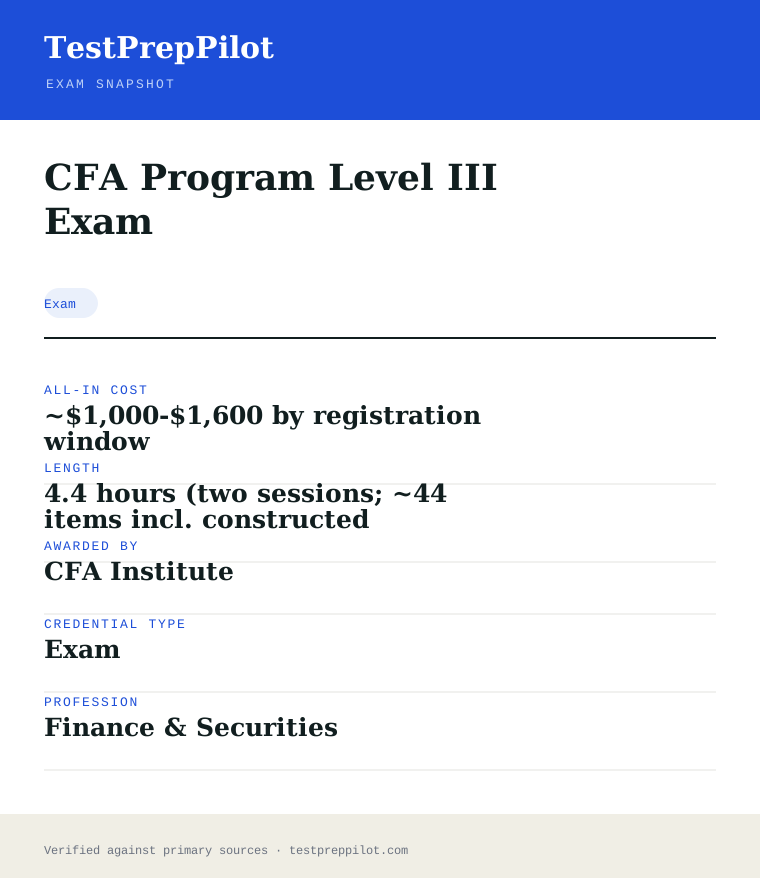
The short version
What is the CFA Program Level III Exam and is it worth it?
CFA Program Level III Exam is a professional credential administered by CFA Institute. It validates job-ready knowledge and skills in the Finance & Securities field and is used for career entry, advancement, or compliance.
- Recognized credential from CFA Institute
- Demonstrates verified competence in Finance & Securities
- Supports career advancement and may satisfy licensing or employer requirements
What is it?
What exactly is the CFA Program Level III Exam?
CFA Program Level III Exam — Finance & Securities credential from CFA Institute
Final CFA paper combining constructed response and item sets on portfolio management, wealth planning and specialised pathways. Offered by CFA Institute, it is designed for candidates who need to demonstrate verified competence in the Finance & Securities field. The credential is commonly used for career entry, advancement, regulatory compliance, or employer requirements. Candidates should review the official handbook for eligibility, exam format, and scoring before registering.
The path in brief
- Confirm you meet any eligibility or prerequisites
- Review the official handbook and study materials
- Register and pay through the awarding body or authorized provider
- Schedule and take the exam (test center or online proctoring)
- Receive your score and, if passed, your credential
Before you book
Who is eligible to sit the CFA Program Level III Exam?
Eligibility varies; many credentials are open to all, while others require coursework, work experience, or sponsorship.
Who it is for: Professionals and candidates seeking to validate Finance & Securities competence.
The test itself
What is the format of the CFA Program Level III Exam?
The CFA Program Level III Exam is administered by CFA Institute and runs 4 hours 24 minutes (two sessions of 2h12m).
| Administered by | CFA Institute |
|---|---|
| Questions | Item sets plus constructed-response (essay) items across two sessions |
| Time limit | 4 hours 24 minutes (two sessions of 2h12m) |
| Pass mark | Passing score set by the awarding body; see the official score report |
| Exam fee | ~$990 early registration / ~$1,290 standard (pricing depends on the registration window) |
| Format | Proctored, computer-based (test center or online remote proctoring) |
Content outline
What topics are on the CFA Program Level III Exam?
The CFA Program Level III Exam covers 4 content domains.
Weightings come from the official exam outline. Study time is best allocated in roughly these proportions rather than evenly across domains.
- Markets & products
Topic area tested on the exam; see the official blueprint for the detailed breakdown.
- Regulation & ethics
Topic area tested on the exam; see the official blueprint for the detailed breakdown.
- Analysis & valuation
Topic area tested on the exam; see the official blueprint for the detailed breakdown.
- Client & risk management
Topic area tested on the exam; see the official blueprint for the detailed breakdown.
The path
How do you register for the CFA Program Level III Exam?
- 1
Visit the awarding body’s official website and create an account
- 2
Select the credential and review its specific requirements
- 3
Complete any required eligibility (education, experience, or training)
- 4
Pay the registration fee
- 5
Schedule the exam at a test center or online
- 6
Take the exam and receive your results
The fine print
What are the retake and renewal rules for the CFA Program Level III Exam?
- Proctoring & delivery
- Proctored, computer-based delivery (test center or remote online proctoring), varying by exam.
- Retake policy
- Varies by credential — most bodies permit retakes after a waiting period and full or partial fee.
- Score reporting
- Scores are reported per the body’s timeline, typically electronically after the exam.
- Recertification
- Varies; many credentials require renewal every 2–3 years via continuing education or a recertification exam.
What it pays
How much does this credential pay?
$101,350 median for financial and investment analysts (BLS, May 2024)
Level III is the final exam gate before the CFA charter, and the wage question at this level is really a question about charterholders. There is no BLS occupation called "CFA charterholder", and the closest official occupation is Financial and Investment Analysts, SOC 13-2051, which had a May 2024 median of $101,350, with the lowest 10 percent under $62,410 and the highest 10 percent over $180,550. Level III candidates are typically already working in investment roles, so the more relevant framing is the distribution: the charter tends to matter most at the upper end of the analyst and portfolio-management market, where it is required or strongly preferred for portfolio-manager, research and senior advisory tracks. BLS counted 368,500 financial analyst jobs in 2024 and projects 6 percent growth from 2024 to 2034, about 29,900 openings a year. The limitation to state plainly: the BLS median covers everyone in the occupation, chartered or not, and the charter's wage premium comes from CFA Institute member compensation surveys, which are member self-reports rather than a BLS series, so we do not quote them as government data. For a candidate at Level III, the practical reading is that passing the exam unlocks access to roles and career ladders where the analyst-median series is the relevant benchmark — the exam itself produces no wage.
| Measure | Figure | Source / note |
|---|---|---|
| Median annual wage, financial and investment analysts | $101,350 | BLS OOH, SOC 13-2051, May 2024 |
| Lowest 10 percent | Under $62,410 | BLS OOH, SOC 13-2051, May 2024 |
| Highest 10 percent | Over $180,550 | BLS OOH, SOC 13-2051, May 2024 |
| Projected openings per year | ~29,900 | BLS OOH, SOC 13-2051, 2024-2034 |
Job growth.BLS projects 6 percent growth for financial analysts from 2024 to 2034, about 29,900 openings per year.
Source: BLS Occupational Outlook Handbook - Financial Analysts
Your odds
What are the pass rates?
CFA Level III publishes pass rates — roughly 47-49% in recent windows (2024-2025)
CFA Institute publishes cohort pass rates for every Level III window. Recent reported figures have clustered in the high-40s: the February 2024 window reported about 49 percent, the August 2024 window about 47 percent, and later 2024-2025 windows have stayed in the mid-to-high 40s. Historically Level III has often posted the highest pass rate of the three levels, which makes sense: candidates who reach it have already survived Level I and Level II, and the exam rewards the applied, portfolio-level thinking that working investment professionals practise daily. The pass line is a fixed, psychometrically calibrated standard — CFA Institute sets the minimum passing score through standard setting, and the pass rate fluctuates with the candidate pool. The unique feature of Level III is the constructed-response (essay) component, and CFA Institute publishes guidance that candidates who do not practise writing answers to past essay questions materially underperform those who do. The most useful numbers for preparation are therefore not the cohort pass rates but the internal comparisons: candidates who complete the mock programme and who practise constructed responses pass at substantially higher rates than the overall cohort, per CFA Institute's own candidate surveys.
Read this before quoting the number.Pass rates are published per window and fluctuate; the figures above are 2024-2025 reported windows, not a guarantee of future rates.
Source: CFA Institute - Level III exam results and pass rates
Your schedule
How long should I study for it?
250-350 hours over 12-16 weeks of focused study
Level III shifts from analysis to synthesis: the curriculum covers portfolio management and wealth planning at the level of constructing, managing and explaining portfolios, and the exam is the only CFA level with constructed-response questions. The exam has two sessions of 2 hours 12 minutes each; one session is item sets (vignettes with multiple-choice questions) and the other is constructed response, with about 44 questions in total across the two formats. The dominant topic is Portfolio Management, which carries by far the largest curriculum weight, followed by Fixed Income, Derivatives, Equity and the other topic areas, with Ethics again a mandatory block. A defensible plan runs 250 to 350 hours over 12 to 16 weeks. The first phase (weeks 1-6) builds the portfolio-management framework through the curriculum readings; the second phase (weeks 7-10) adds deliberate constructed-response practice — writing out full answers to essay-style questions and comparing them to the official guideline answers, which is the skill that most distinguishes passers; the third phase (weeks 11-14) is two or three full mocks plus final Ethics and formula review. The essay component is the reason this level feels different, and it must be trained as a writing skill, not just a knowledge test.
- Weeks 1-6140
Portfolio framework
- Work the portfolio-management and wealth-planning readings
- Do end-of-chapter and online questions by topic
- Build the asset-allocation and IPS frameworks
- Weeks 7-1090
Constructed-response practice
- Write full answers to past essay questions
- Compare against official guideline answers and re-write weak ones
- Drill Ethics with the Code and Standards
- Weeks 11-1480
Mocks and final review
- Two to three full mocks under timed conditions
- Review every miss against the learning outcome statements
- Final formula sheet and Ethics pass
Adjusting the pace
Working full time in investments.The day job accelerates the portfolio material; protect the essay-practice phase, which the job does not cover.
Long gap since Level II.Add two weeks of item-set refresher before the essay phase; the format returns quickly.
How to study
How do I prepare most effectively?
The defining strategy at Level III is to train constructed-response writing deliberately: read the question, decide the answer, then write a concise, structured response that names the decision and the reason, and compare it to the official guideline answer. Candidates who only read sample essays — or who outline answers in their heads — consistently underperform those who write full answers, because the exam awards points for the reasoning chain, not just the conclusion. Second, master the investment policy statement (IPS) and asset-allocation framework, since portfolio-level questions dominate and the same frameworks recur across sessions. Third, keep the answer structure tight: the guideline answers reward the key decision plus two or three supporting points, so practise writing to that shape rather than long prose. Fourth, do the official questions and past constructed-response items even if you use a provider, because the exam is built from the curriculum. Fifth, schedule two full mocks, ideally one with the essay session written out in full under the 2-hour-12-minute clock, so the physical stamina and time allocation of writing under pressure are no longer unknown on exam day.
Write full essay answers
Points go to the reasoning chain; outline-only practice underperforms written practice.
Master the IPS framework
Portfolio-level questions dominate; the IPS structure recurs in nearly every session.
Keep answers tight
Decision plus two or three supporting points matches the guideline-answer shape.
Use official materials
The exam is built from the curriculum and past essay items; providers drift.
Simulate the essay clock
One full mock with the constructed-response session written under the real time limit.
What to buy
Which study resources are worth paying for?
Level III prep mirrors Level II with one addition: a constructed-response practice component. The official curriculum and its digital ecosystem come with registration and are the source of truth for item construction. Kaplan Schweser, Wiley and Mark Meldrum are the major third-party options; Schweser and Wiley offer condensed notes, videos, question banks and mocks from roughly $400 to $1,200, while Mark Meldrum's video-based offering is popular for its depth and lower price point. Because the essay is unique to this level, look for a provider that includes a constructed-response grader or detailed guideline-answer comparisons — practice without feedback is half as useful. Free options include the official mock included with registration, past constructed-response items circulated in the candidate forum, and YouTube topic reviews. Total cost including the registration fee (roughly $1,000 to $1,600 by window) runs about $1,400 to $2,800. Prices below are list prices as of mid-2026 and change annually; we rank nothing by commission.
| Resource | Price | Format | Best for |
|---|---|---|---|
| CFA Institute curriculum + ecosystem | Included with registration | Digital readings + official questions + mock | The source of truth; do the official questions regardless |
| Kaplan Schweser Level III | $500-$1,200 | Condensed notes + video + QBank + mocks | Structured learners wanting the standard compression |
| Wiley Level III | $400-$1,000 | Video + notes + question bank | Video-first learners |
| Mark Meldrum Level III | $300-$700 | Video lectures + mock exams | Candidates who learn well from deep video treatment |
| Free forum past essays | $0 | Candidate forum, past constructed-response items | Essay-format practice between paid blocks |
List prices as of mid-2026, subject to change; registration fees vary by window; no commission or affiliate ranking is implied.
Avoid these
What mistakes do candidates most often make?
The most damaging Level III mistake is treating the constructed-response session like an essay exam for a humanities class: candidates write long prose, bury the decision in the middle, and lose points that the guideline answer would have awarded for a clear, structured response. The fix is to write decision-first answers with two or three supporting points, and to practise that shape repeatedly. The second mistake is skipping written practice entirely and only reading sample answers, which never trains the timing or the retrieval under pressure. Third, candidates under-weight Ethics because of its smaller curriculum share, forgetting that it is the only topic guaranteed to appear in both sessions. Fourth, many candidates over-focus on the newest curriculum topics and neglect the portfolio-management core that carries the largest weight. Fifth, ignoring the physical demands of the exam — two long sessions, one of which is writing — leaves stamina untrained; the mock programme must include the written session under the real clock. Finally, last-week reading of new material instead of reviewing frameworks and Ethics loses more points than it gains.
✕Writing prose instead of structured answers
✓Lead with the decision, then two or three supporting points; match the guideline shape.
✕Only reading sample essays
✓Write full answers and compare against guideline answers; reading does not train timing.
✕Under-weighting Ethics
✓Ethics appears in both sessions; it is the most reliable points block.
✕Chasing new topics over the core
✓Portfolio management carries the largest weight; master the core before the edges.
✕Never simulating the essay clock
✓One full mock with the constructed-response session written under the real time limit.
What you'll face
What question types will I see?
Level III combines two formats across two sessions of 2 hours 12 minutes each. One session is item sets: vignettes followed by multiple-choice questions, testing applied portfolio analysis. The other session is constructed response: open-ended questions requiring written answers, often structured as several sub-parts under one scenario — build an IPS, recommend an allocation, evaluate a fixed-income strategy, or identify and correct an error in a portfolio decision. Constructed-response items are scored against guideline answers that award credit for the decision and the reasoning. Ethics appears in both sessions, usually as scenario questions asking you to identify violations. Samples below are editor-written illustrations of the published blueprint, not live exam items; they show the decision-plus-reason shape the essay answers require.
Vignettes with multiple-choice items on applied portfolio analysis.
Open-ended, multi-part questions scored against guideline answers.
Scenario questions on Code and Standards violations.
Try these
Q1A client with a 10-year horizon and moderate risk tolerance asks you to recommend an asset allocation. Using the IPS framework, the most appropriate first step is to:
Answer:B
The IPS framework derives the allocation from the client's stated objectives (return needs, time horizon) and constraints (risk tolerance, liquidity, tax, legal), so establishing those first is the correct sequence. Recommending a split before the IPS work, copying model portfolios, or deferring entirely each skip the required analytical step.
Q2Under the CFA Institute Code and Standards, when a member learns that a colleague has committed a material violation of applicable law, the member should:
Answer:B
The Standards require members to report suspected violations through their firm's internal compliance procedures, and to dissociate from the activity. Directly contacting regulators is expected in certain circumstances, but the standard pathway begins with internal reporting; ignoring or merely documenting the violation is not compliant.
Q3An investor in a rising-rate environment asks about the interest-rate risk of her bond portfolio. The most direct measure of price sensitivity is:
Answer:B
Modified duration directly measures the approximate percentage price change for a 100-basis-point change in yield, making it the standard sensitivity measure. Yield to maturity and coupon describe the return and cash-flow profile, and convexity refines the duration estimate rather than standing alone.
Samples are editor-written illustrations of the published blueprint, not live exam items.
The big day
What should I expect on exam day?
Level III is a computer-based exam at a Pearson VUE centre during set windows (February and August in most years). You sit two sessions of 2 hours 12 minutes each with a scheduled break, on roughly 44 questions in two formats. Bring your valid passport — the only accepted ID for CFA exams — an approved calculator (TI BA II Plus or HP 12C families), and your appointment confirmation; everything else goes in the locker. Arrive 30 minutes early; late arrivals cannot enter. During the constructed-response session, type your answers into the exam software, which includes a basic word processor; plan time per question and leave the longest questions for last. Results post to your CFA Institute account roughly 6 to 8 weeks after the window, with banded topic performance. On a pass, you complete the work-experience requirement (typically four years of qualified investment work) and the ethics acknowledgement to be awarded the charter. On a fail, retake in a later window. The afterwards matters: Level III is the final exam, but the charter and the career market it unlocks arrive only after the experience requirement is verified.
Bring
- Valid passport (the only accepted ID for CFA exams)
- Approved calculator (TI BA II Plus or HP 12C family) and batteries
- Appointment confirmation
Leave at home
- Phone, smartwatch and all electronics
- Notes, books and formula sheets
- Bags and personal items beyond what the centre allows
How the day runs
Rules in the room
- Passport required; other IDs are not accepted
- Only approved calculators may be brought into the room
- Constructed responses are typed into the exam software
Afterwards.On a pass, complete the work-experience and ethics requirements to receive the charter. On a fail, retake in a later window. The charter is awarded only after all three levels plus the experience requirement are complete.
Reference
What are the key facts about the CFA Program Level III Exam?
CFA Program Level III Exam is a exam credential; awarded by CFA Institute; the exam fee is ~$990 early registration / ~$1,290 standard (pricing depends on the registration window); typical preparation is 4.4 hours (two sessions; ~44 items incl. constructed response); holders typically earn $75,000-$150,000.
| Credential | CFA Program Level III Exam |
|---|---|
| Abbreviation | CFA Level III |
| Type | Exam |
| Profession | Finance & Securities |
| Specialty | Investment & Portfolio Management |
| Awarded by | CFA Institute |
| Difficulty | Regulated |
| Typical prep time | 4.4 hours (two sessions; ~44 items incl. constructed response) |
| All-in cost | ~$1,000-$1,600 by registration window |
| Typical salary range | $75,000-$150,000 |
| Credential | CFA Program Level III Exam |
| Awarding body | CFA Institute |
| Exam format | Proctored, computer-based |
| Validity | CFA exam results are valid for up to 7 years to complete the program; the CFA charter itself does not expire. |
| Languages | Varies — see awarding body |
| Scope | National / Multi-state |
Real questions
Frequently asked questions about the CFA Program Level III Exam
How do I register for the CFA Program Level III Exam exam?
Register through CFA Institute's official portal or an authorized test provider (e.g., Pearson VUE or Prometric where applicable). Create an account, select the exam, pay the fee, and schedule a date.
How much does the exam cost?
Fees vary by location and currency. Confirm the current fee on the official registration page before scheduling.
How long is the credential valid, and how do I renew?
A passing Level III result completes the exam program; you then satisfy the work-experience and membership requirements to earn the charter. The charter does not expire, and exam results are subject to the program's rolling completion limits.
What if I do not pass?
Most bodies allow retakes after a waiting period and payment of the full or partial fee. Check CFA Institute's retake policy before rescheduling.
How do I register for a CFA Institute credential?
Register through the official website, select your exam, pay the fee, and schedule a date.
How do I renew a credential?
Renewal policies vary by credential; check the specific program page for requirements and cycles.
In short
Is the CFA Program Level III Exam worth it?
- CFA Program Level III Exam is awarded by CFA Institute.
- Validates job-ready competence in Finance & Securities.
- Registration is through the awarding body or an authorized test provider.
- Renewal and retake policies vary — confirm before scheduling.
Same awarding body
What other credentials does CFA Institute award?
Worth comparing
How does the CFA Program Level III Exam compare with similar credentials?
Trust
Where does this information come from?
Everything above is taken from the awarding body's own published material. Fees, question counts and domain weights are revised regularly — check the official page before you pay.
Research confidence: low · Last reviewed 2026-08