Allied Health & Medical Support • Exam
DANB Infection Control Exam
DANB Infection Control Exam — Allied Health credential from Dental Assisting National Board (DANB)
Researched and maintained by TestPrepPilot Editorial BoardDental & allied-health certifications desk · Figures last verified August 2026
The short version
What is the DANB Infection Control Exam and is it worth it?
DANB Infection Control Exam is a professional credential administered by Dental Assisting National Board (DANB). It validates job-ready knowledge and skills in the Allied Health field and is used for career entry, advancement, or compliance.
- Recognized credential from Dental Assisting National Board (DANB)
- Demonstrates verified competence in Allied Health
- Supports career advancement and may satisfy licensing or employer requirements
What is it?
What exactly is the DANB Infection Control Exam?
DANB Infection Control Exam — Allied Health credential from Dental Assisting National Board (DANB)
Component exam covering infection control in dental settings., a standardized national examination required for this credential. Offered by Dental Assisting National Board (DANB), it is designed for candidates who need to demonstrate verified competence in the Allied Health field. The credential is commonly used for career entry, advancement, regulatory compliance, or employer requirements. Candidates should review the official handbook for eligibility, exam format, and scoring before registering.
The path in brief
- Confirm you meet any eligibility or prerequisites
- Review the official handbook and study materials
- Register and pay through the awarding body or authorized provider
- Schedule and take the exam (test center or online proctoring)
- Receive your score and, if passed, your credential
Before you book
Who is eligible to sit the DANB Infection Control Exam?
Eligibility varies; many credentials are open to all, while others require coursework, work experience, or sponsorship.
Who it is for: Professionals and candidates seeking to validate Allied Health competence.
The test itself
What is the format of the DANB Infection Control Exam?
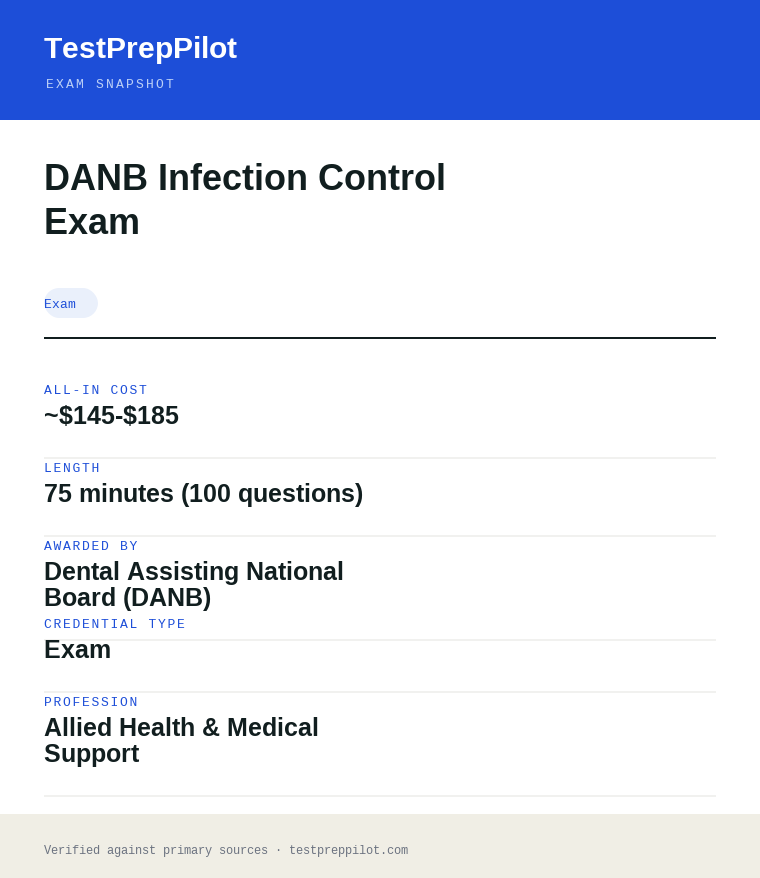
The DANB Infection Control Exam is administered by Dental Assisting National Board (DANB) and runs 75 minutes and contains 100 questions.
| Administered by | Dental Assisting National Board (DANB) |
|---|---|
| Questions | 100 |
| Time limit | 75 minutes |
| Pass mark | Passing score set by the awarding body; see the official score report |
| Exam fee | Varies by location and currency — confirm on the official registration page |
| Format | Proctored, computer-based (test center or online remote proctoring) |
Content outline
What topics are on the DANB Infection Control Exam?
The DANB Infection Control Exam covers 4 content domains.
No percentage weights are listed for these domains here, so the outline is shown as structure only. Check the certifying body's published outline before allocating study time.
- Anatomy & physiology
Topic area tested on the exam; see the official blueprint for the detailed breakdown.
- Clinical procedures
Topic area tested on the exam; see the official blueprint for the detailed breakdown.
- Patient care & safety
Topic area tested on the exam; see the official blueprint for the detailed breakdown.
- Documentation & ethics
Topic area tested on the exam; see the official blueprint for the detailed breakdown.
Study materials
Which study guide should you use for the DANB Infection Control Exam?
Start with the exam sponsor's official content outline. If you also want one structured resource to work through, these are the Mometrix titles that match this exam.
The DANB guide covers all three CDA components (RHS, ICE and GC) in one book.
Affiliate links We may earn a commission if you buy through these links, at no extra cost to you. Mometrix has no say in what our exam guides cover. How we make money.
The path
How do you register for the DANB Infection Control Exam?
- 1
Confirm eligibility pathway
Choose among CODA-program graduate, work-experience, or prior-credential pathways; current CPR is always required.
- 2
Apply and pay
Submit the application with the fee; a $75 non-refundable application fee is included.
- 3
Receive scheduling instructions
An email with a Test Admission Notice lets you schedule within 60 days.
- 4
Schedule with Pearson VUE
Book a Pearson VUE center appointment.
- 5
Sit the exam
Complete the component exam(s); each component passes at 400 on a 100-900 scale.
The fine print
What are the retake and renewal rules for the DANB Infection Control Exam?
- Proctoring & delivery
- Delivered in person at Pearson VUE testing centers. Candidates have 60 days from approval to schedule and sit. The ICE component offers an online option in some cases.
- Retake policy
- No discounted retake; failing a component means paying the same price to retake it. The full CDA may be taken as three components together or separately within a five-month window.
- Score reporting
- Results are mailed after the exam; each component is scored on a 100-900 scale with a 400 pass point.
- Recertification
- DANB certifications renew annually with a $75 fee and 12 continuing dental education (CDE) credits, including two in infection control and one in OSHA bloodborne pathogens. Current CPR is required.
What it pays
How much does this credential pay?
$47,840 median for dental assistants (BLS, May 2024)
There is no Bureau of Labor Statistics occupation called "ICE" — the DANB Infection Control Exam validates dental-assistant infection-control knowledge, and the wage question belongs to the occupation you perform with it. The closest official BLS occupation is Dental Assistants, SOC 31-9091, which had a May 2024 median wage of $47,840, with the lowest 10 percent under $33,900 and the highest 10 percent above $61,420. The fit is direct: DANB-certified dental assistants work in dental offices, clinics and public-health settings, and the ICE credential is one of the components of the DANB Certified Dental Assistant (CDA) certification, which many employers and states require or prefer. BLS counted 338,200 dental assistant jobs in 2024 and projects 9 percent growth from 2024 to 2034, faster than the average for all occupations, with about 28,300 openings a year. The limitation to state plainly: the BLS median covers the whole occupation, credentialed or not, and the certification's value is as an employability and safety signal — employers weigh the DANB credentials in hiring, and several states require infection-control certification for expanded duties. Read the number as the market for the occupation the credential serves.
| Measure | Figure | Source / note |
|---|---|---|
| Median annual wage, dental assistants | $47,840 | BLS OOH, SOC 31-9091, May 2024 |
| Lowest 10 percent | Under $33,900 | BLS OOH, SOC 31-9091, May 2024 |
| Highest 10 percent | Above $61,420 | BLS OOH, SOC 31-9091, May 2024 |
| Projected openings per year | ~28,300 | BLS OOH, SOC 31-9091, 2024-2034 |
Job growth.BLS projects 9 percent growth for dental assistants from 2024 to 2034, about 28,300 openings per year.
Source: BLS Occupational Outlook Handbook - Dental Assistants
Your odds
What are the pass rates?
DANB publishes pass rates by exam — the ICE pass rate is not published as a single national figure, and DANB reports performance by section
DANB does not publish a single national pass rate for the ICE exam in a fixed annual figure, and third-party estimates are not official data, so we do not treat them as authoritative. What DANB does publish is the format and the passing standard: the ICE exam is a computer-based test of 100 scored multiple-choice questions with a 75-minute time limit, and the result is reported as pass/fail with a section-by-section performance breakdown. The exam is delivered at Pearson VUE centres or through remote proctoring. The exam content follows the published ICE outline: preventing cross-contamination (personal protective equipment, hand hygiene, and the infection-control work practices), preventing cross-contamination with dental unit waterlines and biofilms, and the dental-unit waterline and surface-disinfection requirements. The absence of a published pass rate is not an absence of standards: the 100-question format rewards precise knowledge of the infection-control protocols, and DANB's section breakdown lets candidates see exactly where they fell short. The practical reading: study the DANB ICE outline and the infection-control standards, and hold yourself to 80 percent-plus on practice, because the licensure-adjacent pass line leaves little margin.
Read this before quoting the number.DANB publishes the format and section performance but no single national pass rate.
Your schedule
How long should I study for it?
30-50 hours over 3-4 weeks of focused study
The DANB ICE exam is a 100-question, 75-minute computer-based exam built on the published outline: preventing cross-contamination (PPE, hand hygiene, and the work practices), preventing cross-contamination with dental unit waterlines and biofilms, and the surface-disinfection and waterline requirements. A defensible plan runs 30 to 50 hours over 3 to 4 weeks, ideally on top of dental-assisting training or work experience. Week one: the fundamentals of infection control — the chain of infection, PPE selection and use, hand hygiene and the standard precautions — because the exam assumes clinical fluency. Week two: the work practices — instrument processing, the sterilisation methods (autoclave cycles, chemical and dry-heat sterilisation), and the storage of sterile instruments. Week three: waterlines and surface disinfection — the biofilm problem, the waterline treatment, and the surface-disinfection agents and procedures. Week four: practice-question drilling in volume and timed practice exams at the real 100-question, 75-minute format. The plan is protocol-heavy because the exam rewards precise knowledge of the procedures; candidates who memorise general hygiene and skip the specifics fail the exact-number items.
- Week 110
Infection-control fundamentals
- The chain of infection and standard precautions
- PPE selection and hand hygiene
- Occupational exposure management
- Week 212
Instrument processing
- Cleaning, packaging and sterilisation methods
- Autoclave cycles and monitoring
- Sterile storage and handling
- Week 312
Waterlines and surfaces
- Dental unit waterline biofilms
- Waterline treatment protocols
- Surface disinfection agents and procedures
- Week 412
Drill and mocks
- Practice-question drilling in volume
- Timed practice exams at the real format
- Review weak outline areas
Adjusting the pace
Working dental assistant.The clinical protocols are familiar; focus study on the exact numbers — cycles, times and agents.
Student completing training.Add 1-2 weeks of infection-control fundamentals before the full plan.
How to study
How do I prepare most effectively?
The ICE exam rewards precise knowledge of the infection-control protocols, so the dominant strategy is learning the exact numbers and steps: sterilisation cycles and times, the high-level vs intermediate vs low-level disinfection categories, the waterline treatment protocols and the PPE specifics, because the exam tests them precisely. Second, use the DANB ICE outline as the scope map and the DANB practice test as the item-style reference; DANB's official materials are the closest thing to the real exam. Third, master the instrument-processing sequence — cleaning before sterilisation, the packaging rules and the steriliser monitoring — a distinct and heavily weighted block. Fourth, drill the waterline and surface-disinfection material, which candidates with only general hygiene knowledge routinely miss. Finally, take at least two timed practice exams at the real 100-question, 75-minute format; the pace is tight, and the section breakdown on the real exam rewards balanced coverage.
Learn the exact numbers
Cycles, times, disinfection levels and agents are tested precisely.
Use the DANB outline and practice test
The authoritative scope and the closest item style.
Master instrument processing
Cleaning, packaging, sterilisation and monitoring is a heavily weighted block.
Drill waterlines and surfaces
A distinct area that general-hygiene-only study misses.
Run two timed practice exams
100 questions in 75 minutes is a tight pace; rehearse it.
What to buy
Which study resources are worth paying for?
DANB ICE prep is inexpensive because the official materials are low-cost. The DANB ICE outline (free) and the DANB practice test (about $35) are the core resources; dental-assisting textbooks ($50-$150) cover the infection-control material in depth, and many dental-assisting programs bundle review materials. Third-party question banks ($30-$100) add volume. The exam fee is about $145-$185 depending on DANB membership and whether it is taken as part of the CDA bundle. A realistic total budget is $200 to $500 including the exam fee. Prices below are list prices as of mid-2026 and change frequently; we rank nothing by commission.
| Resource | Price | Format | Best for |
|---|---|---|---|
| DANB ICE outline | Free | Official PDF | The authoritative scope; read it first |
| DANB practice test | ~$35 | Official online practice | The closest official item style |
| Dental-assisting textbooks | $50-$150 | Printed or digital book | Infection-control depth |
| Third-party question banks | $30-$100 | Online practice items | Drilling volume |
| ICE exam | ~$145-$185 | Computer-based exam | The certification itself |
List prices as of mid-2026, subject to change; DANB fees vary by membership and bundle; no commission or affiliate ranking is implied.
Avoid these
What mistakes do candidates most often make?
The most common ICE mistake is studying general hygiene instead of the specific protocols: candidates who know the chain of infection but not the sterilisation cycles, disinfection levels or waterline requirements miss the exact-number items that dominate the exam. The fix is protocol-specific study. The second mistake is confusing the disinfection levels — high, intermediate and low — and which surface or situation each applies to; the exam tests the categories precisely. Third, candidates under-prepare the instrument-processing sequence, a heavily weighted block. Fourth, some candidates never take a timed practice exam and misjudge the 75-minute pace. Finally, candidates treat ICE as a standalone checkbox without understanding it is a component of the broader DANB CDA certification; plan the full credential path.
✕Studying general hygiene
✓Learn the specific protocols: cycles, times, levels and agents.
✕Confusing the disinfection levels
✓High, intermediate and low levels and their uses are tested precisely.
✕Under-preparing instrument processing
✓The cleaning-to-sterilisation sequence is a heavily weighted block.
✕Skipping timed practice
✓100 questions in 75 minutes; run timed practice exams.
✕Missing the CDA path
✓ICE is a component of the DANB CDA; plan the full credential.
What you'll face
What question types will I see?
The ICE exam is a 100-question multiple-choice exam in 75 minutes. The items test the published outline: preventing cross-contamination, the waterline and biofilm requirements, and the disinfection and sterilisation protocols — with a heavy concentration on the exact procedures, numbers and categories. Samples below are editor-written illustrations of the published outline, not live exam items; they show the protocol-precision style of the real items.
Cycles, times, monitoring and sterile storage.
High, intermediate and low levels and their uses.
Biofilm control and protective equipment specifics.
Try these
Q1A surface that comes into contact with mucous membranes but is not critical should be cleaned and disinfected with which level of disinfectant?
Answer:A
Semi-critical surfaces require intermediate-level disinfection. Low-level disinfectants serve non-critical surfaces, and soap-and-water or no disinfection does not meet the standard for mucous-membrane contact.
Q2The most reliable method for monitoring that a sterilisation cycle reached the required conditions is:
Answer:A
Biological indicators (spore tests) verify that sterilisation conditions were actually achieved — the most reliable monitoring method. Timers, visual inspection and packaging indicators are less definitive.
Q3Before sterilisation, instruments must first be:
Answer:A
Cleaning must precede sterilisation — debris and bioburden shield microorganisms from the sterilisation process. Wrapping, soaking or drying alone do not substitute for cleaning.
Samples are editor-written illustrations of the published outline, not live exam items.
The big day
What should I expect on exam day?
The DANB ICE exam is a 100-question, 75-minute computer-based exam at a Pearson VUE centre or through remote proctoring. Bring the required identification matching your registration and your exam confirmation; personal items go in the locker. Arrive early — late arrivals may forfeit the appointment and fee. Pace at about 45 seconds per item, flag uncertain items for review, and budget the tight window carefully. Your result is reported as pass/fail after the exam, with the section-by-section performance breakdown. If you do not pass, the DANB retake policy and fee apply. On a pass, the ICE component counts toward the DANB Certified Dental Assistant (CDA) certification, which requires passing ICE plus the other components (typically RHS and GC), and DANB certifications renew on a cycle with continuing education. The afterwards matters: plan the remaining CDA components and the renewal cycle.
Bring
- Required identification matching your registration
- Exam confirmation
Leave at home
- Phone, smartwatch and all electronics
- Notes and study materials
- Personal bags beyond what the centre allows
How the day runs
Rules in the room
- The exam is computer-based and timed
- 75 minutes for 100 questions; the clock does not pause
- ICE counts toward the DANB CDA certification
Afterwards.On a pass, apply the ICE component toward the CDA and plan the renewal cycle. On a fail, retake per the DANB policy after additional outline study.
Reference
What are the key facts about the DANB Infection Control Exam?
DANB Infection Control Exam is a exam credential; awarded by Dental Assisting National Board (DANB); the exam fee is Varies by location and currency — confirm on the official registration page; typical preparation is 75 minutes (100 questions); holders typically earn $34,000-$61,000.
| Credential | DANB Infection Control Exam |
|---|---|
| Abbreviation | ICE |
| Type | Exam |
| Profession | Allied Health & Medical Support |
| Specialty | Dental Support |
| Awarded by | Dental Assisting National Board (DANB) |
| Difficulty | Applied |
| Typical prep time | 75 minutes (100 questions) |
| All-in cost | ~$145-$185 |
| Typical salary range | $34,000-$61,000 |
| Credential | DANB Infection Control Exam |
| Awarding body | Dental Assisting National Board (DANB) |
| Exam format | Proctored, computer-based |
| Validity | DANB certifications renew on a cycle with continuing education. |
| Languages | Varies — see awarding body |
| Scope | National / Multi-state |
Real questions
Frequently asked questions about the DANB Infection Control Exam
How do I register for the DANB Infection Control Exam exam?
Register through Dental Assisting National Board (DANB)'s official portal or an authorized test provider (e.g., Pearson VUE or Prometric where applicable). Create an account, select the exam, pay the fee, and schedule a date.
How much does the exam cost?
Fees vary by location and currency. Confirm the current fee on the official registration page before scheduling.
How long is the credential valid, and how do I renew?
DANB credentials such as the ICE component renew on the DANB cycle with continuing education; the ICE also counts toward the CDA.
What if I do not pass?
Most bodies allow retakes after a waiting period and payment of the full or partial fee. Check Dental Assisting National Board (DANB)'s retake policy before rescheduling.
In short
Is the DANB Infection Control Exam worth it?
- DANB Infection Control Exam is awarded by Dental Assisting National Board (DANB).
- Validates job-ready competence in Allied Health.
- Registration is through the awarding body or an authorized test provider.
- Renewal and retake policies vary — confirm before scheduling.
Same awarding body
What other credentials does Dental Assisting National Board (DANB) award?
Worth comparing
How does the DANB Infection Control Exam compare with similar credentials?
Trust
Where does this information come from?
Everything above is taken from the awarding body's own published material. Fees, question counts and domain weights are revised regularly — check the official page before you pay.
- Dental Assisting National Board (DANB) Awarding body
Research confidence: low · Last reviewed 2026-08