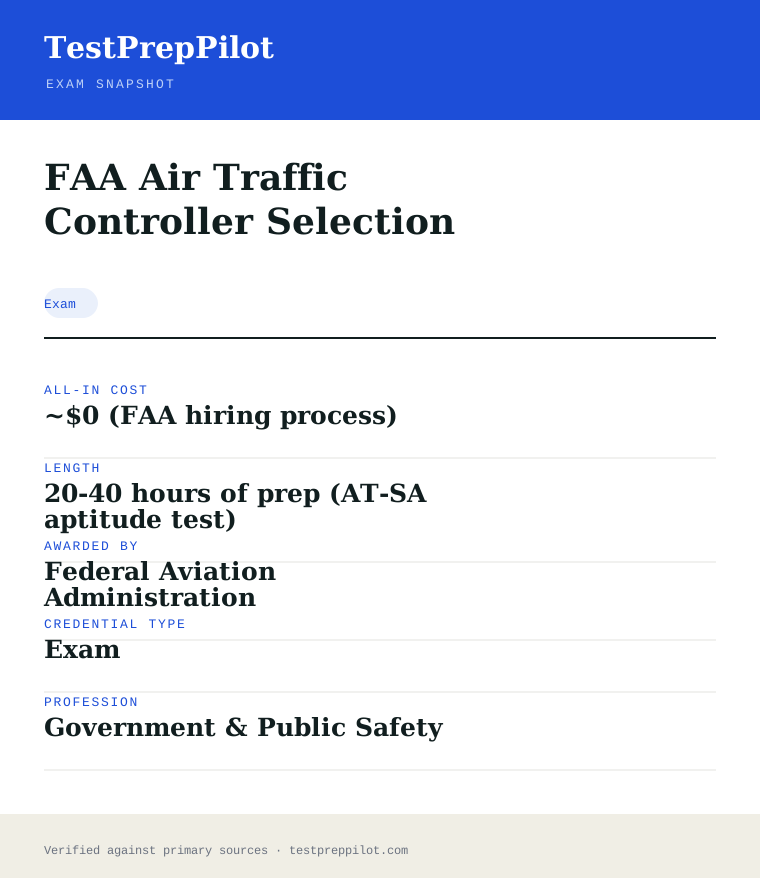
The short version
What is the FAA Air Traffic Controller Selection and is it worth it?
FAA Air Traffic Controller Selection is a professional credential administered by Federal Aviation Administration. It validates job-ready knowledge and skills in the Legal & Government field and is used for career entry, advancement, or compliance.
- Recognized credential from Federal Aviation Administration
- Demonstrates verified competence in Legal & Government
- Supports career advancement and may satisfy licensing or employer requirements
What is it?
What exactly is the FAA Air Traffic Controller Selection?
FAA Air Traffic Controller Selection — Legal & Government credential from Federal Aviation Administration
The full FAA hiring pathway for air traffic controllers combining the AT-SA, medical and training academy qualification for facility placement. Offered by Federal Aviation Administration, it is designed for candidates who need to demonstrate verified competence in the Legal & Government field. The credential is commonly used for career entry, advancement, regulatory compliance, or employer requirements. Candidates should review the official handbook for eligibility, exam format, and scoring before registering.
The path in brief
- Confirm you meet any eligibility or prerequisites
- Review the official handbook and study materials
- Register and pay through the awarding body or authorized provider
- Schedule and take the exam (test center or online proctoring)
- Receive your score and, if passed, your credential
Before you book
Who is eligible to sit the FAA Air Traffic Controller Selection?
Eligibility varies; many credentials are open to all, while others require coursework, work experience, or sponsorship.
Who it is for: Professionals and candidates seeking to validate Legal & Government competence.
The test itself
What is the format of the FAA Air Traffic Controller Selection?
The FAA Air Traffic Controller Selection is administered by Federal Aviation Administration and runs ~3 hours.
| Administered by | Federal Aviation Administration |
|---|---|
| Questions | ~90-140 items (varies) |
| Time limit | ~3 hours |
| Pass mark | Passing score set by the awarding body; see the official score report |
| Exam fee | No fee (FAA hiring process) |
| Format | Proctored, computer-based (test center or online remote proctoring) |
Content outline
What topics are on the FAA Air Traffic Controller Selection?
The FAA Air Traffic Controller Selection covers 4 content domains.
Weightings come from the official exam outline. Study time is best allocated in roughly these proportions rather than evenly across domains.
- Substantive law / procedure
Topic area tested on the exam; see the official blueprint for the detailed breakdown.
- Research & writing
Topic area tested on the exam; see the official blueprint for the detailed breakdown.
- Ethics & rules
Topic area tested on the exam; see the official blueprint for the detailed breakdown.
- Practice & compliance
Topic area tested on the exam; see the official blueprint for the detailed breakdown.
The path
How do you register for the FAA Air Traffic Controller Selection?
- 1
Visit the awarding body’s official website and create an account
- 2
Select the credential and review its specific requirements
- 3
Complete any required eligibility (education, experience, or training)
- 4
Pay the registration fee
- 5
Schedule the exam at a test center or online
- 6
Take the exam and receive your results
The fine print
What are the retake and renewal rules for the FAA Air Traffic Controller Selection?
- Proctoring & delivery
- Proctored, computer-based delivery (test center or remote online proctoring), varying by exam.
- Retake policy
- Varies by credential — most bodies permit retakes after a waiting period and full or partial fee.
- Score reporting
- Scores are reported per the body’s timeline, typically electronically after the exam.
- Recertification
- Varies; many credentials require renewal every 2–3 years via continuing education or a recertification exam.
What it pays
How much does this credential pay?
$144,580 median for air traffic controllers (BLS, May 2024) — among the highest-paid federal civilian occupations, gated by an aptitude screen, not a test of aviation knowledge
The AT-SA is a pre-employment aptitude assessment, not a certification that leads to a job title, so the salary story is the occupation it gates: air traffic controllers (SOC 53-2021), who earned a median of $144,580 in May 2024 per the BLS Occupational Outlook Handbook. That puts the occupation well above the all-occupation median of $49,500 and in the same range as high-end technology and medical roles. The distribution is worth reading carefully because the wage ladder is defined by the FAA, not by the market: the lowest 10 percent of controllers earned under $76,090 in May 2024, the highest 10 percent earned more than $210,410, and the federal government — the dominant employer — paid a median of about $154,000. Pay climbs as trainees complete successive levels: academy trainees start on a training wage, and the FAA states that certified controllers commonly pass $155,000 within about three years of academy graduation, with location and facility complexity driving the spread above that. BLS counted about 24,100 air traffic controller jobs in 2024 and projects essentially flat employment (1 percent growth) from 2024 to 2034, with roughly 2,200 openings a year arising almost entirely from retirements and attrition. That flatness is the key planning fact: this is not a growing occupation, but it is a strongly paid one, and the binding constraint is getting hired — which is exactly what the AT-SA sits in front of. The FAA hires in occasional, large, off-the-street vacancy windows rather than continuously, so applicants must wait for a USAJOBS announcement and meet hard eligibility rules, including U.S. citizenship and being under 31 at application for those without prior air traffic experience.
| Measure | Figure | Source / note |
|---|---|---|
| Median annual wage, air traffic controllers | $144,580 | BLS Occupational Outlook Handbook, May 2024 ($69.51/hr) |
| Lowest 10 percent | less than $76,090 | BLS OOH Pay tab, May 2024 |
| Highest 10 percent | more than $210,410 | BLS OOH Pay tab, May 2024 |
| Federal government median | ~$154,000 | BLS OOH Pay tab, May 2024 — the dominant employer |
| Employment, 2024 | 24,100 jobs | BLS OOH Quick Facts, 2024 |
| Projected annual openings | ~2,200 per year | BLS OOH Job Outlook, 2024-34 — mostly replacement need |
Job growth.1% projected change 2024-34 (little or no change), with ~2,200 replacement-driven openings a year; the constraint is the competitive hiring pipeline, not headcount growth
Source: BLS Occupational Outlook Handbook — Air Traffic Controllers
Your odds
What are the pass rates?
The FAA publishes no AT-SA pass rate — instead it publishes hiring bands: recent campaigns require Well-Qualified (about 85 percent or above) to advance
There is no published pass rate for the Air Traffic Skills Assessment, and there never has been. The FAA does not release aggregate candidate outcomes for the AT-SA, and third-party estimates circulating online are unverified. What the FAA does publish is more useful: the hiring bands it uses to sort applicants. The DOT Office of Inspector General’s review of the ATSA (the test’s predecessor-era validation work) documented that FAA groups scores into Best Qualified (90 percent or above), Well Qualified (85-89 percent), and Qualified (70-84 percent), and FAA hiring-page language for recent off-the-street bids has stated that a Well-Qualified result is required to advance in the process. Treat the exact cut points as announcement-dependent, because the FAA can adjust them between hiring cycles, but treat the strategic implication as stable: this is a competitive, rank-ordered screen, not a pass/fail hurdle where any qualifying score will do. A strong band improves referral odds but guarantees nothing — thousands of applicants apply to each open bid, and the FAA then weighs medical, security, and academy performance before a controller is actually hired. The assessment itself runs about 3.5 hours at a Pearson VUE center and deliberately tests no aviation knowledge; it measures memory, numerical reasoning, spatial reasoning, multitasking under time pressure, decision-making, reading comprehension, logical reasoning, and a biographical/personality component. Because the FAA treats the instrument as protected test content, do not trust anyone selling "actual AT-SA questions," and do not spend study time on controller procedure manuals — the skills the assessment samples are the ones to practise.
Read this before quoting the number.The FAA does not publish AT-SA pass rates or aggregate scores. Published material is limited to the hiring bands described in FAA campaign language and the DOT OIG’s ATSA review, and band thresholds can change between vacancy announcements. We have deliberately left any pass-rate percentage out of this table.
Source: FAA Air Traffic Control Hiring — official program page
Your schedule
How long should I study for it?
24-36 hours over 4-6 weeks of focused study
Plan for four to six weeks of targeted practice at 4-6 hours a week for the AT-SA, and understand that the preparation is for a cognitive skills test, not an aviation-knowledge exam. The assessment runs about 3.5 hours at a Pearson VUE center and samples memory, mental math, spatial reasoning, a radar-style collision-prevention simulation, logical reasoning, reading comprehension, and a biographical component. There is no official FAA syllabus and no licensed question bank, so your study plan should mirror the skill list, not a textbook. The most important hardware decision comes first: many sections force numeric-keypad input with no mouse, so spend the first week drilling 10-key speed and accuracy on a number pad until it is automatic — candidates lose points to the clock, not to the math. Week one should also include a realistic timed diagnostic so you can see which skill blocks drag you down. Weeks two through four are the core: alternate between focused drill on individual skill types (number differences, variable memory, spatial rotation, reading speed) and mixed timed sets that force you to switch demands, because the real test is a marathon of shifting tasks. The collision-prevention radar simulation deserves its own dedicated sessions — it is the section candidates most often describe as overwhelming, and it rewards a rehearsed strategy of prioritising the nearest conflicts rather than reacting to everything. Week five should shift to full 3.5-hour dress rehearsals under test conditions, with no scratch paper, since the FAA provides none and all working must happen in your head. Week six is taper: light mixed practice, sleep discipline, and confirming your test-centre logistics. You can only sit the assessment when the FAA invites you after you apply to an open bid, so your calendar is built backward from the invitation window the announcement specifies.
- Week 15-6 hrs
Hardware, baseline, and diagnosis
- Build 10-key numeric-pad speed and accuracy — many sections allow no mouse, so this is your answer device
- Take a full-length timed diagnostic to map which skill blocks are weakest
- Practise number-difference and quick-arithmetic drills daily
- Confirm your eligibility and application status for the current USAJOBS bid and the invitation window
- Week 25-6 hrs
Memory and mental math
- Drill variable-memory tasks where values shift and you must recompute under time pressure
- Practise holding multi-part instructions and relationships in working memory
- Move from untimed accuracy to timed speed gradually — accuracy first, then pace
- Log every error type so you can see whether misses are memory or arithmetic failures
- Week 35-6 hrs
Spatial and collision-prevention skills
- Practise spatial rotation and visual-relationship tasks from different viewpoints
- Begin the radar-style collision simulation — learn to prioritise the nearest conflicts and ignore noise
- Rehearse calm responses to intentional overload; the section is designed to pressure you
- Time yourself: the goal is sustained performance, not one perfect run
- Week 45-6 hrs
Reading, logic, and mixed switching
- Drill rapid reading comprehension with short passages and quick decisions
- Practise logical reasoning and rule-following under a clock
- Run mixed sets that rotate task types every few minutes to simulate the real switching load
- Revisit your week-one weak areas with the drills that specifically target them
- Week 55-6 hrs
Full dress rehearsals
- Complete two full ~3.5-hour simulations under test conditions
- Do all working in your head — no scratch paper, exactly like the real environment
- Practise the personality/biographical section honestly and consistently
- Review where pacing broke down and rebuild a time-budget strategy
- Week 63-4 hrs
Taper and logistics
- Light mixed practice only — no new material, no cramming
- Confirm the test centre address, check-in rules, and required ID
- Prioritise sleep across the last three days; the assessment is an endurance test
- Prepare your mind for the band result, not a pass/fail verdict
Adjusting the pace
Air traffic collegiate training initiative (CTI) graduate.CTI graduates follow a Track 1 path with defined hiring steps and, in some cycles, reduced experience expectations. Preparation time is the same 4-6 weeks; the difference is your pipeline. Track the FAA’s CTI-specific guidance for the active bid.
Prior military or prior ATC experience.Candidates with prior controller or military air traffic experience may qualify under a different track or age rule. You may need less skill drilling — focus on the written subtest formats you have not seen in years, especially the radar simulation.
Completely new to air traffic work.Give yourself 6-8 weeks. The skills are learnable but the mixed-task stamina is not; add a week of pure 10-key work and an extra dress rehearsal before test day.
How to study
How do I prepare most effectively?
The single highest-yield strategy for the AT-SA is to rehearse the exact cognitive demands the FAA names, under the exact conditions — timed, numeric-keypad input, no mouse in several sections, no scratch paper, and several hours of sustained effort. Reading about memory tasks or watching someone else run a radar simulation produces candidates who recognise the format but cannot hold up for 3.5 hours. Build accuracy first and speed second: the fastest way to lose the assessment is to practise fast-but-wrong until it becomes a habit. Practise task switching deliberately, because the real test rotates demands the way a live position does. Treat the collision-prevention simulation as its own discipline with a rehearsed prioritisation rule, rather than reacting to every blip. Sleep is a test-prep tool here — the FAA explicitly designs the assessment to be gruelling, and a rested, calm candidate beats a crammed one. And be disciplined about what you do not study: no aviation procedure manuals, no radar phraseology, no tower operations, because none of it is on the assessment, and the FAA has said plainly that the AT-SA is a measure of aptitude and multitasking, not knowledge.
Master the numeric keypad before anything else
Several sections do not accept mouse input and expect fast, accurate 10-key entry. If you are hunting for keys, the clock eats you. Spend your first week on daily 10-key drills until entry is automatic, then keep a light warm-up in every session.
Do all working memory arithmetic in your head
The test centre provides no pen or scratch paper, and FAA material describes no note-taking. Practise computing number differences, variable substitutions, and quick arithmetic entirely mentally from week one, so you never discover the constraint for the first time on test day.
Rehearse the collision simulation with a prioritisation rule
The radar-style section is the one candidates most often call overwhelming. Develop a fixed rule — resolve the nearest or most imminent conflict, ignore everything else, then reassess — and drill it until it is automatic. Panic is the failure mode, not speed.
Practise switching, not just individual skills
The AT-SA is a marathon of shifting task types. A candidate who only drills number-difference exercises in isolation will fatigue when the format changes every few minutes. Run mixed sets that rotate memory, spatial, reading, and logic tasks under a clock.
Treat the personality component as honest and consistent
The biographical/personality section has no right answers, but inconsistent responses are flagged. Answer as your actual work self — calm under pressure, decisive, rule-following — rather than as the candidate you imagine the FAA wants, because consistency is part of what is evaluated.
Run at least two full dress rehearsals
A 3.5-hour cognitive marathon is an endurance event. Schedule two complete timed simulations in the final two weeks, under realistic conditions, and review where pacing and stamina broke down. The rehearsal is the only way to learn what sustained attention actually costs you.
What to buy
Which study resources are worth paying for?
There is no official FAA study guide for the AT-SA and no licensed question bank, which is exactly why the resource decision matters — the market is full of third-party simulators of widely varying fidelity, and the FAA publishes no real items for them to mirror. Your cheapest and most defensible resources are the free skill drills you can build yourself (10-key practice, mental arithmetic, reading speed) plus the FAA’s own hiring-page description of the skill areas. The only fee that is mandatory is the assessment itself, and current FAA hiring language indicates invited candidates are not charged for the AT-SA; any commercial product you buy is entirely optional. Commercial AT-SA prep packages range from around $20 practice-test products to several hundred dollars for a full simulator plus coaching, and the honest evaluation is that the simulator fidelity — especially on the radar and spatial sections — is the variable worth paying for if you pay for anything. The personality component needs no commercial product at all. Your employer will not reimburse this; the FAA does not sponsor prep. Treat third-party pass-rate claims with suspicion, because those figures cannot be sourced, and check the FAA’s current hiring page before buying anything to confirm the assessment still matches the description.
| Resource | Price | Format | Best for |
|---|---|---|---|
| The AT-SA itself (invited candidates) | No fee per current FAA hiring language | In-person, Pearson VUE, ~3.5 hours | The only mandatory step — invited after applying to an open bid |
| FAA ATC hiring page | Free | Official web page | The skill list, eligibility rules, and current bid requirements — read this first |
| Free 10-key and mental-math drills | Free | Browser apps and typing sites | Building the hardware and arithmetic fluency the test assumes |
| Commercial AT-SA practice tests | ~$20-60 | Online question sets | Cheap format familiarisation; treat with caution since real items are protected |
| Full AT-SA simulator packages | ~$100-400 | Interactive software with timed modules | The radar/spatial simulation experience — the one thing worth paying a premium for |
| ATC prep books and PDF guides | ~$15-40 | Print or ebook | Background on the hiring process, not licensed test content — read for process, not items |
| Controller procedure manuals | Varies | Print or PDF | Avoid for prep — the FAA states the AT-SA is not a knowledge test |
Prices checked 2026-08 in USD and approximate. The FAA does not endorse any commercial prep product, and AT-SA items are protected test content, so any seller claiming "real questions" is misrepresenting the source. Confirm current hiring language on the FAA page before buying anything.
Avoid these
What mistakes do candidates most often make?
The most damaging mistakes on the AT-SA are about preparation strategy, not intelligence — studying the wrong material, neglecting the numeric keypad, and failing to rehearse the endurance conditions. The most common single error is spending weeks on aviation-knowledge material, which the FAA explicitly says is not tested, while ignoring the memory, math, and multitasking skills that actually carry the assessment. A close second is preparing exclusively with untimed single-skill drills and never simulating the mixed, timed, mouse-free environment, so the first time a candidate feels the real load is on test day. Candidates also routinely under-practise the collision-prevention simulation, panic under its designed overload, and lose entire sections to an unprioritised scramble. The personality component trips up people who answer as an imagined ideal rather than consistently, producing flagged responses. And many applicants misunderstand the result entirely: they treat a Qualified band as a pass, when recent campaigns have required Well-Qualified to advance — so they apply, score, and never move forward because they aimed at the wrong target.
✕Studying aviation knowledge and controller procedures
✓The FAA states the AT-SA is an aptitude assessment, not a knowledge test. None of the separation standards, phraseology, or facility procedures you might study appear on it. Replace that time with memory, mental-math, spatial, reading-speed, and multitasking practice.
✕Preparing only with untimed single-skill drills
✓The assessment is timed, mixed, and about endurance. Run full-length timed sessions that rotate task types and force switching, and finish at least two complete ~3.5-hour dress rehearsals with no scratch paper before test day.
✕Ignoring numeric-keypad fluency
✓Several sections are answered almost entirely with the numeric keypad and do not accept mouse input. Practise 10-key entry until it is automatic, or you will lose points to the interface rather than the content.
✕Scrambling through the radar simulation
✓The collision-prevention section is designed to overwhelm. Develop a fixed prioritisation rule — handle the nearest or most imminent conflict, ignore the rest, reassess — and drill it until panic is not part of the reaction.
✕Answering the personality section as an imagined ideal
✓The biographical component evaluates consistency and fit. Answer honestly and consistently about how you actually behave under pressure; contradictory responses are flagged, and there is no "perfect" profile to fake.
✕Treating a Qualified band as success
✓Recent FAA campaign language has required Well-Qualified to advance. Aim well above the minimum Qualified threshold, and understand that even a top band does not guarantee a selection — medical, security, and academy performance follow.
What you'll face
What question types will I see?
The AT-SA is a single computer-based assessment run in person at Pearson VUE centres, typically about 3.5 hours, and it is deliberately not a knowledge test: the FAA describes it as measuring aptitude relevant to controller training. The subtest list can vary by hiring announcement, but published descriptions consistently include number differences, variable memory and mental arithmetic, spatial and visual relationships, a radar-style collision-prevention simulation, reading comprehension, logical reasoning, and a biographical or personality questionnaire. Scoring places candidates into hiring bands — Best Qualified, Well Qualified, Qualified, or Not Referred — rather than producing a single pass/fail percentage, and the FAA does not publish raw-score formulas. Because the test content is protected, the samples below are editor-written illustrations of the published skill categories, not live items. There is no scratch paper, many sections run on numeric-keypad input, and the pacing pressure is intentional, so preparation should mirror the format rather than the content.
Quick comparison and calculation of numbers under time pressure — often on the numeric keypad. Accuracy first, then speed.
Variables with shifting values that you must hold in working memory and recompute as conditions change.
Determining relative positions of aircraft or objects from changing viewpoints, including from a cockpit-style perspective.
Managing moving objects on a screen to prevent collisions under pressure — rewards a rehearsed prioritisation rule.
Extracting information quickly and drawing conclusions under a clock; deductive reasoning and rule-following.
Work-style questions with no right answers; consistency and fit with controller traits are what matter.
Try these
Q1A memory-and-math exercise asks you to track the value of variable X. X starts at 40. A prompt reads "X increases by 15," then "X decreases by 7," then "X is doubled." What is the final value of X?
Answer:B
Work the steps in order: 40 + 15 = 55; 55 – 7 = 48; 48 doubled is 96. The most common error is doubling 40 early or mis-ordering the changes, which produces 76 or 88. Holding all three instructions in working memory without scratch paper is the actual skill being tested.
Q2A spatial reasoning prompt asks you to imagine a small aircraft positioned directly ahead of you at your 12 o’clock, level with your own aircraft. Which of the following statements is true?
Answer:C
12 o’clock in aviation relative-direction terms is straight ahead, so the aircraft is directly in front. The trap in these items is viewpoint shift — reading "12 o’clock" as a clock position on paper rather than as the pilot’s own reference. Practising viewpoint shifts is what improves these items.
Q3In a decision-making exercise, you are told: "If a conflict is imminent, resolve it before handling any advisory message. If no conflict is imminent, answer the advisory message first." A new advisory message arrives while one aircraft is on a direct collision course with another. What should you do?
Answer:B
The stated rule makes conflict resolution the priority whenever a conflict is imminent, which it is here. A inverts the priority, C wastes time the scenario does not grant, and D is not a supported option in a single-task format — the point of the item is applying a prioritisation rule under pressure rather than reasoning from first principles.
Samples are editor-written illustrations of the published skill categories, not live AT-SA items. Test content is protected, and exact subtests vary by hiring announcement.
The big day
What should I expect on exam day?
The AT-SA is taken in person at a Pearson VUE test centre, lasts about 3.5 hours, and is scheduled only after the FAA invites you following an application to an open off-the-street or CTI bid — you cannot simply register for it. Read the invitation carefully because it controls the scheduling window, the rescheduling deadline, the identification requirements, and the arrival rules, and check the test centre location and travel time well in advance, because appointments near the end of the window are scarce. On the day, bring the exact identification the invitation names — typically a valid government-issued photo ID whose name matches your application exactly — and arrive early enough to complete check-in. Leave phones, smartwatches, notes, and any study materials at home or in a locker; the test environment provides no scratch paper, so your working memory is the only calculation tool you have. Several sections require fast numeric-keypad entry with no mouse, so your hands have been warmed up by your drill work, not by caffeine. Use the opening moments to settle into the first subtest’s rules rather than racing. When the collision simulation arrives, apply your rehearsed prioritisation rule and accept that it is designed to feel overwhelming — the candidates who perform are the ones who stay calm, not the ones who react to everything. Your result comes back as a hiring band — Best Qualified, Well Qualified, Qualified, or Not Referred — and a strong band improves referral odds but does not guarantee a selection, because medical evaluation, security clearance, and FAA Academy training follow for candidates who advance.
Bring
- The exact identification the invitation requires — typically a valid government-issued photo ID
- A name on the ID that matches your application and invitation exactly
- Comfortable, calm clothing for a ~3.5-hour computer session
- A clear picture of the test centre address, arrival time, and check-in rules
Leave at home
- Phones, smartwatches, fitness trackers, and earbuds — locker or at home
- All notes, study materials, and commercial prep printouts
- Scratch paper and pens — none are provided or permitted
- Calculators and any other electronic aids
- Any expectation that you can reschedule at the desk — that window closes earlier per the invitation
How the day runs
Rules in the room
- You cannot register for the AT-SA on your own — it is taken only on FAA invitation after applying to an open hiring bid.
- The assessment is in person at a Pearson VUE centre and typically lasts about 3.5 hours.
- It is an aptitude assessment; no aviation knowledge is required or tested.
- No scratch paper or writing materials are provided; working memory is the only tool.
- Several sections use numeric-keypad input and do not accept mouse input.
- Eligibility rules for the bid include U.S. citizenship and, for applicants without prior air traffic experience, being under 31 at application.
- Results come back as hiring bands, and recent campaigns have required Well-Qualified to advance.
Afterwards.Your AT-SA result comes back as one of the hiring bands — Best Qualified, Well Qualified, Qualified, or Not Referred — rather than a simple pass or fail, and a strong band raises your referral odds without guaranteeing selection. Candidates who advance then move through the FAA’s next steps: medical evaluation, psychological evaluation, drug testing, and a federal security clearance, followed by assignment to the FAA Academy in Oklahoma City for several months of paid training, then on-the-job training toward Certified Professional Controller status. Do not treat the assessment as the finish line, because the academy and facility training have their own significant pass thresholds. If you did not land the band the campaign required, review the active announcement to see whether a future bid is realistic — some candidates reapply in later cycles — and use the intervening months to keep the specific skills sharp rather than starting over cold. On a strong band, begin preparing the medical and security documentation immediately, because those clearances are where well-qualified candidates most often lose momentum. Your score is typically considered valid for several years, but hiring rules and announcements change, so always verify against the current bid before committing time and money to another cycle.
Reference
What are the key facts about the FAA Air Traffic Controller Selection?
FAA Air Traffic Controller Selection is a exam credential; awarded by Federal Aviation Administration; the exam fee is No fee (FAA hiring process); typical preparation is 20-40 hours of prep (AT-SA aptitude test); holders typically earn $60,000-$170,000 (53-2021 median ~$137,380).
| Credential | FAA Air Traffic Controller Selection |
|---|---|
| Abbreviation | ATC |
| Type | Exam |
| Profession | Government & Public Safety |
| Specialty | Federal Hiring & Civil Service |
| Awarded by | Federal Aviation Administration |
| Difficulty | Specialized |
| Typical prep time | 20-40 hours of prep (AT-SA aptitude test) |
| All-in cost | ~$0 (FAA hiring process) |
| Typical salary range | $60,000-$170,000 (53-2021 median ~$137,380) |
| Credential | FAA Air Traffic Controller Selection |
| Awarding body | Federal Aviation Administration |
| Exam format | Proctored, computer-based |
| Validity | AT-SA score valid for one hiring bid |
| Languages | Varies — see awarding body |
| Scope | National / Multi-state |
| Also known as | FAA ATC |
Real questions
Frequently asked questions about the FAA Air Traffic Controller Selection
How do I register for the FAA Air Traffic Controller Selection exam?
Register through Federal Aviation Administration's official portal or an authorized test provider (e.g., Pearson VUE or Prometric where applicable). Create an account, select the exam, pay the fee, and schedule a date.
How much does the exam cost?
Fees vary by location and currency. Confirm the current fee on the official registration page before scheduling.
How long is the credential valid, and how do I renew?
Validity varies by credential (commonly 2–3 years). Renewal usually requires continuing education or a recertification exam — see Federal Aviation Administration's policy.
What if I do not pass?
Most bodies allow retakes after a waiting period and payment of the full or partial fee. Check Federal Aviation Administration's retake policy before rescheduling.
How do I register for a Federal Aviation Administration credential?
Register through the official website, select your exam, pay the fee, and schedule a date.
How do I renew a credential?
Renewal policies vary by credential; check the specific program page for requirements and cycles.
In short
Is the FAA Air Traffic Controller Selection worth it?
- FAA Air Traffic Controller Selection is awarded by Federal Aviation Administration.
- Validates job-ready competence in Legal & Government.
- Registration is through the awarding body or an authorized test provider.
- Renewal and retake policies vary — confirm before scheduling.
Trust
Where does this information come from?
Everything above is taken from the awarding body's own published material. Fees, question counts and domain weights are revised regularly — check the official page before you pay.
Research confidence: medium · Last reviewed 2026-08