Animal & Agriculture • Certification
NAVTA Approved Veterinary Assistant
The national assistant credential earned through an approved programme.
Researched and maintained by TestPrepPilot Editorial BoardVeterinary & animal-care certifications desk · Figures last verified August 2026
The short version
What is the NAVTA Approved Veterinary Assistant and is it worth it?
The AVA is earned by completing a NAVTA-approved assistant programme and passing a 100-question, 150-minute online exam (pass mark 75%) proctored in person, with five attempts allowed at $100 each. The designation is valid for two years and renewed with at least 10 hours of veterinary continuing education. Only graduates of NAVTA-approved programmes may sit the exam.
- Nationally recognised veterinary assistant credential
- Verifies restraint, nursing and clinic skills
- Preferred by many veterinary employers
- Renews with CE, no re-exam needed
- Clear, low-cost per-attempt exam fee
What is it?
What exactly is the NAVTA Approved Veterinary Assistant?
The national assistant credential earned through an approved programme.
The NAVTA Approved Veterinary Assistant (AVA) is the nationally recognised designation for veterinary assistants, created by the National Association of Veterinary Technicians in America. It is earned by graduating from a NAVTA-approved veterinary assistant programme and passing the 100-question AVA examination, which is administered by VetMedTeam and must be observed by an approved proctor. The AVA signals to clinics that an assistant understands restraint, nursing care and clinic operations at a verified standard.
The path in brief
- Graduate approved programme
- Get enrolment code
- Pay $100 exam fee
- Arrange an approved proctor
- Score 75% to certify
Before you book
Who is eligible to sit the NAVTA Approved Veterinary Assistant?
Only graduates of a NAVTA-approved veterinary assistant programme are eligible. You receive an enrolment code from your programme and must take the exam within 30 days of enrolment.
Who it is for: Veterinary assistants and programme graduates.
The test itself
What is the format of the NAVTA Approved Veterinary Assistant?
The NAVTA Approved Veterinary Assistant is administered by VetMedTeam on behalf of NAVTA and runs 150 minutes, contains 100 multiple choice questions and requires 75% to pass.
| Administered by | VetMedTeam on behalf of NAVTA |
|---|---|
| Questions | 100 multiple choice |
| Time limit | 150 minutes |
| Pass mark | 75% |
| Exam fee | $100 per attempt (5 attempts allowed) |
| Format | Online, in-person proctored |
Content outline
What topics are on the NAVTA Approved Veterinary Assistant?
The NAVTA Approved Veterinary Assistant covers 4 content domains.
No percentage weights are listed for these domains here, so the outline is shown as structure only. Check the certifying body's published outline before allocating study time.
- Office and client relations
Front-desk and communication
- Pharmacy and preventive care
Medication and protocols
- Animal nursing
Restraint, care, hygiene
- Laboratory and surgical assist
Samples, prep, recovery
Money & time
How much does the NAVTA Approved Veterinary Assistant cost?
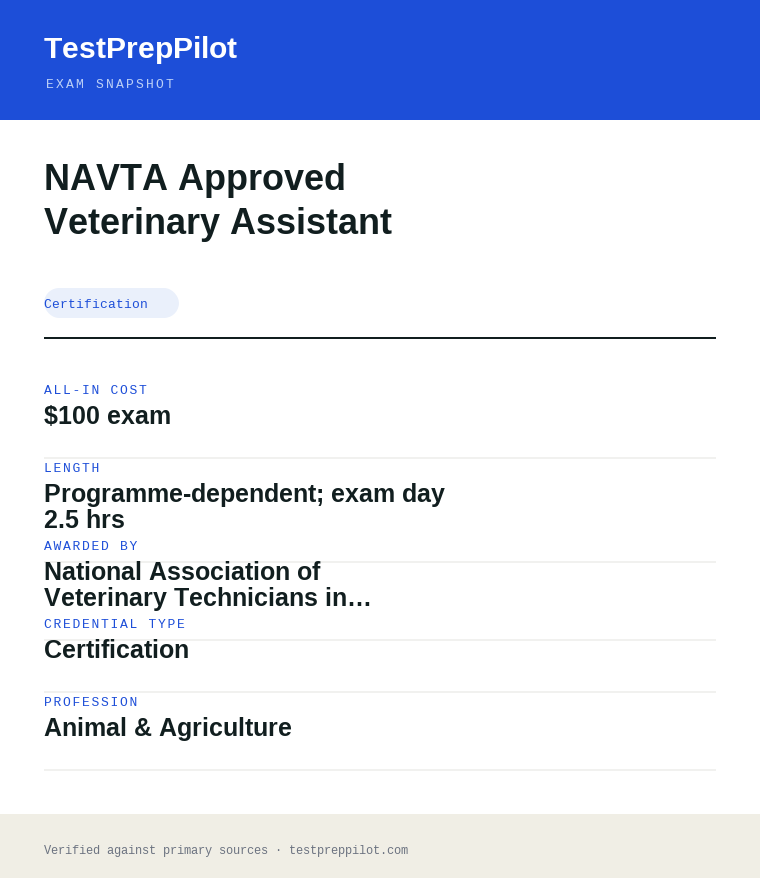
For the NAVTA Approved Veterinary Assistant, the exam fee is $100 per attempt (5 attempts allowed); the all-in cost is typically $100 exam; most candidates spend Programme-dependent; exam day 2.5 hrs preparing.
Cost breakdown
| AVA exam (per attempt) | $100 |
|---|---|
| Programme tuition | Varies by school |
| Renewal | CE + fee if lapsed |
| Typical total | $100 exam (+ programme tuition) |
Exam fee is $100 per attempt; programme tuition is separate and varies widely by school.
Timeline
- Complete programme Programme length
- Enrol + proctor Within 30 days
- Exam 150 minutes
- Renew Every 2 years
Typical prep: Programme-dependent; exam day 2.5 hrs
The path
How do you register for the NAVTA Approved Veterinary Assistant?
- 1
Graduate a NAVTA-approved programme
To sit the AVA exam you must complete a NAVTA-approved veterinary assistant programme and obtain your enrolment code.
The exam is not open to the general public.
- 2
Enrol for the exam15 minutes
Pay the $100 exam fee through VetMedTeam, NAVTA's exam partner, using the code from your programme.
- 3
Arrange a proctorSchedule
Secure an approved proctor (a veterinarian, credentialed technician, or testing centre) to observe the timed online exam.
- 4
Take the exam150 minutes
Complete the 100-question, 150-minute exam within 30 days of enrolment and score at least 75%.
The fine print
What are the retake and renewal rules for the NAVTA Approved Veterinary Assistant?
- Proctoring & delivery
- The AVA exam is online but must be observed in person by an approved proctor; remote-only proctoring is not permitted. Five attempts are allowed.
- Retake policy
- Each of the five attempts costs the $100 fee; lapsed designations may require retaking the exam plus a higher renewal fee.
- Score reporting
- The score and certificate are available immediately on passing; results are forwarded to NAVTA.
- Recertification
- The AVA is valid two years and renewed with at least 10 hours of veterinary continuing education; no exam is required to renew.
What it pays
How much does this credential pay?
$34,920 median for veterinary assistants and laboratory animal caretakers (BLS, May 2024)
There is no Bureau of Labor Statistics occupation called "AVA" — the NAVTA Approved Veterinary Assistant credential validates entry-level veterinary-assistant training, and the wage question belongs to the occupation you perform with it. The closest official BLS occupation is Veterinary Assistants and Laboratory Animal Caretakers, SOC 31-9096, which had a May 2024 median wage of $34,920, with the lowest 10 percent under $27,050 and the highest 10 percent above $47,890. The fit is direct: NAVTA-approved veterinary assistants work in clinics, hospitals and shelters performing the animal-care, restraint and facility duties, all inside this occupation. BLS counted 111,900 veterinary assistant jobs in 2024 and projects 16 percent growth from 2024 to 2034, much faster than the average for all occupations, with about 17,500 openings a year. The limitation to state plainly: the BLS median covers the whole occupation, credentialed or not, and the AVA credential's value is as a training-and-competency signal that clinics use in hiring; the certification does not replace the higher-paying veterinary-technician credential, which BLS reports separately at a higher median. Read the number as the market for the entry occupation the credential serves.
| Measure | Figure | Source / note |
|---|---|---|
| Median annual wage, veterinary assistants and lab animal caretakers | $34,920 | BLS OOH, SOC 31-9096, May 2024 |
| Lowest 10 percent | Under $27,050 | BLS OOH, SOC 31-9096, May 2024 |
| Highest 10 percent | Above $47,890 | BLS OOH, SOC 31-9096, May 2024 |
| Median, veterinary technologists and technicians (senior track) | $43,350 | BLS OOH, SOC 29-2056, May 2024 |
Job growth.BLS projects 16 percent growth for veterinary assistants from 2024 to 2034, about 17,500 openings per year.
Source: BLS Occupational Outlook Handbook - Veterinary Assistants and Laboratory Animal Caretakers
Your odds
What are the pass rates?
NAVTA publishes the format and the 75% passing standard — and does not publish a cohort pass rate
NAVTA does not publish cohort pass rates for the Approved Veterinary Assistant exam, and third-party estimates are not official data, so we do not treat them as authoritative. What NAVTA does publish is the format and the passing standard: the AVA exam has 100 multiple-choice questions with a 90-minute time limit, and a passing score of 75 percent — at least 75 correct answers. The exam is delivered online through NAVTA's proctored platform after the candidate completes the NAVTA-approved training program, and the certification is valid for two years, renewed by continuing education. The exam content follows the published AVA course curriculum: veterinary practice and animal handling, anatomy and physiology basics, medical terminology, the clinical procedures and the practice-management duties. The absence of a published pass rate is not an absence of standards: the 75 percent line on 100 questions is a real bar, and the exam validates the training the approved program delivered. The practical reading: the credential requires completing the NAVTA-approved course first, and the exam rewards the course's content, so preparation is studying the course material and practising with the AVA practice exam.
Read this before quoting the number.NAVTA publishes the 75% passing standard but no cohort pass rate; the exam requires completing the approved training program.
Your schedule
How long should I study for it?
15-30 hours over 2-3 weeks (after the approved training program) of focused study
The AVA exam is a 100-question, 90-minute online exam with a 75 percent passing line, and the credential requires completing a NAVTA-approved veterinary-assistant training program first — the exam validates that training. A defensible plan runs 15 to 30 hours of exam-focused study over 2 to 3 weeks, on top of the training program. Week one: review the course material on animal handling and restraint, the anatomy and physiology basics, and the medical terminology, because the exam assumes the course's vocabulary. Week two: the clinical procedures — the examination-room duties, the sample collection, the surgical-assistance basics and the patient-care tasks — plus the practice-management and communication duties. Week three: the AVA practice exam, targeted review of the weak areas, and a timed run at the real 100-question, 90-minute format. The plan is course-review-heavy because the exam is built on the approved curriculum; candidates who complete the training and review the material pass at high rates.
- Week 18
Fundamentals review
- Animal handling and restraint
- Anatomy and physiology basics
- Medical terminology
- Week 210
Clinical procedures
- Examination-room and patient-care duties
- Sample collection and surgical assistance
- Practice management and communication
- Week 38
Practice and exam
- The AVA practice exam
- Targeted review of weak areas
- One timed run, then the exam
Adjusting the pace
Recently completed the course.The material is fresh; focus on the practice exam and the timed format.
Working in a clinic without the course.Complete the NAVTA-approved training first; the exam requires it.
How to study
How do I prepare most effectively?
The AVA exam rewards the course's content, so the dominant strategy is reviewing the approved training material thoroughly and using the AVA practice exam, which mirrors the real item style. Second, master the animal-handling and restraint material, a core part of the assistant role and the exam, because the exam assumes hands-on familiarity. Third, learn the medical terminology and the anatomy basics precisely, since the exam tests the vocabulary the course taught. Fourth, cover the clinical procedures and the practice-management duties deliberately — the assistant scope includes both the patient-care tasks and the front-office duties. Finally, take at least one timed practice run at the real 100-question, 90-minute format; the 75 percent line leaves room for review but not for rushing, and the timed run builds the pacing.
Review the course material
The exam is built on the approved curriculum; study it.
Master animal handling and restraint
A core part of the role and the exam.
Learn the terminology precisely
The exam tests the course's vocabulary and anatomy basics.
Cover procedures and management
Both the patient-care and the front-office duties are tested.
Run one timed practice exam
100 questions in 90 minutes; practise the pacing.
What to buy
Which study resources are worth paying for?
AVA prep costs are dominated by the training program. NAVTA-approved veterinary-assistant programs range from roughly $300 to $2,000 depending on the provider and format (many are online with a clinical component). The AVA exam fee is about $100-$150 for NAVTA members and slightly more for non-members, and the practice exam is included or low-cost. Free resources include the NAVTA program pages and the course materials you receive with the training. A realistic total budget is $500 to $2,500 including the training and exam. Prices below are list prices as of mid-2026 and change frequently; we rank nothing by commission.
| Resource | Price | Format | Best for |
|---|---|---|---|
| NAVTA-approved training program | $300-$2,000 | Online or classroom + clinical | The required training and core learning |
| AVA practice exam | Included or ~$30 | Official online practice | The closest item style |
| AVA exam | ~$100-$150 | Proctored online exam | The certification itself |
| Veterinary-assistant textbooks | $50-$100 | Printed or digital book | Supplementary review material |
List prices as of mid-2026, subject to change; NAVTA fees vary by membership; no commission or affiliate ranking is implied.
Avoid these
What mistakes do candidates most often make?
The most common AVA mistake is treating the exam as optional preparation: candidates who complete the training but do not review the material meet the exam without the vocabulary and procedures fresh, and the 75 percent line punishes that. The fix is a focused review week. The second mistake is under-preparing the animal-handling and restraint material, a core part of the role and the exam. Third, candidates skip the practice-management and communication duties, treating them as minor when they are tested. Fourth, some candidates never take a timed practice run and misjudge the 90-minute pace. Finally, candidates who have not completed the NAVTA-approved training cannot take the exam at all — the course is the gate, so confirm the approved-program requirement before planning.
✕Skipping the review
✓Review the course material; the 75% line punishes stale knowledge.
✕Under-preparing animal handling
✓A core part of the role and the exam; master it.
✕Skipping practice-management duties
✓A tested part of the assistant scope; cover it.
✕Never timing a practice run
✓100 questions in 90 minutes; run a timed practice exam.
✕Skipping the approved course
✓The exam requires the NAVTA-approved training; complete it first.
What you'll face
What question types will I see?
The AVA exam is a 100-question multiple-choice exam in 90 minutes, delivered online under proctoring. The items test the approved course curriculum: animal handling and restraint, anatomy and physiology basics, medical terminology, the clinical procedures and the practice-management duties. Many items are scenario-based — a clinic or patient situation followed by the correct assistant action. Samples below are editor-written illustrations of the published curriculum, not live exam items; they show the veterinary-assistant style of the real items.
Safe handling and restraint of common species.
Patient care, sample collection and surgical assistance.
Medical terms and practice-management duties.
Try these
Q1When restraining a small dog for a blood draw, the veterinary assistant should:
Answer:A
Safe restraint is gentle but secure — keeping the animal still and the vein accessible without causing distress. Overly tight restraint, muzzling without handling or letting the animal roam each fail the safe-restraint standard.
Q2Which term describes the surgical preparation of the patient's skin to reduce the risk of infection?
Answer:A
Surgical site preparation — clipping and scrubbing the surgical site — reduces the infection risk. Handwashing, bandaging and monitoring are different steps in the surgical process.
Q3A client calls with a routine appointment question. The veterinary assistant's appropriate response is to:
Answer:A
The assistant handles scheduling and front-office duties, routing medical questions to the veterinarian or technician. Giving medical advice, hanging up or diagnosing the pet each exceed the assistant's scope.
Samples are editor-written illustrations of the published curriculum, not live exam items.
The big day
What should I expect on exam day?
The AVA exam is a 100-question, 90-minute online exam through NAVTA's proctored platform, taken after completing the NAVTA-approved training program. Confirm your system meets the proctoring requirements — webcam, stable internet and a quiet space — and close unrelated applications before starting. Pace at about 54 seconds per item, flag uncertain items for review, and finish with time to spare; the 75 percent line leaves room for review but not for rushing. Your result is reported on completion, with the certificate following on a pass. If you do not pass, the retake policy defines the terms. On a pass, the AVA is valid for two years and renewed by continuing education. The afterwards matters: keep the renewal cycle on your calendar, and consider the veterinary-technician path — the higher-paid credential BLS reports separately — as the next step.
Bring
- Computer with webcam and stable internet
- A quiet, private testing space
- Your NAVTA account login
Leave at home
- Phone and other devices within the proctor's view
- Notes and open browser tabs — the exam is closed book
How the day runs
Rules in the room
- Closed-book online exam under proctoring
- 90 minutes for 100 questions; the clock does not pause
- The certification is valid 2 years, renewed by continuing education
Afterwards.On a pass, your AVA is valid for two years; renew with continuing education. On a fail, retake per the policy after additional course review.
Reference
What are the key facts about the NAVTA Approved Veterinary Assistant?
NAVTA Approved Veterinary Assistant is a certification credential; awarded by National Association of Veterinary Technicians in America; the exam fee is $100 per attempt (5 attempts allowed); typical preparation is Programme-dependent; exam day 2.5 hrs.
| Credential | NAVTA Approved Veterinary Assistant |
|---|---|
| Abbreviation | AVA |
| Type | Certification |
| Profession | Animal & Agriculture |
| Specialty | Animal & Veterinary Support |
| Awarded by | National Association of Veterinary Technicians in America |
| Difficulty | Easy |
| Typical prep time | Programme-dependent; exam day 2.5 hrs |
| All-in cost | $100 exam |
| Attempts | Up to 5 at $100 each |
| Proctor | Vet, credentialed tech or centre |
| Validity | 2 years |
| Renewal | 10 CE hrs, no exam |
| Scope | National / Multi-state |
Real questions
Frequently asked questions about the NAVTA Approved Veterinary Assistant
How hard is the AVA exam?
It is considered accessible for programme graduates: 100 straightforward multiple-choice questions with a 75% pass mark. The bigger hurdle is completing an approved programme first.
How long should I study?
Most graduates review for a few weeks using their programme materials and VetMedTeam practice resources, then sit the 150-minute exam.
Does the AVA expire?
Yes, the designation is valid two years from the exam date and renewed with at least 10 hours of veterinary CE. Lapsed status may require retaking the exam plus a higher fee.
Is the AVA worth it?
For assistants it is worthwhile: employers prefer the verified credential, and it can support articulation into veterinary technology programmes.
Who is eligible?
Only graduates of a NAVTA-approved veterinary assistant programme may sit the exam; you need an enrolment code from your school.
In short
Is the NAVTA Approved Veterinary Assistant worth it?
- AVA is NAVTA’s national veterinary assistant credential.
- 100 questions, 150 minutes, 75% to pass, $100 per attempt.
- Requires graduation from a NAVTA-approved programme.
- Valid 2 years; renew with 10 CE hours, no re-exam.
Trust
Where does this information come from?
Everything above is taken from the awarding body's own published material. Fees, question counts and domain weights are revised regularly — check the official page before you pay.
- National Association of Veterinary Technicians in America Awarding body
- Official NAVTA Approved Veterinary Assistant exam page Exam page
Research confidence: high · Last reviewed 2026-08