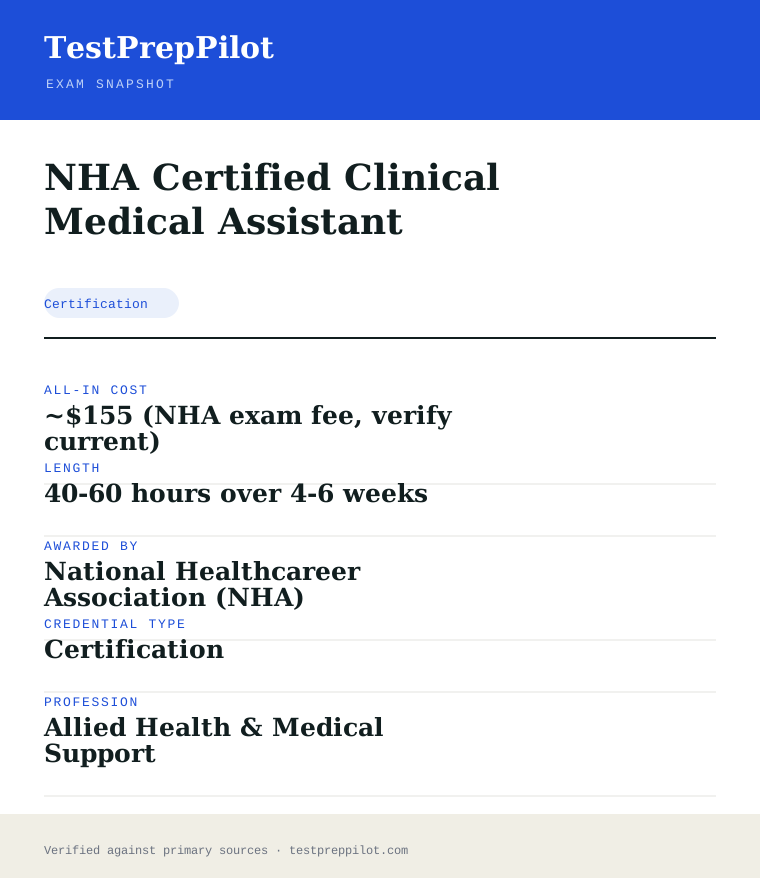
The short version
What is the NHA Certified Clinical Medical Assistant and is it worth it?
NHA Certified Clinical Medical Assistant is a professional credential administered by National Healthcareer Association (NHA). It validates job-ready knowledge and skills in the Allied Health field and is used for career entry, advancement, or compliance.
- Recognized credential from National Healthcareer Association (NHA)
- Demonstrates verified competence in Allied Health
- Supports career advancement and may satisfy licensing or employer requirements
What is it?
What exactly is the NHA Certified Clinical Medical Assistant?
NHA Certified Clinical Medical Assistant — Allied Health credential from National Healthcareer Association (NHA)
Credential for clinical medical assistants certified through the NHA., a nationally recognized professional credential in this field. Offered by National Healthcareer Association (NHA), it is designed for candidates who need to demonstrate verified competence in the Allied Health field. The credential is commonly used for career entry, advancement, regulatory compliance, or employer requirements. Candidates should review the official handbook for eligibility, exam format, and scoring before registering.
The path in brief
- Confirm you meet any eligibility or prerequisites
- Review the official handbook and study materials
- Register and pay through the awarding body or authorized provider
- Schedule and take the exam (test center or online proctoring)
- Receive your score and, if passed, your credential
Before you book
Who is eligible to sit the NHA Certified Clinical Medical Assistant?
Eligibility varies; many credentials are open to all, while others require coursework, work experience, or sponsorship.
Who it is for: Professionals and candidates seeking to validate Allied Health competence.
The test itself
What is the format of the NHA Certified Clinical Medical Assistant?
The NHA Certified Clinical Medical Assistant is administered by National Healthcareer Association (NHA) and runs 180 minutes.
| Administered by | National Healthcareer Association (NHA) |
|---|---|
| Questions | ~180 questions (150 scored + 30 pretest) |
| Time limit | 180 minutes |
| Pass mark | Passing score set by the awarding body; see the official score report |
| Exam fee | ~$155 |
| Format | Proctored, computer-based (test center or online remote proctoring) |
Content outline
What topics are on the NHA Certified Clinical Medical Assistant?
The NHA Certified Clinical Medical Assistant covers 4 content domains.
Weightings come from the official exam outline. Study time is best allocated in roughly these proportions rather than evenly across domains.
- Anatomy & physiology
Topic area tested on the exam; see the official blueprint for the detailed breakdown.
- Clinical procedures
Topic area tested on the exam; see the official blueprint for the detailed breakdown.
- Patient care & safety
Topic area tested on the exam; see the official blueprint for the detailed breakdown.
- Documentation & ethics
Topic area tested on the exam; see the official blueprint for the detailed breakdown.
The path
How do you register for the NHA Certified Clinical Medical Assistant?
- 1
Visit the awarding body’s official website and create an account
- 2
Select the credential and review its specific requirements
- 3
Complete any required eligibility (education, experience, or training)
- 4
Pay the registration fee
- 5
Schedule the exam at a test center or online
- 6
Take the exam and receive your results
The fine print
What are the retake and renewal rules for the NHA Certified Clinical Medical Assistant?
- Proctoring & delivery
- Proctored, computer-based delivery (test center or remote online proctoring), varying by exam.
- Retake policy
- Varies by credential — most bodies permit retakes after a waiting period and full or partial fee.
- Score reporting
- Scores are reported per the body’s timeline, typically electronically after the exam.
- Recertification
- Varies; many credentials require renewal every 2–3 years via continuing education or a recertification exam.
What it pays
How much does this credential pay?
$44,200 median for medical assistants (BLS OOH, May 2024) — the role the CCMA credential supports.
The salary answer for the CCMA is the medical assistant occupation it certifies: the BLS reports a median annual wage of $44,200 for medical assistants in May 2024, or $21.25 per hour, in an occupation with 811,000 jobs — and the honest framing is that the credential does not change this occupation-level number, it changes your place in the queue for it. BLS classifies by job duties rather than by certificate, so the wage data covers all medical assistants, certified or not, and the certified-to-uncertified difference shows up in hiring preference and modest pay premiums rather than in any BLS line: employer surveys reported by NHA and industry sources say 89-96 percent of employers require or encourage certification for medical assistants, and some industry surveys report certified assistants earning on average a few thousand dollars more per year than uncertified peers, figures we cite as industry-reported rather than as BLS data. The occupational outlook is genuinely strong: BLS projects employment of medical assistants to grow 12 percent from 2024 to 2034, much faster than the average for all occupations, with about 112,300 openings per year, driven by an aging population, growing chronic-care needs, and the expansion of outpatient settings. Entry-level education is a postsecondary nondegree award, which is why the CCMA is one of the most accessible healthcare credentials: a high school diploma or GED plus completion of a medical assistant training program or qualifying work experience is the published eligibility path. The practical takeaway for a CCMA candidate is that the median is real but the distribution matters more: the lowest 10 percent earn near minimum wage while experienced assistants in high-cost areas and specialised settings earn well above the median, and the credential is the lever that moves a new graduate toward the employable end of that distribution rather than a guarantee of a particular wage.
| Measure | Figure | Source / note |
|---|---|---|
| Median annual wage, medical assistants | $44,200 | BLS Occupational Outlook Handbook, May 2024 ($21.25/hr) |
| Employment, 2024 | 811,000 jobs | BLS OOH Quick Facts |
| Projected annual openings | ~112,300 per year | BLS OOH Job Outlook, 2024-34 |
| Typical entry-level education | Postsecondary nondegree award | BLS OOH; certificate programmes are the common path |
| Certified premium | Industry-reported, not BLS | Employer surveys report a few thousand dollars more for certified assistants |
Job growth.12% projected change 2024-34 (much faster than average), with ~112,300 openings a year; outpatient-care expansion and an aging population drive demand.
Source: BLS Occupational Outlook Handbook — Medical Assistants
Your odds
What are the pass rates?
NHA-reported CCMA pass rates ran 81.4% in 2024 (78,681 administrations) and 77% in 2023, with a passing scaled score of 390 on a 200-500 scale — though NHA does not maintain a single always-visible public pass-rate page, so we cite these figures with that caveat.
The direct answer on pass rates is that NHA reports CCMA pass-rate statistics, and the most recent figures published by NHA and reproduced by multiple compilers show an 81.38 percent pass rate in 2024 from 78,681 exam administrations and roughly 77 percent in 2023, with a passing scaled score of 390 on a 200-500 scale — which prep providers estimate corresponds to roughly 78 percent of the 150 scored questions answered correctly, an estimate we flag as approximate because NHA does not publish the raw-to-scaled conversion. The honest caveat is that NHA does not maintain a single always-visible public pass-rate page on its certification site, so these figures come from NHA statistics reported through its own materials and third-party compilations, and a candidate should treat them as a directionally reliable benchmark rather than a precisely auditable number. What is fully published and verifiable is the exam mechanics: the CCMA is a computer-based, NCCA-accredited exam of 180 multiple-choice questions in 180 minutes, of which 150 are scored and 30 are unscored pretest items, with a passing scaled score of 390 on the 200-500 scale; there is no penalty for guessing, the exam covers seven content domains with Clinical Patient Care carrying roughly 56 percent of the scored questions, and results are posted in the NHA account within about two days. The practical read on difficulty is consistent with the published pass rate: a candidate who completes an accredited training programme or has supervised work experience, drills the Clinical Patient Care content, and practises timed 180-question exams is well positioned, while a candidate who sits cold is swimming against a real failure rate of roughly one in five. Because the pretest items are indistinguishable from scored items, the pacing plan should treat all 180 questions as if they count.
Read this before quoting the number.NHA pass-rate figures (81.4% in 2024, ~77% in 2023) are reported by NHA and third-party compilations; NHA does not maintain a single always-visible public pass-rate page, and the raw-to-scaled conversion is not published. The 390/500 passing scaled score is the verifiable official threshold.
Source: NHA — Certified Clinical Medical Assistant (CCMA) certification page
Your schedule
How long should I study for it?
40-60 hours over 4-8 weeks of focused study
A realistic NHA CCMA study plan runs 40-60 hours over 4-8 weeks, because the exam is a single 180-question, 180-minute sitting covering seven content domains and the largest score gains come from weighting study time to the Clinical Patient Care domain, which carries roughly 56 percent of the scored questions. The NHA CCMA test plan is the scope map: it is free and published by NHA and outlines the seven domains — Clinical Patient Care; Safety, Infection Control, and Standard Precautions; Phlebotomy and Laboratory Procedures; EKG and Cardiovascular Testing; Medical Law and Ethics; Patient Intake, Triage, and Vital Signs; and Communication and Customer Service — with the approximate percentages of scored items per domain, and the plan should be built backward from that weighting. The study window should split into a content-coverage phase (weeks 1-4) working the domains in weight order, a drilling phase (weeks 5-6) using practice exams and question banks, and a final two weeks of full timed rehearsals of 180 questions in 180 minutes. Candidates completing a training programme should budget the lower end and focus on exam mechanics and pacing; candidates qualifying through work experience should budget the upper end and cover the formal terminology and lab-order content that on-the-job experience often skips. The final two weeks should include at least two full timed practice exams at the real 1-minute-per-question pace, because the 30 unscored pretest items are indistinguishable from the 150 scored items and the pacing plan must treat all 180 questions as if they count. Results post to the NHA account within about two days, so the plan should preserve a clean buffer before any job-application deadline.
- Weeks 1-210-12 hrs
Clinical Patient Care (56%)
- Study patient care: assisting with exams, injections and medications, specimen handling
- Cover vital signs, patient intake, and patient education
- Start a flashcard deck of the lab values and abbreviations in the domain
- Weeks 3-410-12 hrs/week
Phlebotomy, lab, and EKG
- Study phlebotomy: order of draw, venipuncture, complications
- Cover laboratory procedures and EKG lead placement and interpretation
- Drill the safety, infection control, and standard precautions content
- Week 510-12 hrs
Law, ethics, and communication
- Cover medical law and ethics: HIPAA, scope of practice, consent
- Study communication and customer service scenarios
- Take a section-level practice set on the administrative domains
- Weeks 6-712-14 hrs/week
Timed practice exams
- Take full 180-question practice exams under the 180-minute limit
- Analyse every miss by domain and re-drill the weakest domains
- Practise the 1-minute-per-question pacing habit
- Week 88-10 hrs
Readiness and logistics
- Take one final timed practice exam and review the misses
- Confirm eligibility, schedule the exam, and verify ID requirements
- Confirm the retake rules (30-day wait after fail) before exam day
Adjusting the pace
Recent training-program graduate.Budget the lower end; the programme covers the content, so weight time toward timed practice exams and the 1-minute-per-question pacing habit.
Qualifying through work experience.Budget the upper end and add formal study of terminology, phlebotomy order-of-draw, and EKG content that on-the-job learning often skips.
How to study
How do I prepare most effectively?
The dominant prep strategy for the NHA CCMA exam is to weight study time to the Clinical Patient Care domain and to practise timed 180-question exams, because Clinical Patient Care carries roughly 56 percent of the scored questions and the 180-minute, 1-minute-per-question format is the discipline most candidates underestimate. First, download the free NHA CCMA test plan and use it as the checklist: the seven domains and their approximate item weights are published, and studying in weight order is the highest-yield plan. Second, drill the clinical content hard — vital signs ranges, injection and medication administration, specimen handling, and assisting with exams and procedures — because the Clinical Patient Care domain dominates the scored questions and is the domain most likely to decide the pass. Third, master the lab and EKG content that work experience often skips: the order of draw for phlebotomy, common lab values, EKG lead placement, and basic rhythm recognition are frequent items, and candidates who train in clinics sometimes have more hands-on skill than formal knowledge of the tested terminology. Fourth, take full timed practice exams from early in the plan, because the 30 unscored pretest items are indistinguishable from the 150 scored items and the 1-minute-per-question pace is a real constraint; a candidate who only studies content and never times a full exam is the classic failure pattern. Fifth, use the domain breakdown on your score report after a practice exam — or after a failed attempt — as the roadmap for re-study, because retaking without targeting the weakest domains is how a $155-165 exam becomes a recurring expense. Finally, confirm the retake and renewal rules before you register: a failed attempt requires a 30-day wait (and a one-year wait after a third failure), and the credential renews every two years with 10 continuing-education credits.
Weight study time to Clinical Patient Care
Roughly 56% of scored questions; vital signs, injections, specimen handling, and exam assistance are the highest-yield content.
Master phlebotomy and EKG specifics
Order of draw, lab values, and EKG lead placement are frequent items that on-the-job training often skips.
Take timed full exams early
The 180-minute, 1-minute-per-question format is a real constraint; treat all 180 questions as if they count.
Use the domain breakdown as the roadmap
Re-study the weakest domains from your practice-exam or score-report breakdown rather than re-reading everything.
Know the retake and renewal rules
30-day wait after a fail (1-year after the third), and 10 CE credits every 2 years to renew.
What to buy
Which study resources are worth paying for?
NHA CCMA prep resources split into the official NHA study tools, third-party question banks and guides, and free materials, and the buying logic is anchored by the NHA test plan because it is the only document that publishes the seven domains and their item weights, and it is free. NHA sells its own study guide, practice tests, and a preparation package that bundles both, with prices in the $44-94 range depending on the product and current promotions; the practice tests are the most NHA-adjacent third-party option because they are written by the exam developer, though NHA notes that purchasing prep materials is not required to sit for the exam. Third-party question banks and study guides, roughly $30-80, add volume and explanations and are useful for drilling, but candidates should use them alongside rather than instead of the official test plan, because fidelity to the published domain weights matters more than raw question volume. Free resources include NHA’s downloadable test plan, the candidate handbook, and employer- or school-sponsored prep that training programmes often provide. The footnote that anchors the comparison: prices below are approximate as of mid-2026 and change frequently, we rank nothing by commission, and the exam fee itself — commonly quoted at $155-165 depending on the source — is set by NHA and frequently covered or discounted by employers and training schools, so the real out-of-pocket cost varies widely and should be confirmed at registration. A cheap readiness check is the free test plan plus a timed practice exam before buying anything, because candidates who recently finished a training programme often need only the practice tests, while experienced-but-uncertified assistants usually need a full study guide to cover terminology gaps.
| Resource | Price | Format | Best for |
|---|---|---|---|
| NHA CCMA test plan | Free | PDF domain blueprint with item weights | The authoritative scope — download first |
| NHA practice tests | ~$44-49 | Three online practice exams | The most exam-adjacent drilling from the exam developer |
| NHA study guide / prep package | ~$62-94 | Online guide, games, flashcards, or bundle | Candidates wanting NHA-written content |
| Third-party question bank | ~$30-80 | Online drilling with explanations | Volume drilling alongside the official test plan |
| CCMA exam registration | ~$155-165 | NHA registration; PSI center or live remote proctoring | The real exam; often covered by employers and schools |
Prices are approximate as of mid-2026 and change frequently; we rank nothing by commission. The CCMA exam fee is commonly quoted at $155-165 depending on the source and is frequently covered or discounted by employers and training schools — confirm the actual price at registration.
Avoid these
What mistakes do candidates most often make?
The most common mistake on the NHA CCMA exam is studying content without weighting it, because the Clinical Patient Care domain carries roughly 56 percent of the scored questions and candidates who divide their time equally across all seven domains under-prepare the domain that decides the pass. The second is sitting the exam without a single timed 180-question rehearsal, because the 180-minute, 1-minute-per-question format is a real constraint and the 30 unscored pretest items are indistinguishable from the 150 scored items, so candidates who never practise pacing run out of clock. A third recurring error is neglecting the phlebotomy, lab, and EKG content that hands-on work experience often skips: the order of draw, common lab values, and EKG lead placement are frequent items, and clinically experienced candidates routinely miss them precisely because the tasks are automatic in their day job. Candidates also routinely ignore the administrative domains — medical law and ethics, communication, and customer service — which together are a meaningful minority of the score and are highly coachable with scenario-based practice. Another pattern is retaking after a fail without using the score-report domain breakdown, wasting the 30-day wait period on undirected re-reading when the report points at one or two domains. Finally, some candidates confuse the NHA CCMA with the AAMA CMA or AMT RMA and study the wrong eligibility path, exam fee, or renewal terms, when each credential has a different price, pass rate, and renewal cycle. A final pattern is treating the exam as an endurance event that experience alone can carry and skipping the timed rehearsals, ignoring that the NHA-reported pass rate of roughly 77-81 percent means about one in five candidates fails — and that pacing practice is the cheapest insurance against being that one.
✕Studying all seven domains equally
✓Weight time to the published domain weights — Clinical Patient Care is roughly 56% of the scored questions.
✕Never doing a timed 180-question rehearsal
✓Take full timed practice exams; the 1-minute-per-question pace and the 30 pretest items demand pacing practice.
✕Skipping phlebotomy, lab, and EKG specifics
✓Drill order of draw, lab values, and EKG lead placement even if the tasks are automatic in your job.
✕Ignoring the administrative domains
✓Law, ethics, and communication are a meaningful minority of the score and are coachable with scenario practice.
✕Retaking without using the score-report breakdown
✓Re-study the one or two weakest domains from the report during the 30-day wait rather than re-reading everything.
✕Confusing CCMA with CMA or RMA
✓Confirm which credential you are registered for: each has different eligibility, fee, pass rate, and renewal terms.
✕Ignoring the live remote proctoring requirements
✓If testing remotely, run the system check on the same machine and network you will use and set up a private room with a closed door and clear desk; a failed check postpones the attempt.
✕Discovering the retake and renewal rules late
✓Confirm before exam day: a failed attempt carries a 30-day wait, and the credential renews every two years with 10 CE credits — plan for both instead of reacting.
What you'll face
What question types will I see?
The NHA CCMA exam is a computer-based, NCCA-accredited test of 180 multiple-choice questions in 180 minutes, of which 150 are scored and 30 are unscored pretest items, delivered at a PSI testing center or through live remote proctoring, with a passing scaled score of 390 on the 200-500 scale and no penalty for guessing. The questions are four-option, single-best-answer items drawn from seven content domains — Clinical Patient Care (roughly 56 percent), Safety, Infection Control, and Standard Precautions, Phlebotomy and Laboratory Procedures, EKG and Cardiovascular Testing, Medical Law and Ethics, Patient Intake, Triage, and Vital Signs, and Communication and Customer Service — and they run the range from direct recall of lab values and medication facts to scenario-based items that describe a patient or workplace situation and ask for the correct action. Because NHA uses a scaled score rather than a raw percentage, the passing threshold of 390 corresponds to an estimated raw performance of roughly 78 percent of scored items, an estimate we flag as approximate because NHA does not publish the conversion. The exam is linear rather than adaptive: questions are presented in random order across the domains, you can flag and review, and the pretest items are indistinguishable from scored items, so every question should be treated as if it counts. The samples below illustrate three of the recurring formats — a recall item, a scenario-based clinical item, and a priority-action item. The sample items are editor-written illustrations of the published test plan, not live exam items.
Direct items on lab values, normal vital-sign ranges, medication routes, and the order of draw; fast points for a candidate who drills the lists.
Describe a patient or procedure situation and ask for the correct action, next step, or finding; rewards reasoning about priorities and safety.
HIPAA, scope of practice, consent, documentation, and patient-communication scenarios from the law, ethics, and communication domains.
Phlebotomy order of draw, specimen handling, EKG lead placement, and basic rhythm recognition; common blind spot for experienced assistants.
Try these
Q1A medical assistant is preparing to draw blood using a vacuum tube system. Which tube should be filled first according to the standard order of draw?
Answer:A
The standard order of draw for a vacuum tube system places the light-blue citrate tube first among additive tubes (after a discard tube when required), followed by red or gold, green, lavender, and grey. Filling out of order risks additive carry-over that contaminates the specimen. Option B, the lavender EDTA tube, is the most commonly chosen wrong answer because it is ubiquitous, but it comes later in the sequence.
Q2A patient reports feeling lightheaded during a blood draw. What is the medical assistant’s best immediate action?
Answer:B
For a vasovagal response during venipuncture, the correct immediate action is to stop the draw and position the patient with the head lowered below the shoulders to maintain cerebral blood flow, then monitor the patient. Continuing the draw, standing the patient up, or sending them home all risk injury from a syncopal episode. This scenario item tests the safety-and-reaction protocols in the clinical and phlebotomy domains.
Q3A medical assistant is asked to share a patient’s test results with the patient’s spouse, who is not authorised on the record. What should the assistant do?
Answer:C
HIPAA permits disclosure only to the patient or to individuals the patient has authorised, and family relationships do not create automatic access. The correct action is to decline and state that the spouse is not authorised to receive the information, without confirming whether the patient has an account at the facility. Option B is closer but still routes protected information without authorisation, and options A and D are direct violations.
Samples are editor-written illustrations of the published blueprint, not live exam items.
The big day
What should I expect on exam day?
The NHA CCMA exam is a 180-minute, 180-question computer-based exam — 150 scored plus 30 unscored pretest items — taken at a PSI testing center or through live remote proctoring, with a passing scaled score of 390 on the 200-500 scale, and the direct exam-day answer is that you will pace at about one minute per question, treat every question as if it counts, and receive your result in your NHA account within about two days. At a test center, arrive at least 30 minutes early with a government-issued photo ID and a secondary form of identification; for live remote proctoring, complete the system check on the same machine and network you will use, and set up in a private room with a closed door and a clear desk. The check-in includes identity verification, and phones, smartwatches, notes, and study materials are not allowed in the testing space; for remote proctoring the proctor will require a room scan. The exam is linear, so you can flag items and review within the 180 minutes, and there is no penalty for guessing, so every question should get an answer — leaving blanks is the only guaranteed way to lose those points. Expect questions across all seven domains in random order, including the 30 pretest items you cannot identify; the pacing plan of roughly one minute per question with flagged items returned to at the end is the standard approach. If you do not pass, the score report shows your performance by domain, and NHA requires a 30-day wait before the second and third attempts and a one-year wait after the third — so the domain breakdown is the roadmap for the wait. On a pass, your electronic certificate posts to your NHA account, and the credential renews every two years with 10 continuing-education credits.
Bring
- Government-issued photo ID (driver’s license, passport, state or military ID)
- A secondary ID at a test center (credit card, bank card, or school ID)
- For live remote proctoring: a tested webcam, microphone, and connection on the exact machine you will use
Leave at home
- Phones, smartwatches, fitness trackers, and earbuds — locker at a center, out of the room remotely
- Notes and study materials (prohibited)
- Bags, coats, hats, food, and drink beyond what the center or proctor permits
- Second monitors for remote proctoring, which must be unplugged and turned away
How the day runs
Rules in the room
- Passing scaled score is 390 on a 200-500 scale; no penalty for guessing, so answer every question
- 150 scored questions plus 30 unscored pretest items, indistinguishable during the exam
- No scheduled breaks in the 180-minute exam; the clock does not stop
- Government-issued photo ID required; phones, smartwatches, and notes are prohibited
- 30-day wait after a failed attempt; one-year wait after the third failed attempt
Afterwards.Your result posts in your NHA account within about two days. On a pass, download the electronic certificate and share the credential with employers through the NHA verification system; on a fail, use the domain-by-domain score breakdown to target the weakest domains during the 30-day wait before retaking. The CCMA credential renews every two years with 10 continuing-education credits, so log the expiry date and start banking CE credits from real work rather than scrambling at renewal time.
Reference
What are the key facts about the NHA Certified Clinical Medical Assistant?
NHA Certified Clinical Medical Assistant is a certification credential; awarded by National Healthcareer Association (NHA); the exam fee is ~$155; typical preparation is 40-60 hours over 4-6 weeks; holders typically earn $33,000-$55,000 (31-9092 median $44,200).
| Credential | NHA Certified Clinical Medical Assistant |
|---|---|
| Abbreviation | CCMA |
| Type | Certification |
| Profession | Allied Health & Medical Support |
| Specialty | Medical Office |
| Awarded by | National Healthcareer Association (NHA) |
| Difficulty | Applied |
| Typical prep time | 40-60 hours over 4-6 weeks |
| All-in cost | ~$155 (NHA exam fee, verify current) |
| Typical salary range | $33,000-$55,000 (31-9092 median $44,200) |
| Credential | NHA Certified Clinical Medical Assistant |
| Awarding body | National Healthcareer Association (NHA) |
| Exam format | Proctored, computer-based |
| Validity | Valid 2 years (renewal with CEUs) |
| Languages | Varies — see awarding body |
| Scope | National / Multi-state |
Real questions
Frequently asked questions about the NHA Certified Clinical Medical Assistant
How do I register for the NHA Certified Clinical Medical Assistant exam?
Register through National Healthcareer Association (NHA)'s official portal or an authorized test provider (e.g., Pearson VUE or Prometric where applicable). Create an account, select the exam, pay the fee, and schedule a date.
How much does the exam cost?
Fees vary by location and currency. Confirm the current fee on the official registration page before scheduling.
How long is the credential valid, and how do I renew?
Validity varies by credential (commonly 2–3 years). Renewal usually requires continuing education or a recertification exam — see National Healthcareer Association (NHA)'s policy.
What if I do not pass?
Most bodies allow retakes after a waiting period and payment of the full or partial fee. Check National Healthcareer Association (NHA)'s retake policy before rescheduling.
How do I register for a National Healthcareer Association (NHA) credential?
Register through the official website, select your exam, pay the fee, and schedule a date.
How do I renew a credential?
Renewal policies vary by credential; check the specific program page for requirements and cycles.
In short
Is the NHA Certified Clinical Medical Assistant worth it?
- NHA Certified Clinical Medical Assistant is awarded by National Healthcareer Association (NHA).
- Validates job-ready competence in Allied Health.
- Registration is through the awarding body or an authorized test provider.
- Renewal and retake policies vary — confirm before scheduling.
Trust
Where does this information come from?
Everything above is taken from the awarding body's own published material. Fees, question counts and domain weights are revised regularly — check the official page before you pay.
Research confidence: low · Last reviewed 2026-08