The stages, in the usual order
Departments differ on sequence, but almost all of them use every stage below. Many are pass/fail; the written exam and oral board are often scored and used to rank candidates.
- Application and minimum qualifications. Age, education, citizenship, a valid driver’s license and a disqualifier check. Read the department’s posting for the exact standards.
- Written exam. A test of reading, writing, reasoning and judgment. Which one you take depends on the department.
- Physical ability test. A job-simulation course or a fitness battery of push-ups, sit-ups and a run.
- Oral board interview. A structured panel interview, usually scored.
- Background investigation. A personal history statement, records checks, references and, at many departments, a polygraph.
- Conditional offer, then psychological and medical exams. These come after a conditional offer under the Americans with Disabilities Act, along with drug screening.
- Academy, field training and probation. Academy instruction, then supervised patrol with a field training officer during a probationary period.
Which written exam will you take?
Most departments buy a validated entry-level test from a testing company rather than writing their own. Three account for a large share of U.S. hiring, and a few big cities run their own. The job posting usually names the test; if it does not, ask the recruiter before you buy any study material.
- National Police Officer Selection Test. Our full guide to the written exam, with practice questions.
- NYPD Police Officer Exam. The DCAS-administered exam and the NYPD’s later stages.
| Exam | Publisher | What it tests | How it is scored |
|---|---|---|---|
| National Police Officer Selection Test (POST) | Stanard & Associates | Arithmetic, reading comprehension, grammar and incident report writing | Each agency sets an overall cutoff, a cutoff per section, or ranks candidates; Iowa mandates it statewide |
| FrontLine National | National Testing Network | A video-based human relations test, a reading test and a report-writing test built from an incident video | Agencies set their own minimums per section (one posting requires 65 video, 70 reading, 70 writing) |
| PELLETB | California POST | Reading and writing ability plus reasoning | Converted to a T-score (mean 50); each agency sets its cutoff, commonly 42 to 50 |
| NYPD Police Officer Exam | NYC DCAS | Cognitive ability, observation and memory | Ranked civil-service list; candidates are called in list order |
From the publishers’ and agencies’ pages in November 2026. Some agencies accept a recent PELLETB score in place of FrontLine; check each posting.
Study materials
Which study guide should you use for the police officer exam?
Start with the exam sponsor's official content outline. If you also want one structured resource to work through, these are the Mometrix titles that match this exam.
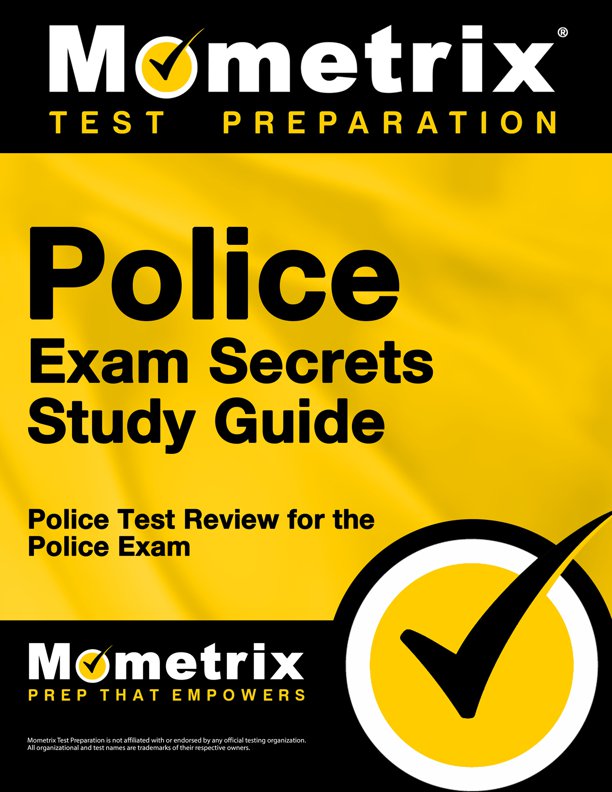
This is a general police officer entrance exam guide, not a test-specific edition. Use it for the reading, writing and reasoning skills these exams share.
Affiliate links We may earn a commission if you buy through these links, at no extra cost to you. Mometrix has no say in what our exam guides cover. How we make money.
The physical ability test
Physical tests come in two families. Job-simulation courses ask you to complete a sequence of tasks — running, climbing, dragging a dummy, a trigger-pull test — inside a time limit; the NYPD's Job Standards Test is a well-known example. Fitness-norm batteries measure push-ups, sit-ups and a timed run against age- and sex-based norms, which many state academies use as entry standards.
Either way, the test is pass/fail and comes early. Train specifically for the format your department uses, starting at least eight to twelve weeks out. Candidates who ace the written exam and fail the run are common.
The oral board
An oral board is a structured interview with a panel of officers and sometimes civilians. Expect questions about why you want the job, how you have handled conflict, ethical dilemmas ("you see a fellow officer take money from a scene") and scenario questions about priorities. Panels score answers against a rubric, so specific examples from your work, military or school life score better than general statements of values.
Prepare five or six true stories that show judgment, honesty, teamwork and calm under pressure. Tell each one as situation, action and result, in under two minutes.
Background investigation and polygraph
The background investigation is usually the longest stage. You will complete a personal history statement listing every address, job, supervisor and school for years back, any arrests or citations, drug use, debts and social media. Investigators verify it with records, references, neighbours and past employers. Many departments add a polygraph that covers the same history.
Disqualifiers vary by department and state, but the one that is close to universal is dishonesty. An old mistake you disclose is often survivable; an omission the investigator finds usually is not.
Psychological and medical evaluations
Under the Americans with Disabilities Act, employers may require medical examinations, including psychological tests that diagnose mental conditions, only after a conditional job offer. Police psychological screening usually combines written personality inventories with an interview by a psychologist. The medical exam covers vision, hearing and general fitness for duty, and drug screening is standard.
Pay and the academy
The Bureau of Labor Statistics reported a median annual wage of $76,290 for police and detectives in May 2024. Academy length is set by each state's officer-standards body and the hiring department and varies widely, so check your state's requirements. Most recruits then spend several months with a field training officer and serve a probationary period, often a year, before they are permanent.
How to prepare for the written exam
Whatever the test, the written stage rewards the same core skills: reading dense procedural text quickly, writing clear factual reports, basic arithmetic, and choosing the professionally sound response in judgment items.
- Identify the test. NPOST, FrontLine, PELLETB or a city exam. Each has a different format and a different scoring model.
- Take a timed diagnostic. Find your weakest section before you study anything else.
- Practise report writing. Write short reports from incident descriptions or videos: who, what, when, where, in chronological order, in plain sentences.
- Drill grammar and spelling daily. These sections are small but easy to improve, and they often carry their own cutoff.
- Aim for rank, not a pass. Where departments rank candidates, every point moves you up the list.
Try four practice questions
Editor-written examples of the arithmetic, grammar, spelling and report-writing styles entry-level police tests use. They are not live exam items.
-
Q1 An officer drives 18 miles in 24 minutes. What is the average speed?
Show answer
Answer: C. 24 minutes is 0.4 hours, and 18 ÷ 0.4 = 45 mph. A quick check: 18 miles in 24 minutes is 3 miles every 4 minutes, so 45 miles in 60 minutes.
-
Q2 Choose the correctly written sentence.
Show answer
Answer: B. “I” is the subject form. Remove “Officer Lee and” to test it: “I responded” is correct, while “me responded” and “myself responded” are not.
-
Q3 The suspect’s ______ was confirmed by two witnesses. Choose the correct spelling.
Show answer
Answer: B. Alibi has one l and one b. Spelling items draw heavily on words officers use in reports.
-
Q4 Which order puts these report facts in the right sequence? (1) The suspect fled on foot. (2) The officer arrived at 1405 hours. (3) The caller reported a break-in at 1358 hours. (4) The officer broadcast a description.
Show answer
Answer: B. Reports run in time order: the 1358 call, the 1405 arrival, the suspect fleeing, then the broadcast. Incident report items reward chronological, factual sequencing.
Frequently asked questions
What test do you take to become a police officer?
It depends on the department. Many use a purchased entry-level exam such as Stanard’s National Police Officer Selection Test (arithmetic, reading comprehension, grammar and incident report writing) or National Testing Network’s FrontLine National (video-based human relations, reading and report writing). California agencies use the POST PELLETB, and large cities such as New York run their own civil-service exams. The job posting names the test.
What is the order of the police hiring process?
Typically: application and minimum qualifications, written exam, physical ability test, oral board interview, background investigation (often with a polygraph), a conditional job offer, psychological and medical evaluations with drug screening, then the academy, field training and probation. Departments vary the order, but psychological and medical exams come after the conditional offer.
What disqualifies you from becoming a police officer?
Standards vary by department and state, but felony convictions, certain misdemeanors such as domestic violence, recent illegal drug use and serious driving offenses are common disqualifiers. Dishonesty during the background investigation is close to universally disqualifying, which is why disclosing past problems is usually safer than leaving them out.
What is a passing score on the police written exam?
There is no single passing score. Agencies using Stanard’s POST set overall or per-section cutoffs or rank candidates; FrontLine agencies set their own section minimums; PELLETB results are T-scores with agency cutoffs commonly between 42 and 50. Where candidates are ranked, a higher score moves you up the hiring list.
How much do police officers make?
The Bureau of Labor Statistics reported a median annual wage of $76,290 for police and detectives in May 2024. Pay varies widely by department, and large departments publish their salary schedules.
Sources
Checked against these primary sources in November 2026. Agencies change their rules without notice, so confirm anything you are about to pay for or sign on the official page.
- Stanard & Associates — National Police Officer Selection Test (POST)
- National Testing Network — FrontLine National law enforcement test
- California Commission on POST
- NYC DCAS — Police Officer exam
- U.S. EEOC — Preemployment disability-related questions and medical examinations
- Bureau of Labor Statistics — Police and Detectives (Occupational Outlook Handbook)