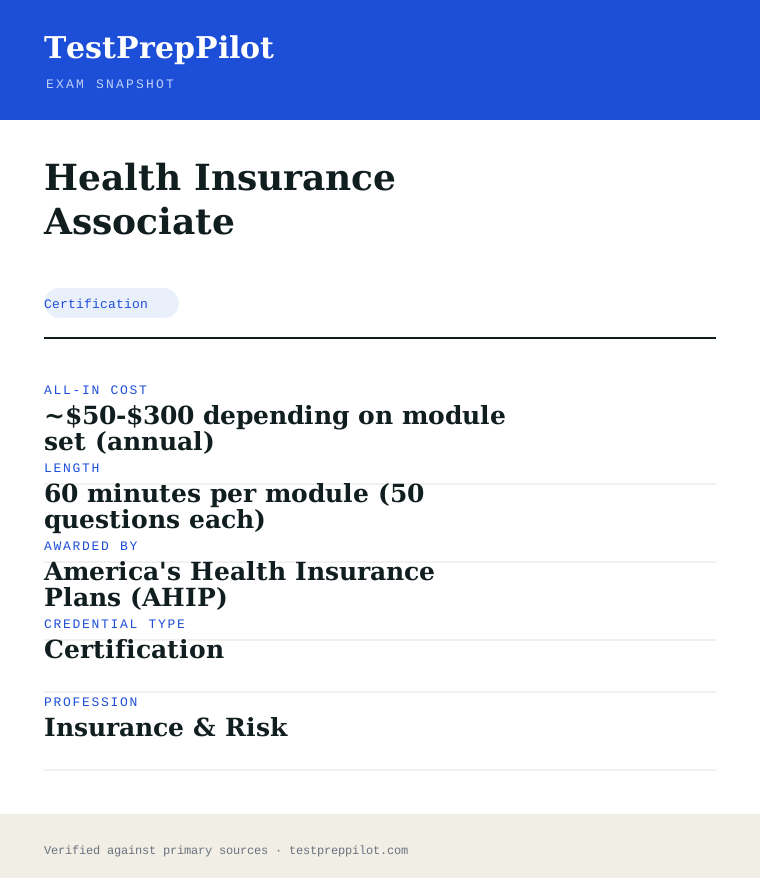
The short version
What is the Health Insurance Associate and is it worth it?
Health Insurance Associate is a professional credential administered by America's Health Insurance Plans (AHIP). It validates job-ready knowledge and skills in the Insurance & Risk field and is used for career entry, advancement, or compliance.
- Recognized credential from America's Health Insurance Plans (AHIP)
- Demonstrates verified competence in Insurance & Risk
- Supports career advancement and may satisfy licensing or employer requirements
What is it?
What exactly is the Health Insurance Associate?
Health Insurance Associate — Insurance & Risk credential from America's Health Insurance Plans (AHIP)
Designation programme covering medical expense products, disability and long-term care insurance, underwriting and claim administration. Offered by America's Health Insurance Plans (AHIP), it is designed for candidates who need to demonstrate verified competence in the Insurance & Risk field. The credential is commonly used for career entry, advancement, regulatory compliance, or employer requirements. Candidates should review the official handbook for eligibility, exam format, and scoring before registering.
The path in brief
- Confirm you meet any eligibility or prerequisites
- Review the official handbook and study materials
- Register and pay through the awarding body or authorized provider
- Schedule and take the exam (test center or online proctoring)
- Receive your score and, if passed, your credential
Before you book
Who is eligible to sit the Health Insurance Associate?
Eligibility varies; many credentials are open to all, while others require coursework, work experience, or sponsorship.
Who it is for: Professionals and candidates seeking to validate Insurance & Risk competence.
The test itself
What is the format of the Health Insurance Associate?
The Health Insurance Associate is administered by America's Health Insurance Plans (AHIP) and runs Up to 2 hours (auto-submits at the deadline) and contains 50 (randomly selected from all five training modules) questions.
| Administered by | America's Health Insurance Plans (AHIP) |
|---|---|
| Questions | 50 (randomly selected from all five training modules) |
| Time limit | Up to 2 hours (auto-submits at the deadline) |
| Pass mark | Passing score set by the awarding body; see the official score report |
| Exam fee | ~$175 (many carriers reimburse or discount to ~$125) |
| Format | Proctored, computer-based (test center or online remote proctoring) |
Content outline
What topics are on the Health Insurance Associate?
The Health Insurance Associate covers 4 content domains.
Weightings come from the official exam outline. Study time is best allocated in roughly these proportions rather than evenly across domains.
- Products & coverage
Topic area tested on the exam; see the official blueprint for the detailed breakdown.
- Underwriting
Topic area tested on the exam; see the official blueprint for the detailed breakdown.
- Regulation & ethics
Topic area tested on the exam; see the official blueprint for the detailed breakdown.
- Claims & risk management
Topic area tested on the exam; see the official blueprint for the detailed breakdown.
The path
How do you register for the Health Insurance Associate?
- 1
Visit the awarding body’s official website and create an account
- 2
Select the credential and review its specific requirements
- 3
Complete any required eligibility (education, experience, or training)
- 4
Pay the registration fee
- 5
Schedule the exam at a test center or online
- 6
Take the exam and receive your results
The fine print
What are the retake and renewal rules for the Health Insurance Associate?
- Proctoring & delivery
- Proctored, computer-based delivery (test center or remote online proctoring), varying by exam.
- Retake policy
- Varies by credential — most bodies permit retakes after a waiting period and full or partial fee.
- Score reporting
- Scores are reported per the body’s timeline, typically electronically after the exam.
- Recertification
- Varies; many credentials require renewal every 2–3 years via continuing education or a recertification exam.
What it pays
How much does this credential pay?
$60,370 median for insurance sales agents (BLS, May 2024)
There is no Bureau of Labor Statistics occupation called "AHIP-certified agent" — the AHIP Health Insurance Associate credential certifies that an agent understands Medicare and health insurance products well enough to sell them compliantly, and the wage question belongs to the occupation the agent performs. The closest official BLS occupation is Insurance Sales Agents, SOC 41-3021, which had a May 2024 median wage of $60,370, with the lowest 10 percent under $30,680 and the highest 10 percent above $131,170. Read the median carefully: compensation for health and Medicare agents is dominated by commissions and renewals, so the BLS wage base understates what producing agents earn, and income varies enormously with product mix and season — Medicare annual election period business concentrates a large share of the year's volume into the fall. BLS counted 453,700 insurance sales agent jobs in 2024 and projects 8 percent growth from 2024 to 2034, faster than the average for all occupations, with about 58,600 openings a year, most from replacement need as experienced agents retire. The honest framing: the AHIP credential is a market-access gate — most carriers require it before a producer may sell their Medicare products — and the wage you benchmark is the agent occupation, earned only while the credential and the carrier appointments are current.
| Measure | Figure | Source / note |
|---|---|---|
| Median annual wage, insurance sales agents | $60,370 | BLS OOH, SOC 41-3021, May 2024 |
| Lowest 10 percent | Under $30,680 | BLS OOH, SOC 41-3021, May 2024 |
| Highest 10 percent | Above $131,170 | BLS OOH, SOC 41-3021, May 2024 |
| Projected openings per year | ~58,600 | BLS OOH, SOC 41-3021, 2024-2034 |
Job growth.BLS projects 8 percent growth for insurance sales agents from 2024 to 2034, about 58,600 openings per year.
Source: BLS Occupational Outlook Handbook - Insurance Sales Agents
Your odds
What are the pass rates?
AHIP sets an 80% passing standard per module and does not publish cohort pass rates
AHIP does not publish cohort pass rates for its certification exams, so any percentage you see online is a third-party estimate, not official data. What AHIP does publish is the passing standard and the format: each module exam contains 50 multiple-choice questions with a 60-minute time limit, and a candidate must answer at least 80 percent correctly to pass the module. The certification is delivered online and is typically taken at home, which makes it structurally different from proctored credential exams: the pass standard is meaningful because the material is product-specific and current-year, and because carriers independently audit producer certification before annual election period appointments. Two things matter more than pass-rate statistics. First, the certification is renewed annually — AHIP's health insurance certifications are year-specific, so a certification earned for one plan year must be renewed for the next, with the exams rebuilt around that year's product rules, premiums and formularies. Second, most Medicare Advantage and Part D carriers require their own product-specific training and exams in addition to AHIP's core certification, so the effective certification burden for a working agent includes both layers. The practical implication: study the current-year material, not last year's, and budget a dedicated study block each fall.
Read this before quoting the number.AHIP publishes the 80% module standard but no cohort pass rates; any percentage circulating online is a third-party estimate.
Source: AHIP - Health Insurance Associate certification program
Your schedule
How long should I study for it?
15-30 hours per certification cycle of focused study
The AHIP certification is modular: candidates complete the core Health Insurance Associate curriculum and then the product-specific modules relevant to their work — Medicare Advantage, Medicare Part D, and in some cases supplemental or marketplace products. Each module's exam is 50 questions in 60 minutes with an 80 percent pass line, and the material is delivered through AHIP's online learning portal, which includes the required reading and practice assessments. A realistic plan is 15 to 30 hours per certification cycle depending on how many product modules you need, concentrated in the six weeks before the Annual Election Period (AEP) opens, because carriers expect certification in place before the selling season. Week one should cover the Medicare framework: the parts of Medicare, enrollment periods, eligibility and the government's marketing rules. Week two should cover the product-specific module: Medicare Advantage plan design, cost-sharing, star ratings and the annual notice of change. Week three should cover Part D: formularies, tiers, the coverage gap and the late-enrollment penalty. The final week should be practice assessments and a full run of each module exam at the 60-minute, 80-percent standard. Because the material is current-year specific, study the live portal content rather than archived prep from prior years.
- Week 18
Medicare framework
- Parts A/B/C/D and enrollment periods
- Eligibility, penalties and the federal marketing rules
- AHIP core curriculum readings and practice quiz
- Week 28
Medicare Advantage module
- Plan design, cost sharing and extra benefits
- Star ratings and the annual notice of change
- 50-question timed practice at the 80% standard
- Week 38
Part D module
- Formularies, tiers and the coverage gap
- Late-enrollment penalty and creditable coverage
- Second module exam practice
- Week 46
Final certification
- Re-read weak sections in the live portal
- Retake practice assessments to 90%+
- Sit each required module exam
Adjusting the pace
Medicare-only producer.Core + Medicare Advantage + Part D is the standard stack; skip marketplace modules.
Multiline agent.Add marketplace or supplemental modules; allocate a week per additional module.
How to study
How do I prepare most effectively?
The dominant strategy for AHIP is to use the official portal as the primary source, because the certification is current-year specific and third-party summaries routinely lag the live material. Work each module's required reading once, then take the built-in practice assessments; the practice items mirror the exam phrasing closely, so performance on them is the best readiness signal. Second, treat the 80 percent standard as a target, not a floor for comfort: aim for 90 percent on practice before sitting, because the real exam includes item variants you have not seen. Third, budget for the annual renewal cycle: the certification is year-specific, so schedule a recurring fall study block rather than treating it as a one-time event, and register early because carrier appointment deadlines cluster before AEP. Fourth, do not rely on memory from prior years — plan design, formularies and the federal rules change annually, and the exam is rebuilt around the current year's products. Finally, coordinate with your carrier: many carriers require their own product-specific exams on top of AHIP, and completing those in the same window keeps your appointment active for the selling season.
Use the official portal
Third-party summaries lag the current-year material; the portal is the source of truth.
Aim for 90% on practice
The real exam adds unseen variants; comfort at 80% is not comfort at all.
Plan the annual cycle
The certification is year-specific; schedule the fall study block every year.
Do not reuse prior-year prep
Plan design and rules change annually; study the live content.
Stack carrier exams
Complete any carrier product exams in the same window to keep your appointment active.
What to buy
Which study resources are worth paying for?
AHIP prep is unusual because the certification content is the course: the required reading, practice assessments and exams all live inside AHIP's portal, and the certification fee covers access. There is therefore no meaningful market of third-party prep for the core credential the way there is for, say, the CISSP; the third-party content that exists is mostly broker-oriented training by carriers and field marketing organizations, which is valuable for product strategy but not a substitute for the portal material. Free options include Medicare.gov's official publications (the "Medicare & You" handbook and the federal marketing guidelines), which are genuinely useful for the Medicare framework, and carrier training portals, which many carriers open to appointed producers at no charge. A defensible budget is the certification fee itself plus zero to a few hundred dollars for optional broker training. Prices below are list prices as of mid-2026 and change annually; we rank nothing by commission.
| Resource | Price | Format | Best for |
|---|---|---|---|
| AHIP portal + exams | Fee varies by module set | Online readings, practice and exams | The required path; budget for annual renewal |
| Medicare.gov publications | Free | Official handbooks and rules | The Medicare framework and marketing rules |
| Carrier training portals | Often free to appointed producers | Product-specific online training | The second certification layer carriers require |
| Field marketing organization training | $0-$300 | Broker workshops and materials | Product strategy and lead-gen, not exam prep |
List prices as of mid-2026, subject to change; AHIP fees vary by module set and year; no commission or affiliate ranking is implied.
Avoid these
What mistakes do candidates most often make?
The most common AHIP mistake is studying archived material: candidates who prepare from last year's course or a broker's older deck discover on exam day that the current-year rules have changed, and the exam is rebuilt around the current year's products. The fix is to work only the live portal content. The second mistake is treating the 80 percent pass line as a comfort zone: candidates who pass practice at 80 percent sit the real exam and find the unseen variants push them under the line; target 90 percent on practice. Third, many agents schedule the exams at the last minute and then miss carrier appointment deadlines, because the certification must be in place before AEP selling begins; plan the fall block early. Fourth, candidates forget that most carriers layer their own product exams on top of AHIP and are surprised by the extra burden; check your carrier's requirements before you start. Finally, some agents treat the certification as a one-time event and let it lapse, losing carrier appointments mid-year; the annual renewal is part of the job.
✕Studying prior-year material
✓The exam is rebuilt each year; work only the live portal content.
✕Aiming for 80% on practice
✓Target 90%+; unseen exam variants push borderline candidates under the line.
✕Waiting until AEP to certify
✓Start the fall study block early; carrier deadlines cluster before the selling season.
✕Forgetting carrier-layer exams
✓Check carrier product-training requirements before you begin.
✕Letting the credential lapse
✓The certification renews annually; schedule the renewal like a recurring appointment.
What you'll face
What question types will I see?
Each AHIP module exam is 50 multiple-choice questions delivered online with a 60-minute time limit and an 80 percent passing standard. The items test current-year product rules and federal marketing requirements: plan design features, cost-sharing, enrollment periods, penalties, and what an agent may or may not say in marketing materials and to beneficiaries. Many items are scenario-based — a beneficiary profile or a marketing situation — asking for the correct rule, the compliant action, or the correct plan feature. The samples below are editor-written illustrations of the published curriculum, not live exam items; they show the format and the current-year specificity of the questions.
Medicare Advantage and Part D features, cost-sharing, star ratings and benefits.
Enrollment periods, eligibility and the late-enrollment penalty.
What agents may say, disclose and use in beneficiary marketing.
Try these
Q1A beneficiary with Original Medicare asks an agent whether a Medicare Advantage plan can charge a higher monthly premium than the Part B premium. The correct statement is:
Answer:A
Medicare Advantage plans are private plans that set their own monthly premiums, which can be above, equal to, or below the Part B premium depending on the plan. The other statements misstate how private plan pricing works.
Q2A beneficiary who does not enroll in a Part D plan when first eligible and has no creditable coverage will generally:
Answer:A
The Part D late-enrollment penalty is added to the monthly premium for beneficiaries who go without creditable drug coverage after their initial enrollment period. Permanent exclusion, penalty-free late enrollment and automatic free enrollment each misstate the penalty rule.
Q3During a marketing call with a beneficiary, an agent may:
Answer:A
Agent marketing must follow the federal marketing rules, including required disclosures and approved sales presentations. Unsolicited contact limits, disclosure requirements, and the prohibition on cash or other inducements make the other options non-compliant.
Samples are editor-written illustrations of the published curriculum, not live exam items.
The big day
What should I expect on exam day?
AHIP module exams are taken online through the AHIP portal at a time you choose, so "exam day" is a block of time you schedule rather than a testing-centre appointment. Confirm your system meets the portal requirements, close other applications, and budget a full 60 minutes per module exam with the 80 percent standard in mind. The exam is not proctored in the traditional sense, but it is current-year locked: you must complete the certification within the plan year it serves, and your certificate is dated for that year. Before you start, have your AHIP account, the module list you need for your carriers, and a quiet workspace ready; notes are not prohibited but the material is specific enough that retrieval beats lookup. On completion you see your result immediately, and the certificate is available in your account. Coordinate the timing with your carrier: carriers require certification before AEP appointments are active, so schedule the exams with enough buffer for any retake. The afterwards: save the certificate, note the renewal month, and add the annual renewal to your calendar before you move on to carrier product training.
Bring
- Reliable computer with current browser
- AHIP account login
- 60 uninterrupted minutes per module
Leave at home
- Distractions — phone notifications, second screens with unrelated content
How the day runs
Rules in the room
- The exam is current-year specific — it serves the plan year you are certifying for
- Each module allows 60 minutes; the clock is per module
- Carrier deadlines cluster before AEP — schedule with buffer for retakes
Afterwards.On a pass, your certificate is active for the plan year; complete carrier product training and keep the renewal month on your calendar. On a fail, retake the module after additional portal review.
Reference
What are the key facts about the Health Insurance Associate?
Health Insurance Associate is a certification credential; awarded by America's Health Insurance Plans (AHIP); the exam fee is ~$175 (many carriers reimburse or discount to ~$125); typical preparation is 60 minutes per module (50 questions each); holders typically earn $35,000-$100,000.
| Credential | Health Insurance Associate |
|---|---|
| Abbreviation | HIA |
| Type | Certification |
| Profession | Insurance & Risk |
| Specialty | Life & Health Designations |
| Awarded by | America's Health Insurance Plans (AHIP) |
| Difficulty | Regulated |
| Typical prep time | 60 minutes per module (50 questions each) |
| All-in cost | ~$50-$300 depending on module set (annual) |
| Typical salary range | $35,000-$100,000 |
| Credential | Health Insurance Associate |
| Awarding body | America's Health Insurance Plans (AHIP) |
| Exam format | Proctored, computer-based |
| Validity | Valid for one plan year — annual recertification required. |
| Languages | Varies — see awarding body |
| Scope | National / Multi-state |
Real questions
Frequently asked questions about the Health Insurance Associate
How do I register for the Health Insurance Associate exam?
Register through America's Health Insurance Plans (AHIP)'s official portal or an authorized test provider (e.g., Pearson VUE or Prometric where applicable). Create an account, select the exam, pay the fee, and schedule a date.
How much does the exam cost?
Fees vary by location and currency. Confirm the current fee on the official registration page before scheduling.
How long is the credential valid, and how do I renew?
AHIP Medicare certification is valid for one plan year and must be renewed annually by completing the updated training and exam for the new plan year; the content changes each year to track CMS rules, so last year's pass does not carry over.
What if I do not pass?
Most bodies allow retakes after a waiting period and payment of the full or partial fee. Check America's Health Insurance Plans (AHIP)'s retake policy before rescheduling.
How do I register for a America's Health Insurance Plans (AHIP) credential?
Register through the official website, select your exam, pay the fee, and schedule a date.
How do I renew a credential?
Renewal policies vary by credential; check the specific program page for requirements and cycles.
In short
Is the Health Insurance Associate worth it?
- Health Insurance Associate is awarded by America's Health Insurance Plans (AHIP).
- Validates job-ready competence in Insurance & Risk.
- Registration is through the awarding body or an authorized test provider.
- Renewal and retake policies vary — confirm before scheduling.
Trust
Where does this information come from?
Everything above is taken from the awarding body's own published material. Fees, question counts and domain weights are revised regularly — check the official page before you pay.
Research confidence: low · Last reviewed 2026-08