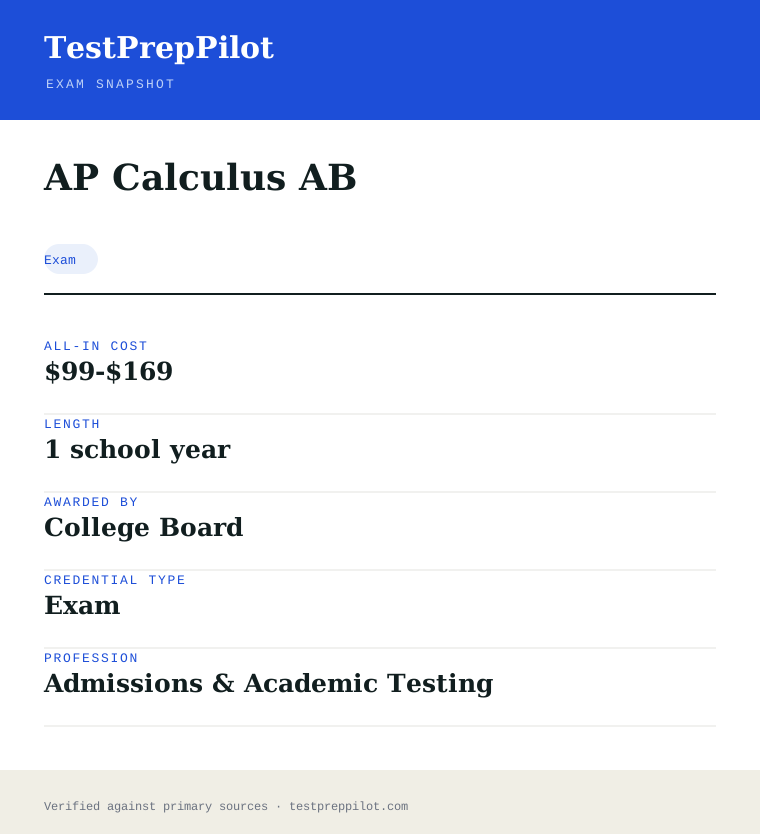
The short version
What is the AP Calculus AB and is it worth it?
AP Calculus AB is a hybrid digital exam: 42 multiple-choice questions in 100 minutes and six free-response questions in 90 minutes. Scored 1-5, a 3 generally earns Calculus I credit.
- Equivalent to a first-semester college calculus course
- Clear, stable format with calculator and non-calculator portions
- Strongly valued for STEM, business, and economics majors
- Free official practice through AP Classroom
What is it?
What exactly is the AP Calculus AB?
Bank first-semester college calculus credit with limits, derivatives, and integrals.
AP Calculus AB covers the material of a first-semester college calculus course: limits, derivatives, integrals, and the Fundamental Theorem of Calculus. The exam is hybrid digital, with 42 multiple-choice questions in Bluebook and six free-response questions answered by hand. A 3 typically earns credit for Calculus I at public universities, while engineering and selective schools often expect a 4 or 5.
The path in brief
- Join AP Calculus AB via My AP
- Master limits, derivatives, integrals
- Practice FRQs with and without a calculator
- Take progress checks
- Sit the hybrid digital exam in May
Before you book
Who is eligible to sit the AP Calculus AB?
Who it is for: High-school students needing college calculus for STEM or business
The test itself
What is the format of the AP Calculus AB?
The AP Calculus AB is administered by School-administered, Bluebook + paper FRQ and runs 3 hours 10 minutes, contains 42 multiple choice + 6 free response questions and requires 3 (1-5 scale) to pass.
| Administered by | School-administered, Bluebook + paper FRQ |
|---|---|
| Questions | 42 multiple choice + 6 free response |
| Time limit | 3 hours 10 minutes |
| Pass mark | 3 (1-5 scale) |
| Exam fee | $99 (US) / $129 (intl) |
| Format | Hybrid digital |
Content outline
What topics are on the AP Calculus AB?
The AP Calculus AB is weighted across 8 domains; the largest are Unit 1: Limits and Continuity (10-15%), Unit 2: Differentiation (10-15%), Unit 3: Composite and Implicit Functions (5-10%).
Weightings come from the official exam outline. Study time is best allocated in roughly these proportions rather than evenly across domains.
- Unit 1: Limits and Continuity 10-15%
Definition, properties, continuity
- Unit 2: Differentiation 10-15%
Definitions and basic rules
- Unit 3: Composite and Implicit Functions 5-10%
Chain rule, implicit differentiation
- Unit 4: Contextual Applications 10-15%
Related rates, motion
- Unit 5: Analytical Applications 15-20%
Extrema, concavity
- Unit 6: Integration 15-20%
Accumulation, FTC
- Unit 7: Differential Equations 5-10%
Slope fields, separation
- Unit 8: Applications of Integration 10-15%
Area, volume
Money & time
How much does the AP Calculus AB cost?
For the AP Calculus AB, the exam fee is $99 (US) / $129 (intl); the all-in cost is typically $99-$169; most candidates spend 1 school year preparing.
Cost breakdown
| AP exam fee (US, territories, Canada, DoDEA) | $99 |
|---|---|
| AP exam fee (international) | $129 |
| Late order or unused/canceled exam | $40 |
| Fee reduction for eligible students | -$37 |
| Prep materials (optional) | $0-$40 |
| Typical total | $99 US / $129 intl (eligible students pay ~$53 / ~$83); late or canceled adds $40 |
Fees are the 2025-26 AP charges. Schools may add a local administrative fee; the College Board fee reduction lowers the base by $37.
Timeline
- Enroll in the AP course Fall
- Study the 8 units Aug-May
- Practice calculator and non-calculator FRQs 2-3 months
- Take the hybrid exam May
- Receive scores Early July
Typical prep: 1 school year
The path
How do you register for the AP Calculus AB?
- 1
Create a College Board account10 minutes
Register at collegeboard.org with your legal name exactly as it appears on the photo ID you will bring on test day. One account covers the SAT, the PSAT-related assessments, AP and BigFuture.
- 2
Choose a weekend SAT date or let your school register you20 minutes
The SAT is booked directly by the student for weekend national administrations. PSAT 8/9, PSAT 10 and the PSAT/NMSQT are ordered and scheduled by the school, so for those you speak to your counselor rather than registering yourself.
- 3
Pay the fee or claim a fee waiver5 minutes
The US SAT registration fee is 68 dollars; international test takers add a regional fee of 43 dollars and, at some centres, a further test centre fee. Eligible US students get the SAT free through a counsellor-issued fee waiver, which also unlocks unlimited free score sends.
- 4
Install Bluebook and complete exam setup30 minutes
Download the free Bluebook app to your own laptop or tablet, or use a school-managed device, then run exam setup in the five days before test day to download the test and get your admission ticket.
Students who skip exam setup can be turned away or delayed at check-in.
- 5
Practise with Bluebook full-length tests and Khan Academy4 to 12 weeks
Six free adaptive full-length practice tests sit inside Bluebook, and Official Digital SAT Prep on Khan Academy is free and keyed to the same content domains.
- 6
Test, then review scores onlinetest day
Arrive with your admission ticket, acceptable photo ID and a charged device. Scores post to your College Board account, typically within about two weeks for weekend SAT dates.
The fine print
What are the retake and renewal rules for the AP Calculus AB?
- Proctoring & delivery
- All SAT Suite tests are taken in Bluebook on a laptop or tablet, in a school or an authorised weekend test centre, under a live human proctor. There is no at-home option. Bluebook locks the device, and a built-in Desmos graphing calculator and formula sheet are available throughout the Math section; you may also bring your own approved non-CAS calculator.
- Retake policy
- There is no limit on SAT attempts and no mandatory waiting period beyond the eight national dates offered each year. The PSAT-related assessments are given once per school year per grade band and are not retaken on demand. Most selective colleges superscore across SAT sittings, taking your best Reading and Writing score and your best Math score.
- Score reporting
- The SAT reports a 400 to 1600 total built from two 200 to 800 section scores. The PSAT/NMSQT and PSAT 10 report 320 to 1520 with 160 to 760 sections, and the PSAT 8/9 reports 240 to 1440 with 120 to 720 sections, so results across the suite sit on one comparable scale. PSAT/NMSQT reports also carry an NMSC Selection Index of 48 to 228.
- Recertification
- SAT Suite scores do not expire and never need renewal, but colleges commonly ask for a score from within the last five years and most students test in the spring of eleventh grade and again in the autumn of twelfth grade. Only a PSAT/NMSQT taken in eleventh grade enters the National Merit competition.
- Refunds & rescheduling
- Cancelling an SAT registration by the change deadline costs 34 dollars; cancelling after the deadline but before test day costs 44 dollars. Changing test centre costs 34 dollars, and late registration costs 38 dollars. Fee-waiver students are not charged for cancellation or late registration.
Context
The digital SAT Suite compared
| Assessment | Grades | Score scale | Length | |
|---|---|---|---|---|
| PSAT 8/9 | 8 and 9 | 240 to 1440 | 2h 14m | |
| PSAT 10 | 10 (spring) | 320 to 1520 | 2h 14m | |
| PSAT/NMSQT | 10 and 11 (autumn) | 320 to 1520 | 2h 14m | |
| SAT | 11 and 12 | 400 to 1600 | 2h 14m |
What it pays
How much does this credential pay?
AP Calculus AB has no direct salary outcome — its value is college credit and placement, and the earnings impact flows through the bachelor’s-degree premium and STEM and quantitative career paths.
The salary answer for AP Calculus AB is the college-credit story shared by AP exams, with a STEM-weighted twist: the BLS does not publish a wage for AP scores because the AP program is a college-credit and placement system, but calculus is the gateway course for STEM, engineering, and quantitative majors, and those majors carry some of the highest starting salaries in the BLS data. A qualifying AP Calculus AB score (3 or higher, depending on the college) earns credit toward the first-semester college calculus course, which places students directly into Calculus II and keeps STEM majors on schedule — and a 4 or 5 at selective schools can satisfy the calculus requirement entirely, saving thousands in tuition and a semester of schedule pressure. AP Calculus AB is one of the largest AP exams, with roughly 270,000 test-takers per year, and colleges across the STEM spectrum accept it for placement and credit. The exam is 3 hours 15 minutes: a multiple-choice section (45 questions, 105 minutes, with 30 calculator-free and 15 calculator-permitted) and a free-response section (6 questions, 90 minutes, with 2 calculator-permitted), scored 1-5. The honest caveat is that credit policies vary: engineering and pre-med programs sometimes cap AP math credit or require a placement exam, and a 3 may place rather than credit at selective schools, so the score’s value depends on the specific college’s policy. For a candidate asking whether AP Calculus AB pays, the direct answer is that it pays through credit, placement, and the STEM pathway it opens — the highest-leverage AP exam for students heading into quantitative majors.
| Measure | Figure | Source / note |
|---|---|---|
| Annual test-takers | ~270,000 | One of the largest AP exams (College Board) |
| Score scale | 1-5 | 3+ typically qualifies for credit; 4-5 at selective schools |
| Exam length | 3h15m | 45 MC (105 min) + 6 FRQs (90 min) |
| Salary impact | Indirect | College credit and placement; gateway to STEM majors |
Job growth.AP Calculus AB volume tracks the growth of the AP program and STEM enrollment; it remains one of the most-taken AP exams.
Your odds
What are the pass rates?
The College Board publishes AP Calculus AB score distributions, not pass rates; in recent cycles roughly three-fifths of test-takers scored 3+ (qualifying), with 4 and 5 concentrated in the top quarter.
The direct answer on pass rates requires precision: the College Board does not publish a "pass rate" for AP exams because scores are reported on a 1-5 scale and each college defines what qualifies, but the College Board does publish the annual score distribution for every AP subject, which is the closest published statistic. For AP Calculus AB in recent cycles, roughly three-fifths of test-takers scored 3 or higher — the score most colleges treat as qualifying — with the 4 and 5 scores concentrated in the top quarter of test-takers; the exact percentages shift modestly by year, and the College Board’s annual report is the authoritative source. The exam structure is fixed and published: 45 multiple-choice questions in 105 minutes (50 percent of the score, split into a calculator-free section of 30 questions and a calculator-permitted section of 15) and 6 free-response questions in 90 minutes (50 percent, with 2 calculator-permitted), scored 1-5, with a scientific or graphing calculator permitted in the designated sections. The content covers the first-semester college calculus course: limits and continuity, differentiation, applications of derivatives, integration, and the Fundamental Theorem, plus the analytical and numerical approaches the course requires. The practical read on difficulty: AP Calculus AB is a math-exam-with-writing — the free responses require justifying answers with the reasoning the scoring expects (e.g., citing the Fundamental Theorem or the conditions for a relative extremum) — and candidates who practice the free-response justification language score higher than candidates who compute correctly but write weak justifications. Because the credit value depends on the college’s policy, the smart approach is to check the target colleges’ AP credit tables and study the free-response justification formats deliberately.
Read this before quoting the number.The College Board publishes score distributions, not pass rates; whether a 3, 4, or 5 "passes" depends on each college’s AP credit policy.
Source: College Board AP score distribution report and AP Calculus AB exam description
Your schedule
How long should I study for it?
60-90 hours over 10-16 weeks of focused study
An efficient AP Calculus AB study plan is 60-90 hours over 10-16 weeks, because the exam is a skill-and-justification test and the fastest score gains come from mastering the differentiation and integration techniques while drilling the free-response justification formats that carry half the score. The College Board course and exam description is the scope map: limits and continuity, differentiation (including the chain rule, implicit differentiation, and related rates), applications of derivatives (optimization, curve sketching), integration and the Fundamental Theorem, and applications of integrals (area, volume), with the multiple-choice section (45 questions, 105 minutes) and the free-response section (6 questions, 90 minutes) each worth 50 percent. The study window should split into technique mastery (weeks 1-8) and free-response justification drilling (weeks 9-12), followed by full practice exams (weeks 13-16): the free responses require not just the answer but the justification — citing the derivative rules, the conditions for extrema, or the Fundamental Theorem — and candidates who practice that language score higher. Candidates taking the course in school should budget the lower end; self-studying candidates should budget the upper end and add a structured review book or course. The final three weeks should be full practice exams at the real format — 45 MC in 105 minutes and 6 FRQs in 90 minutes, with the calculator policy — because the pacing and the justification writing are the two things candidates underestimate. A mid-plan checkpoint helps: after the technique-coverage weeks, take a calculator-free multiple-choice set and one free response to measure whether the routines are automatic, because the exam rewards speed on the routine items and the remaining weeks should target the weak techniques before the justification drilling phase. Candidates who keep a running error log during coverage report faster gains in the final practice-exam phase.
- Week 1-424
Limits and differentiation
- Study limits, continuity, and the definition of the derivative
- Master differentiation rules: product, quotient, chain, implicit
- Practice related-rates and tangent-line problems
- Week 5-824
Applications and integration
- Study optimization, curve sketching, and the Mean Value Theorem
- Master integration: antiderivatives, u-substitution, and the Fundamental Theorem
- Practice area and volume problems
- Week 9-1220
Free-response justification
- Drill the six FRQ formats and the justification language the scoring expects
- Practice citing conditions: extrema, concavity, and the FTC
- Do a full 45-MC + 6-FRQ practice exam
- Week 13-1618
Full exams and readiness
- Take two more full practice exams scoring 3+ then 4+
- Re-drill the missed techniques and justifications until clean
- Confirm the exam-day logistics, calculator, and registration
Adjusting the pace
Taking the course in school.Budget the lower end; weight time toward the free-response justification formats.
Self-study.Budget the upper end and add a structured review book or course for the technique sequence.
How to study
How do I prepare most effectively?
The dominant prep strategy for AP Calculus AB is technique mastery plus free-response justification drilling, because the exam rewards both correct computation and the reasoning language the scoring expects, and candidates who practice the justification formats outperform those who only drill computational problems. First, use the College Board course and exam description as the checklist: the units, the calculator policy, and the exam formats are published, and studying the technique sequence — limits to derivatives to integrals — in order is the highest-yield plan. Second, master the differentiation and integration techniques until they are automatic: the multiple-choice section rewards speed, and candidates who can differentiate and integrate routine functions quickly leave time for the hard items. Third, drill the free-response justification language deliberately: the scoring expects candidates to cite the rules and conditions (the derivative definition, the chain rule, the Mean Value Theorem conditions, the Fundamental Theorem), and practicing that language against past College Board FRQs with their scoring guidelines is the fastest way to raise the FRQ score. Fourth, practice the calculator-permitted items with the approved calculator, because efficiency on the calculator sections saves time for the calculator-free work. Fifth, run full practice exams at the real timing — 45 MC in 105 minutes and 6 FRQs in 90 minutes — because the pacing and the writing load are the constraints candidates underestimate. Finally, confirm the target colleges’ AP credit policies, because the value of a 3 vs a 5 depends on where the score is sent, and STEM programs often have specific math placement policies. A further high-yield tactic is to build a formula and justification cheat-sheet during study — derivative rules, the FTC, the conditions for extrema and concavity — because the act of writing it consolidates the material and the sheet becomes the final review list.
Master techniques until automatic
The MC section rewards speed; drill differentiation and integration routines.
Drill the justification language
The FRQs are scored on the reasoning — cite rules and conditions explicitly.
Practice with the approved calculator
Efficiency on calculator sections saves time for calculator-free work.
Use past FRQs and scoring guidelines
College Board materials show exactly what the justifications must include.
Build a cheat-sheet during study
Writing rules and conditions consolidates the material and becomes the final review list.
What to buy
Which study resources are worth paying for?
AP Calculus AB prep resources split into the College Board official set, review books, and online courses, and the buying logic is anchored by the official materials because the College Board publishes the course and exam description, past free-response questions, scoring guidelines, and sample questions for free. The official free set — the CED and the past FRQs with scoring guidelines — defines the content and the justification standards precisely. Review books from major publishers, roughly $20-40, add structured technique coverage and practice exams, which helps both course-takers and self-studiers. Online courses and question banks, $30-100, add video instruction and problem drilling, which helps self-studying candidates who want structure and worked examples. The footnote that anchors the comparison: prices below are list prices as of mid-2026 and change frequently, and we rank nothing by commission. The exam fee is about $99 per AP exam (plus any school or state fees), with fee reductions available for eligible students. A cheap readiness check is the free sample questions and one past FRQ set from the College Board before buying anything, because candidates who took the course often need only the review book and full practice exams. Candidates should also verify the school’s AP exam registration process and deadline, because late registration fees are a common avoidable cost. The well-regarded review books track the current course framework and include full practice exams at the real timing, and candidates should prefer an edition published after the most recent course update; the online courses that include worked free-response solutions add the most value because the justification language is where the score is won, and the free official materials should always come first.
| Resource | Price | Format | Best for |
|---|---|---|---|
| College Board official materials | Free | CED + past FRQs + scoring guides | The authoritative content and scoring standards |
| AP Calculus AB review book | $20-40 | Book with technique reviews and practice | Structured coverage for any candidate |
| Online course / question bank | $30-100 | Video + problem drilling | Self-studiers wanting worked examples |
| AP exam registration | ~$99 | School/College Board | The real exam; fee reductions available |
List prices as of mid-2026 and change frequently; we rank nothing by commission. The AP exam fee is ~$99 with reductions for eligible students.
Avoid these
What mistakes do candidates most often make?
The most common mistake on AP Calculus AB is computing correctly but writing weak justifications on the free responses, because the scoring rewards the reasoning language — citing derivative rules, the Mean Value Theorem conditions, or the Fundamental Theorem — and candidates who give bare answers lose most of the credit; the second is mis-using the calculator, either relying on it in the calculator-free section or failing to practice the calculator-permitted items. A third recurring error is under-practicing related rates and optimization, which are high-frequency free-response topics with a checklist structure (diagram, rates, equation, differentiate, evaluate). Candidates also routinely mis-time the exam, spending too long on the calculator-free multiple-choice items and rushing the FRQs. Another pattern is skipping the justification practice for existence conditions — the continuity and differentiability conditions behind the MVT and extrema — which the FRQ scoring expects. Finally, some candidates never run a full practice exam at the real 3h15m format, so the pacing and the writing load surprise them on test day. A further recurring error is dropping the differential when working related rates or failing to include units in application answers, which costs partial credit the scoring would otherwise award; others mis-apply the Fundamental Theorem by evaluating antiderivatives at the wrong bounds, and some leave the calculator-free section items blank instead of attempting the algebra, when partial-credit show-your-work items reward any correct step. A further recurring error is dropping the differential when working related rates or failing to include units in application answers, which costs partial credit the scoring would otherwise award; others mis-apply the Fundamental Theorem by evaluating antiderivatives at the wrong bounds, and some leave the calculator-free section items blank instead of attempting the algebra, when partial-credit show-your-work items reward any correct step. Candidates who run full practice exams at the real 3h15m timing find the justification writing manageable when the technique routines are automatic.
✕Computing without justifications
✓Practice citing the rules and conditions the FRQ scoring expects; the reasoning is most of the credit.
✕Mis-using the calculator
✓Practice the calculator-permitted items with the approved calculator; know which section allows it.
✕Under-practicing related rates and optimization
✓Drill the checklist structure: diagram, rates, equation, differentiate, evaluate.
✕Mis-pacing the exam
✓Practice the 45-MC + 6-FRQ timing; leave time for the justification writing.
✕Skipping existence-condition practice
✓Know the continuity and differentiability conditions behind the MVT and extrema; the scoring expects them.
What you'll face
What question types will I see?
The AP Calculus AB exam is 3 hours 15 minutes: 45 multiple-choice questions in 105 minutes (50 percent) and 6 free-response questions in 90 minutes (50 percent), scored 1-5. The multiple-choice section is split into a calculator-free part (30 questions) and a calculator-permitted part (15 questions); the free-response section has 2 calculator-permitted and 4 calculator-free questions. The content covers limits, differentiation, applications, integration, and the Fundamental Theorem. The samples below illustrate three formats — a calculator-free MC item, a related-rates FRQ, and an integration FRQ. The sample items are editor-written illustrations of the published format, not live test items. The calculator-free multiple-choice items test limits, derivatives, and antiderivatives computable by hand; the calculator-permitted items add numerical work; and the free responses cover the full range — limits and continuity, differentiation with justification, related rates, optimization, area and volume with the Fundamental Theorem, and the analytical reasoning the scoring expects. The justification requirements are published in the scoring guidelines, and candidates should practice writing them explicitly. The calculator-free multiple-choice items test limits, derivatives, and antiderivatives computable by hand; the calculator-permitted items add numerical work; and the free responses cover the full range — limits and continuity, differentiation with justification, related rates, optimization, area and volume with the Fundamental Theorem, and the analytical reasoning the scoring expects. The justification requirements are published in the scoring guidelines, and candidates should practice writing them explicitly — citing the derivative rules, the Mean Value Theorem conditions, and the Fundamental Theorem — because the reasoning language is most of the free-response credit.
Limits, derivatives, and integrals computable by hand.
Diagram, rates, equation, differentiate, and evaluate with justification.
Compute an integral and justify with the Fundamental Theorem; often an accumulation or area problem.
Try these
Q1Compute the limit: limit as x approaches 3 of (x^2 - 9) / (x - 3).
Answer:C
Factor the numerator: x^2 - 9 = (x - 3)(x + 3). Cancel the (x - 3) factor to get x + 3, which evaluates to 6 at x = 3. The limit exists and equals 6 even though the original expression is undefined at x = 3.
Q2Related-rates FRQ (illustrated): "A balloon is being inflated at a rate of 10 cubic feet per minute. Find the rate of change of the radius when the radius is 2 feet."
Answer:B
The related-rates format rewards the full solution: the volume formula, implicit differentiation with respect to time, substitution of the given rate and radius, and solving for dr/dt with the units. A bare number earns little credit.
Q3Evaluate the definite integral from 1 to 4 of (2x + 1) dx.
Answer:B
The antiderivative is x^2 + x. Evaluate at the bounds: (16 + 4) - (1 + 1) = 20 - 2 = 18. The Fundamental Theorem gives the definite integral as 18.
Samples are editor-written illustrations of the published format, not live test items.
The big day
What should I expect on exam day?
The AP Calculus AB exam is a paper-and-pencil test administered at your school on the College Board’s AP exam schedule, and the direct exam-day answer is that you will sit 45 multiple-choice questions in 105 minutes (30 calculator-free + 15 calculator-permitted), then 6 free-response questions in 90 minutes, for a 3h15m exam scored 1-5, with scores released in July. Arrive with your school-issued admission ticket, a government-issued or school photo ID, and the permitted materials — No. 2 pencils for the multiple-choice section, black or blue pens for the free-response section, and an approved scientific or graphing calculator, per the College Board’s current rules; no notes or electronic devices are permitted. The exam begins with the multiple-choice section, then a brief break, then the free-response section; the proctor enforces strict timing, and the calculator is allowed only in the designated parts. Expect a controlled testing environment with other AP candidates; follow the proctor’s instructions exactly. In the multiple-choice section, pace to finish with review margin; in the free-response section, budget roughly 15 minutes per question and write the justifications the scoring expects — show the derivatives, the conditions, and the evaluation steps. Scores are released online in July through the College Board account, and the score report can be sent to colleges. If the score falls short of the target colleges’ credit policy, the exam can be retaken the following year — AP exams are offered once per year. The free-response timing should be budgeted at roughly 15 minutes per question, with the justification steps written out in the order the scoring expects — the derivative setup, the conditions, and the evaluation — and candidates should label their answers by part so the scoring reads cleanly; the calculator is allowed only in the designated parts, so know which section permits it before the appointment.
Bring
- School-issued AP admission ticket
- Photo ID (school or government issued)
- No. 2 pencils and black/blue pens per College Board rules
- Approved scientific or graphing calculator
Leave at home
- Notes and electronic devices (prohibited)
- Study materials
- Personal stationery (the booklet and materials are provided)
- Any item on the College Board prohibited list
How the day runs
Rules in the room
- No notes or electronic devices
- No. 2 pencils for multiple choice; black/blue pens for free response
- Calculator allowed only in designated parts; confirm the current policy
- Strict proctor-enforced timing on both sections
Afterwards.Receive the 1-5 score in July, send it to colleges through the College Board, and check each college’s AP credit and math-placement policy. The exam can be retaken the following year if the score falls short.
Reference
What are the key facts about the AP Calculus AB?
AP Calculus AB is a exam credential; awarded by College Board; the exam fee is $99 (US) / $129 (intl); typical preparation is 1 school year; holders typically earn College credit outcomes vary by school (3+ typically qualifies).
| Credential | AP Calculus AB |
|---|---|
| Abbreviation | Calc AB |
| Type | Exam |
| Profession | Admissions & Academic Testing |
| Specialty | Advanced Placement |
| Awarded by | College Board |
| Difficulty | Moderate |
| Typical prep time | 1 school year |
| All-in cost | $99-$169 |
| Typical salary range | College credit outcomes vary by school (3+ typically qualifies) |
| Score scale | 1 to 5 |
| Credit | 3+ typically earns Calculus I credit |
| Delivery | Hybrid digital (Bluebook MCQ, paper FRQ) |
| Calculator | Required for one part of each section |
| Exam timing | Early May |
| Scope | National / Multi-state |
Real questions
Frequently asked questions about the AP Calculus AB
How many credits is AP Calculus AB worth?
Most colleges grant three to five credits for a 3 or higher, typically placing you out of Calculus I. Selective schools may require a 4 or 5.
Should I take AB or BC?
AB covers a single semester of calculus; BC covers a full year plus series and vectors and includes an AB subscore. Take BC if you have strong algebra foundations and want more credit.
Can I self-study Calculus AB?
Yes, many students self-study successfully using the CED and practice exams, since the format is highly predictable. You still register for the exam through a school.
What score do I need for credit?
A 3 is the usual credit threshold for Calculus I at public universities; engineering programs often want 4 or 5.
How long is the exam?
Three hours and ten minutes total: 100 minutes of multiple choice and 90 minutes of free response.
Why do all four SAT Suite tests take the same 2 hours 14 minutes?
Since the digital transition every assessment in the suite uses the same blueprint: 54 Reading and Writing questions in two 32-minute modules and 44 Math questions in two 35-minute modules. Difficulty is calibrated to the grade band rather than by adding or removing time.
Can I take an SAT Suite test at home?
No. Unlike some other admissions tests, every College Board digital assessment must be taken in a supervised school or test centre, even though it runs on your own device.
How do fee waivers work?
US students in eleventh or twelfth grade who meet income eligibility get SAT fee waivers from their school counsellor. A waiver covers the registration fee, waives cancellation and late fees, and gives unlimited free score reports to colleges.
In short
Is the AP Calculus AB worth it?
- Equivalent to first-semester college calculus
- 42 multiple-choice and six free-response questions
- Hybrid digital with calculator and non-calculator parts
- Scored 1-5; a 3 generally earns Calculus I credit
Same awarding body
What other credentials does College Board award?
Worth comparing
How does the AP Calculus AB compare with similar credentials?
Trust
Where does this information come from?
Everything above is taken from the awarding body's own published material. Fees, question counts and domain weights are revised regularly — check the official page before you pay.
- College Board Awarding body
- Official AP Calculus AB exam page Exam page
Research confidence: high · Last reviewed 2026-08