The short version
What is the Child Development Associate — Preschool and is it worth it?
Child Development Associate — Preschool is a professional credential administered by Council for Professional Recognition. It validates job-ready knowledge and skills in the Education & Teaching field and is used for career entry, advancement, or compliance.
- Recognized credential from Council for Professional Recognition
- Demonstrates verified competence in Education & Teaching
- Supports career advancement and may satisfy licensing or employer requirements
What is it?
What exactly is the Child Development Associate — Preschool?
Child Development Associate — Preschool — Education & Teaching credential from Council for Professional Recognition
Most common CDA setting, for educators of children aged three to five, assessed by portfolio, observation and a 65-item examination. Offered by Council for Professional Recognition, it is designed for candidates who need to demonstrate verified competence in the Education & Teaching field. The credential is commonly used for career entry, advancement, regulatory compliance, or employer requirements. Candidates should review the official handbook for eligibility, exam format, and scoring before registering.
The path in brief
- Confirm you meet any eligibility or prerequisites
- Review the official handbook and study materials
- Register and pay through the awarding body or authorized provider
- Schedule and take the exam (test center or online proctoring)
- Receive your score and, if passed, your credential
Before you book
Who is eligible to sit the Child Development Associate — Preschool?
Eligibility varies; many credentials are open to all, while others require coursework, work experience, or sponsorship.
Who it is for: Professionals and candidates seeking to validate Education & Teaching competence.
The test itself
What is the format of the Child Development Associate — Preschool?
The Child Development Associate — Preschool is administered by Council for Professional Recognition and runs State-set and contains 65 questions.
| Administered by | Council for Professional Recognition |
|---|---|
| Questions | 65 questions |
| Time limit | State-set |
| Pass mark | Passing score set by the awarding body; see the official score report |
| Exam fee | ~$425 application |
| Format | Proctored, computer-based (test center or online remote proctoring) |
Content outline
What topics are on the Child Development Associate — Preschool?
The Child Development Associate — Preschool covers 4 content domains.
Weightings come from the official exam outline. Study time is best allocated in roughly these proportions rather than evenly across domains.
- Subject content
Topic area tested on the exam; see the official blueprint for the detailed breakdown.
- Instruction & pedagogy
Topic area tested on the exam; see the official blueprint for the detailed breakdown.
- Assessment
Topic area tested on the exam; see the official blueprint for the detailed breakdown.
- Classroom management
Topic area tested on the exam; see the official blueprint for the detailed breakdown.
The path
How do you register for the Child Development Associate — Preschool?
- 1
Visit the awarding body’s official website and create an account
- 2
Select the credential and review its specific requirements
- 3
Complete any required eligibility (education, experience, or training)
- 4
Pay the registration fee
- 5
Schedule the exam at a test center or online
- 6
Take the exam and receive your results
The fine print
What are the retake and renewal rules for the Child Development Associate — Preschool?
- Proctoring & delivery
- Proctored, computer-based delivery (test center or remote online proctoring), varying by exam.
- Retake policy
- Varies by credential — most bodies permit retakes after a waiting period and full or partial fee.
- Score reporting
- Scores are reported per the body’s timeline, typically electronically after the exam.
- Recertification
- Varies; many credentials require renewal every 2–3 years via continuing education or a recertification exam.
What it pays
How much does this credential pay?
Expect preschool-teacher pay at a May 2024 median of $37,120 (BLS) — the CDA is the early-childhood field’s most recognised credential, and it improves employability and positioning for the occupation rather than setting pay directly
The direct answer is that the Child Development Associate (CDA) credential does not have its own BLS occupation — it is the early-childhood field’s most widely recognised entry credential — and the occupation it serves, preschool teachers, except special education (SOC 25-2011), earned a May 2024 median annual wage of $37,120, with the lowest 10 percent under about $28,300 and the highest 10 percent above about $60,070. The honest framing is that the CDA is a competence credential that improves employability and is increasingly required or preferred by Head Start programs, state quality-rating systems, and childcare employers, but the pay is set by the childcare labour market — notoriously low relative to other education roles — rather than by the credential itself, though some states and employers add CDA bonuses or wage differentials. BLS counted about 555,000 preschool teachers in 2024 and projects about 4 percent employment growth from 2024 to 2034, with roughly 65,000 annual openings. The credential’s role is positional: the CDA requires 120 hours of professional education plus 480 hours of experience with children, a portfolio, and a verification visit and exam, and it is renewable every three years — a meaningful but accessible investment for childcare staff. The practical read: pursue the CDA if you work in or are entering early childhood education, because it is the field’s standard first credential, many employers subsidise it, and it positions you for lead-teacher roles and advancement toward associate and bachelor’s degrees in early childhood education, which are where the occupation’s higher-paying roles and centre-director positions sit.
| Measure | Figure | Source / note |
|---|---|---|
| Median annual wage, preschool teachers (except special ed) | $37,120 | BLS Occupational Outlook Handbook, May 2024 (SOC 25-2011) |
| Lowest 10 percent | less than $28,300 | BLS OOH, May 2024 |
| Highest 10 percent | more than $60,070 | BLS OOH, May 2024 |
| Projected growth, 2024-34 | +4% | BLS Employment Projections |
| The credential itself | Professional credential | Renewable every 3 years; 120 training hours + 480 experience hours required |
Job growth.BLS projects about 4% growth for preschool teachers from 2024 to 2034, with roughly 65,500 annual openings.
Source: BLS OOH — Preschool Teachers
Your odds
What are the pass rates?
No pass rate is published — the CDA is assessed through portfolio review, a verification visit, and a 65-question exam, and the Council does not release cohort pass data
The core fact is that the Council for Professional Recognition does not publish pass rates for the CDA credential, and none is available from an independent source, because the CDA is a portfolio-and-observation credential rather than a single exam. What is published is the assessment structure: to earn the CDA you must complete 120 hours of formal professional education, accumulate 480 hours of experience working with children, build a professional portfolio (reflective statements, family questionnaires, resource collection, and professional philosophy), pass a verification visit where a Professional Development Specialist observes you working with children, and complete a 65-question multiple-choice exam covering the CDA Competency Standards. The exam covers six competency standards: establishing and maintaining a safe, healthy learning environment; advancing physical and intellectual competence; supporting social and emotional development; building productive relationships with families; managing an effective program; and maintaining a commitment to professionalism. Because the credential is completion-based — the portfolio, observation, and exam together — the practical pass rate is high for candidates who complete the required hours and prepare the portfolio properly, and the common failure mode is under-preparing the portfolio rather than failing the exam. The certification is valid for three years and renewable with continuing education. The preparation implication is to treat the portfolio and the verification visit as the real gates: the exam is drawn from the competency standards and the CDA study materials, but the observation of your practice is what distinguishes a credential from a paper exercise.
Read this before quoting the number.No official pass rate is published; the CDA is assessed through portfolio, verification visit, and a 65-question exam.
Your schedule
How long should I study for it?
120 education hours + 480 experience hours + portfolio/exam preparation of focused study
Plan for roughly 3 to 6 months to complete the CDA requirements: 120 hours of professional education (often completed through an employer program, community college, or online provider), 480 hours of experience with children (typically satisfied by current employment), then portfolio development, the verification visit, and the 65-question exam. The most efficient sequence is: first, confirm you can accumulate the 480 experience hours (current childcare employment covers this) and enrol in a CDA training program for the 120 education hours; second, study the six CDA Competency Standards as you work, connecting daily practice to each standard; third, build the portfolio sections deliberately — reflective statements and the family questionnaire are the parts candidates under-prepare; fourth, schedule the verification visit with your Professional Development Specialist; and fifth, take the exam after preparing with the official CDA exam prep materials, which mirror the competency standards. The highest-yield study content is the six competency standards and the functional areas within them, since both the observation and the exam are structured around them. Budget the portfolio work for the final month, because the reflective statements need drafting and revision, and keep your training-hour certificates organised, since documentation is the backbone of the application. After the credential, note the three-year renewal with continuing education, and plan the next step — an associate or bachelor’s degree in early childhood education — since the CDA is the field’s foundation credential, not its ceiling.
- Months 1-3120
Education + experience hours
- Enrol in a CDA training program (120 hrs)
- Accumulate/document 480 experience hours
- Study the six competency standards
- Months 4-530
Portfolio + visit
- Draft the portfolio reflective statements
- Complete the family questionnaires
- Schedule and pass the verification visit
- Final month15
Exam + application
- Prepare with CDA exam materials
- Complete the application
- Take the 65-question exam
Adjusting the pace
CDA setting types.The CDA is available for centre-based preschool, centre-based infant-toddler, family childcare, and home visitor settings.
Renewal.The CDA is valid 3 years and renews with continuing education.
How to study
How do I prepare most effectively?
The strategy that reliably earns the CDA is "connect daily practice to the six competency standards, then over-prepare the portfolio and the verification visit," and the single biggest error is treating the credential as an exam-only exercise and neglecting the portfolio, which is the assessment’s backbone. A second proven approach is documenting your experience hours rigorously from the start — the application requires verified documentation, and candidates who track hours as they go avoid a scramble at the end. Third, study the functional areas within each competency standard, because both the observation and the exam test the specifics — for example, the safety and healthy-environment functional area appears in both. Fourth, prepare the reflective statements by connecting your actual work with children to the standards, since the verification visit builds on the portfolio. Fifth, practise the exam format with official prep materials, which mirror the 65-question multiple-choice structure. Finally, respect the three-year renewal and plan continuing education, and treat the CDA as the foundation for the degree pathway that leads to the occupation’s higher-paying and lead-teacher roles.
Learn the six standards cold
The observation and exam are both structured around the competency standards.
Document hours as you go
The application requires verified documentation; track it from day one.
Over-prepare the portfolio
Reflective statements and the family questionnaire are the under-prepared parts.
Connect practice to the standards
The verification visit builds on a portfolio tied to your real work.
Plan the degree pathway
The CDA is the foundation; degrees unlock lead-teacher and director roles.
What to buy
Which study resources are worth paying for?
The CDA’s main costs are the 120-hour training program (often $400 to $1,000, frequently employer-subsidised) and the application and exam fees (roughly $425), with portfolio materials largely free. The comparison below separates the training, the application, and the prep resources, with prices current to this review. The buying rule is to check employer and state subsidy programs first — Head Start and many states fund CDA training — before paying out of pocket.
| Resource | Price | Format | Best for |
|---|---|---|---|
| CDA training program (120 hrs) | ~$400-1,000 (often subsidised) | Community college, online, or employer program | The education-hour requirement |
| CDA application + exam | ~$425 | Online application + 65-question exam | The credential itself |
| CDA Competency Standards book | ~$30-50 | Printed guide | The authoritative content outline |
| CDA exam prep guides | ~$20-60 | Book or online | Exam readiness |
| Professional Development Specialist fee | Included in application | Verification visit | The observation assessment |
Prices approximate and dated to this review; the credential is valid 3 years and renews with continuing education.
Avoid these
What mistakes do candidates most often make?
The most common mistake is treating the CDA as an exam-only credential and neglecting the portfolio, which is the assessment’s backbone; the second is under-documenting the 480 experience hours and scrambling for verification at application time. A third recurring error is memorising the standards without connecting them to daily practice, which shows in the verification visit. Candidates also routinely rush the reflective statements, and many miss the family questionnaire and resource collection components. Finally, some candidates ignore the three-year renewal and continuing-education requirement, losing the credential employers list.
✕Neglecting the portfolio
✓The portfolio is the assessment backbone; draft reflective statements deliberately.
✕Under-documenting experience hours
✓Track the 480 hours with verified records from day one.
✕Memorising without connecting to practice
✓The verification visit assesses your actual work, tied to the standards.
✕Rushing the reflective statements
✓Draft, revise, and connect them to real practice.
✕Missing the renewal
✓Renew every 3 years with continuing education.
What you'll face
What question types will I see?
The CDA exam contains 65 multiple-choice questions covering the six CDA Competency Standards and their functional areas, with items testing both knowledge and applied practice. The samples below are editor-written illustrations of the published competency standards, not live exam items.
Safety, health, and learning-environment practices.
Physical, cognitive, language, and creative development.
Self-concept, self-regulation, and relationships.
Partnering with families and cultural responsiveness.
Observation, documentation, and program operations.
Ethics, reflective practice, and professional growth.
Try these
Q1Which action best demonstrates a safe, healthy learning environment for toddlers?
Answer:B
Daily safety checks and active supervision are core practices of the safe-environment standard.
Q2A child is struggling to separate from a parent at drop-off. What is the most supportive response?
Answer:B
Acknowledging feelings and providing a predictable routine supports social and emotional development.
Q3Which practice best supports productive relationships with families?
Answer:B
Regular, two-way communication and family input are the core of the family-relationships standard.
Samples are editor-written illustrations of the published competency standards, not live exam items.
The big day
What should I expect on exam day?
The CDA assessment happens in two parts: the verification visit — where the Professional Development Specialist observes you working with children at your site and reviews your portfolio — and the 65-question multiple-choice exam, taken at a Pearson VUE testing center after the visit. The core rules: complete the 120 education hours and 480 experience hours first, submit the application with your portfolio, schedule the verification visit, then take the exam at the testing center with photo ID. Results are issued by the Council after both parts are complete, and the credential is valid for three years. The most useful exam-day habits: treat the verification visit as the priority — prepare your space, have the portfolio organised, and demonstrate the standards in your daily work; for the exam, study the competency standards and answer every question with the practice-applied mindset. After the credential, plan the renewal (continuing education every three years) and the degree pathway, since the CDA is the field’s foundation credential and the route to lead-teacher and director roles.
Bring
- Photo ID (exam)
- Your organised portfolio (verification visit)
- Documentation of education and experience hours
Leave at home
- Study materials at the exam center
- A portfolio thrown together at the last minute
How the day runs
Rules in the room
- 120 education hours + 480 experience hours
- Portfolio required
- Verification visit required
- 65-question exam at a testing center
Afterwards.Passing both the verification visit and the exam, with the completed portfolio, earns the CDA — the early-childhood field’s standard credential, renewable every 3 years.
Reference
What are the key facts about the Child Development Associate — Preschool?
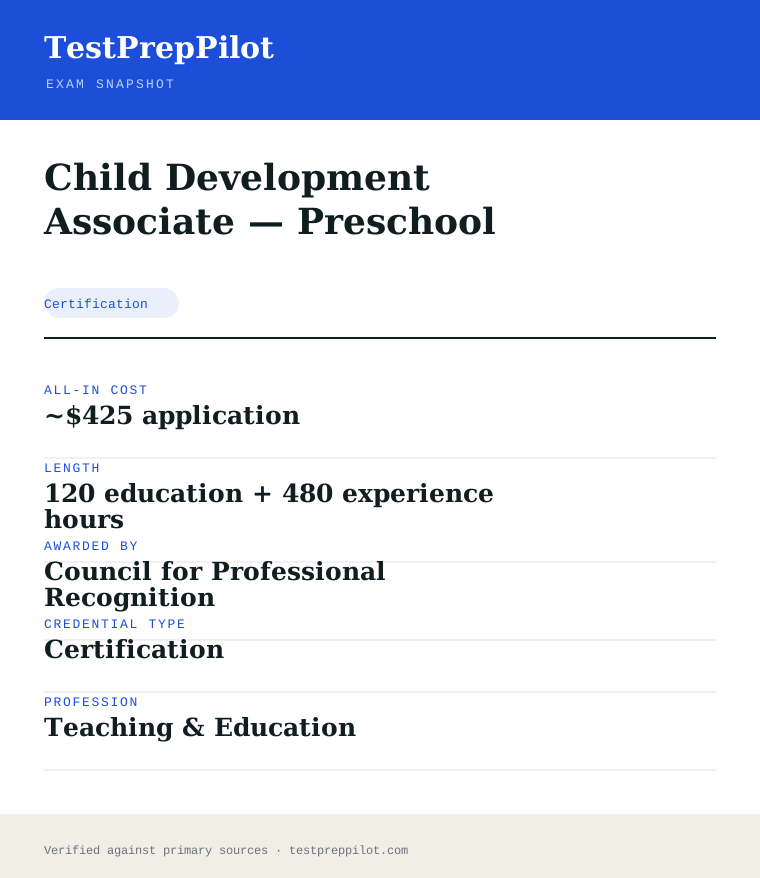
Child Development Associate — Preschool is a certification credential; awarded by Council for Professional Recognition; the exam fee is ~$425 application; typical preparation is 120 education + 480 experience hours; holders typically earn $37,120 median, preschool teachers (BLS May 2024).
| Credential | Child Development Associate — Preschool |
|---|---|
| Abbreviation | CDA Preschool |
| Type | Certification |
| Profession | Teaching & Education |
| Specialty | Early Childhood, Paraeducator & Instructional Support |
| Awarded by | Council for Professional Recognition |
| Difficulty | Mixed |
| Typical prep time | 120 education + 480 experience hours |
| All-in cost | ~$425 application |
| Typical salary range | $37,120 median, preschool teachers (BLS May 2024) |
| Credential | Child Development Associate — Preschool |
| Awarding body | Council for Professional Recognition |
| Exam format | Proctored, computer-based |
| Validity | Valid 3 years, then renewal with CEUs |
| Languages | Varies — see awarding body |
| Scope | National / Multi-state |
| Also known as | Preschool CDA |
Real questions
Frequently asked questions about the Child Development Associate — Preschool
How do I register for the Child Development Associate — Preschool exam?
Register through Council for Professional Recognition's official portal or an authorized test provider (e.g., Pearson VUE or Prometric where applicable). Create an account, select the exam, pay the fee, and schedule a date.
How much does the exam cost?
Fees vary by location and currency. Confirm the current fee on the official registration page before scheduling.
How long is the credential valid, and how do I renew?
Validity varies by credential (commonly 2–3 years). Renewal usually requires continuing education or a recertification exam — see Council for Professional Recognition's policy.
What if I do not pass?
Most bodies allow retakes after a waiting period and payment of the full or partial fee. Check Council for Professional Recognition's retake policy before rescheduling.
How do I register for a Council for Professional Recognition credential?
Register through the official website, select your exam, pay the fee, and schedule a date.
How do I renew a credential?
Renewal policies vary by credential; check the specific program page for requirements and cycles.
In short
Is the Child Development Associate — Preschool worth it?
- Child Development Associate — Preschool is awarded by Council for Professional Recognition.
- Validates job-ready competence in Education & Teaching.
- Registration is through the awarding body or an authorized test provider.
- Renewal and retake policies vary — confirm before scheduling.
Trust
Where does this information come from?
Everything above is taken from the awarding body's own published material. Fees, question counts and domain weights are revised regularly — check the official page before you pay.
- Council for Professional Recognition Awarding body
Research confidence: low · Last reviewed 2026-08