The short version
What is the Praxis Elementary Education: Content Knowledge (5018) and is it worth it?
Praxis Elementary Education: Content Knowledge (5018) is a professional credential administered by ETS. It validates job-ready knowledge and skills in the Education & Teaching field and is used for career entry, advancement, or compliance.
- Recognized credential from ETS
- Demonstrates verified competence in Education & Teaching
- Supports career advancement and may satisfy licensing or employer requirements
What is it?
What exactly is the Praxis Elementary Education: Content Knowledge (5018)?
Praxis Elementary Education: Content Knowledge (5018) — Education & Teaching credential from ETS
Single-session elementary content test spanning reading and language arts, mathematics, social studies and science. Offered by ETS, it is designed for candidates who need to demonstrate verified competence in the Education & Teaching field. The credential is commonly used for career entry, advancement, regulatory compliance, or employer requirements. Candidates should review the official handbook for eligibility, exam format, and scoring before registering.
The path in brief
- Confirm you meet any eligibility or prerequisites
- Review the official handbook and study materials
- Register and pay through the awarding body or authorized provider
- Schedule and take the exam (test center or online proctoring)
- Receive your score and, if passed, your credential
Before you book
Who is eligible to sit the Praxis Elementary Education: Content Knowledge (5018)?
Eligibility varies; many credentials are open to all, while others require coursework, work experience, or sponsorship.
Who it is for: Professionals and candidates seeking to validate Education & Teaching competence.
The test itself
What is the format of the Praxis Elementary Education: Content Knowledge (5018)?
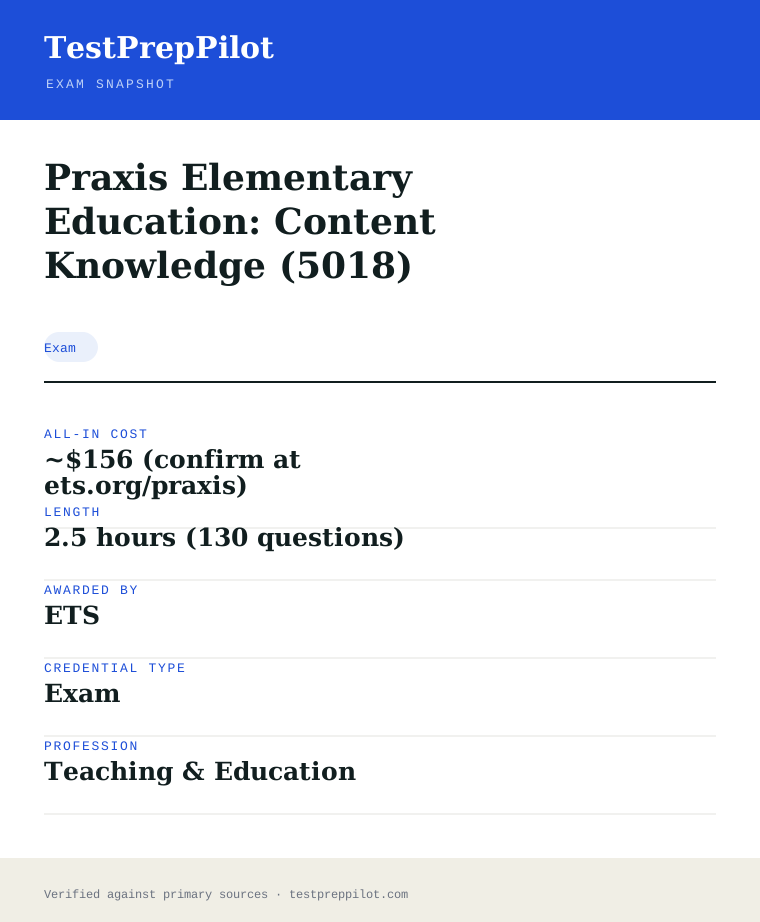
The Praxis Elementary Education: Content Knowledge (5018) is administered by ETS and runs 2 hours 30 minutes and contains 130 (110 selected-response + 20 selected-response case-study items) questions.
| Administered by | ETS |
|---|---|
| Questions | 130 (110 selected-response + 20 selected-response case-study items) |
| Time limit | 2 hours 30 minutes |
| Pass mark | Passing score set by the awarding body; see the official score report |
| Exam fee | ~$156 (confirm the current fee at ets.org/praxis) |
| Format | Proctored, computer-based (test center or online remote proctoring) |
Content outline
What topics are on the Praxis Elementary Education: Content Knowledge (5018)?
The Praxis Elementary Education: Content Knowledge (5018) covers 4 content domains.
Weightings come from the official exam outline. Study time is best allocated in roughly these proportions rather than evenly across domains.
- Subject content
Topic area tested on the exam; see the official blueprint for the detailed breakdown.
- Instruction & pedagogy
Topic area tested on the exam; see the official blueprint for the detailed breakdown.
- Assessment
Topic area tested on the exam; see the official blueprint for the detailed breakdown.
- Classroom management
Topic area tested on the exam; see the official blueprint for the detailed breakdown.
The path
How do you register for the Praxis Elementary Education: Content Knowledge (5018)?
- 1
Read your state requirements page20 minutes
Open hiset.org and select your state or jurisdiction. Age minimums, residency rules, whether you must enrol in an adult education programme first, and the exact fees are all set locally.
- 2
Create a myHiSET account15 minutes
Sign up through the state requirements page to generate your HiSET number, which you need for scheduling, score access and any state paperwork.
- 3
Take the official practice tests1 to 2 hours per subtest
HiSET publishes free and low-cost official practice tests for each subtest. Unlike the GED at-home route, HiSET does not require a practice-test pass before you can schedule.
- 4
Schedule subtests one at a time10 minutes each
Book any of the five subtests in any order, on paper or computer at a test centre or through HiSET@Home online proctoring where your state allows it.
- 5
Test with valid photo ID65 to 120 minutes per subtest
Bring a current government-issued photo ID showing your name, date of birth, signature and photograph. At-home testers need a private room, a webcam and a stable connection.
- 6
Check scores and claim your credential1 to 2 weeks
Multiple-choice results typically post within about five to seven days and essay results within about seven to ten days. Once all five subtests pass, your state issues the credential.
The fine print
What are the retake and renewal rules for the Praxis Elementary Education: Content Knowledge (5018)?
- Proctoring & delivery
- HiSET is offered in three ways: paper-based at a test centre, computer-based at a test centre and HiSET@Home under live online proctoring, with availability depending on the state. Calculators and formula sheets are supplied at test centres. The full battery in English or Spanish is permitted, and several states allow candidates to mix languages across subtests.
- Retake policy
- Retake rules are set per state, but a common pattern allows three attempts per subtest in a calendar year, sometimes extending to six. Several states use a favourable pricing structure in which the full fee is charged only on the first and fourth attempts while the second and third cost only the test centre or proctor fee.
- Score reporting
- Each of the five subtests is scored 1 to 20. To pass you must score at least 8 on every subtest, at least 2 out of 6 on the Language Arts Writing essay, and at least 45 out of 100 in total across the five. A score of 15 or higher on a subtest is treated as HiSET honours-level performance in several states.
- Recertification
- The credential a state issues on the strength of a passing HiSET battery is permanent and needs no renewal. Passing subtest scores are carried forward within a state-defined window while you complete the remaining subjects.
- Refunds & rescheduling
- Refund and reschedule windows are administered by PSI and vary by state and test centre; most centres require cancellation at least 24 hours before the appointment. Registering by phone rather than online attracts an additional fee in some states.
Context
HiSET subtests at a glance
| Subtest | Questions | Time | |
|---|---|---|---|
| Language Arts - Reading | About 40 to 50 multiple choice | 65 minutes | |
| Language Arts - Writing | About 50 multiple choice plus 1 essay | 120 minutes | |
| Mathematics | About 50 multiple choice | 90 minutes | |
| Science | About 50 multiple choice | 80 minutes | |
| Social Studies | About 50 multiple choice | 70 minutes |
What it pays
How much does this credential pay?
$62,340 median for elementary school teachers (BLS, May 2024)
The Elementary Education: Content Knowledge (5018) exam licenses the generalist elementary teacher, so the directly relevant occupation is Elementary School Teachers, Except Special Education, SOC 25-2021. That occupation had a May 2024 median annual wage of $62,340, with the lowest 10 percent earning under $46,440 and the highest 10 percent over $102,010. The distribution deserves careful reading because elementary-teacher pay is set overwhelmingly by district salary schedules — years of service plus education credits — rather than by market pressure, and geography dominates the spread: state-level medians range from the high $40,000s to more than $90,000, with the highest-paying states being largely the highest-cost ones such as California, New York, Massachusetts and Washington. BLS counted 1,539,800 kindergarten and elementary school teachers in 2024 and projects a 2 percent decline in employment from 2024 to 2034, driven mainly by falling elementary enrollment, while still expecting about 103,800 openings a year, almost all of them replacement need from retirement and career change. The practical reading for a 5018 candidate is that this exam is a toll gate on a stable, schedule-driven career rather than a lever on your pay: passing it efficiently matters, but the wage work is done over time by the salary schedule, additional endorsements and experience. One nuance specific to 5018: because the exam is a content-knowledge test required alongside a pedagogy test such as the PLT, candidates should treat the two as a licensing sequence and budget for both, since neither alone clears the licence.
| Measure | Figure | Source / note |
|---|---|---|
| Median annual wage, elementary school teachers (except special education) | $62,340 | BLS Occupational Outlook Handbook, May 2024 |
| Lowest 10 percent | less than $46,440 | BLS OOH Pay tab, May 2024 |
| Highest 10 percent | more than $102,010 | BLS OOH Pay tab, May 2024 |
| Employment, 2024 (kindergarten and elementary) | 1,539,800 jobs | BLS OOH Quick Facts, 2024 |
| Projected annual openings | ~103,800 per year | BLS OOH Job Outlook, 2024-34 — almost all replacement need |
Job growth.-2% projected change 2024-34 (decline driven by falling elementary enrollment), with ~103,800 replacement openings a year. Pay is set by district salary schedules, so experience and geography matter more than the credential.
Source: BLS Occupational Outlook Handbook — Kindergarten and Elementary School Teachers
Your odds
What are the pass rates?
ETS publishes no pass rate — the cut score is set by each state
ETS does not publish a pass-rate statistic for Praxis 5018 or any other Praxis test, and there is no single national passing score: each state education agency sets its own cut for the exam, and the state requirements vary widely — for content-knowledge exams like this one you will commonly see state-set passing scores spread across the 150s and 160s on the 100-200 scaled score scale, and some states also set different requirements depending on the grade band or on whether the candidate already holds a related endorsement. That means the same score can clear licensure in one state and fall short in another, so the first research step — before buying any prep product — is to look up your state's exact 5018 cut score on the ETS Praxis state requirements page or your state's educator-certification site. What is uniform and verifiable nationwide is the operational policy: the test is scored on a scaled scale, ETS enforces a 21-day waiting period after score release before any retake, there is no limit on attempts, and each attempt is paid at full price. A second structural fact matters for planning: because passing scores are state-set per exam, candidates licensed across state lines (or earning a second endorsement) must re-check the requirement for each new state rather than assuming one passing score travels. The correct planning question is therefore not "what is the pass rate" but "what is my state's cut score, and how far above it do my practice scores sit" — everything else, including forum anecdotes and prep-vendor pass-rate claims, is noise.
Read this before quoting the number.ETS publishes no pass rate by exam. The 5018 cut score is set independently by each state education agency on the 100-200 scaled score scale; confirm your state's requirement before registering.
Source: ETS — Praxis Elementary Education: Content Knowledge (5018)
Your schedule
How long should I study for it?
65-85 hours of focused study
The 5018 is a single, content-heavy paper of roughly 130 selected-response questions in about 2.5 hours, covering four content areas: Reading and Language Arts, Mathematics, Social Studies, and Science. Unlike the four-subtest Elementary Education: Multiple Subjects (5001), the 5018 is one sitting with one score, but the content map is the same generalist territory and the two exams are often treated as alternatives by different states — some require 5001, some 5018, and a few accept either. Before planning, confirm which exam your state actually requires, because preparing for the wrong one wastes your money. The structural fact that shapes the schedule is that reading and language arts plus mathematics carry roughly two-thirds of the weight between them, so a candidate strong in math and weak in reading has exactly one repair target, and vice versa. The plan below runs eight weeks at roughly 8-10 hours a week, with the first three weeks on your two weakest content areas, the middle weeks on breadth review and timed sub-drills, and the final week on full-length mock exams to rehearse the 2.5-hour stamina and pacing. Because every question is selected-response, the exam is trainable: the payoff of preparation is content breadth plus discrimination under time pressure, not essay craft or constructed-response writing, which distinguishes this paper from the Praxis PLT and from the Core Writing subtest.
- Week 18-10 hrs
Diagnostic and state cut-score lookup
- Take one untimed diagnostic pass through all four content areas to rank your starting position
- Look up your state's exact 5018 cut score on the ETS Praxis state requirements page and write it down
- Confirm 5018 is the exam your state requires (some states use 5001 instead) before investing a week
- Download the ETS Study Companion for 5018 and map its content categories
- Weeks 2-39-11 hrs/week
Weakest content area — breadth repair
- If math: drill number and operations, algebra, geometry and measurement, and data/statistics at the K-8 level
- If reading: work reading foundations, comprehension, writing and speaking/listening against the Study Companion objectives
- Tag every miss to a content category so the repair list stays short
- One timed 50-question drill per week under 60 minutes to build pace
- Week 49-11 hrs
Second-weakest content area
- Repeat the breadth-repair loop on the second-weakest area
- Keep the weakest area alive with 30-45 minutes of spaced category drills
- For social studies: build timelines and concept maps for US history, government, geography and economics
- Re-test the original weakest area once to confirm the repair took
- Weeks 5-69-11 hrs/week
Strong areas and integrated timing
- Give the two stronger areas their first structured pass — the reading strategy layer and the science breadth
- Two timed 65-question half-exams per week, rotated so all four areas stay warm
- For science: review earth, life and physical science facts and the nature-of-science items
- Practise discrimination under time — every item is selected-response, so eliminate-and-move is the skill
- Week 79-11 hrs
Full-length mock exams
- Two full 5018 mocks: ~130 questions in one 2.5-hour sitting, no notes, no phone
- Review both by content area — the pattern of misses matters more than the total
- Drill the specific categories that cost points in the mocks
- Confirm your practice scaled scores sit above your state cut with a margin
- Week 86-8 hrs
Taper and logistics
- Light review of category checklists and miss lists
- One more timed 65-question half-exam to keep the pace reflex fresh
- Confirm your state cut score, your ID name matches your Praxis account, and your seat
- One quiet day before the exam
Adjusting the pace
Current education student mid-program.Five to six weeks at 8-10 hrs/week. Your methods courses cover much of the pedagogy-adjacent content; spend the recovered time on the math and science breadth, which are the most common failure points for strong readers.
Career changer with a math or science degree.Six to eight weeks at 8-10 hrs/week. Your strength inverts the typical profile: put the bulk of the time into reading and language arts strategy, social studies breadth, and elementary-level content review.
Returning adult out of school for years.Ten to twelve weeks at 7-9 hrs/week. Add two weeks before Week 1 for math and science remediation — the K-8 content is not hard but it decays badly with disuse.
How to study
How do I prepare most effectively?
The 5018 is a breadth exam with no essays and no constructed-response tasks — every question is selected-response — which makes it unusually trainable if you use the right tactics: learn the four content maps, drill under timing, and rehearse the full 2.5-hour sitting. The strategies below are ordered by score impact, and the first two are the difference between a passing plan and a lucky one.
Repair by content area, not by scattered topics
The four content areas — reading/language arts, math, social studies and science — are weighted unevenly, with literacy and numeracy together carrying roughly two-thirds of the paper. Diagnose in Week 1, give your two weakest areas about 60 percent of your hours, and re-test them before the exam. A candidate who studies "a bit of everything" is really studying to miss everywhere at the margin.
Learn the reading-and-language-arts strategy layer
Fluent readers routinely underperform on elementary content exams because the reading section tests literacy-instruction concepts — phonemic awareness versus phonics, the five pillars of reading, text structure, the writing process — not just reading ability. Work the Study Companion category list explicitly; this is where strong readers lose points most.
Build timelines and concept maps for social studies
The social-studies content spans US history, government and citizenship, geography, and economics — a lot of breadth in a modest number of questions. Timeline and concept-map reviews (major eras, amendments, branches of government, geographic concepts, supply/demand) compress the breadth into a recallable structure and are far more efficient than reading a textbook chapter by chapter.
Drill science breadth with a fact checklist
Earth, life and physical science at the K-8 level is mostly factual recall plus a handful of nature-of-science items. Build a checklist from the Study Companion's science objectives and drill it in short spaced sessions; the volume is smaller than it looks and highly coachable.
Rehearse the full 2.5-hour sitting at least twice
A 130-question, 2.5-hour paper rewards pacing: roughly a minute per item with no constructed-response cushion. Two full-length mocks in Week 7, under exam conditions, tell you exactly where fatigue and over-thinking cost you, and let you rehearse the eliminate-and-move discipline.
Know your state cut score, not an average
Because the passing score is set per state, a candidate who studies to "beat a 160" may be over- or under-preparing. Look up your state's requirement in Week 1, aim at it plus a margin, and re-check the week before the exam in case the state changed the cut.
What to buy
Which study resources are worth paying for?
The highest-value resources for a breadth exam like the 5018 are the free ETS Study Companion (which contains the exact content categories and sample questions) and ETS's own Interactive Practice Test, which is the closest thing to the real item style. Third-party subscription courses add structure and drilling volume and are worth it mainly if a specific content area needs systematic repair — math and science especially. The buying decision is really: how much structured remediation do your two weakest content areas need?
| Resource | Price | Format | Best for |
|---|---|---|---|
| ETS Study Companion (5018) | Free | PDF content outline with sample questions | The authoritative content map — tag every miss to these categories |
| ETS Praxis Interactive Practice Test (5018) | ~$20 | Timed online practice with immediate scoring | Closest question style to the real exam; the best single readiness check |
| Exam registration (5018) | ~$130 (confirm current fee at ets.org/praxis) | Prometric centre or online proctoring | Required — book only after practice scores clear your state cut with a margin |
| 240 Tutoring or similar Praxis 5018 course | ~$80-100 subscription | Diagnostic plus content-area lessons and practice | Structured repair for the weakest content area, especially math or science |
| Khan Academy (free) + Mometrix flashcards | Free to ~$40 | Video lessons and drill decks | Cheap math and science breadth review |
| District or university Praxis prep course | Often free or low-cost | In-person or live online with an instructor | Accountability and structured pacing for career changers |
Prices checked 2026-08 in USD before promotions; ETS registration fees are set by ETS and state surcharges may apply. Passing scores are set by state and are not included in any fee. We do not rank by commission.
Avoid these
What mistakes do candidates most often make?
The 5018 failure modes cluster around two roots: studying to the wrong exam or the wrong cut score, and treating a breadth exam like a content cram with no timed rehearsal. The six traps below are the recurring ones in candidate post-mortems, and every one of them is fixable within a single eight-week cycle.
✕Preparing for the wrong exam
✓Some states require 5018, others require the four-subtest 5001, and a few accept either. Preparing for the wrong one wastes your money and your study weeks. Confirm which exam your state actually requires in Week 1, and download that exam's Study Companion rather than a generic "Praxis elementary" guide.
✕Training to a national passing score that does not exist
✓There is no single Praxis passing score; each state sets its own cut for 5018, commonly in the 150s-160s on the 100-200 scale. Look up your state's requirement in Week 1 and require your practice mocks to beat it by a margin. A score that "usually passes" can still fail your state.
✕Treating reading and language arts as "free points"
✓Fluent readers routinely underperform on the reading section because it tests literacy-instruction concepts — phonemic awareness versus phonics, the five pillars of reading, text structure — not just reading ability. Work the category list explicitly instead of assuming your reading skill carries the section.
✕Studying evenly across the four content areas
✓Literacy and numeracy together carry roughly two-thirds of the paper. A flat study plan shortchanges the areas that cost the most points and wastes hours on the ones you already know. Diagnose in Week 1, weight by weakness, and re-test before the exam.
✕Never running a full-length mock
✓A 130-question, 2.5-hour paper is a pacing test as much as a knowledge test. Candidates who never run the full sitting over-think early items and rush the final section. Two full mocks in Week 7 turn pacing from a surprise into a planned discipline.
✕Ignoring the 21-day retake wait
✓ETS enforces a 21-day waiting period after score release before a retake, and each attempt is paid at full price. A candidate who fails and needs the score by a licensure deadline can miss it entirely because of the wait. Treat the first attempt as serious, and use the window for targeted repair rather than a same-knowledge re-sit.
What you'll face
What question types will I see?
The 5018 is roughly 130 selected-response questions in about 2.5 hours, scored on the 100-200 scaled scale against a state-set cut. The paper covers four content areas — Reading and Language Arts, Mathematics, Social Studies, and Science — and every item is selected-response, mostly single-answer multiple choice with four choices, plus a minority of alternative formats such as multiple-selection or order-matching items that ETS uses across its tests. ETS notes that some questions on a form are pretest items that do not count toward your score. Because there are no essays and no constructed-response tasks, pacing is the dominant tactical skill: roughly one minute per item, sustained across the whole sitting, with eliminate-and-move as the core discipline — answer confidently, flag genuinely uncertain items for review, and never let a single question eat several minutes. The content weighting rewards breadth: a candidate who can discriminate between adjacent topics (e.g., phonemic awareness versus phonics, or weathering versus erosion) collects the majority of points, while a candidate who studied depth in one area and skimmed the rest loses the breadth items that dominate the paper.
Four answer choices across all four content areas. Distractors are plausible near-misses from adjacent topics, so partial familiarity is punished.
Select more than one correct option or place items in the correct sequence. Scoring is all-or-nothing on these formats, so read the stem's instruction carefully.
Type the exact numeric value rather than choosing a letter; rounding and transcription slips are the classic failure mode.
Try these
Q1A teacher notices that a student can identify the letters of the alphabet but cannot yet hear that the word "cat" is made of three separate sounds. Which skill is most directly missing?
Answer:A
Phonemic awareness is the ability to hear and manipulate the individual sounds (phonemes) in spoken words — segmenting "cat" into /k/ /a/ /t/ is exactly that skill — and it is a prerequisite for mapping sounds to letters (A). Print concepts (B) concern how a book works — directionality, spacing — not sound segmentation. The alphabetic principle (C) is the sound-to-letter correspondence that the student has not yet reached because the phonemic layer is missing. Reading fluency (D) requires decoding and automaticity that come later.
Q2A rectangular classroom is 30 feet by 40 feet. A teacher wants to install carpet, leaving a 3-foot border of uncovered floor around the edge. What is the area, in square feet, that will be carpeted?
Answer:B
A 3-foot border on every side leaves a carpeted rectangle of (30 - 6) by (40 - 6), or 24 by 34 feet, so the carpeted area is 24 × 34 = 816 square feet (B). A (1,200) is the full floor, forgetting the border. C (1,176) comes from subtracting only one border dimension. D is a miscalculation from subtracting 3 rather than 6 feet on each dimension — the classic error of forgetting that a border takes space from both sides. Numeric-entry versions of this item would require typing 816 exactly.
Q3Which of the following is a direct consequence of the westward expansion of the United States in the nineteenth century?
Answer:A
As the nation expanded westward, the question of whether new territories would permit slavery produced a series of political compromises, beginning with the Missouri Compromise of 1820 (A). B is false in timing — abolition came with the 13th Amendment in 1865, not as an immediate consequence of expansion. C is the reverse of the record; immigration surged during the nineteenth century. D (1913) is decades later and unrelated to territorial expansion.
Samples are editor-written illustrations of the published blueprint, not live exam items. Numeric-entry variants of the math sample would require typing the exact value rather than choosing a letter.
The big day
What should I expect on exam day?
The 5018 is a single appointment of about 2.5 hours at a Prometric test centre or via online proctoring, containing roughly 130 selected-response questions in one sitting. The most common way a qualified candidate loses the seat is administrative: your government-issued photo ID must match your Praxis account name exactly, and for online proctoring you need a private room, working camera and microphone, and a clean desk. Check your account spelling and your state's cut score the week before. At the centre you are checked in, photographed, and seated at a computer; scratch paper is issued and collected. The testing interface allows flagging and review within the single section, and there are no separately timed subtests — the 2.5-hour clock runs continuously, so budget roughly a minute per item and keep moving. The practical pacing plan is: clear the items you are confident on, flag genuinely uncertain ones, and use the final minutes to review flags rather than re-reading everything. There are no scheduled breaks in a 2.5-hour sitting; unscheduled breaks may be taken but the clock does not stop, so use the restroom before check-in and keep a water bottle at the centre's discretion. When you finish, your scaled score appears on screen, and the official score report follows in about five weeks to the recipients you selected at registration.
Bring
- Government-issued photo ID with your name matching your Praxis account exactly
- Your Praxis registration confirmation or candidate ID in case check-in cannot locate the booking
- For online proctoring: a phone for check-in, a private room, and a webcam and microphone already tested on the machine you will use
- Your state's 5018 cut score, so you can interpret the on-screen result correctly
Leave at home
- Phones, smartwatches, fitness trackers and earbuds — secured in a locker at a centre
- All notes, textbooks and printed study materials — no personal scratch paper is allowed
- Bags, coats, food and drink beyond what the centre permits
- Any other person in the room for online proctoring; the session is recorded
How the day runs
Rules in the room
- ~130 selected-response questions in one ~2.5-hour session; scaled score on the 100-200 scale with a state-set cut.
- You may flag items and review them within the single section; there are no separately timed subtests.
- No scheduled breaks in the sitting; unscheduled breaks may be taken but the clock does not stop.
- Scratch paper is issued at a test centre and collected; online proctoring uses a digital whiteboard only.
- Some questions on the form are pretest items that do not count toward your score.
- Retake: ETS requires a 21-day wait after score release; no limit on attempts; each attempt paid in full.
- Scores are valid for 10 years, subject to your state's acceptance window.
Afterwards.Your scaled score appears on screen when you finish, and the official report follows in about five weeks to the recipients you selected — typically your state education agency and teacher-preparation program. Because the cut score is state-set, read your result against your state's published 5018 requirement rather than against any number on the report. On a pass, the content-knowledge hurdle is cleared and you move to the remaining licensure requirements — commonly a pedagogy test such as the PLT and any state-specific components. On a fail, the path is straightforward: wait the 21 days, but use the window deliberately. The most common failure pattern on a content-knowledge exam is not missing knowledge overall but a specific content area — usually math or science for strong readers, or the reading strategy layer for strong mathematicians — and that is fixable in one targeted cycle. Do not re-book the same knowledge; spend the window repairing the specific area your practice and the score report point to, and the second attempt will be a different exam experience.
Reference
What are the key facts about the Praxis Elementary Education: Content Knowledge (5018)?
Praxis Elementary Education: Content Knowledge (5018) is a exam credential; awarded by ETS; the exam fee is ~$156 (confirm the current fee at ets.org/praxis); typical preparation is 2.5 hours (130 questions); holders typically earn $45,000-$80,000.
| Credential | Praxis Elementary Education: Content Knowledge (5018) |
|---|---|
| Type | Exam |
| Profession | Teaching & Education |
| Specialty | Praxis Elementary & Early Childhood |
| Awarded by | ETS |
| Difficulty | Mixed |
| Typical prep time | 2.5 hours (130 questions) |
| All-in cost | ~$156 (confirm at ets.org/praxis) |
| Typical salary range | $45,000-$80,000 |
| Credential | Praxis Elementary Education: Content Knowledge (5018) |
| Awarding body | ETS |
| Exam format | Proctored, computer-based |
| Validity | Praxis scores are valid for 10 years. |
| Languages | Varies — see awarding body |
| Scope | National / Multi-state |
| Also known as | 5018 |
Real questions
Frequently asked questions about the Praxis Elementary Education: Content Knowledge (5018)
How do I register for the Praxis Elementary Education: Content Knowledge (5018) exam?
Register through ETS's official portal or an authorized test provider (e.g., Pearson VUE or Prometric where applicable). Create an account, select the exam, pay the fee, and schedule a date.
How much does the exam cost?
Fees vary by location and currency. Confirm the current fee on the official registration page before scheduling.
How long is the credential valid, and how do I renew?
Praxis scores are valid for 10 years, subject to your state's acceptance window; because the passing score is set by each state, your state education agency is the authority on both the cut score and the validity period.
What if I do not pass?
Most bodies allow retakes after a waiting period and payment of the full or partial fee. Check ETS's retake policy before rescheduling.
Is HiSET run by ETS or by PSI?
Both. ETS develops the HiSET test content and PSI delivers it operationally, following the ETS acquisition of PSI in January 2024. In practice you register and schedule through myHiSET on the PSI platform.
Do I have to live in a HiSET state to test?
Usually not. Several HiSET states, including Georgia and Oklahoma, explicitly allow non-residents to test, though you generally must pass your final subtest in the state whose credential you want.
Is HiSET easier than the GED?
They are set to comparable standards but structured differently: HiSET has five subtests with reading and writing separated, while the GED combines them into one Reasoning Through Language Arts test. HiSET is more widely available on paper, which some candidates prefer.
In short
Is the Praxis Elementary Education: Content Knowledge (5018) worth it?
- Praxis Elementary Education: Content Knowledge (5018) is awarded by ETS.
- Validates job-ready competence in Education & Teaching.
- Registration is through the awarding body or an authorized test provider.
- Renewal and retake policies vary — confirm before scheduling.
Same awarding body
What other credentials does ETS award?
Worth comparing
How does the Praxis Elementary Education: Content Knowledge (5018) compare with similar credentials?
Trust
Where does this information come from?
Everything above is taken from the awarding body's own published material. Fees, question counts and domain weights are revised regularly — check the official page before you pay.
- ETS Awarding body
Research confidence: medium · Last reviewed 2026-08