Transportation & Aviation • Exam
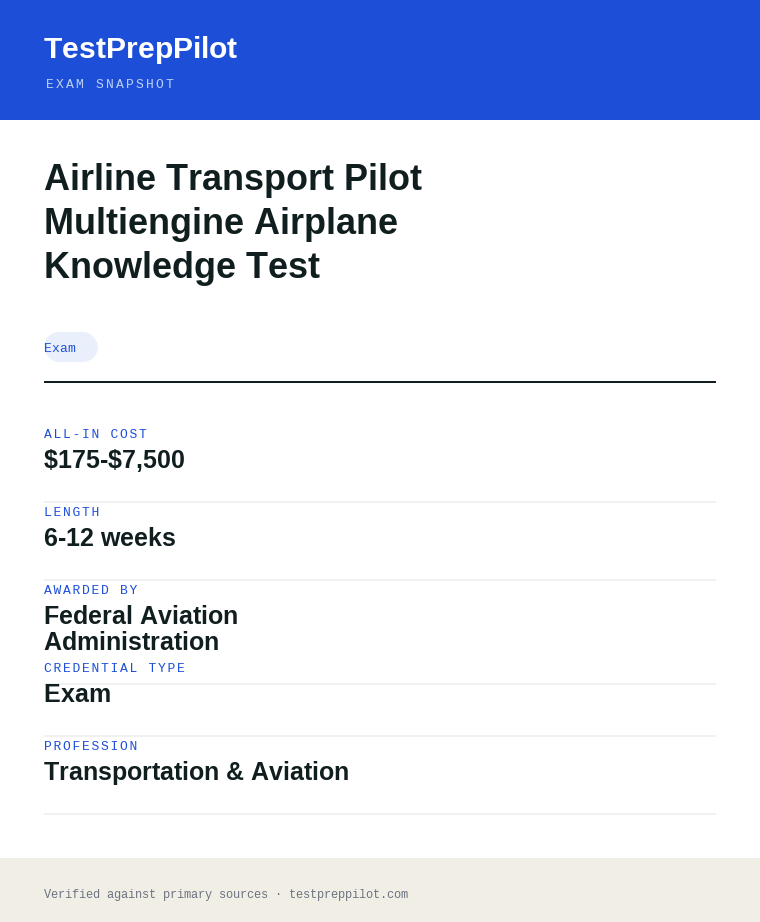
Airline Transport Pilot Multiengine Airplane Knowledge Test
The 125-question, four-hour ATP written that is the gateway to flying for the airlines.
Researched and maintained by TestPrepPilot Editorial BoardAviation & FAA licensure desk · Figures last verified August 2026
The short version
What is the Airline Transport Pilot Multiengine Airplane Knowledge Test and is it worth it?
The ATM is a 125-question, four-hour computer-based FAA test for the multiengine ATP certificate, scheduled via PSI for $175 and passed at 70%. It covers transport performance, weather, CRM and Part 121 operations. Passing it is mandatory before the ATP practical and is the standard airline-entry written.
- Required to captain airliners under Part 121
- The definitive top-rung pilot certificate
- Recognized by every U.S. airline
- Flat $175 PSI fee
- Builds directly on commercial and instrument knowledge
What is it?
What exactly is the Airline Transport Pilot Multiengine Airplane Knowledge Test?
The 125-question, four-hour ATP written that is the gateway to flying for the airlines.
The ATP Multiengine Airplane (ATM) knowledge test, commonly called the ATP written, is the FAA exam required for the Airline Transport Pilot certificate in multiengine airplanes, the credential needed to act as an airline captain. It is the longest and most demanding FAA written, with 125 questions over four hours covering transport-category performance, meteorology, crew resource management and Part 121 operations. It is taken after meeting the ATP aeronautical-experience minimums and is required before the ATP practical test. It sits at the top of the pilot certificate ladder.
The path in brief
- Meet ATP aeronautical experience
- Study transport performance and Part 121
- Get endorsement if required
- Pass 125-question ATM at 70%
- Complete the ATP practical
Before you book
Who is eligible to sit the Airline Transport Pilot Multiengine Airplane Knowledge Test?
Who it is for: Airline-bound multiengine pilots
The test itself
What is the format of the Airline Transport Pilot Multiengine Airplane Knowledge Test?
The Airline Transport Pilot Multiengine Airplane Knowledge Test is administered by PSI FAA-approved testing center and runs 4.0 hours, contains 125 questions and requires 70% to pass.
| Administered by | PSI FAA-approved testing center |
|---|---|
| Questions | 125 |
| Time limit | 4.0 hours |
| Pass mark | 70% |
| Exam fee | $175 |
| Format | Computer-based multiple choice (PSI) |
Content outline
What topics are on the Airline Transport Pilot Multiengine Airplane Knowledge Test?
The Airline Transport Pilot Multiengine Airplane Knowledge Test covers 6 content domains.
No percentage weights are listed for these domains here, so the outline is shown as structure only. Check the certifying body's published outline before allocating study time.
- Transport-category aircraft performance
- Meteorology and high-altitude weather
- Crew resource management (CRM)
- Part 121 air carrier operations
- Regulations (Part 61/91/121)
- Navigation and flight planning
Money & time
How much does the Airline Transport Pilot Multiengine Airplane Knowledge Test cost?
For the Airline Transport Pilot Multiengine Airplane Knowledge Test, the exam fee is $175; the all-in cost is typically $175-$7,500; most candidates spend 6-12 weeks preparing.
Cost breakdown
| Knowledge test fee (PSI) | $175 |
|---|---|
| ATP-CTP course (often required) | $3,000-$5,000 |
| Prep materials | $0-$300 |
| Retake (if failed) | $175 each |
| ATP practical (DPE) | $1,500-$2,500 |
| Typical total | $175 up to ~$7,500 |
Airlines and many bridge programs cover the ATP-CTP and practical costs; the written fee alone is $175.
Timeline
- ATP-CTP course (if used) 1-2 weeks
- Study 6-12 weeks
- Schedule with PSI 1-2 weeks
- Take ATM 1 day
Typical prep: 6-12 weeks
The path
How do you register for the Airline Transport Pilot Multiengine Airplane Knowledge Test?
- 1
Obtain an FAA Tracking Number (FTN)10 minutes
Create an IACRA account at iacra.faa.gov and receive your FTN. You cannot open a PSI testing account without it, so do this first.
Enter your name exactly as it appears on your government photo ID, or the testing center will reject it.
- 2
Get the required instructor endorsement or authorization
Most pilot and instructor knowledge tests require a logbook or written endorsement from an authorized instructor certifying you are prepared. Some tests (dispatcher, ground instructor, remote pilot, flight navigator) need no endorsement.
- Flight/Ground instructor signs the endorsement
- Canadian and military conversion tests use your foreign or service certificate as authorization
- 3
Create a PSI testing account10 minutes
Register at faa.psiexams.com with your FTN and enable two-factor authentication. PSI is the FAA-contracted vendor that delivers every airman knowledge test.
- 4
Schedule and pay for the test
Choose your exam, verify eligibility, pick a testing center and date, and pay the $175 fee by credit card. You may reschedule up to 12 months later.
The fee is paid to PSI, not the FAA. The FAA charges nothing for the application or certificate.
- 5
Bring ID and authorization on test day
Arrive with a government photo ID showing your current address and your instructor endorsement or authorization form. Non-U.S. citizens must also bring a passport.
The fine print
What are the retake and renewal rules for the Airline Transport Pilot Multiengine Airplane Knowledge Test?
- Proctoring & delivery
- Knowledge tests are delivered on PSI computer workstations at hundreds of FAA-approved testing centers in the U.S. and abroad. You may use an aviation calculator, E6B, plotter, straightedge and the official FAA testing supplement (figures booklet). A government photo ID is required and the session is continuously monitored.
- Retake policy
- If you score below 70% you must wait 30 days before retaking, and you must present a new endorsement from an authorized instructor certifying additional training in the subjects you failed. You may retest sooner than 30 days only if that instructor signs a statement that you are ready. There is no limit on the number of attempts, but each attempt costs a fresh $175.
- Score reporting
- Your score displays on screen the moment you finish, and you receive an Airman Knowledge Test Report (AKTR) showing pass/fail and the ACS codes for any weak areas. A passing score is 70%. The DPE or examiner sees your score and weak-area codes before your practical test.
- Recertification
- A passed knowledge test is valid for 24 calendar months. To earn the certificate you must complete the practical test within that window; if it lapses you must retake the knowledge test. Pilot and instructor certificates themselves carry no expiration once issued, but flight instructors must renew every 24 months via a FIRC, and remote pilots must complete free recurrent training every 24 months.
- Refunds & rescheduling
- You may cancel or reschedule through the PSI site. Rescheduling more than 48 hours ahead typically avoids penalty; the $175 is consumed only when the test is attempted. Check your specific center’s policy before the appointment.
Context
FAA certificate ladder (knowledge test only)
| Step | Example test | Questions | Typical prep | |
|---|---|---|---|---|
| Sport / Recreational | SPA / RPA | 40-50 | 2-6 weeks | |
| Private | PAR | 60 | 6-12 weeks | |
| Instrument | IRA | 60 | 4-8 weeks | |
| Commercial | CAX | 100 | 8-16 weeks | |
| ATP | ATM | 125 | 10-20 weeks |
What it pays
How much does this credential pay?
Commercial pilots earned a May 2024 BLS median of $122,670; airline transport pilots at the majors typically earn far more.
The salary conclusion for an ATP certificate holder is unusually strong: the BLS Occupational Outlook Handbook reports a May 2024 median annual wage of $122,670 for the SOC 53-2012 Commercial Pilots occupation, and this figure understates the top of the market because airline transport pilots at major carriers are counted separately and earn considerably more through seniority-based pay scales, per-diem, and profit sharing. The BLS lumps pilots by job duty, not by certificate, so an ATP holder flying cargo single-pilot and a 777 captain both appear in pilot occupations; the certificate itself is the credential that unlocks the airline hiring pipeline rather than a job title. The lowest 10 percent of commercial pilots earned below roughly $57,000 in the same survey, while the highest 10 percent cleared well over $200,000, which is the widest spread of any occupation in this catalog and the reason the ATP path is high-risk, high-reward. Airlines, the FAA, and the Department of Transportation projected steady replacement demand through 2034, and the BLS projects about 16,900 openings per year for airline and commercial pilots combined, driven mainly by the mandatory age-65 retirement rule that turns over cockpit seats continuously. Regional carriers, cargo operators, and fractional jet companies hire ATP-rated pilots, and the credential also matters for non-airline jobs: corporate flight departments and medevac operators commonly require an ATP or an ATP with restricted privileges. Two caveats anchor the optimism: first, the earnings trajectory is back-loaded, because a new ATP typically starts at a regional airline or a cargo feeder, not a major; second, the occupation requires passing FAA medical standards and accumulating 1,500 flight hours (or qualifying under a restricted-ATP path) before the certificate is even possible. For a candidate asking whether the ATP pays, the direct answer is that it is the highest-paying certificate in aviation, but the pay arrives after years of building hours, not the day the written test is passed.
| Measure | Figure | Source / note |
|---|---|---|
| Median annual wage | $122,670 | BLS OOH, Commercial Pilots (SOC 53-2012), May 2024 |
| Lowest 10% | About $57,000 | Typical entry-level regional/cargo first-officer pay |
| Highest 10% | Over $200,000 | Senior captains at major airlines |
| Typical entry point | Regional airline FO | Often below the median for the first 1-3 years |
Job growth.BLS projects about 16,900 openings per year for airline and commercial pilots (2024-2034), with overall employment growth of about 3-4 percent plus heavy replacement demand from the age-65 retirement rule.
Source: BLS Occupational Outlook Handbook - Airline and Commercial Pilots
Your odds
What are the pass rates?
The FAA does not publish an ATP written-test pass rate; the fixed passing standard is 70 percent on a 130-question, 4-hour knowledge test.
The direct answer on pass rates is that the FAA does not publish cohort pass-rate statistics for the ATM (Airline Transport Pilot Multiengine Airplane) knowledge test, so any percentage circulating online is a private provider estimate, not an official figure, and we do not restate one here. What is published and stable is the passing standard: the FAA scores the ATM written test on a percentage scale and a score of 70 percent is required to pass, with no curve and no form-by-form adjustment the way some certification bodies scale scores. The test itself is 130 questions with a 4-hour time limit, delivered by an FAA-approved computer testing center such as PSI, and the question mix follows the Airman Certification Standards for the airline transport pilot certificate. The realistic read on difficulty comes from the question bank rather than pass rates: the ATM pulls from a large pool that is publicly visible through the FAA question banks used by testing centers, and the failure patterns reported by training providers are consistent — candidates who pass the written without studying the current ACS-mandated topics (instrument procedures, high-altitude operations, weather, weight and balance, and the performance planning items) are the ones who fail, while candidates who run two or three full-length practice papers at the real 130-question, 240-minute format routinely clear 70 percent. The written test is also only the first of three gates: after the knowledge test comes the required ATP Certification Training Program (ATP CTP, a ground and simulator course), and then the practical checkride with an FAA examiner. Because the written is valid for 24 months toward the practical test, the practical advice is to treat the written as a gate to clear early in the ATP CTP sequence rather than the hard part of the process; the checkride is where most candidates spend their additional preparation. The FAAs failure-risk is concentrated in the 15 percent of items drawn from the most-currently-revised ACS topics, so currency of study materials matters more than raw volume of questions answered.
Read this before quoting the number.The FAA publishes no official pass-rate statistic for the ATM knowledge test; the 70 percent passing standard and 130-question/4-hour format are the published, verifiable facts.
Source: FAA Airman Certification Standards and FAA Written Test Matrix
Your schedule
How long should I study for it?
80-120 hours over 5-7 weeks of focused study
The efficient ATP written study plan is a 5-to-7 week program of roughly 80-120 total hours, because the ATM is a breadth exam: it covers instrument procedures, high-altitude and Mach operations, weather, weight and balance, performance planning, and crew-resource management, and it assumes the knowledge base of the commercial and instrument certificates that precede it. Candidates who already hold an instrument rating and a commercial certificate should budget the lower end, because the ATM reuses much of that material at a deeper level; candidates coming from a military background without recent civilian written tests should budget the higher end. The published ATP CTP curriculum is the best scope map: its topics track the ACS, so completing the CTP ground course first, then drilling the written items, is the order most successful candidates use. The study plan below assumes the written is being taken while enrolled in or immediately before the ATP CTP, which is the norm for airline-pipeline candidates. A note on sequencing: the FAA allows the knowledge test to be taken before the CTP in most cases, but studying the CTP material first raises written scores, so plan the two together. The final two weeks should be pure practice-test work at the real format, because the 4-hour endurance and the question density are the two things candidates underestimate, and the failure mode on the ATM is pacing rather than knowledge gaps for candidates who prepared thoroughly.
- Week 1-225
Foundation review
- Review instrument procedures, approach plates, and missed-approach criteria
- Work high-altitude operations: Mach effects, pressurization, RVSM
- Complete the first pass of the current FAA ACS topics list
- Week 3-430
ATM-specific content
- Study performance planning: takeoff/landing charts, weight and balance
- Work weather and NOTAM items at the airline transport level
- Take the ATP CTP ground course or its syllabus topics
- Week 520
Question-bank work
- Drill 200-400 questions from a current ATM question bank
- Log every miss and re-read the associated ACS topic
- Take one full 130-question timed paper
- Week 6-725
Full papers and readiness
- Take two more full-length timed papers scoring 80%+
- Re-drill the missed-item log until clean
- Confirm the testing center booking and required IDs
Adjusting the pace
Military pilots.Candidates with an ATP written or practical waiver history should confirm their status with the FAA; the written itself is still required for a civilian ATP certificate.
Restricted ATP path.University aviation programs and military pilots can qualify for an R-ATP with fewer than 1,500 hours; the ATM written is the same test.
How to study
How do I prepare most effectively?
The dominant prep strategy for the FAA ATM written is working a current question bank at volume while using the ACS as the scope map, because the FAA publishes the item pool philosophy and the test draws from a bank that reputable providers mirror closely; the same pattern holds across every FAA knowledge test. First, buy or access the most recent ATM question bank and study guide — the currency of the material matters more than the brand, because the FAA revises the ACS and the bank on a published cycle, and studying a retired edition is the classic cause of failed attempts. Second, take the free FAA materials seriously: the Airman Certification Standards document and the FAA instrument, commercial, and ATP handbooks are all free PDFs, and the topics the handbooks cover are the topics the test asks about. Third, train the question formats deliberately: the ATM includes straight multiple-choice and some items that require consulting the performance charts and tables in the test supplement, so rehearse the supplement lookup until the charts are familiar before the exam day rather than learning them under the clock. Fourth, run at least three full-length timed papers at 130 questions and 4 hours, because the stamina profile is real and candidates who only drill in short blocks run out of focus in hour three. Fifth, build a miss log: every wrong answer gets re-read in the ACS topic and re-tested the next day, which turns the bank into a targeted study plan. Finally, book the written so it lands in the window of the ATP CTP, and keep the 24-month written validity in mind when scheduling the checkride. A further, high-yield tactic is to study with the test supplement in hand from the first day, because the ATM rewards knowing where the charts live as much as knowing the concepts, and candidates who rehearse the supplement treat it as a tool while candidates who skip it treat it as an obstacle. Use the missed-item log as the final checklist, and on the day before the test, stop new content and review only the log.
Use a current question bank
The ATM draws from a published-style pool; the pass standard is 70%, so drilling 400+ current items with explanations reliably clears the bar.
Master the test supplement
Performance charts, tables, and instrument plates appear in the test; rehearse looking them up before exam day.
Run full-length timed papers
Three papers at 130 questions/4 hours build the pacing and endurance the real test demands.
Keep a miss log tied to the ACS
Re-read the specific ACS topic for every miss and retest it the next day; this converts volume into targeted learning.
What to buy
Which study resources are worth paying for?
ATP written-prep resources split into the free FAA official set, current third-party question banks, and structured training programs, and the buying logic is dominated by the currency rule: because the FAA revises the ACS and item bank on a published cycle, the single most important purchase decision is whether the material matches the current test, not which brand is cheapest. The free FAA stack — the ACS document, the Airman Certification Standards handbook set, and the FAA instrument/commercial/ATP handbooks — covers the concepts completely at zero cost and should be the foundation of every plan. The paid question bank is the standard purchase because the test is a bank-driven exam and rehearsal against current items is the closest thing to the real paper; prices typically run $60-120 for a subscription with explanations and updates. Structured programs, including online ATP written courses, add video instruction and progress tracking and typically cost $200-500, with the most expensive tier bundling simulator or CTP-style content that duplicates what the official ATP CTP already provides. The footnote that anchors the comparison: prices below are list prices as of mid-2026 and change frequently, and we rank nothing by commission. Candidates on the airline-pipeline track should check whether their ATP CTP provider includes the written-prep materials, because several majors and universities bundle them, which makes the incremental cost of the written near zero. Candidates buying their own should prioritize the question bank and the FAA PDFs, and treat the video course as optional unless they want external structure. A cheap readiness check is taking the free FAA sample items or a single practice paper before buying anything, because candidates who already hold a recent instrument and commercial written will score higher than they expect and may need only the bank, not the course.
| Resource | Price | Format | Best for |
|---|---|---|---|
| FAA ACS + handbooks (official) | Free (PDF) | Official documents | The authoritative scope map |
| ATM question bank | $60-120 | Online, current items | Bank-driven rehearsal at volume |
| Online ATP written course | $200-500 | Video + bank + progress | Candidates wanting structure |
| ATP CTP (bundled prep) | Part of CTP fee | Classroom + simulator | Airline-pipeline candidates |
List prices as of mid-2026 and change frequently; we rank nothing by commission. Confirm that any paid bank matches the current FAA ACS revision before purchase.
Avoid these
What mistakes do candidates most often make?
The most common mistake on the FAA ATM written is studying from a retired edition of the question bank or handbook, because the FAA revises the ACS and item pool on a published cycle and candidates who prepare against last year’s content meet items that have been replaced; the second is treating the written as the hard part of the ATP process, when in fact the checkride and the flight-hour accumulation are the gates that actually filter candidates. A third recurring error is ignoring the test supplement: the ATM includes chart-and-table items, and candidates who never rehearsed the supplement lose those items to the clock even when they know the concept. Candidates also routinely underestimate the endurance element, studying in 30-minute blocks and then running out of focus in hour three of the real paper. Another pattern is scheduling the written without checking the 24-month validity window against the checkride plan, which forces a re-sit or a rushed practical test. Finally, some candidates skip the missed-item log and simply re-drill the whole bank, which wastes hours on questions they already know instead of targeting the ACS topics where the misses live.
✕Studying a retired ACS or question-bank edition
✓Confirm the current FAA ACS revision date on the FAA website and buy material published after it; currency is the top predictor of a pass.
✕Treating the written as the hardest gate
✓Plan for the full arc — written, ATP CTP, checkride, and hour-building — and reserve energy for the practical stage.
✕Never rehearsing the test supplement
✓Open the performance charts and instrument plates while studying from day one, so lookup is fast on exam day.
✕Skipping full-length timed practice
✓Run three 130-question, 4-hour papers; the pacing profile is part of the test.
What you'll face
What question types will I see?
The ATM knowledge test is 130 multiple-choice questions with one correct answer per item, delivered by computer at an FAA-approved testing center, and the item mix follows the airline transport pilot ACS topics: instrument procedures and navigation, weather and weather services, high-altitude and Mach operations, performance and weight and balance, crew resource management, and regulation items. The test supplement provides the charts, tables, and plates used by a subset of questions, and those lookup items are a distinct format worth rehearsing. The sample below illustrates the published item style — an instrument-procedures question, a performance-planning question, and a high-altitude operations question — using the format of the real exam with four options. The sample items are editor-written illustrations of the published blueprint, not live exam items.
One correct option per item, drawn from the ACS topics; the FAA scores 70% as the passing standard.
Items that require consulting the test supplement, typically performance, weight-and-balance, or instrument-plate lookups.
Items framed as an operational situation asking which regulation or procedure applies; the style the ACS tests most deliberately.
Try these
Q1During a high-altitude cruise at Mach 0.82, the aircraft experiences a sudden loss of cabin pressurization at FL410. Which action has the highest priority?
Answer:B
Loss of cabin pressurization at FL410 creates an immediate hypoxia risk, and the correct response per the ACS and FARs is to declare an emergency if needed and start an emergency descent without delay. The other options delay the safety-critical action.
Q2Which document is the authoritative source of the passing standard and content areas for the airline transport pilot knowledge test?
Answer:B
The FAA Airman Certification Standards define the knowledge, risk-management, and skill areas tested on the ATP written and practical tests. The other documents govern operations and equipment, not the test content.
Q3A performance-planning item gives a takeoff chart for a multiengine airplane. The correct use of the chart requires consulting which element of the test?
Answer:B
Performance items on FAA knowledge tests require looking up values in the performance tables provided in the test supplement, which is why rehearsing supplement lookup is a core prep strategy.
Samples are editor-written illustrations of the published blueprint, not live exam items.
The big day
What should I expect on exam day?
The ATM written is a computer-based knowledge test delivered at an FAA-approved testing center, and the direct exam-day answer is that it is a 130-question, 4-hour appointment scored against a 70 percent passing standard, with a preliminary pass/fail result usually available immediately after submission. Arrive with the two forms of identification the center requires (a government-issued photo ID is the standard), and check the center’s booking confirmation for any location-specific instructions, because rules vary slightly by vendor. The appointment begins with a brief tutorial on the testing software, then the clock starts on the 130 questions; there are no scheduled breaks, and pausing the test is not an option, so the 4-hour stamina plan matters. The test supplement is provided at the workstation, and candidates may use the scratch material the center supplies; calculators are typically embedded in the software or prohibited per the vendor rules, so confirm before the appointment. Expect the environment to be quiet and proctored, with a countdown clock visible; pace the paper at roughly 30 questions per hour to leave margin for the chart-and-table items. After submission, the center provides a preliminary result immediately, and the official score report follows through the FAA’s testing portal; a passing written is valid for 24 months toward the ATP practical test, and a failed attempt can be retaken after the FAA’s required waiting period, which candidates should confirm on the testing vendor’s site because the retake rule is set by the FAA, not the center. Afterwards, the written score feeds the next stage: complete the ATP CTP (if not already done) and schedule the practical checkride, and use the remaining written validity window deliberately, because a lapsed written means re-sitting the test.
Bring
- Government-issued photo ID (two forms if the center requires it)
- Booking confirmation and any vendor-issued confirmation code
- Approved glasses or hearing aids if used
- Snacks for before the appointment (not in the test room)
Leave at home
- Phone and smartwatch (stored per center rules)
- Study materials and notes
- Flight bag and headset
- Any item on the center’s prohibited list
How the day runs
Rules in the room
- No electronic devices in the test room; store them per center rules
- No scheduled breaks; the 4-hour clock runs continuously
- The test supplement is provided; scratch material is supplied by the center
- Confirm the retake waiting-period rule with the testing vendor if you do not pass
Afterwards.A passing ATM written is valid 24 months toward the ATP practical test. Complete the ATP CTP if not already done, schedule the checkride, and keep building toward the 1,500-hour (or restricted-ATP) requirement. A failed written can be retaken after the FAA-required waiting period.
Reference
What are the key facts about the Airline Transport Pilot Multiengine Airplane Knowledge Test?
Airline Transport Pilot Multiengine Airplane Knowledge Test is a exam credential; awarded by Federal Aviation Administration; the exam fee is $175; typical preparation is 6-12 weeks.
| Credential | Airline Transport Pilot Multiengine Airplane Knowledge Test |
|---|---|
| Abbreviation | ATM |
| Type | Exam |
| Profession | Transportation & Aviation |
| Specialty | FAA Airman Knowledge Tests |
| Awarded by | Federal Aviation Administration |
| Difficulty | Hard |
| Typical prep time | 6-12 weeks |
| All-in cost | $175-$7,500 |
| Delivery | PSI computer test center |
| Retake | 30-day wait plus instructor endorsement |
| Validity | 24 calendar months |
| Scope | National / Multi-state |
| Also known as | ATM, ATP Written |
Real questions
Frequently asked questions about the Airline Transport Pilot Multiengine Airplane Knowledge Test
How hard is the ATM?
Hard. With 125 questions over four hours and command-level content, it is the toughest FAA written. Most candidates take an ATP-CTP course first and target well above 70% because airlines see the score.
How long to study?
Six to twelve weeks depending on experience, plus the ATP-CTP course that many employers require before the practical.
Does it expire?
Yes, valid 24 calendar months; you must complete the ATP practical within that window.
Is it worth it?
It is mandatory for any airline captain role, and a strong score helps at competitive carriers, so it is absolutely worth it for that path.
How do I schedule it?
Via faa.psiexams.com with your FTN, select ATM, pay $175 and choose a center; confirm endorsement or ATP-CTP needs with your instructor.
Who actually charges the $175 knowledge-test fee?
PSI Services, the FAA’s testing contractor, charges the $175 when you schedule. The FAA charges nothing for the application, the background check or the certificate itself.
Is the knowledge test the same as the checkride?
No. The knowledge test is the computer-based written exam. Earning a certificate also requires a practical test (flight test or oral exam) with a Designated Pilot Examiner (DPE) or FAA inspector.
In short
Is the Airline Transport Pilot Multiengine Airplane Knowledge Test worth it?
- 125 questions, 4 hours, 70% to pass
- Required for the airline transport pilot certificate
- Covers transport performance, weather and Part 121
- Valid 24 months; precedes the ATP practical
Same awarding body
What other credentials does Federal Aviation Administration award?
Worth comparing
How does the Airline Transport Pilot Multiengine Airplane Knowledge Test compare with similar credentials?
Trust
Where does this information come from?
Everything above is taken from the awarding body's own published material. Fees, question counts and domain weights are revised regularly — check the official page before you pay.
- Federal Aviation Administration Awarding body
Research confidence: high · Last reviewed 2026-08