Transportation & Aviation • Training
Part 107 Small UAS Recurrent Training
The free online recurrent course every Part 107 pilot repeats every 24 months.
Researched and maintained by TestPrepPilot Editorial BoardAviation & FAA certification desk · Figures last verified August 2026
The short version
What is the Part 107 Small UAS Recurrent Training and is it worth it?
ALC-677 is a free, self-paced online FAASTeam course that Part 107 remote pilots complete every 24 calendar months to keep their certificate current. It covers rule updates, airspace and safety, and replaces the old paid recurrent written. You finish it online and the completion is logged; no PSI test or fee is required.
- Free and entirely online
- Required only every 24 months
- Replaced the old paid recurrent written
- Self-paced on FAASafety.gov
- Keeps your remote pilot privileges active
What is it?
What exactly is the Part 107 Small UAS Recurrent Training?
The free online recurrent course every Part 107 pilot repeats every 24 months.
The Part 107 Small UAS Recurrent Training (ALC-677) is a free online course on the FAA FAASTeam site that remote pilots complete every 24 calendar months to keep their Part 107 certificate privileges current. It replaced the paid recurrent knowledge exam in 2021 and covers rule changes, airspace refreshers and safety. Completing it online satisfies the recurrent requirement; no separate test or fee is involved. It is training, not a PSI exam.
The path in brief
- Hold a Part 107 certificate
- Log into FAASafety.gov before expiry
- Complete ALC-677 online
- Keep the completion record
- Stay current for another 24 months
Before you book
Who is eligible to sit the Part 107 Small UAS Recurrent Training?
Who it is for: Current Part 107 remote pilots maintaining currency
The test itself
What is the format of the Part 107 Small UAS Recurrent Training?
The Part 107 Small UAS Recurrent Training is administered by FAA FAASTeam online and runs Self-paced (about 1-2 hours).
| Administered by | FAA FAASTeam online |
|---|---|
| Questions | Course (no fixed exam question count) |
| Time limit | Self-paced (about 1-2 hours) |
| Pass mark | Completion-based |
| Exam fee | Free |
| Format | Online course (FAASTeam / FAASafety.gov) |
Content outline
What topics are on the Part 107 Small UAS Recurrent Training?
The Part 107 Small UAS Recurrent Training covers 3 content domains.
No percentage weights are listed for these domains here, so the outline is shown as structure only. Check the certifying body's published outline before allocating study time.
- Part 107 rule updates
- Airspace refresher
- Safety and risk management
Money & time
How much does the Part 107 Small UAS Recurrent Training cost?
For the Part 107 Small UAS Recurrent Training, the exam fee is Free; the all-in cost is typically Free; most candidates spend 1-2 days preparing.
Cost breakdown
| Course fee | Free |
|---|---|
| Typical total | Free |
This is an online training course, not a PSI knowledge test; the FAA charges nothing.
Timeline
- Complete ALC-677 1-2 days
- Logged as current immediately
Typical prep: 1-2 days
The path
How do you register for the Part 107 Small UAS Recurrent Training?
- 1
Obtain an FAA Tracking Number (FTN)10 minutes
Create an IACRA account at iacra.faa.gov and receive your FTN. You cannot open a PSI testing account without it, so do this first.
Enter your name exactly as it appears on your government photo ID, or the testing center will reject it.
- 2
Get the required instructor endorsement or authorization
Most pilot and instructor knowledge tests require a logbook or written endorsement from an authorized instructor certifying you are prepared. Some tests (dispatcher, ground instructor, remote pilot, flight navigator) need no endorsement.
- Flight/Ground instructor signs the endorsement
- Canadian and military conversion tests use your foreign or service certificate as authorization
- 3
Create a PSI testing account10 minutes
Register at faa.psiexams.com with your FTN and enable two-factor authentication. PSI is the FAA-contracted vendor that delivers every airman knowledge test.
- 4
Schedule and pay for the test
Choose your exam, verify eligibility, pick a testing center and date, and pay the $175 fee by credit card. You may reschedule up to 12 months later.
The fee is paid to PSI, not the FAA. The FAA charges nothing for the application or certificate.
- 5
Bring ID and authorization on test day
Arrive with a government photo ID showing your current address and your instructor endorsement or authorization form. Non-U.S. citizens must also bring a passport.
The fine print
What are the retake and renewal rules for the Part 107 Small UAS Recurrent Training?
- Proctoring & delivery
- Knowledge tests are delivered on PSI computer workstations at hundreds of FAA-approved testing centers in the U.S. and abroad. You may use an aviation calculator, E6B, plotter, straightedge and the official FAA testing supplement (figures booklet). A government photo ID is required and the session is continuously monitored.
- Retake policy
- If you score below 70% you must wait 30 days before retaking, and you must present a new endorsement from an authorized instructor certifying additional training in the subjects you failed. You may retest sooner than 30 days only if that instructor signs a statement that you are ready. There is no limit on the number of attempts, but each attempt costs a fresh $175.
- Score reporting
- Your score displays on screen the moment you finish, and you receive an Airman Knowledge Test Report (AKTR) showing pass/fail and the ACS codes for any weak areas. A passing score is 70%. The DPE or examiner sees your score and weak-area codes before your practical test.
- Recertification
- A passed knowledge test is valid for 24 calendar months. To earn the certificate you must complete the practical test within that window; if it lapses you must retake the knowledge test. Pilot and instructor certificates themselves carry no expiration once issued, but flight instructors must renew every 24 months via a FIRC, and remote pilots must complete free recurrent training every 24 months.
- Refunds & rescheduling
- You may cancel or reschedule through the PSI site. Rescheduling more than 48 hours ahead typically avoids penalty; the $175 is consumed only when the test is attempted. Check your specific center’s policy before the appointment.
Context
FAA certificate ladder (knowledge test only)
| Step | Example test | Questions | Typical prep | |
|---|---|---|---|---|
| Sport / Recreational | SPA / RPA | 40-50 | 2-6 weeks | |
| Private | PAR | 60 | 6-12 weeks | |
| Instrument | IRA | 60 | 4-8 weeks | |
| Commercial | CAX | 100 | 8-16 weeks | |
| ATP | ATM | 125 | 10-20 weeks |
What it pays
How much does this credential pay?
ALC-677 confers no wage — it is a free FAA compliance course that refreshes your Part 107 operating currency; BLS has no occupation for small-UAS pilots, so no official salary figure exists for drone work
The direct answer is that ALC-677 has no salary story, and the honest framing is that it is not a credential that moves pay — it is a free, online regulatory compliance course that a Part 107 remote pilot completes every 24 calendar months to refresh the aeronautical-knowledge recency required by 14 CFR 107.65 before operating commercially under Part 107. The Bureau of Labor Statistics does not publish an occupation for small-unmanned-aircraft-system pilots, so there is no official median wage for drone work — any site quoting a "drone pilot salary" is quoting job-board aggregates or vendor surveys, not government data, and those figures vary wildly with the type of work. The closest BLS categories are in manned aviation — airline pilots and commercial pilots — but they do not isolate drone operations, and quoting them here would mislead, so we do not. What is verifiable is the economic structure around this training: the course is free, the FAA certificate itself does not expire, and the only cost is the time to complete the modules, which is exactly why recurrent compliance is cheap compared with the initial Part 107 knowledge test at a testing centre (60 questions, 2 hours, roughly $175, taken once to earn the certificate). Actual earnings for drone work depend on the market, the employer or client, the type of operations — real-estate photography, inspection, mapping, agriculture, film — and whether the pilot is an employee or a contractor, so the honest planning advice is to price jobs locally rather than chase a national figure. The practical value of completing ALC-677 on time is not a raise; it is the legal right to keep accepting paid Part 107 work at all, because a pilot whose 24-calendar-month currency has lapsed is grounded for commercial purposes until the course is completed.
| Measure | Figure | Source / note |
|---|---|---|
| Course cost | $0 | Free online course on the FAA Safety Team (FAASTeam) Learning Center at FAASafety.gov |
| Frequency | Every 24 calendar months | 14 CFR 107.65 aeronautical-knowledge recency for Part 107 privileges |
| BLS occupation for small-UAS pilots | None published | BLS does not isolate drone pilots as an occupation; no official wage figure exists |
| Reference: initial Part 107 knowledge test | ~$175, once | 60 questions, 2 hours, at an FAA-approved testing centre — taken once to earn the certificate |
| Certificate expiry | Does not expire | The Remote Pilot Certificate is permanent; only the 24-month knowledge currency lapses without recurrent training |
Job growth.No BLS projection exists for small-UAS pilots as an occupation. The demand context is the growing commercial use of drones across real estate, inspection, agriculture and public safety, but earnings and employment are not tracked by BLS in a way that produces an official figure.
Source: FAA — Become a Certificated Remote Pilot (Part 107 recurrent requirements)
Your odds
What are the pass rates?
There is no pass rate to report — ALC-677 is a completion-based training course, not a scored exam; your currency is restored by finishing the course and receiving the completion certificate
The direct answer is that ALC-677 has no published pass rate because it is not a scored examination — it is a free, self-paced online training course on the FAA Safety Team Learning Center, and the FAA’s recurring-currency requirement is satisfied by course completion, not by passing a proctored test at a testing centre. The FAA eliminated the in-person proctored recurrent knowledge test for Part 107 pilots and replaced it with online recurrent training, so there is no exam-day pass line, no test-centre fee, and no official pass-rate statistic anywhere in the program. What the course does include, in the FAA’s own design, is a knowledge check or review at the end of the modules that is open-book — you may reference the course material while working through it — and that you may retake as many times as needed until you complete it, which is why the completion requirement is usually described as confirming you have worked through the content rather than as a scored barrier. Because there is no score and no pass rate, the statistics that matter are entirely different: the recency window of 24 calendar months, calculated to the last day of the month 24 months after your qualifying event — your initial knowledge-test pass, eligible initial Part 61 online training, or your last recurrent training completion — and the fact that completing the course early simply starts the next 24-month window from the new completion month, per the FAA’s guidance. The practical implication is that "pass rate" thinking does not apply: plan the course as a 2-3 hour block of reading, complete the modules and the review, download the certificate of completion, and carry it as proof of current aeronautical knowledge when you fly. The only real failure mode is letting the 24-calendar-month window lapse, which grounds you for commercial work until you finish the course.
Read this before quoting the number.ALC-677 has no published pass rate because it is a completion-based online course rather than a scored exam; the FAA replaced the proctored recurrent knowledge test with this free training. The relevant facts are the 24-calendar-month recency window under 14 CFR 107.65, the open-book course review with unlimited retakes, and the completion certificate that is your proof of currency.
Source: FAA — Recurrent Training Courses for Drone Pilots Available Online
Your schedule
How long should I study for it?
2-3 hours, completed within your 24-calendar-month currency window of focused study
The study plan for ALC-677 is short by design — budget roughly 2 to 3 hours of focused time to read the course modules and complete the open-book review, done in one sitting or two, with no days of preparation required — because this is a refresher course whose job is to update your knowledge of current Part 107 regulations, airspace, weather, night operations, Remote ID and operational safety, not to teach you to fly drones. The critical planning step comes before the course, not during it: calculate your 24-calendar-month deadline correctly, because the window ends on the last day of the month 24 months after your qualifying event, not exactly 730 days later — a pilot who passed the initial knowledge test on 10 April 2024 remained current through 30 April 2026, and could not exercise Part 107 privileges from 1 May 2026 without completing qualifying recurrent training. Decide which course you are eligible for before you start: ALC-677 is the standard recurrent course for anyone holding a Part 107 Remote Pilot Certificate, current or lapsed, while ALC-515 is a shorter alternative limited to Part 107 pilots who also hold a Part 61 certificate with a current flight review — if you are a Part 61 pilot whose flight review has lapsed, take ALC-677. On the day, create a free FAASafety.gov account if you do not have one, find ALC-677 in the course catalogue, work through the modules at your own pace — the course is self-paced and can be completed from any internet-connected device — complete the open-book review, and download the certificate of completion immediately. One habit that prevents the most common failure: set a calendar reminder about a month before your deadline, and treat the course as done when the certificate is saved, because the FAA may ask for it during a ramp check, and every day past the window is a day you cannot legally accept paid work.
- Before you start30-45 min
Verify eligibility and calculate the deadline
- Confirm you hold a Part 107 Remote Pilot Certificate, or that you are a Part 61 pilot choosing between ALC-677 and ALC-515 based on a current flight review
- Calculate your 24-calendar-month window to the last day of the corresponding month, not 730 days
- Create or log in to your free FAASafety.gov account and locate ALC-677 in the course catalogue
- Course day2-3 hrs
Complete the modules and the review
- Work through the modules covering current regulations, airspace, weather, night operations, Remote ID and operational safety
- Complete the open-book knowledge review at the end of the course — you may reference the material and retake as needed
- Download and save the certificate of completion immediately
- After completion15 min
Record the new window
- Note the new 24-calendar-month window that starts from this completion month
- Save a backup copy of the certificate in an easily reachable place for ramp checks
- Set a reminder for about a month before the next deadline
Adjusting the pace
Part 61 pilot with a current flight review.You may take the shorter ALC-515 recurrent course instead of ALC-677. Confirm your flight review is current before relying on it — if it has lapsed, use ALC-677.
Currency already lapsed.The course is identical and free whether you are current or lapsed. Complete ALC-677 as soon as possible; there is no penalty beyond the days you cannot exercise Part 107 privileges.
Prefer to review before the course.Read the Part 107 rule summary and the Remote Pilot Small Unmanned Aircraft Systems Airman Certification Standards on the FAA site first, so the course modules reinforce rather than introduce the material.
How to study
How do I prepare most effectively?
The strategy that matters for ALC-677 is mostly calendar management and only slightly study, because the course is a free, open-book refresher whose completion — not a score — restores your Part 107 currency, so the real preparation is knowing your deadline, protecting the time, and understanding what the course is designed to do. First, compute the 24-calendar-month window correctly: it ends on the last day of the month 24 months after your qualifying event, so 10 April 2024 buys you through 30 April 2026, and completing the course early starts the next window from the new completion month — meaning there is no benefit to waiting and real risk in it. Second, plan the 2 to 3 hours as a scheduled block rather than "someday this week," because the course must be read through and the modules take uninterrupted attention; candidates who defer find the window has closed. Third, when you do sit down, read for currency rather than for novelty — the content updates since your last training, particularly Remote ID requirements and night-operation rules, are where the course is most likely to contain material you do not already know, and the open-book review at the end is simply a check that you have worked through it. Fourth, treat the certificate of completion as an operational document: download it, save a backup, and keep it where you can produce it during a ramp check or an employer’s compliance audit, because the FAA can ask for it and your proof of currency is the certificate, not your plastic certificate card. Finally, build the reminder system now — a calendar alert about a month before the next deadline — because the entire economic cost of missing this course is the loss of the legal right to accept paid Part 107 work until it is completed, which is a much larger loss than the course itself could ever cost.
Compute the window to the last day of the month
Under 14 CFR 107.65 the recency window is 24 calendar months, ending on the last day of the month 24 months after your qualifying event — not 730 days. A test passed 10 April 2024 keeps you current through 30 April 2026. Get this calculation wrong and you will ground yourself unknowingly.
Schedule the 2-3 hours like an appointment
The course is self-paced but requires uninterrupted reading through the modules. Book the block in your calendar a month ahead of the deadline, so the window never closes while you are "about to" do it.
Read for what changed, not what you know
The modules refresh your knowledge of the current regulations, and the material most likely to be new is Remote ID compliance, night-operation lighting rules, and recent airspace changes. Spend your attention where the course updates, not where you already operate daily.
Treat the certificate as an operational document
Download and back up the certificate of completion. It is your proof of current aeronautical knowledge during ramp checks and employer audits — the plastic Remote Pilot Certificate does not expire, but the currency record is the certificate you carry or can produce.
Set the next reminder immediately
The moment you complete the course, add a calendar alert for about a month before the new deadline. The cost of lapsed currency — days or weeks of being unable to legally accept paid work — dwarfs the 2-3 hours this course takes.
What to buy
Which study resources are worth paying for?
There is essentially nothing to buy for ALC-677, and the buying decision here is really about which official resources to read alongside the free course, because the course itself is free, the FAA materials that explain the requirement are free, and the only private products worth considering are supplementary study aids that cost roughly the same as a coffee. The required resource is the course itself: ALC-677 on the FAA Safety Team Learning Center at FAASafety.gov, at no cost, for any Part 107 certificate holder. The FAA materials that make the course easy are also free: the Become a Certificated Remote Pilot page explains the two recurrent options and the 24-month rule, the Remote Pilot Small Unmanned Aircraft Systems Airman Certification Standards explains the knowledge the certificate implies, and the FAA news announcement on recurrent training documents when and why the proctored recurrent test was replaced by the online course. For pilots who want structured review before or alongside the course, the cheap private options are Part 107 recurrent-training review courses and practice-question apps from drone-training vendors, typically $10 to $50, which quiz the same regulatory material in a multiple-choice format — useful if you want to test yourself on the content, but not required, because the course itself is open-book and completion-based. The honest rule: spend the $0 on the FAA course first and read the three free FAA pages, buy a private review product only if you want a self-test of the material before the course, and remember that no product, free or paid, replaces the certificate of completion — that certificate, from the FAA’s own platform, is the only record the FAA counts.
| Resource | Price | Format | Best for |
|---|---|---|---|
| ALC-677 on the FAASTeam Learning Center (FAASafety.gov) | Free | Self-paced online course with modules and an open-book review | Required — the course that restores your 24-month currency |
| FAA Become a Certificated Remote Pilot page | Free | Official FAA web page on the two recurrent options and the 24-month rule | Confirming eligibility for ALC-677 versus ALC-515 and the recency deadline |
| Remote Pilot Small UAS Airman Certification Standards (FAA) | Free | Official PDF / FAA web page | Understanding the knowledge base the certificate implies, before or after the course |
| Private Part 107 recurrent review courses and quiz apps | ~$10-50 | Video or quiz app | Optional self-testing of the regulatory material; not required because the course is open-book and completion-based |
The FAA course is free and completion-based, so no paid product is required. Prices for private review aids are approximate and dated to 2026; we do not rank by commission.
Avoid these
What mistakes do candidates most often make?
The most common mistake on ALC-677 is a calendar error, not a knowledge error: pilots calculate the 24-calendar-month window as 730 days and ground themselves unknowingly, when the correct calculation is to the last day of the month 24 months after the qualifying event — a pilot current through 30 April cannot fly from 1 May even if exactly 730 days have not passed. The second is taking the wrong course: Part 61 pilots who also hold a remote pilot certificate often click ALC-515 — the shorter course for Part 61 pilots with a current flight review — without checking that their flight review is actually current, and the course does not count if it is not; the standard ALC-677 is the safe choice for anyone whose Part 61 flight review has lapsed. A third recurring error is treating the open-book knowledge review as an exam to study for and then deferring it, when it is a completion gate that can be retaken freely and the real risk is never sitting down to finish the course at all. Candidates also forget that completing the course early starts the next 24-month window from the new completion month, so there is no benefit to waiting until the deadline. Many pilots finish the course but never download the certificate, and then have no proof of currency when an employer or an FAA inspector asks for it. Finally, some pilots confuse this recurrent course with the initial knowledge test — a 60-question, 2-hour, roughly $175 test at a testing centre — and prepare as if they were re-sitting an exam, when the recurrent path is a free course with no test-centre visit.
✕Calculating the 24-month window as 730 days
✓The window ends on the last day of the month 24 months after your qualifying event, not exactly two years from the date. A pilot current through 30 April is grounded from 1 May. Compute it to the month and set the reminder a month before that date.
✕Taking ALC-515 without a current Part 61 flight review
✓ALC-515 only counts for Part 61 pilots whose flight review is current. If your flight review has lapsed, or you are unsure, take the standard ALC-677 — it is the same free cost and the safe eligibility choice.
✕Treating the course review as an exam to defer
✓The open-book review is a completion gate with unlimited retakes — you may reference the material as you work. The real failure is never finishing the course, so schedule the 2-3 hours and complete it well before the deadline.
✕Waiting until the deadline to complete the course
✓Completing early starts the next 24-month window from the new completion month, so finishing a month ahead costs you nothing and removes the risk of a lapse. There is no benefit to waiting.
✕Not downloading the completion certificate
✓The certificate of completion is your proof of current aeronautical knowledge for ramp checks and employer audits. Download it, back it up, and keep it reachable — the plastic Remote Pilot Certificate does not expire, but the course certificate is the currency record.
✕Confusing the recurrent course with the initial knowledge test
✓The initial Part 107 test is a 60-question, 2-hour, roughly $175 proctored exam at a testing centre, taken once. Recurrent training is a free online course with no test-centre visit and no scored pass line — prepare for the course by scheduling time, not by re-studying for an exam.
What you'll face
What question types will I see?
ALC-677 is a completion-based online course rather than a scored examination, so it does not have the question mix of a test — but the course does include a knowledge review at the end that works through the same categories of content the modules cover, in an open-book, unlimited-retake format, and it is worth knowing what those categories are so you can focus your reading. The content areas are current Part 107 regulations and operational rules, airspace classifications and controlled-airspace authorisation, weather effects on small-UAS performance, emergency procedures, crew resource management, night operations including anti-collision lighting requirements, and Remote ID compliance. Because the review is open-book and retakeable, the honest way to describe it is as a structured check that you have worked through the modules rather than as a scored barrier — there is no pass-rate statistic, no scaled score, and no comparison with other candidates. The practical skill the course actually builds is recognition of the current rules: being able to answer, from the updated material, whether a given operation needs a Remote ID broadcast module, what the night-operation lighting rule requires, and when a controlled-airspace authorisation applies. The single most useful preparation is reading the course modules with attention to what changed since your last training — Remote ID and night operations are the two areas that most often contain genuinely new material for returning pilots — and then completing the review, referencing the material as needed, until it is done. The sample items below are editor-written illustrations of the kind of knowledge-check questions the course format uses, not live exam items and not scored items on any official examination.
Current Part 107 requirements: who may operate, what the remote pilot in command is responsible for, and how the rules apply to a given commercial operation.
Controlled versus uncontrolled airspace, the classes of airspace, and when an FAA airspace authorisation or a specific operational approval is required.
Weather effects on small-UAS performance and battery life, emergency procedures, and the crew coordination practices that keep operations safe.
Anti-collision lighting requirements for night operations and the three standard Remote ID compliance paths, plus FAA authorisations where they apply.
Try these
Q1A remote pilot in command plans a night operation under Part 107. Which of the following is required for the operation to be legal?
Answer:B
Under the current Part 107 rules, remote pilots may operate at night without a waiver if the small unmanned aircraft is equipped with anti-collision lighting visible for at least three statute miles, and the pilot has the appropriate night-operations knowledge — which recurrent training refreshes. A is the outdated answer: the night-operation waiver requirement was removed by the Operations Over People rule, which is why night operations are now a standard course topic rather than a waiver process. C is wrong because Part 107 does not require a person aboard the aircraft — the aircraft is unmanned. D is wrong because a flight plan is not universally required for Part 107 operations; controlled-airspace authorisation depends on where the operation occurs, not on a blanket flight-plan requirement.
Q2A pilot’s Part 107 aeronautical-knowledge currency lapses because the 24-calendar-month window passes without completing recurrent training. What happens to the Remote Pilot Certificate?
Answer:C
The Remote Pilot Certificate does not expire; what lapses is the aeronautical-knowledge recency that 14 CFR 107.65 requires before operating under Part 107. The pilot is grounded for Part 107 purposes until qualifying recurrent training — the free online course — is completed, after which the 24-month window restarts. A is wrong because there is no automatic six-month suspension; currency is simply absent. B is wrong because the initial knowledge test does not need to be retaken — the recurrent course restores currency regardless of how long it has lapsed. D is wrong because Part 107 privileges are commercial privileges; the certificate does not "remain valid" for one category over another once currency is gone.
Q3Which of the following statements about Remote ID compliance is most accurate under the current rules?
Answer:B
The Remote ID rule offers three standard compliance paths — a standard Remote ID broadcast module installed on the aircraft, an FAA-approved broadcast module attached to the aircraft, or operation within an FAA-recognised identification area — plus limited FAA authorisations where the standard paths do not apply. A is wrong because altitude does not determine the Remote ID requirement. C is wrong because Remote ID applies to operations under Part 107 regardless of certificate holding. D is wrong because the rule is not limited to airport proximity; it applies to the aircraft’s operation wherever it flies. This question style — recognising the current compliance paths — is exactly the kind of updated content recurrent training exists to refresh.
Samples are editor-written illustrations of the published blueprint, not live exam items.
The big day
What should I expect on exam day?
There is no exam day for ALC-677 in the traditional sense — the course is a self-paced online training completed from any internet-connected device through the FAA Safety Team Learning Center at FAASafety.gov, with no test centre, no proctor, no scheduled seat and no fee — but there is a completion day, and the habits that make it go right are the same as for any compliance deadline. The week before, log in to FAASafety.gov, confirm your account works, locate ALC-677 in the course catalogue, and verify you are taking the right course — the standard recurrent course for Part 107 certificate holders, rather than ALC-515 which is restricted to Part 61 pilots with a current flight review. On the day, set aside the full 2 to 3 hours in a quiet place with a reliable connection, work through the modules in order, and complete the open-book knowledge review at the end — you may reference the course material while answering, and you may retake it as many times as needed, so the only requirement is to finish it. The moment you finish, download the certificate of completion, save a backup copy, and record the new 24-calendar-month window that begins from this completion month. Then set the next reminder for about a month before the new deadline, because the entire risk of this course is calendar drift — a pilot who lets the window lapse loses the legal right to accept paid Part 107 work until the course is completed. Carry or be able to produce the certificate during flights, because the FAA may ask for it during a ramp check, and employers routinely verify currency before signing work.
Bring
- A computer, tablet or phone with a stable internet connection and a free FAASafety.gov account
- About 2-3 hours of uninterrupted time and a quiet place to read the modules
- Your Part 107 Remote Pilot Certificate details, so the course record connects to your FAA profile
- The calculation of your 24-calendar-month deadline, so you know exactly when the window ends
Leave at home
- Any assumption that this is a scored exam — it is completion-based and open-book
- Any expectation of a fee or a test-centre visit — there is neither
- The urge to skim past the Remote ID and night-operation modules — they are the most likely to contain material new since your last training
- The habit of "I will finish it later" — the calendar window, not the course, is what grounds you
How the day runs
Rules in the room
- The course is free, self-paced and completed online through FAASafety.gov — no test centre, no fee, no scheduled seat.
- The requirement is completion of the course, not a scored pass; the knowledge review is open-book with unlimited retakes.
- The 24-calendar-month window ends on the last day of the corresponding month, not 730 days after your qualifying event.
- The Remote Pilot Certificate itself does not expire; only the knowledge currency lapses, and the course restores it regardless of how long it has been lapsed.
- ALC-515 is an alternative only for Part 61 pilots with a current flight review; otherwise use ALC-677.
- You must be able to produce the certificate of completion when the FAA or an employer verifies currency.
Afterwards.With the certificate downloaded, your Part 107 aeronautical-knowledge currency is restored for the next 24 calendar months, counted to the last day of the month 24 months from this completion — so record that date, set a reminder for a month before it, and keep the certificate where you can produce it during a ramp check or an employer’s compliance audit. There is no application to file and no agency to notify; the course completion itself is the record. From here the practical work is operational, not administrative: update your Remote ID status if your equipment or aircraft has changed, review the night-operation lighting on aircraft you fly, and price your drone work against the local market rather than any national salary figure, because BLS publishes no occupation for small-UAS pilots and the honest earnings answer is local and client-specific. The cost of this cycle — free, two or three hours, once every two years — is the cheapest compliance item most commercial drone operators will ever have, and missing it is the only expensive mistake, because a lapsed pilot is grounded for paid work until the course is completed.
Reference
What are the key facts about the Part 107 Small UAS Recurrent Training?
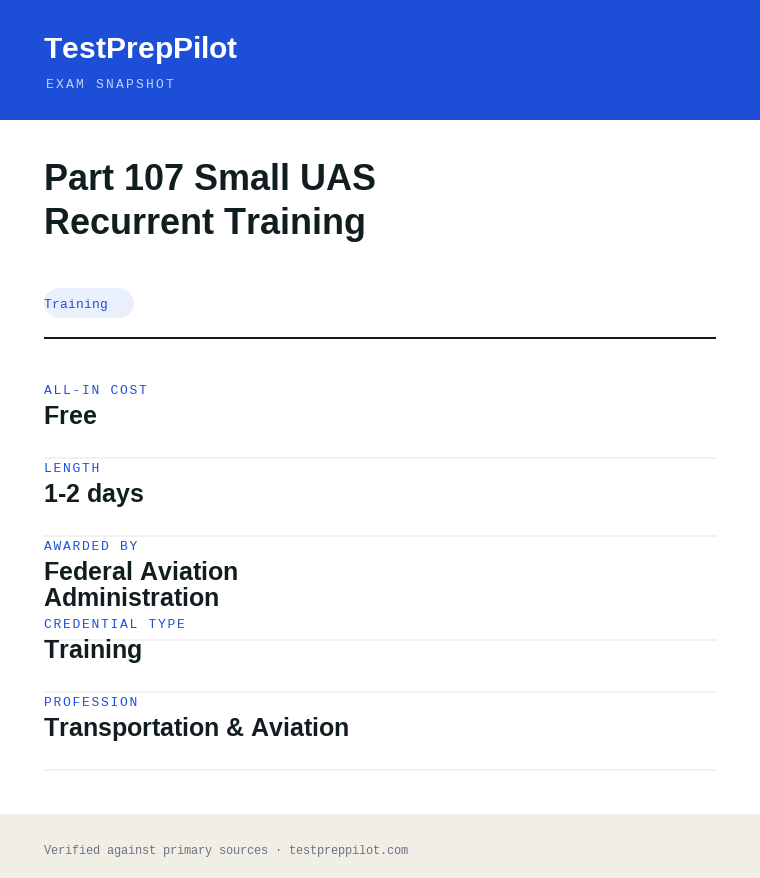
Part 107 Small UAS Recurrent Training is a training credential; awarded by Federal Aviation Administration; the exam fee is Free; typical preparation is 1-2 days.
| Credential | Part 107 Small UAS Recurrent Training |
|---|---|
| Abbreviation | ALC-677 |
| Type | Training |
| Profession | Transportation & Aviation |
| Specialty | FAA Airman Knowledge Tests |
| Awarded by | Federal Aviation Administration |
| Difficulty | Easy |
| Typical prep time | 1-2 days |
| All-in cost | Free |
| Delivery | FAA FAASTeam online course |
| Retake | Free to repeat as needed |
| Validity | Recurrent every 24 calendar months |
| Scope | National / Multi-state |
| Also known as | ALC-677, Part 107 Recurrent |
Real questions
Frequently asked questions about the Part 107 Small UAS Recurrent Training
Is ALC-677 a test?
No. It is a free online refresher course. You complete the modules and your completion is logged; there is no PSI written or fee.
How long does it take?
Most pilots finish in one to two hours of self-paced study.
Does it expire?
The currency it grants lasts 24 calendar months; you repeat the course before then to stay current.
Is it worth it?
Yes, it is mandatory to keep flying under Part 107, and it is free.
How do I enroll?
Log into FAASafety.gov, open the Part 107 recurrent (ALC-677) course, and complete it before your 24-month window ends.
Who actually charges the $175 knowledge-test fee?
PSI Services, the FAA’s testing contractor, charges the $175 when you schedule. The FAA charges nothing for the application, the background check or the certificate itself.
Is the knowledge test the same as the checkride?
No. The knowledge test is the computer-based written exam. Earning a certificate also requires a practical test (flight test or oral exam) with a Designated Pilot Examiner (DPE) or FAA inspector.
In short
Is the Part 107 Small UAS Recurrent Training worth it?
- Free online FAASTeam course, not a PSI test
- Required every 24 months to stay current
- Replaced the paid recurrent written
- Keeps Part 107 privileges active
Same awarding body
What other credentials does Federal Aviation Administration award?
Worth comparing
How does the Part 107 Small UAS Recurrent Training compare with similar credentials?
Trust
Where does this information come from?
Everything above is taken from the awarding body's own published material. Fees, question counts and domain weights are revised regularly — check the official page before you pay.
- Federal Aviation Administration Awarding body
Research confidence: high · Last reviewed 2026-08