Teaching & Education • Certification
Microsoft Certified Educator
Microsoft Certified Educator — Education & Teaching credential from Microsoft
Researched and maintained by TestPrepPilot Editorial BoardEdTech & teacher-certification desk · Figures last verified August 2026
The short version
What is the Microsoft Certified Educator and is it worth it?
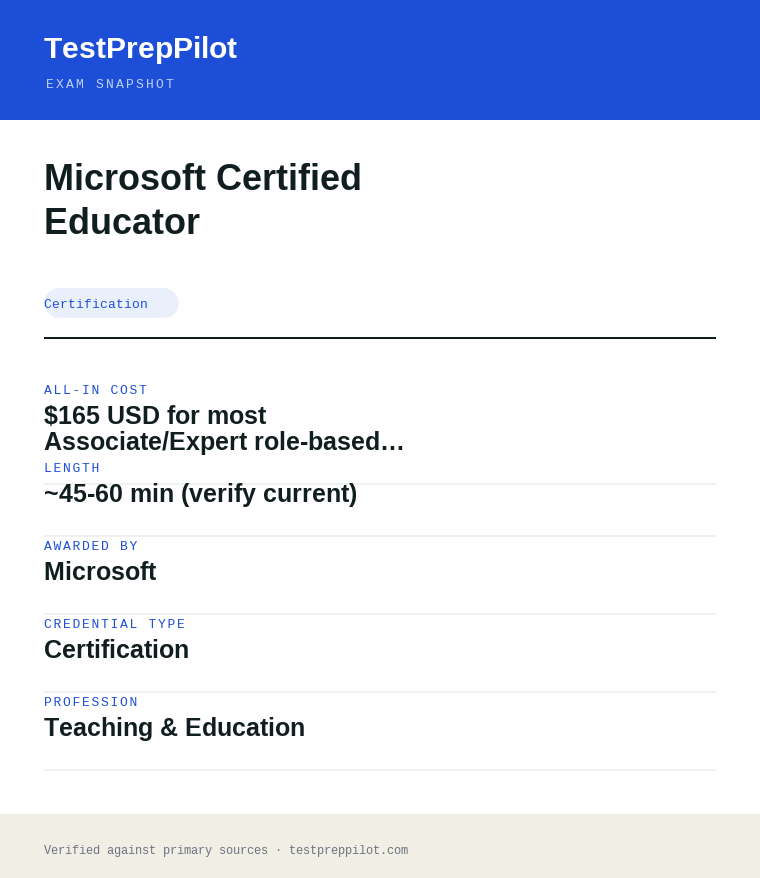
Microsoft Certified Educator is a Microsoft credential in the Education & Teaching field. It validates job-ready competence and is used for career entry, advancement, or compliance. Exam fee: $165 USD for most Associate/Expert role-based exams; Fundamentals-tier exams (e.
- Recognized Microsoft credential
- Demonstrates verified Education & Teaching competence
- Supports career advancement and may satisfy employer or regulatory requirements
What is it?
What exactly is the Microsoft Certified Educator?
Microsoft Certified Educator — Education & Teaching credential from Microsoft
Certification validating an educator ability to design technology-rich learning experiences using the ICT competency framework. Offered by Microsoft, it validates job-ready Education & Teaching competence. Exam fee: $165 USD for most Associate/Expert role-based exams; Fundamentals-tier exams (e. Review the official program page for eligibility, format, and scoring before registering.
The path in brief
- Confirm eligibility and any prerequisites
- Review the official exam guide and study materials
- Purchase and schedule the exam via Pearson VUE
- Take the exam (test center, online proctoring, or assessment)
- Receive results and your credential if passed
Before you book
Who is eligible to sit the Microsoft Certified Educator?
None (educators)
Who it is for: Professionals and candidates seeking to validate Education & Teaching competence with a Microsoft credential.
The test itself
What is the format of the Microsoft Certified Educator?
The Microsoft Certified Educator is administered by Pearson VUE and runs ~45-60 min and contains 40-60 (verify current) questions.
| Administered by | Pearson VUE |
|---|---|
| Questions | 40-60 (verify current) |
| Time limit | ~45-60 min |
| Pass mark | Passing score set by the awarding body; see the official score report |
| Exam fee | $50-$150 |
| Format | Proctored, computer-based — Pearson VUE test center or online remote proctoring. Price is the same either way. |
Content outline
What topics are on the Microsoft Certified Educator?
The Microsoft Certified Educator covers 4 content domains.
No percentage weights are listed for these domains here, so the outline is shown as structure only. Check the certifying body's published outline before allocating study time.
- Cloud / platform fundamentals
Topic area for this credential; see the official blueprint for the detailed breakdown.
- Configuration & implementation
Topic area for this credential; see the official blueprint for the detailed breakdown.
- Security & compliance
Topic area for this credential; see the official blueprint for the detailed breakdown.
- Operations & troubleshooting
Topic area for this credential; see the official blueprint for the detailed breakdown.
The path
How do you register for the Microsoft Certified Educator?
- 1
Sign in with a personal Microsoft account and open your Learn profile10-15 minutes
Microsoft strongly recommends registering with a personal Microsoft account (MSA) rather than a work or school account, because exam records tied to an organizational account are lost and unrecoverable if you leave that organization. Connect your certification profile to your Microsoft Learn profile so you can schedule, renew and print certificates.
- Sign in at learn.microsoft.com with a personal MSA
- Connect your certification profile to your Learn profile
- Confirm the legal name matches your government ID
Use the exact name on your ID; a mismatch can cost you the appointment and the fee.
- 2
Choose the exam and schedule through Pearson VUE10 minutes
From the exam page on Microsoft Learn, select Schedule exam and you are redirected to Pearson VUE. You can book up to 90 days in advance and can hold a maximum of two Microsoft Certification exams on the schedule at one time. The price shown depends on the country or region where you will be proctored.
- Open the exam page, for example learn.microsoft.com/credentials/certifications/exams/az-104
- Select a test center or online proctoring through Pearson VUE OnVUE
- Pay and confirm the appointment time
Associate and expert exams typically cost US$165; Fundamentals exams list at US$99 in the United States.
- 3
Reschedule or cancel at least 24 hours ahead if plans change5 minutes
Reschedule or cancel through your Learn profile, which redirects to Pearson VUE. A change made less than 24 hours before the appointment forfeits the fee, and a company voucher is forfeited as well. Microsoft does not refund fees for failed exams or missed appointments.
- Open Profile, then Credentials, then Certifications on Microsoft Learn
- Select Reschedule or Cancel beside the appointment
- Complete the change on the Pearson VUE site
Rescheduling inside the 24-hour window forfeits the exam fee.
- 4
Check in and sit the exam65 minutes (Fundamentals) to 140 minutes (associate/expert with labs) seat time
Take the exam at a Pearson VUE test center or through online proctoring, with government photo ID. Fundamentals exams give 45 minutes of exam time (65-minute seat time); associate and expert exams give 100 minutes (120-minute seat time), or 120 minutes (140-minute seat time) when labs may appear. Five minutes of unscheduled break time are built in, but the clock keeps running during a break.
- Arrive early for a test center or complete the OnVUE check-in
- Read the introduction screen for case study and lab counts
- Use the Microsoft Learn button on the left navigation pane for role-based exams
Learn access during the exam is allowed on associate and expert exams, not on Fundamentals exams.
- 5
Read your score report and, if you pass, claim the certificationMinutes after the exam; up to 24 hours to post
Most results appear within minutes of finishing; exams with labs take about 30 minutes to score. The score report shows a numeric score from 1 to 1,000, pass or fail, and a bar chart by skill area. Scores post to your Learn profile within 24 hours.
- Open Profile, Credentials, Certifications, then Past exams
- Select View details on provider site to open the Pearson VUE score report
- Claim your badge and certificate from the Learn profile
The bar chart cannot be summed into a percentage.
The fine print
What are the retake and renewal rules for the Microsoft Certified Educator?
- Proctoring & delivery
- Delivered by Pearson VUE at test centers or by OnVUE online proctoring. The exam is closed book apart from the Microsoft Learn window, which is available on associate and expert exams but not on Fundamentals exams. Exams with labs are restricted to test centers that meet connectivity requirements.
- Retake policy
- If you do not pass, you must wait 24 hours before the second attempt, then 14 days between every later attempt. You may not take the same exam more than five times in 12 months from your first attempt; after five failures you are eligible again 12 months from the date of the first attempt. You pay for every attempt, and you cannot retake an exam you passed unless the certification has expired.
- Score reporting
- Scores are scaled from 1 to 1,000 and 700 or higher passes; the scale compensates for question difficulty, so 700 does not equal 70 percent of the points. Results usually appear within minutes (about 30 minutes for exams with labs) and post to your Learn profile within 24 hours. There is no penalty for guessing, and some questions are unscored pilot items you cannot identify.
- Recertification
- Associate, expert and specialty certifications expire 12 months after you earn them, and renewal is free: pass an unproctored, open-book online assessment on Microsoft Learn during the six months before expiry, and the certification extends one year from the expiration date. There is no limit on renewal assessment attempts. Fundamentals certifications, including Azure AI Fundamentals, do not expire. Retired certifications and their renewal assessments can no longer be renewed.
- Refunds & rescheduling
- Microsoft does not refund fees for exams you fail or appointments you miss. Reschedule or cancel at least 24 hours before the appointment or the fee is forfeited. If a technical failure interrupts your exam and Pearson VUE opens a case, you can ask Microsoft Credentials support to waive the retake waiting period.
Context
Azure certifications in this group compared
| Exam | Level | Exam time | Renewal | |
|---|---|---|---|---|
| AI-901 Azure AI Fundamentals | Fundamentals | 45 minutes | Does not expire | |
| AZ-104 Azure Administrator Associate | Associate | 100 minutes | Free every 12 months | |
| AZ-140 Azure Virtual Desktop Specialty | Specialty | 100 minutes | Free every 12 months | |
| AI-102 Azure AI Engineer Associate | Associate (retired) | 100 minutes | Retired 30 June 2026 | |
| AZ-204 Azure Developer Associate | Associate (retired) | Retired 31 July 2026 | Retired 31 July 2026 |
What it pays
How much does this credential pay?
MCE evidences technology integration skill: kindergarten and elementary teachers earned a $62,340 median in May 2024 (BLS)
The Microsoft Certified Educator (MCE) certification evidences a teacher’s ability to use technology to support teaching and learning, mapped to the UNESCO ICT Competency Framework for Teachers. It is a professional-development credential, not a teaching license, so no BLS SOC code attaches to it; the salary story belongs to the teaching profession it serves. BLS reported that kindergarten and elementary school teachers (SOC 25-2021) earned a median of $62,340 in May 2024, and high school teachers (25-2031) about $64,580; teacher pay is set by district salary schedules driven by education and experience, not by certificates, which is the honest structural point. The value of the MCE is professional positioning: it signals technology-integration skill that districts consider in hiring, curriculum leadership and professional-development roles, and it sits alongside the Microsoft Innovative Educator (MIE) community program as the formal certification tier. BLS classifies workers by occupation, not certifications, so no certificate maps to a specific wage; the value is the professional-development signal in a field where districts weigh skills and leadership potential. The MCE exam (exam code 98-381 in some regions, with the program delivered through the Microsoft Learn educator path and regional exam delivery) tests the six ICT competency areas from the UNESCO framework - understanding ICT in education, curriculum and assessment, pedagogy, ICT tools, organization and administration, and teacher professional learning. The certification is valid for a set period (typically two to three years depending on the program edition; verify the current validity on Microsoft Learn) and requires renewal by re-certification.
| Measure | Figure | Source / note |
|---|---|---|
| Kindergarten and elementary teachers median, May 2024 | $62,340 | BLS OEWS, SOC 25-2021 |
| High school teachers median, May 2024 | $64,580 | BLS OEWS, SOC 25-2031 |
| All-occupation median, May 2024 | $49,500 | BLS OEWS |
| MCE exam basis | UNESCO ICT Competency Framework | Microsoft, six competency areas |
Job growth.Teacher employment is projected to grow about 1-2 percent from 2024 to 2034 with large replacement demand; edtech skill is a differentiator.
Source: BLS Occupational Outlook Handbook - Kindergarten and Elementary School Teachers
Your odds
What are the pass rates?
The MCE exam requires a passing score of 700 on a 1000-point scale; Microsoft publishes no pass rates
Microsoft does not publish pass rates for the Microsoft Certified Educator exam, but the assessment mechanics are public. The MCE exam is delivered through Microsoft’s certification platform and regional exam partners (in some regions it is administered by local education authorities), with a passing score of 700 on a 1000-point scale; the question count and time are stated in the exam description (commonly a computer-based exam of about 40-60 questions with a time allowance near 45-60 minutes, but candidates must verify the current specification on Microsoft Learn, because the program has been updated over the years). The exam tests the six ICT competency areas from the UNESCO ICT Competency Framework for Teachers: understanding ICT in education policies, curriculum and assessment, pedagogy (technology integration in teaching), ICT tools and resources, organization and administration (managing the digital classroom), and teacher professional learning. The exam is scenario-based: items present classroom situations and ask which technology approach or integration practice is most appropriate. The certification is valid for a period set by the program edition (commonly two to three years; verify the current validity on Microsoft Learn) and requires re-certification to renew. The honest summary is that the passing bar is 700/1000, the exam is scenario-based against the UNESCO framework, and the current exam code, length and validity must be verified on Microsoft Learn before registration, because the program has evolved over time.
Read this before quoting the number.Microsoft publishes no pass rates; the exam requires 700/1000. Verify the current exam code, length and validity on Microsoft Learn.
Your schedule
How long should I study for it?
20-40 hours over 2-4 weeks of focused study
A realistic MCE plan runs 20-40 hours over 2-4 weeks for a teacher already using Microsoft tools in the classroom. The exam is scenario-based against the UNESCO ICT Competency Framework, so preparation is about connecting classroom practice to the framework’s six competency areas. Week 1: review the six competency areas (understanding ICT in education, curriculum and assessment, pedagogy, ICT tools, organization and administration, teacher professional learning) and take a baseline assessment with the free Microsoft Learn educator training. Weeks 2-3: complete the Microsoft Learn educator path modules, which map to the framework, with hands-on practice in the Microsoft tools (Teams, OneNote, Forms, Flip-style tools, and the Microsoft 365 education apps) - create sample lessons, assignments and assessments using the tools, because the scenario items test whether you know which tool and integration practice fits which classroom situation. Week 4: take the practice questions and sample items, drill the exposed gaps, and take the real exam. The exam content clusters around: choosing the right technology approach for a learning goal, aligning technology use with curriculum and assessment, managing the digital classroom (Teams, communication, permissions), and integrating ICT across the six framework areas. Teachers with daily Microsoft tool use can compress the plan to 2 weeks; candidates new to the Microsoft education stack should budget the full path and hands-on practice. Registration and exam delivery vary by region, so candidates should verify the current process on the Microsoft Learn educator center.
- Week 16
Framework review and baseline
- Review the six ICT competency areas
- Baseline with free educator training
- Weeks 2-324
Modules and hands-on practice
- Microsoft Learn educator path
- Sample lessons with Teams, OneNote, Forms
- Week 48
Practice and real exam
- Practice questions
- Drill gaps; take the exam
Adjusting the pace
Regional delivery.Exam delivery and registration vary by region; verify the current process on the Microsoft Learn educator center.
MIE community.The Microsoft Innovative Educator community is the complementary, free membership program; MCE is the formal certification.
How to study
How do I prepare most effectively?
The most effective MCE strategies connect classroom practice to the framework. Strategy one: learn the six UNESCO ICT competency areas as the organizing map, because every exam item maps to a framework area and the scenario questions test which area’s practices apply to a given situation. Strategy two: practice with the Microsoft education tools hands-on - build sample lessons in Teams, OneNote and Forms, create assignments and assessments, and manage a practice class - because the scenario items assume tool familiarity and candidates who know the tools answer integration questions faster. Strategy three: use the Microsoft Learn educator training as the primary content source, because it is written to the framework and is free. Strategy four: practice the scenario-item style - items present a classroom situation (a differentiation need, a collaboration task, an assessment goal) and ask which technology approach is most appropriate; working through sample items internalizes the decision logic. Strategy five: review the pedagogy and curriculum areas even if you feel they are "education theory," because the exam tests technology integration within pedagogy, not tools in isolation. Strategy six: verify the current exam code, delivery and validity on Microsoft Learn before registering, because the program has been updated over the years and regional processes differ.
Learn the six framework areas
Every item maps to the UNESCO ICT competency areas.
Practice in the Microsoft tools
Teams, OneNote and Forms familiarity answers integration items.
Use Microsoft Learn educator training
Free and written to the framework.
Practice scenario items
Match classroom situations to the right technology approach.
What to buy
Which study resources are worth paying for?
The MCE resource market is anchored by Microsoft’s free official content. The Microsoft Learn educator center provides the training modules mapped to the UNESCO framework, the exam description and the registration process - all free; the Microsoft Innovative Educator (MIE) community membership is also free and complements the certification. Hands-on practice requires access to the Microsoft education tools (Microsoft 365 Education accounts, often free for educators through their school or the free educator offer). The exam fee varies by region and delivery partner (commonly in the $50-$150 range, with some regional programs subsidizing or requiring it through education authorities; verify the current fee for your region). Third-party prep materials for the MCE are scarce and unnecessary, because the free Microsoft content and the framework documents cover the scope. The honest ranking: the free Microsoft Learn educator path and the UNESCO framework document, hands-on tool practice, and the exam registration as the only cost. Prices here are current as of 2025-26 and vary by region.
| Resource | Price | Format | Best for |
|---|---|---|---|
| Microsoft Learn educator path | Free | Online | The official study content |
| UNESCO ICT framework document | Free | The organizing map for the exam | |
| Microsoft 365 education tools | Free for educators (often) | Web/desktop | Hands-on practice surface |
| MIE community | Free | Online | Professional community and resources |
Prices dated 2025-26; the exam fee varies by region. Verify current process on Microsoft Learn. No commission-based ranking.
Avoid these
What mistakes do candidates most often make?
The most common MCE mistakes come from studying tools in isolation from the framework. Mistake one: practicing tool features without the framework; the exam tests technology integration within the six UNESCO competency areas, and candidates who know the tools but not the integration logic miss the scenario items. Mistake two: skipping the pedagogy and curriculum areas as "theory"; the exam weighs technology use within curriculum, assessment and pedagogy, and candidates who skip them miss a large share of the items. Mistake three: assuming tool familiarity from daily teaching; the exam tests specific integration practices (choosing the right tool for the learning goal), which requires deliberate practice with sample scenarios, not just habitual use. Mistake four: ignoring the regional delivery differences; registration, fees and delivery vary by region, and candidates who assume a uniform process miss deadlines. Mistake five: letting the certification lapse; the MCE has a validity period (commonly two to three years, verify the current term) and requires re-certification. Mistake six: using outdated materials; the program has been updated over the years, and candidates should verify the current exam code and content on Microsoft Learn.
✕Tools without the framework
✓Learn the six UNESCO competency areas.
✕Skipping pedagogy and curriculum
✓Technology integration within pedagogy is the test’s core.
✕Assuming daily use is enough
✓Practice scenario items and integration decisions.
✕Ignoring regional delivery
✓Verify registration, fees and delivery for your region.
✕Letting the certification lapse
✓Renew by re-certification within the validity period.
What you'll face
What question types will I see?
The Microsoft Certified Educator exam is a computer-based exam (commonly 40-60 questions with a time allowance near 45-60 minutes; verify the current specification on Microsoft Learn), passing at 700/1000. Items are scenario-based and mapped to the six UNESCO ICT competency areas: understanding ICT in education, curriculum and assessment, pedagogy, ICT tools, organization and administration, and teacher professional learning. Question formats include multiple choice and scenario-based items presenting classroom situations. Samples below are editor-written illustrations of the published exam scope, not live exam items.
Policies, digital literacy, responsible use.
Aligning technology with curriculum goals and assessments.
Integration practices and choosing the right tool.
Managing the digital classroom and teacher learning.
Try these
Q1A teacher wants students to collaborate on a single document in real time and leave comments for peer feedback. Which approach is most appropriate?
Answer:A
A shared document with edit permissions supports real-time collaboration and commenting; the other options prevent simultaneous editing and peer feedback.
Q2A teacher needs to gather quick comprehension data from 30 students during class. Which tool-based approach is most appropriate?
Answer:A
A Forms quiz provides instant, structured comprehension data during class, enabling immediate adjustment; the other options delay or lose the data.
Q3A school wants teachers to demonstrate they have integrated ICT into their teaching practice. Which certification-based evidence aligns with the UNESCO framework?
Answer:A
The MCE certifies teacher ICT competency mapped to the UNESCO framework; owning devices, attending one session, or using a projector does not evidence integration competency.
Samples are editor-written illustrations of the published exam scope, not live exam items.
The big day
What should I expect on exam day?
The Microsoft Certified Educator exam is delivered through the Microsoft certification platform and regional exam partners; delivery varies by region (online proctored in many regions, test-center in others), so candidates must confirm the current process on the Microsoft Learn educator center. On the day, complete any system check ahead of time (online delivery), use a quiet private room, and bring valid ID for test-center delivery; the exam runs per the current specification (commonly under an hour), and the passing score is 700/1000. Results appear on screen or within a short reporting window, and the certification is recorded in the candidate’s Microsoft profile. The certification is valid for the period set by the program edition (commonly two to three years; verify the current term) and requires re-certification to renew. Afterwards, add the certification to your resume and district professional-development records, set the renewal reminder, and join the Microsoft Innovative Educator community if you have not, because the community membership complements the formal certification.
Bring
- Valid ID (test center)
- Appointment confirmation
- Online: verified system and quiet room
- Microsoft profile sign-in
Leave at home
- Phone, smartwatch, and personal electronics
- Notes or study materials
- Second monitors or devices for online delivery
How the day runs
Rules in the room
- Delivery varies by region; verify the process on Microsoft Learn.
- The passing score is 700/1000.
- No notes or assistance are permitted.
- The certification has a validity period and requires re-certification.
Afterwards.Add the certification to your resume and district records, set the renewal reminder, and join the MIE community for the complementary professional network.
Reference
What are the key facts about the Microsoft Certified Educator?
Microsoft Certified Educator is a certification credential; awarded by Microsoft; the exam fee is $50-$150; typical preparation is ~45-60 min (verify current); holders typically earn $45,000-$80,000 (K-12 teachers).
| Credential | Microsoft Certified Educator |
|---|---|
| Abbreviation | MCE |
| Type | Certification |
| Profession | Teaching & Education |
| Specialty | TESOL, Language & Education Technology |
| Awarded by | Microsoft |
| Difficulty | Mixed |
| Typical prep time | ~45-60 min (verify current) |
| All-in cost | $165 USD for most Associate/Expert role-based exams; Fundamentals-tier exams (e |
| Typical salary range | $45,000-$80,000 (K-12 teachers) |
| Credential | Microsoft Certified Educator |
| Awarding body | Microsoft |
| Exam fee | $165 USD for most Associate/Expert role-based exams; Fundamentals-tier exams (e |
| Delivery | Proctored, computer-based — Pearson VUE test center or online remote proctoring. Price is the same either way. |
| Validity | Renewable annually via free online assessment |
| Scope | National / Multi-state |
| Also known as | MCE |
Real questions
Frequently asked questions about the Microsoft Certified Educator
How much does the Microsoft Certified Educator exam cost?
$165 USD for most Associate/Expert role-based exams; Fundamentals-tier exams (e.g., AZ-900) are $99 USD. Priced per attempt in USD, billed in local currency; regional tax may apply.
How do I register and schedule?
Register and schedule through Pearson VUE. Create an account, purchase the exam, and pick a date (test center, online proctoring, or assessment as applicable).
How long is the credential valid, and how do I renew?
The MCE exam is scenario-based against the UNESCO ICT Competency Framework and passes at 700/1000; delivery varies by region.
What is the retake policy?
Full fee per attempt. First retake after 24 hours; subsequent retakes after a 14-day wait; maximum 5 attempts in 12 months.
Do Microsoft certifications expire?
Associate, expert and specialty Microsoft certifications expire after 12 months unless renewed, but Fundamentals certifications never expire. Renewal is free: you pass an unproctored, open-book online assessment on Microsoft Learn during the six months before expiry, and Microsoft extends the certification one year from the expiration date. You can retake the renewal assessment as many times as needed.
What is the Microsoft exam retake policy?
After a failed attempt you wait 24 hours, then 14 days between every later attempt, with a maximum of five attempts in 12 months from your first. You pay the full exam fee each time. Microsoft grants a waiver of the waiting period only when internet or equipment failure interrupted the exam and Pearson VUE created a case.
How is a Microsoft certification exam scored?
Technical exam scores run from 1 to 1,000 and 700 is the passing score. It is a scaled score, so it does not equal 70 percent of the points. There is no penalty for guessing, and unscored pilot questions are mixed in without being identified. Your report shows an overall score and a bar chart by skill area.
In short
Is the Microsoft Certified Educator worth it?
- Microsoft Certified Educator is awarded by Microsoft.
- Validates Education & Teaching competence.
- Exam fee: $165 USD for most Associate/Expert role-based exams; Fundamentals-tier exams (e.
- Renewal: Free online renewal assessment on Microsoft Learn (role-based and specialty certs renew this way; effectively no recurring fee).
Same awarding body
What other credentials does Microsoft award?
Trust
Where does this information come from?
Everything above is taken from the awarding body's own published material. Fees, question counts and domain weights are revised regularly — check the official page before you pay.
- Microsoft Awarding body
- Microsoft certification programme Programme rules
Research confidence: medium · Last reviewed 2026-08