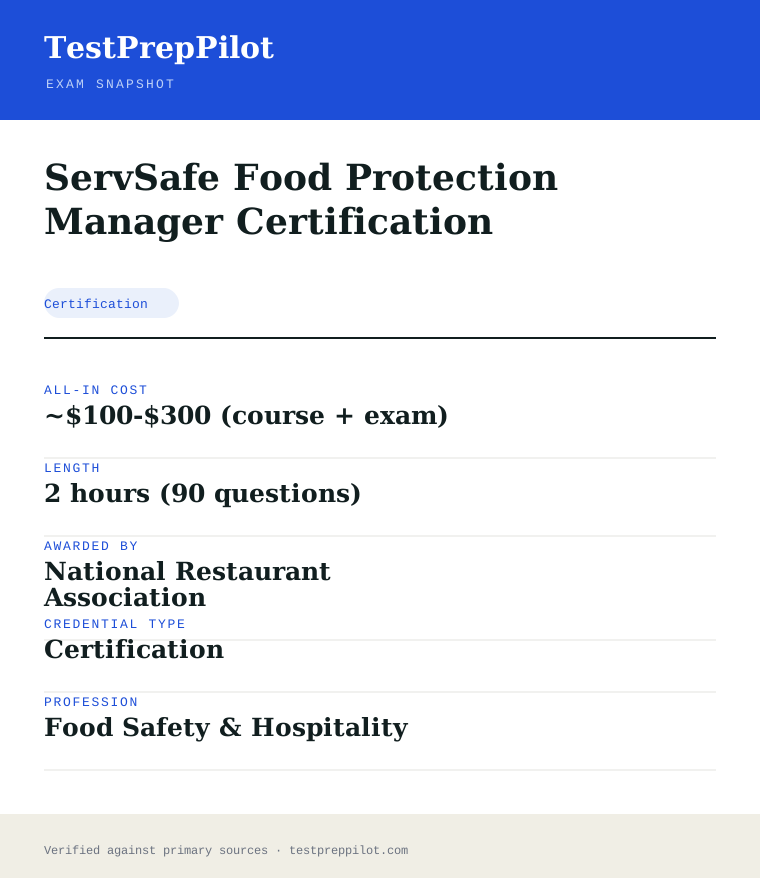
The short version
What is the ServSafe Food Protection Manager Certification and is it worth it?
ServSafe Food Protection Manager Certification is a professional credential administered by National Restaurant Association. It validates job-ready knowledge and skills in the Beauty, Food, Security & Recreation field and is used for career entry, advancement, or compliance.
- Recognized credential from National Restaurant Association
- Demonstrates verified competence in Beauty, Food, Security & Recreation
- Supports career advancement and may satisfy licensing or employer requirements
What is it?
What exactly is the ServSafe Food Protection Manager Certification?
ServSafe Food Protection Manager Certification — Beauty, Food, Security & Recreation credential from National Restaurant Association
Most widely accepted ANSI-CFP accredited manager food safety examination, valid five years in most United States jurisdictions. Offered by National Restaurant Association, it is designed for candidates who need to demonstrate verified competence in the Beauty, Food, Security & Recreation field. The credential is commonly used for career entry, advancement, regulatory compliance, or employer requirements. Candidates should review the official handbook for eligibility, exam format, and scoring before registering.
The path in brief
- Confirm you meet any eligibility or prerequisites
- Review the official handbook and study materials
- Register and pay through the awarding body or authorized provider
- Schedule and take the exam (test center or online proctoring)
- Receive your score and, if passed, your credential
Before you book
Who is eligible to sit the ServSafe Food Protection Manager Certification?
Eligibility varies; many credentials are open to all, while others require coursework, work experience, or sponsorship.
Who it is for: Professionals and candidates seeking to validate Beauty, Food, Security & Recreation competence.
The test itself
What is the format of the ServSafe Food Protection Manager Certification?
The ServSafe Food Protection Manager Certification is administered by National Restaurant Association and runs 2 hours and contains 90 (68 of 90, 75%, to pass) questions.
| Administered by | National Restaurant Association |
|---|---|
| Questions | 90 (68 of 90, 75%, to pass) |
| Time limit | 2 hours |
| Pass mark | Passing score set by the awarding body; see the official score report |
| Exam fee | Varies by location and currency — confirm on the official registration page |
| Format | Proctored, computer-based (test center or online remote proctoring) |
Content outline
What topics are on the ServSafe Food Protection Manager Certification?
The ServSafe Food Protection Manager Certification covers 4 content domains.
Weightings come from the official exam outline. Study time is best allocated in roughly these proportions rather than evenly across domains.
- Core techniques
Topic area tested on the exam; see the official blueprint for the detailed breakdown.
- Sanitation & safety
Topic area tested on the exam; see the official blueprint for the detailed breakdown.
- Client / guest service
Topic area tested on the exam; see the official blueprint for the detailed breakdown.
- Regulations
Topic area tested on the exam; see the official blueprint for the detailed breakdown.
The path
How do you register for the ServSafe Food Protection Manager Certification?
- 1
Visit the awarding body’s official website and create an account
- 2
Select the credential and review its specific requirements
- 3
Complete any required eligibility (education, experience, or training)
- 4
Pay the registration fee
- 5
Schedule the exam at a test center or online
- 6
Take the exam and receive your results
The fine print
What are the retake and renewal rules for the ServSafe Food Protection Manager Certification?
- Proctoring & delivery
- Proctored, computer-based delivery (test center or remote online proctoring), varying by exam.
- Retake policy
- Varies by credential — most bodies permit retakes after a waiting period and full or partial fee.
- Score reporting
- Scores are reported per the body’s timeline, typically electronically after the exam.
- Recertification
- Varies; many credentials require renewal every 2–3 years via continuing education or a recertification exam.
What it pays
How much does this credential pay?
$66,860 median for food service managers (BLS, May 2024)
There is no Bureau of Labor Statistics occupation called "ServSafe Manager" — the ServSafe Food Protection Manager certification validates food-safety knowledge, and the wage question belongs to the role you perform with it. The closest official BLS occupation is Food Service Managers, SOC 35-2021, which had a May 2024 median wage of $66,860, with the lowest 10 percent under $41,450 and the highest 10 percent above $112,000. The fit is direct: the certification is the standard requirement for food-safety managers in restaurants, institutional kitchens and retail foodservice, and in many jurisdictions a certified manager must be on staff — so the credential is a gate to the manager role itself. BLS counted 286,100 food service manager jobs in 2024 and projects 3 percent growth from 2024 to 2034, with about 27,700 openings a year, nearly all replacement demand. The limitation to state plainly: the BLS median covers all food service managers, certified or not, and the certification carries no wage premium in government data; its value is employability — many employers require it for management positions, and health-department audits check for a certified manager. Read the number as the market for the role the credential unlocks, and note that front-line food workers earn substantially less, around the median for food preparation and serving workers.
| Measure | Figure | Source / note |
|---|---|---|
| Median annual wage, food service managers | $66,860 | BLS OOH, SOC 35-2021, May 2024 |
| Lowest 10 percent | Under $41,450 | BLS OOH, SOC 35-2021, May 2024 |
| Highest 10 percent | Above $112,000 | BLS OOH, SOC 35-2021, May 2024 |
| Projected openings per year | ~27,700 | BLS OOH, SOC 35-2021, 2024-2034 |
Job growth.BLS projects 3 percent growth for food service managers from 2024 to 2034, about 27,700 openings per year.
Source: BLS Occupational Outlook Handbook - Food Service Managers
Your odds
What are the pass rates?
ServSafe publishes the format and the 75% passing standard, and reports that most candidates pass on the first attempt
ServSafe (the National Restaurant Association) publishes the passing standard and describes the certification as passable by the large majority of prepared candidates, though it does not publish a precise cohort pass-rate statistic in its official materials; we treat the "most candidates pass" framing as the body's own characterization rather than a precise figure. What ServSafe does publish is the format: the Food Protection Manager exam has 90 questions with a 2-hour time limit, and a passing score of 75 percent — at least 68 correct answers. The exam is delivered on paper or by computer through ServSafe's proctored network, and the certification is valid for five years, renewable by retaking the exam. The exam content follows the ServSafe course: foodborne microorganisms and allergens, personal hygiene, time and temperature control, cross-contamination prevention, cleaning and sanitizing, and the food-safety management system. The practical reading: the 75 percent line on 90 questions is an achievable bar for candidates who complete the ServSafe course and study, and the bigger failure mode is administrative — arriving without the required identification or a valid exam voucher — rather than content failure.
Read this before quoting the number.ServSafe publishes the 75% passing standard and course-pass framing but not a precise cohort pass rate.
Your schedule
How long should I study for it?
12-20 hours over 1-2 weeks of focused study
The ServSafe Food Protection Manager exam is a 90-question, 2-hour test with a 75 percent passing line, and its curriculum is the ServSafe Manager course: the six content areas of food safety — microorganisms and foodborne illness, personal hygiene, time and temperature control, cross-contamination, cleaning and sanitizing, and the food-safety management system. A defensible plan runs 12 to 20 hours over one to two weeks. Days one to three: work the course material on the pathogens — the Big Six illnesses, their sources and prevention — because foodborne-illness items are a large share of the exam. Days four to six: master time and temperature control — the temperature danger zone, minimum cooking temperatures, cooling and reheating rules, and holding requirements — the largest and most item-heavy content area. Days seven to nine: cover cross-contamination, cleaning and sanitizing (including the chemical sanitizers and their concentrations), and personal hygiene. Day ten: take the ServSafe practice exam, review weak areas, and schedule the certification. The plan is compact because the scope is focused and the exam is a professional requirement, not a competitive gate; most candidates pass with the course plus practice.
- Days 1-36
Pathogens and illness
- The Big Six foodborne illnesses: sources and prevention
- Food allergens and their management
- Personal hygiene and handwashing rules
- Days 4-66
Time and temperature
- The temperature danger zone and holding rules
- Minimum cooking temperatures by food
- Cooling, reheating and thawing procedures
- Days 7-95
Contamination, cleaning, sanitizing
- Cross-contamination prevention and storage order
- Cleaning vs sanitizing; sanitizer concentrations
- The food-safety management system
- Day 103
Practice and exam
- Take the ServSafe practice exam
- Review weak content areas
- Sit the certification exam
Adjusting the pace
Experienced kitchen manager.Compress the plan to 5-7 days; the time-and-temperature details and sanitizer concentrations are the highest-yield review.
New to foodservice.Stretch to 3 weeks; the course readings matter more when the kitchen context is unfamiliar.
How to study
How do I prepare most effectively?
The ServSafe Manager exam rewards applied food-safety reasoning, so the dominant strategy is learning the rules as a system rather than memorising isolated facts: the exam asks what to do in a described kitchen situation, so practice items are where the learning happens. Second, master time and temperature as the largest content block — the danger zone (41°F to 135°F), minimum cooking temperatures for poultry, ground meats, seafood and eggs, and the cooling and reheating procedures — because candidates who know these cold cover the biggest share of items. Third, learn the "Big Six" illnesses and their control points: the exam tests which food is linked to which pathogen and what prevents it. Fourth, study the sanitizer concentrations and the cleaning-versus-sanitizing distinction precisely, because those items reward exact numbers. Fifth, use the ServSafe practice exam, which closely mirrors the real item style, and hold yourself to 80 percent-plus on practice because the 75 percent line leaves little margin on a 90-question paper. Finally, remember the certification is valid five years; note your renewal date and plan the retake.
Drill applied scenarios
The exam asks what to do in a kitchen situation; practise that decision style.
Master time and temperature
The danger zone, cooking minimums and cooling rules are the largest block.
Learn the Big Six
Pathogen-to-food links and their prevention are tested directly.
Know the sanitizer numbers
Concentrations and the clean-versus-sanitize distinction reward exact recall.
Plan the five-year renewal
The certification is valid 5 years; mark the retake date.
What to buy
Which study resources are worth paying for?
ServSafe prep is inexpensive because the course and exam are bundled. The ServSafe Food Protection Manager course is offered in three formats — online, print and classroom — with pricing from roughly $100 to $300 depending on format and whether the exam voucher is included; the standard package is the online course plus the exam. The ServSafe practice exam and study guide are the key supplements, and the ServSafe website provides the content outline free. Third-party study guides ($20-$50) and question banks ($20-$60) add practice volume. Free resources include the ServSafe content outline, state food-code publications and the FDA Food Code, which is the regulatory reference behind the exam. A realistic total budget is $120 to $350 including the course and exam. Prices below are list prices as of mid-2026 and change frequently; we rank nothing by commission.
| Resource | Price | Format | Best for |
|---|---|---|---|
| ServSafe content outline | Free | Official PDF | The authoritative scope; read it first |
| ServSafe Manager course (online) | ~$100-$200 | Online course + exam voucher | The standard path; bundle the exam |
| ServSafe classroom course | ~$200-$300 | Instructor-led class + exam | Learners who prefer live instruction |
| ServSafe practice exam | ~$30-$50 | Online practice items | The closest thing to the real exam |
| Third-party question banks | $20-$60 | Online practice items | Extra drilling volume |
List prices as of mid-2026, subject to change; ServSafe pricing varies by format and provider; no commission or affiliate ranking is implied.
Avoid these
What mistakes do candidates most often make?
The most common ServSafe mistake is memorising facts without learning the applied rules: candidates who know what salmonella is but cannot answer what temperature poultry must reach miss the largest block of items. The fix is scenario drilling, especially on time and temperature. The second mistake is confusing cleaning with sanitizing, or misremembering the sanitizer concentrations — the exam tests the exact numbers, and a common failing is knowing the procedure but not the strength. Third, candidates mislearn the danger zone boundaries or the cooling rules, which are tested precisely (41°F-135°F, and cooling from 135°F to 70°F in two hours then to 41°F in four). Fourth, some candidates skip the practice exam and meet the item style cold; the applied phrasing is learnable, so practise it. Finally, administrative mistakes — missing ID, an expired voucher, or scheduling at the wrong site — are a real failure mode; confirm the logistics before exam day.
✕Memorising facts, not rules
✓Drill what to do in described kitchen situations, especially temperatures.
✕Confusing cleaning and sanitizing
✓Learn the distinction and the exact sanitizer concentrations.
✕Mislearning the cooling rules
✓135°F to 70°F in 2 hours, then to 41°F in 4 — tested precisely.
✕Skipping the practice exam
✓The applied item style is learnable; take the official practice exam.
✕Administrative slip-ups
✓Confirm ID, voucher and site before exam day.
What you'll face
What question types will I see?
The ServSafe Manager exam is a 90-question multiple-choice exam in 2 hours. The items are scenario-heavy: a described kitchen situation — a delivery, a storage problem, a cooling procedure, a cleaning task — followed by the correct food-safety action or rule. The exam covers the six content areas, with time and temperature the largest block. Samples below are editor-written illustrations of the published course content, not live exam items; they show the applied, kitchen-scenario style of the real items.
Danger zone, cooking minimums, cooling and holding rules.
Foodborne illnesses, allergens, personal hygiene.
Cross-contamination, cleaning vs sanitizing, storage order.
Try these
Q1A cook is preparing ground beef patties. To be safe, the patties must be cooked to an internal temperature of at least:
Answer:A
Ground meats (including ground beef) must reach 155°F for 15 seconds. Whole muscle meats are 145°F, poultry is 165°F, and 135°F is the holding temperature for hot food — mixing them up is the classic trap.
Q2A food worker has diarrhea and reports to work. Under ServSafe rules, the manager should:
Answer:A
A food worker with diarrhea must be excluded from the operation per food-safety rules (a diarrheal symptom triggers exclusion, not just restriction). Allowing any food handling, kitchen work or self-assessment misapplies the symptom-based policy.
Q3To cool a large pot of chili safely, the first step per ServSafe is to:
Answer:A
Shallow pans increase surface area and speed cooling, which is the first step of proper cooling. Leaving chili on the counter, covering it tightly at room temperature or waiting overnight each keep it in the danger zone and violate the cooling rules.
Samples are editor-written illustrations of the published course content, not live exam items.
The big day
What should I expect on exam day?
The ServSafe Food Protection Manager exam is a 90-question, 2-hour test delivered on paper or by computer through ServSafe's proctored network, typically at a training site or an approved testing location. Bring the required identification matching your registration and the exam voucher; without them you may be turned away. Arrive early — the site has check-in procedures. Pace at about 80 seconds per item and flag uncertain items for review; the 75 percent line (68 of 90) leaves a modest margin, so review flagged items carefully. Your result is reported after scoring, and ServSafe issues the certificate on a pass. If you do not pass, you retake per the program's policy, typically after additional study. On a pass, the certification is valid for five years and is renewed by retaking the exam. The afterwards matters: provide the certificate to your employer for the health-department requirement, note the renewal date, and keep a copy for audits.
Bring
- Required identification per the exam confirmation
- Your exam voucher
- Any materials the site requires
Leave at home
- Phone, smartwatch and personal electronics
- Notes and study materials — the exam is closed book
How the day runs
Rules in the room
- The exam is closed book
- 90 questions in 2 hours; the clock does not pause
- The certification is valid 5 years, renewed by retaking
Afterwards.On a pass, your ServSafe Manager certification is valid for five years; provide it to your employer and mark the renewal date. On a fail, retake after additional course and practice-exam study.
Reference
What are the key facts about the ServSafe Food Protection Manager Certification?
ServSafe Food Protection Manager Certification is a certification credential; awarded by National Restaurant Association; the exam fee is Varies by location and currency — confirm on the official registration page; typical preparation is 2 hours (90 questions); holders typically earn $41,000-$112,000.
| Credential | ServSafe Food Protection Manager Certification |
|---|---|
| Type | Certification |
| Profession | Food Safety & Hospitality |
| Specialty | Food Safety & Culinary |
| Awarded by | National Restaurant Association |
| Difficulty | Entry to Applied |
| Typical prep time | 2 hours (90 questions) |
| All-in cost | ~$100-$300 (course + exam) |
| Typical salary range | $41,000-$112,000 |
| Credential | ServSafe Food Protection Manager Certification |
| Awarding body | National Restaurant Association |
| Exam format | Proctored, computer-based |
| Validity | 5 years — renew by retaking the exam. |
| Languages | Varies — see awarding body |
| Scope | National / Multi-state |
Real questions
Frequently asked questions about the ServSafe Food Protection Manager Certification
How do I register for the ServSafe Food Protection Manager Certification exam?
Register through National Restaurant Association's official portal or an authorized test provider (e.g., Pearson VUE or Prometric where applicable). Create an account, select the exam, pay the fee, and schedule a date.
How much does the exam cost?
Fees vary by location and currency. Confirm the current fee on the official registration page before scheduling.
How long is the credential valid, and how do I renew?
ServSafe Food Protection Manager certification is valid for 5 years and is renewed by retaking the exam; there is no continuing-education renewal path.
What if I do not pass?
Most bodies allow retakes after a waiting period and payment of the full or partial fee. Check National Restaurant Association's retake policy before rescheduling.
How do I register for a National Restaurant Association credential?
Register through the official website, select your exam, pay the fee, and schedule a date.
How do I renew a credential?
Renewal policies vary by credential; check the specific program page for requirements and cycles.
In short
Is the ServSafe Food Protection Manager Certification worth it?
- ServSafe Food Protection Manager Certification is awarded by National Restaurant Association.
- Validates job-ready competence in Beauty, Food, Security & Recreation.
- Registration is through the awarding body or an authorized test provider.
- Renewal and retake policies vary — confirm before scheduling.
Same awarding body
What other credentials does National Restaurant Association award?
Worth comparing
How does the ServSafe Food Protection Manager Certification compare with similar credentials?
Trust
Where does this information come from?
Everything above is taken from the awarding body's own published material. Fees, question counts and domain weights are revised regularly — check the official page before you pay.
Research confidence: low · Last reviewed 2026-08