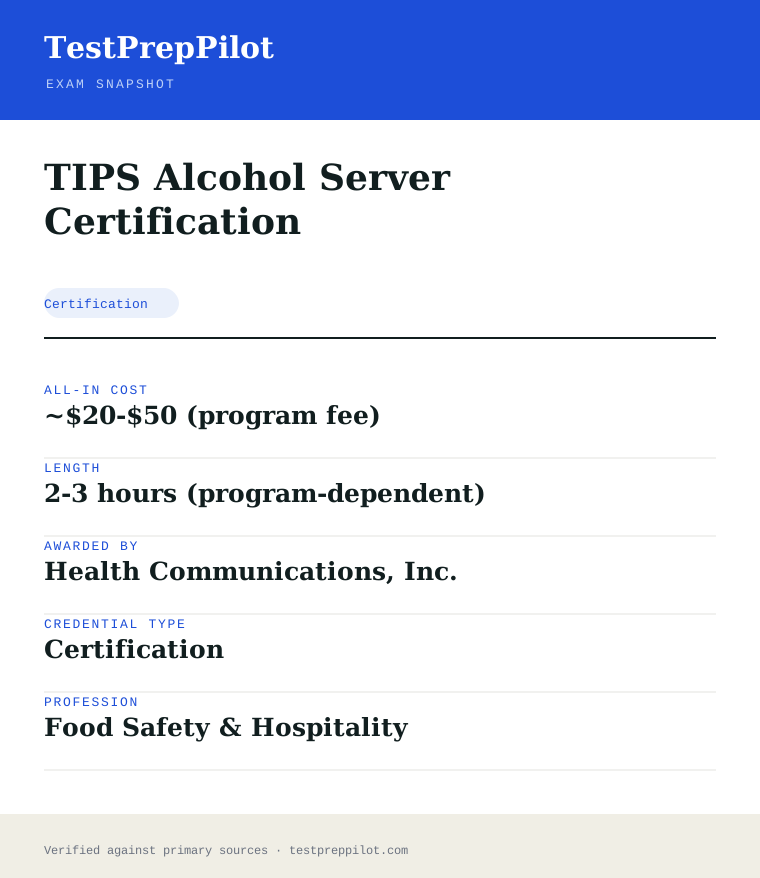
The short version
What is the TIPS Alcohol Server Certification and is it worth it?
TIPS Alcohol Server Certification is a professional credential administered by Health Communications, Inc.. It validates job-ready knowledge and skills in the Beauty, Food, Security & Recreation field and is used for career entry, advancement, or compliance.
- Recognized credential from Health Communications, Inc.
- Demonstrates verified competence in Beauty, Food, Security & Recreation
- Supports career advancement and may satisfy licensing or employer requirements
What is it?
What exactly is the TIPS Alcohol Server Certification?
TIPS Alcohol Server Certification — Beauty, Food, Security & Recreation credential from Health Communications, Inc.
Long-established responsible alcohol service training and test used nationally, with separate state-approved course versions. Offered by Health Communications, Inc., it is designed for candidates who need to demonstrate verified competence in the Beauty, Food, Security & Recreation field. The credential is commonly used for career entry, advancement, regulatory compliance, or employer requirements. Candidates should review the official handbook for eligibility, exam format, and scoring before registering.
The path in brief
- Confirm you meet any eligibility or prerequisites
- Review the official handbook and study materials
- Register and pay through the awarding body or authorized provider
- Schedule and take the exam (test center or online proctoring)
- Receive your score and, if passed, your credential
Before you book
Who is eligible to sit the TIPS Alcohol Server Certification?
Eligibility varies; many credentials are open to all, while others require coursework, work experience, or sponsorship.
Who it is for: Professionals and candidates seeking to validate Beauty, Food, Security & Recreation competence.
The test itself
What is the format of the TIPS Alcohol Server Certification?
The TIPS Alcohol Server Certification is administered by Health Communications, Inc. and runs ~1 hour.
| Administered by | Health Communications, Inc. |
|---|---|
| Questions | ~40 questions |
| Time limit | ~1 hour |
| Pass mark | Passing score set by the awarding body; see the official score report |
| Exam fee | ~$20-$50 |
| Format | Proctored, computer-based (test center or online remote proctoring) |
Content outline
What topics are on the TIPS Alcohol Server Certification?
The TIPS Alcohol Server Certification covers 4 content domains.
Weightings come from the official exam outline. Study time is best allocated in roughly these proportions rather than evenly across domains.
- Core techniques
Topic area tested on the exam; see the official blueprint for the detailed breakdown.
- Sanitation & safety
Topic area tested on the exam; see the official blueprint for the detailed breakdown.
- Client / guest service
Topic area tested on the exam; see the official blueprint for the detailed breakdown.
- Regulations
Topic area tested on the exam; see the official blueprint for the detailed breakdown.
The path
How do you register for the TIPS Alcohol Server Certification?
- 1
Visit the awarding body’s official website and create an account
- 2
Select the credential and review its specific requirements
- 3
Complete any required eligibility (education, experience, or training)
- 4
Pay the registration fee
- 5
Schedule the exam at a test center or online
- 6
Take the exam and receive your results
The fine print
What are the retake and renewal rules for the TIPS Alcohol Server Certification?
- Proctoring & delivery
- Proctored, computer-based delivery (test center or remote online proctoring), varying by exam.
- Retake policy
- Varies by credential — most bodies permit retakes after a waiting period and full or partial fee.
- Score reporting
- Scores are reported per the body’s timeline, typically electronically after the exam.
- Recertification
- Varies; many credentials require renewal every 2–3 years via continuing education or a recertification exam.
What it pays
How much does this credential pay?
TIPS certification is an employment gate for alcohol service: bartenders earned a $33,530 median in May 2024 (BLS OOH, SOC 35-3011)
The TIPS Alcohol Certification is a responsible-beverage-service training certificate, not a licence for a specific occupation, so there is no single BLS SOC code attached to it; what it does is prove that a person who serves or sells alcohol understands how to prevent intoxication, underage drinking and drunk driving — a credential that many employers, municipalities and some states require as a condition of employment or licensing. The salary story belongs to the occupations that require it. BLS reported that bartenders (SOC 35-3011), the occupation most closely associated with TIPS certification, earned a median annual wage of $33,530 in May 2024, with employment of 756,700 and growth projected at 6 percent from 2024 to 2034 — faster than the average for all occupations — and about 129,600 openings projected each year. The structural point for workers is that the certificate is inexpensive (typically $40 to $55 for the online course), quick (two to three hours online, three to four hours in a classroom), and widely required: in states and municipalities where responsible-beverage training is mandatory — such as Boston, which requires TIPS for all alcohol servers and sellers — you cannot work without an approved certificate, and in voluntary jurisdictions most employers require it anyway. For employers it is a liability tool — certified staff strengthen the establishment’s position under dram-shop liability rules and can qualify it for insurance premium discounts. BLS classifies workers by job duty, not certificates, so no credential maps to a specific wage; the certificate removes a hiring barrier, and the wage follows the job — which for bartenders is a $33,530 median with a wide tip-inclusive range and strong entry-level demand.
| Measure | Figure | Source / note |
|---|---|---|
| Bartenders median, May 2024 | $33,530 | BLS Occupational Outlook Handbook, SOC 35-3011 |
| Bartenders employment, 2024 | 756,700 jobs | BLS OOH Quick Facts, 2024 |
| Bartenders projected growth, 2024-34 | +6% | BLS OOH Quick Facts — faster than average, ~129,600 openings/yr |
| The certificate itself | No direct occupation | A training certificate, not a licence; employers and municipalities set who must hold it |
Job growth.BLS projects 6% growth for bartenders from 2024 to 2034, faster than the average for all occupations, with about 129,600 openings a year; TIPS certification is the entry gate into that workforce where employers or municipalities require it.
Your odds
What are the pass rates?
TIPS publishes the exam requirement — a 70% passing score on the approximately 40-question final exam — but no pass-rate statistics; the widely cited figure of roughly 85% passing on the first attempt is an industry estimate, not official TIPS data
The core fact is that TIPS does not publish pass-rate statistics for its certification exams, and no official national figure exists, so treat online percentages as estimates rather than official outcomes. What TIPS and its approved providers do publish is the exam mechanics: the certification exam is a multiple-choice test of approximately 40 questions, and the passing score is 70 percent, which means roughly 28 of 40 correct on the standard paper. The training precedes the exam — two to three hours for the online eTIPS course, three to four hours for the instructor-led classroom version — and it is built around the TIPS behavioural model for recognising signs of intoxication (the JIRC cues — changes in judgement, inhibition, reactions and coordination), checking IDs and spotting fakes, intervention techniques for refusing service, and the legal and liability framework of alcohol service. Because the exam is scenario-based and drawn from the training, and because candidates who complete the modules are prepared for the item style, industry sources commonly report that roughly 85 percent of candidates pass on the first attempt — but that figure is a provider estimate, not an official TIPS statistic, and we present it as such. The score that matters is the 70 percent line, and because the exam is untimed in most online formats and can be retaken, the honest summary is that completion of the training is the realistic bar: the certificate’s value is in satisfying the employer and municipal training requirement, not in competitive scoring. Certification is valid for three years in most jurisdictions, after which the course and exam are retaken.
Read this before quoting the number.TIPS publishes the 70% passing score on the approximately 40-question exam but no pass-rate statistics. The widely cited figure of roughly 85% first-attempt pass is an industry estimate from providers, not official TIPS data. Certification is valid three years in most jurisdictions.
Your schedule
How long should I study for it?
2-4 hours (training) plus the exam of focused study
The TIPS certification is short and training-led, so a study plan is measured in hours rather than weeks: plan for two to three hours of online course time (or three to four hours in a classroom), followed by the exam, and remember that the exam is drawn from the training itself, so completing the modules attentively is the core preparation. The curriculum is built around the TIPS behavioural model: how alcohol affects the body and blood alcohol content; recognising the signs of intoxication through the behavioural cues — changes in judgement, inhibitions, reactions and coordination; checking IDs accurately and recognising fake ID clues; intervention techniques for slowing or refusing service without confrontation; and the legal and liability framework, including dram-shop responsibility and the consequences of serving minors and visibly intoxicated patrons. A realistic plan: session one (two to three hours) works through the modules in order, paying close attention to the video scenarios, which mirror the exam’s scenario items; session two (20 to 40 minutes) takes the certification exam, aiming well above the 70 percent line; if a retake is needed, session three reviews the intervention techniques and the ID-checking content, which are the clusters the scenario items lean on. Because the online course is self-paced and can be paused, the efficient path is to complete it in one or two focused sittings and take the exam while the material is fresh. The single highest-yield habit is understanding the intervention-first philosophy: the exam rewards the answer that intervenes early and politely, refuses a sale when necessary, and prioritises safety over the sale — that pattern answers most of the scenario items.
- Session 12-3 hrs online / 3-4 hrs classroom
Training modules
- Work through the online or classroom modules in order
- Study the JIRC behavioural cues and the intervention techniques
- Note the ID-checking and fake-ID content
- Session 20.5-1 hr
Certification exam
- Take the approximately 40-question exam targeting the 70% line
- Review any missed items
- Retake if needed
Adjusting the pace
Program type.TIPS offers specialised versions — on-premise (bars and restaurants), off-premise (liquor and grocery stores), gaming, concessions and delivery — and the one you take should match your workplace, because the scenarios and the state content differ.
State-specific requirements.Some states and municipalities mandate specific programs or add state content; confirm the TIPS version your state or employer requires before enrolling, and note the certificate is valid three years in most jurisdictions.
How to study
How do I prepare most effectively?
The most effective strategies for the TIPS certification exam are about internalising the intervention-first philosophy and applying it to scenarios. Strategy one: learn the behavioural cues for intoxication — the JIRC model of changes in judgement, inhibition, reactions and coordination — because recognising intoxication is the foundation of every scenario item, and the training videos teach exactly the cues the exam uses, so a candidate who learns the cues from the videos rather than the definitions is prepared for the item style. Strategy two: adopt the intervention-first answer pattern: when a question presents a service situation, the answer that intervenes early and politely, refuses a sale when needed, or offers a non-alcoholic alternative is the one the exam rewards — prioritise safety over the sale every time, because that is the philosophy the program is built on. Strategy three: master the ID-checking content — acceptable forms of identification, how to verify them and how to recognise fakes — because preventing underage service is a core legal theme and a dependable share of the items, and the ID items are among the most predictable on the paper. Strategy four: study the alcohol-effects content, including blood alcohol content and how alcohol and other substances interact, which appears in direct knowledge items and anchors the effects section. Strategy five: watch the training video scenarios carefully, because they are very close to the exam’s scenario style, and take the exam in the same sitting while the material is fresh — the exam is drawn from the training, so completion is the preparation. Finally, confirm you are enrolling in the right program type for your workplace and the version your state requires, because taking an unapproved or wrong-version course means paying again and starting over.
Internalise the behavioural cues
The JIRC cues — changes in judgement, inhibition, reactions and coordination — are how you recognise intoxication, and they anchor the scenario items. Learn them from the training videos, which mirror the exam style.
Use the intervention-first pattern
The exam rewards the answer that intervenes early and politely, refuses a sale when necessary, or offers a non-alcoholic alternative. Prioritise safety over the sale — that pattern answers most scenario items.
Master ID checking
Acceptable forms of identification, how to verify them and how to spot fakes are core content and a dependable share of the items — underage-service prevention is the legal heart of the training.
Study the alcohol-effects content
Blood alcohol content and how alcohol and other substances interact appear in direct knowledge items — know the definitions and the factors that influence intoxication.
Watch the scenarios closely
The training video scenarios are very close to the exam’s scenario items. Take the exam in the same sitting as the training, while the material is fresh.
Pick the right program type
TIPS on-premise, off-premise, gaming, concessions and delivery versions differ in scenarios and state content. Enrol in the version your workplace and state require, or you pay again and start over.
What to buy
Which study resources are worth paying for?
The TIPS resource market is simple because the training is the preparation: the official TIPS certification (eTIPS online or instructor-led classroom) includes the curriculum and the exam, priced at roughly $40 to $55 for the online version, with classroom sessions typically $40 to $75 and employer-sponsored training often free, so the total cost is small and the course itself is the study material. The official TIPS website is the authoritative source for which course version your state and workplace need, and many employers cover the cost, so check with the employer before paying out of pocket. Third-party "TIPS study" sites and practice-question services exist but are unnecessary — the exam is drawn from the official training, and the scenario style is taught in the training videos, so the highest-value preparation is completing the official course attentively rather than buying add-on content. The comparison below separates the official path from optional extras, with prices current to this review. The honest ranking: buy the official TIPS course for your program type, complete the training, and take the exam in the same sitting; skip the third-party add-ons, and remember that the certificate is valid three years in most jurisdictions, so the renewal cost is a repeating budget item to plan for.
| Resource | Price | Format | Best for |
|---|---|---|---|
| Official TIPS certification (eTIPS online) | ~$40-55 | Online, self-paced, 2-3 hours, includes the exam | The certification itself — the standard individual path |
| Official TIPS classroom training | ~$40-75 (employer-sponsored often free) | Instructor-led, 3-4 hours | Group training and candidates who prefer live instruction |
| The official TIPS website | Free | Official web pages | Confirming which program version your state and workplace require |
| Third-party TIPS study and quiz sites | Free-$20 | Online practice quizzes | Unnecessary — the exam is drawn from the official training |
Prices dated 2026-08 and vary by state, program type and trainer; employer-sponsored training is often free. We do not rank by commission.
Avoid these
What mistakes do candidates most often make?
The most common mistake on the TIPS certification path is enrolling in the wrong program version — an on-premise course for an off-premise job, or a version not accepted by your state or municipality — and discovering the certificate does not satisfy the requirement, after the fee is spent and the course must be bought again. The second is treating the exam as a memorisation test when it is scenario-based: candidates who skim the training and answer from instinct miss the intervention-first pattern, which is the key to the scenario items. A third recurring error is failing to internalise the behavioural cues, which makes the recognition-of-intoxication items guesswork — the cues are the foundation the scenario questions build on. Candidates also routinely assume the certificate never expires and let it lapse at the three-year mark, and some wait until after passing to discover their employer requires a different program type or a state-specific version. Finally, some candidates trust third-party study sites over the official training, which is the actual source of the exam items, and others delay the certification until an employer asks, turning a two-hour course into a hiring delay. The fix for each is to confirm the version first, complete the official training attentively, apply the intervention-first and behavioural-cue patterns, and diary the three-year renewal.
✕Enrolling in the wrong program version
✓Confirm the TIPS version — on-premise, off-premise, gaming, concessions or delivery — that your workplace and state or municipality require before paying. A certificate from the wrong version satisfies neither the employer nor the regulator, and you pay again.
✕Answering from instinct instead of the training
✓The exam is scenario-based and rewards the intervention-first pattern — intervene early and politely, refuse when necessary, offer a non-alcoholic alternative. Apply the taught procedures rather than your instinct about customer service.
✕Not internalising the behavioural cues
✓The JIRC cues — judgement, inhibition, reactions, coordination — are how you recognise intoxication, and the scenario items depend on them. Learn the cues from the training videos, not just the definitions.
✕Assuming the certificate is permanent
✓TIPS certification is valid for three years in most jurisdictions. Diary the expiry date the week you pass and plan the renewal, or an expired certificate fails the same compliance check the original satisfied.
✕Trusting third-party content over the training
✓The exam is drawn from the official TIPS training, and the scenario style is taught in the training videos. Complete the official course attentively; third-party quiz sites are not the source of the exam.
✕Waiting to check the state requirement
✓Check whether your state or municipality mandates a specific program before enrolling, because some jurisdictions require particular providers or versions. An unapproved course is a lost fee and a delayed start.
What you'll face
What question types will I see?
The TIPS certification exam is a multiple-choice assessment of approximately 40 questions with a 70 percent passing score, taken at the end of the training, untimed in most online formats, and retakeable. The items are drawn from the training curriculum: recognising the signs of intoxication through the behavioural cues (changes in judgement, inhibition, reactions and coordination), checking IDs and spotting fakes, intervention techniques for refusing service, the effects of alcohol on the body, and the legal and liability framework of alcohol service. The item mix is roughly a third direct knowledge questions and two-thirds scenario questions that describe a service situation and ask what the server should do — the scenario style mirrors the training videos, and the intervention-first answer pattern is the key to most of them. Because the exam is untimed in most online formats and drawn from the training, the practical challenge is completing the training attentively rather than the difficulty of the items. Samples below are editor-written illustrations of the published course content, not live exam items.
Definitions and facts: blood alcohol content, the effects of alcohol, acceptable ID forms, the behavioural cues of intoxication, and liability concepts.
A described service situation — an intoxicated patron, an underage customer, a disputed ID — asking what the server should do. These reward applying the intervention-first pattern and the behavioural-cue recognition the training teaches.
Try these
Q1A regular customer has had several drinks and is now showing changes in judgement and reactions. When the customer orders another drink, what should the server do?
Answer:B
B is correct — the server should intervene using the TIPS techniques: slow or refuse service in a calm, non-confrontational way, and if needed offer a non-alcoholic alternative. A is wrong because regular status does not override intoxication. C is wrong because serving one more drink still adds risk and liability. D is wrong because arranging a ride does not address the immediate service decision and is not the server’s intervention duty. The item rewards the intervention-first pattern that dominates the scenario questions.
Q2Which of the following is the best indicator that a patron may be becoming intoxicated?
Answer:B
B is correct — the behavioural cues of intoxication are changes in judgement, inhibition, reactions and coordination, the JIRC model the TIPS training teaches. A, C and D are wrong because ordering food, drinking slowly and time spent are not reliable indicators of intoxication — the observable behavioural changes are the signal. The item tests the core recognition skill that the scenario questions build on.
Q3A patron presents an out-of-state ID that appears altered. What is the appropriate response?
Answer:B
B is correct — when an ID appears altered, the safe and compliant response is to refuse the sale and follow the establishment’s policy for handling a possibly false ID. A is wrong because an out-of-state ID is not a reason to lower verification standards. C is wrong because selling with a note does not remove the liability for an underage or false-ID sale. D is wrong because a companion’s presence does not verify the patron’s age or identity. The item tests accurate ID handling, a core legal theme of the certification.
Samples are editor-written illustrations of the published course content, not live exam items.
The big day
What should I expect on exam day?
The TIPS certification exam has no physical test centre for the online path: you complete the eTIPS training modules and the approximately 40-question exam through your TIPS account, at your own pace, and there is no appointment for most versions — the classroom version follows the instructor’s schedule instead. The core rules: complete the training first — the exam unlocks after the modules — then answer the approximately 40 multiple-choice questions, aiming well above the 70 percent passing line; most online formats are untimed, and a retake is possible if you fall short. Before you begin, confirm the program version matches your workplace and your state or municipality’s requirement, because a certificate from the wrong version satisfies no one and the fee is lost. The efficient exam-day plan is a single focused sitting: work the modules in order, watch the video scenarios closely, note the behavioural cues and the intervention techniques, then take the exam while the material is fresh, applying the intervention-first pattern to the scenario items. On passing, download your digital certification card immediately — it is your proof until the physical card arrives — and set a renewal reminder, because TIPS certification is valid for three years in most jurisdictions and an expired certificate fails the same compliance check the original satisfied. If you fall short of 70 percent, review the intervention and ID-checking content and retake rather than guessing the same material will stick.
Bring
- Your TIPS account and course access
- A stable internet connection (online path)
- Two to three hours of uninterrupted time
- Confirmation of the program version your workplace and state require
Leave at home
- A proctor or appointment — there is none for the online path
- The assumption that one version fits every workplace — on-premise, off-premise, gaming, concessions and delivery differ
- The assumption that the certificate is permanent — it is valid three years in most jurisdictions
How the day runs
Rules in the room
- The online path has no appointment and no proctor; the classroom path follows the instructor’s schedule.
- The exam is approximately 40 multiple-choice questions with a 70% passing score, drawn from the training.
- The program version must match your workplace and satisfy your state or municipal requirement.
- The certificate is valid for three years in most jurisdictions and is renewed by retaking the course and exam.
Afterwards.On a pass, download your digital certification card immediately — it is your proof until the physical card arrives — and set a renewal reminder, because TIPS certification is valid for three years in most jurisdictions and an expired certificate fails the same compliance check the original satisfied. Add the certification to your resume and your employer’s records, since it is a condition of employment or licensing in many workplaces and municipalities. On a fail, review the intervention techniques and the ID-checking content, which are the clusters the scenario items lean on, and retake — the exam is untimed in most online formats and the material is finite. Whichever way it goes, remember that this credential is an entry gate, not a career endpoint: the certificate satisfies the responsible-service training requirement, and the wage story belongs to the occupation — bartenders at a $33,530 median with strong projected growth — where the certified, reliable worker is the one employers keep and promote.
Reference
What are the key facts about the TIPS Alcohol Server Certification?
TIPS Alcohol Server Certification is a certification credential; awarded by Health Communications, Inc.; the exam fee is ~$20-$50; typical preparation is 2-3 hours (program-dependent); holders typically earn $24,000-$45,000 (35-3011 median $29,820).
| Credential | TIPS Alcohol Server Certification |
|---|---|
| Type | Certification |
| Profession | Food Safety & Hospitality |
| Specialty | Food Safety & Culinary |
| Awarded by | Health Communications, Inc. |
| Difficulty | Entry to Applied |
| Typical prep time | 2-3 hours (program-dependent) |
| All-in cost | ~$20-$50 (program fee) |
| Typical salary range | $24,000-$45,000 (35-3011 median $29,820) |
| Credential | TIPS Alcohol Server Certification |
| Awarding body | Health Communications, Inc. |
| Exam format | Proctored, computer-based |
| Validity | Valid 3 years (renewal required) |
| Languages | Varies — see awarding body |
| Scope | National / Multi-state |
Real questions
Frequently asked questions about the TIPS Alcohol Server Certification
How do I register for the TIPS Alcohol Server Certification exam?
Register through Health Communications, Inc.'s official portal or an authorized test provider (e.g., Pearson VUE or Prometric where applicable). Create an account, select the exam, pay the fee, and schedule a date.
How much does the exam cost?
Fees vary by location and currency. Confirm the current fee on the official registration page before scheduling.
How long is the credential valid, and how do I renew?
Validity varies by credential (commonly 2–3 years). Renewal usually requires continuing education or a recertification exam — see Health Communications, Inc.'s policy.
What if I do not pass?
Most bodies allow retakes after a waiting period and payment of the full or partial fee. Check Health Communications, Inc.'s retake policy before rescheduling.
How do I register for a Health Communications, Inc. credential?
Register through the official website, select your exam, pay the fee, and schedule a date.
How do I renew a credential?
Renewal policies vary by credential; check the specific program page for requirements and cycles.
In short
Is the TIPS Alcohol Server Certification worth it?
- TIPS Alcohol Server Certification is awarded by Health Communications, Inc..
- Validates job-ready competence in Beauty, Food, Security & Recreation.
- Registration is through the awarding body or an authorized test provider.
- Renewal and retake policies vary — confirm before scheduling.
Trust
Where does this information come from?
Everything above is taken from the awarding body's own published material. Fees, question counts and domain weights are revised regularly — check the official page before you pay.
Research confidence: low · Last reviewed 2026-08