Allied Health & Medical Support • Certification
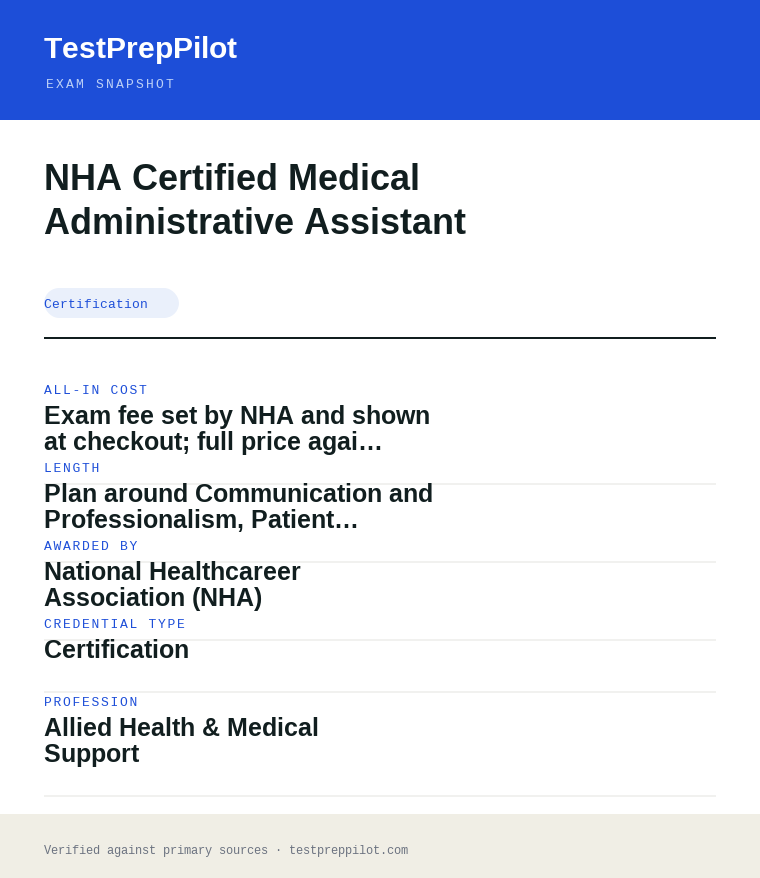
NHA Certified Medical Administrative Assistant
The NHA CMAA: front-office medical administration, 110 scored items in 2 hours 15 minutes.
Researched and maintained by TestPrepPilot Editorial BoardAllied-health & front-office administration certifications desk · Figures last verified August 2026
The short version
What is the NHA Certified Medical Administrative Assistant and is it worth it?
The NHA CMAA exam has 135 questions in 2 hours 15 minutes: 110 scored and 25 pretest. A scaled score of 390 passes. Communication and Professionalism and Patient Encounter carry 21 scored items each. You qualify with a diploma or GED plus a medical administrative training program or supervised work experience.
- No clinical skills are tested, so the exam fits front-office staff with no hands-on patient care.
- Two domains, Communication and Professionalism and Patient Encounter, are 42 of 110 scored items.
- Scheduling has its own domain with 16 items, so appointment-system questions are predictable.
- The work route needs 1 year of supervised administrative experience in the last 3 years, or 2 in the last 5.
What is it?
What exactly is the NHA Certified Medical Administrative Assistant?
The NHA CMAA: front-office medical administration, 110 scored items in 2 hours 15 minutes.
The NHA CMAA exam has 110 scored questions plus 25 pretest items in 2 hours 15 minutes, and a scaled score of 390 passes. The Certified Medical Administrative Assistant test plan, based on a 2021 job analysis, spreads 110 scored items over seven domains: Communication and Professionalism (21), Patient Encounter (21), Medical Law, Ethics, and Compliance (17), Scheduling (16), Medical Practice Administrative Procedures and Logistics (14), Billing and Revenue Cycle (11) and Foundational Knowledge (10). Front-desk staff, schedulers and medical office coordinators take it to show they can run the administrative side of a clinic.
The path in brief
- Confirm your training program or supervised administrative experience
- Download the CMAA test plan and rank the seven domains by item count
- Apply in your NHA account and pay within 2 hours
- Schedule PSI or Live Remote Proctoring for the 135-minute exam
- Check your score report within 48 hours
Before you book
Who is eligible to sit the NHA Certified Medical Administrative Assistant?
Pathway 1 is a training program, a DOL-registered apprenticeship or formal military training in the field completed within 5 years. Pathway 2 is supervised work experience: 1 year in the last 3 years or 2 years in the last 5. Students may test before finishing an externship if their school has an NHA agreement, then have 90 days to complete it.
Who it is for: Receptionists, schedulers, patient access staff and medical office assistants who run the front desk of a practice.
The test itself
What is the format of the NHA Certified Medical Administrative Assistant?
The NHA Certified Medical Administrative Assistant is administered by NHA (eligibility, scoring, certification); PSI (test centers and Live Remote Proctoring) and runs 2 hours 15 minutes (135 minutes), one sitting, contains 135 total: 110 scored plus 25 unscored pretest items questions and requires Scaled score of 390 on a 200-500 scale to pass.
| Administered by | NHA (eligibility, scoring, certification); PSI (test centers and Live Remote Proctoring) |
|---|---|
| Questions | 135 total: 110 scored plus 25 unscored pretest items |
| Time limit | 2 hours 15 minutes (135 minutes), one sitting |
| Pass mark | Scaled score of 390 on a 200-500 scale |
| Exam fee | Set by NHA and shown in the NHA store at checkout; paid per attempt, full price again for each retake; free reschedule if 24+ hours ahead |
| Format | Computer-based, multiple choice, NCCA-accredited; PSI test center or Live Remote Proctoring |
Content outline
What topics are on the NHA Certified Medical Administrative Assistant?
The NHA Certified Medical Administrative Assistant covers 7 content domains.
No percentage weights are listed for these domains here, so the outline is shown as structure only. Check the certifying body's published outline before allocating study time.
- Foundational Knowledge
10 scored items: health care organizations, record types, medical terminology.
- Communication and Professionalism
21 scored items.
- Medical Law, Ethics, and Compliance
17 scored items.
- Scheduling
16 scored items.
- Patient Encounter
21 scored items.
- Billing and Revenue Cycle
11 scored items.
- Medical Practice Administrative Procedures and Logistics
14 scored items.
Study materials
Which study guide should you use for the NHA Certified Medical Administrative Assistant?
Start with the exam sponsor's official content outline. If you also want one structured resource to work through, these are the Mometrix titles that match this exam.
Affiliate links We may earn a commission if you buy through these links, at no extra cost to you. Mometrix has no say in what our exam guides cover. How we make money.
Money & time
How much does the NHA Certified Medical Administrative Assistant cost?
For the NHA Certified Medical Administrative Assistant, the exam fee is Set by NHA and shown in the NHA store at checkout; paid per attempt, full price again for each retake; free reschedule if 24+ hours ahead; the all-in cost is typically Exam fee set by NHA and shown at checkout; full price again for each retake; most candidates spend Plan around Communication and Professionalism, Patient Encounter and Medical Law, then allow 135 minutes preparing.
Cost breakdown
| Exam fee, one attempt (set by NHA; shown in the NHA store at checkout) | Paid at application; an institution or employer may cover it |
|---|---|
| Retake after a failed attempt | Full exam price again; no discounted retake is described in the Candidate Handbook |
| Reschedule at least 24 hours ahead, within 6 months | $0; missing the deadline forfeits the fee |
| Optional NHA study guide or practice assessment | Sold separately; not required for eligibility |
| Recertification after 2 years | 10 CE credits plus a recertification fee that NHA frames as about $8 per month; no amount is printed in the handbook |
| Typical total | One exam fee per attempt (amount set in the NHA store), plus 10 CE credits and a recertification fee every 2 years |
NHA prints no fee amounts in the Candidate Handbook, so confirm the current price at checkout. Prep materials are optional.
Timeline
- Meet eligibility (training or work route) Training within the past 5 years, or 1 year of work in the last 3 or 2 years in the last 5
- Apply in the NHA account and pay Pay within 2 hours of applying or the application is voided
- Schedule PSI or Live Remote Proctoring and take the exam 2 hours 15 minutes (135 minutes), one sitting
- Final score report Within 48 hours of testing at PSI or Live Remote Proctoring
- Retake if needed At least 30 days after a failed attempt
Typical prep: Plan around Communication and Professionalism, Patient Encounter and Medical Law, then allow 135 minutes
The path
How do you register for the NHA Certified Medical Administrative Assistant?
- 1
Check eligibility for your exam
Every NHA exam except the ExCPT requires a high school diploma or equivalent plus either a training program completed within the past 5 years or supervised work experience (1 year in the last 3, or 2 years in the last 5). The ExCPT work route is 1,200 hours of supervised pharmacy work in one year within the last 3 years. Phlebotomy and EKG add skills minimums (CPT: 30 venipunctures and 10 capillary sticks; CET: 10 EKGs).
- Confirm your diploma or GED status
- Match yourself to Pathway 1 (training) or Pathway 2 (work experience)
- California CCMA candidates on the work route need 2 years of medical assistant experience in the last 5 years
Students may sit up to 18 months before graduating (12 months for the ExCPT) and receive a Provisional Certification.
- 2
Create your NHA account and candidate profile
Register at nhanow.com. You must complete your own application because parents, teachers and school officials cannot register for you. If your school is an NHA-authorized testing institution you apply for a specific exam date through the school; otherwise you choose to register individually.
- Create the candidate profile with your name exactly as it appears on your government ID
- Choose institution-based or individual registration
- Read and accept the Attestation Agreement
Answering "Disagree" on the attestation puts the application in contingency status until an exception appeal is approved.
- 3
Apply for the exam and pay within 2 hoursPayment window: 2 hours
Select the certification under Apply for Exam in your NHA account and pay the exam fee shown at checkout, unless an institution or employer pays for you. You have 2 hours to finish payment after applying, or the application is voided and you must start again. NHA prints no fee amounts in its Candidate Handbook; the price appears in the NHA store.
- Open Apply for Exam in your NHA account
- Decide whether to share scores with your school
- Finish payment inside the 2-hour window and keep the confirmation email
Study guides and practice tests are optional and are not required to become eligible.
- 4
Schedule PSI or Live Remote ProctoringReschedule window: 6 months from the original date
Individual registrants take the exam at a PSI testing center or through Live Remote Proctoring (LRP), which needs a computer that meets the proctor system requirements and an internet connection that supports Voice over IP. You can reschedule without repaying within 6 months of the original date, but only if you change it at least 24 hours before the appointment.
- Choose a PSI center or LRP in your NHA account
- Run the system check if you chose LRP
- Reschedule inside your account at least 24 hours ahead if needed
Missing the 24-hour deadline forfeits the fee. PSI candidate support is 1.833.537.1330.
- 5
Verify your identity and sit the examExam time depends on the exam, from 125 minutes to 3 hours
Proctors, including remote proctors, check a current government-issued photo ID that shows your signature and permanent address. If the address on the ID differs from the one you registered, bring proof of address such as a current utility bill. You may be asked to re-attest to eligibility at the site.
- Bring a driver license, passport or similar ID that matches your NHA profile name
- Expect an ID check and roster initialing before testing
- Answer every question; pretest items are not identifiable
- 6
Read your score report and download your certificateWithin 48 hours at PSI or LRP
Candidates who test at PSI or by LRP see the final score report in their NHA account within 48 hours; exams taken at an institution give a preliminary report immediately. A passing score triggers an email telling you to print the certificate under My Achievements. Passing candidates are listed in the NHA online Verification Tool, which never shows scores or failed attempts.
- Log in and open the score report for pass or fail and domain feedback
- Print the certificate from My Achievements
- Share your score with employers only through the certificate or verification tool, not preliminary results
Scores are never given by phone.
The fine print
What are the retake and renewal rules for the NHA Certified Medical Administrative Assistant?
- Proctoring & delivery
- Every NHA exam is computer-based and proctored, either at a PSI testing center or by Live Remote Proctoring, or at an NHA-authorized school or employer site. A current government-issued photo ID is verified before entry, and the address on the ID must match your registration or be backed by proof of address. Instructors cannot test at their own institution and must register individually.
- Retake policy
- After a failed attempt you must wait 30 days before retaking. You get three attempts with at least 30 days between each, and every failure after the third attempt requires a 1-year wait. Each retake means re-registering and paying the full exam price. Hand rescoring requests must be received within 60 days of the exam date and NHA may charge a fee.
- Score reporting
- NHA reports one scaled score from 200 to 500 and a passing standard of 390 on every exam, set by an Angoff-based standard-setting study so the same standard applies to every exam form. The report shows pass or fail plus Above, Near or Below the passing standard for each major content area; areas with 5 or fewer questions show N/A. When a new test plan launches, NHA can hold results briefly during a pilot scoring period.
- Recertification
- Certifications last 2 years and renew with 10 continuing education credits (2 CE hours equal 1 credit) plus a recertification fee; the ExCPT pharmacy technician credential instead needs 20 CE hours, including at least 1 hour of pharmacy law and 1 hour of patient safety. NHA allows a one-month grace period. A lapsed credential can be reinstated within 1 year with 15 credits (20 hours for ExCPT) plus renewal and reinstatement fees; after that you must retake the exam. NHA frames renewal as about $8 per month but does not print a fee in its handbook.
- Refunds & rescheduling
- NHA refunds an exam fee only when NHA, PSI or another remote proctoring provider cancels your exam and you do not reschedule. If severe weather closes a PSI site, PSI reschedules at no charge. Otherwise the fee is forfeited when you miss the 24-hour reschedule deadline or reschedule to a date more than 6 months after the original.
Context
NHA certifications in this guide compared
| Credential | Scored items and time | Largest domain | Renewal | |
|---|---|---|---|---|
| CCMA (clinical medical assistant) | 150 scored plus 30 pretest, 3 hours | Clinical Patient Care, 84 items | 10 CE credits every 2 years | |
| CMAA (medical administrative assistant) | 110 scored plus 25 pretest, 2 hours 15 minutes | Communication and Professionalism and Patient Encounter, 21 items each | 10 CE credits every 2 years | |
| CEHRS (electronic health records) | 100 scored plus 25 pretest, 125 minutes | Clinical Operations, 32 items | 10 CE credits every 2 years | |
| CPCT/A (patient care technician) | 100 scored plus 20 pretest, 2 hours | Patient Care, 45 items | 10 CE credits every 2 years | |
| ExCPT CPhT (pharmacy technician) | 100 scored plus 20 pretest, 2 hours 10 minutes | Dispensing Process, 43 items | 20 CE hours every 2 years |
What it pays
How much does this credential pay?
$44,640 median for medical secretaries and administrative assistants (BLS SOC 43-6013, May 2024)
The salary answer for the CMAA is the occupation it certifies: medical secretaries and administrative assistants, the front-office workforce of clinics and hospitals, had a BLS median annual wage of $44,640 in May 2024, about $21.46 an hour, and the honest framing is that the credential does not move this occupation-level number, it improves your position in the queue for the jobs within it. BLS classifies workers by job duties rather than by certificate, so the wage data covers all medical secretaries, certified or not; the certified-to-uncertified difference shows up in hiring preference and employer practice rather than in any government line. NHA reports in its own industry research that roughly 84 percent of employers require or encourage certification for medical administrative assistants, and independent employer surveys commonly report certified assistants at a modest pay premium over uncertified peers, figures we cite as industry-reported rather than as BLS data. The distribution matters as much as the median: the lowest 10 percent of medical secretaries earned less than about $35,050 and the highest 10 percent earned more than about $60,050, so earnings follow setting, region and experience — hospital and outpatient roles pay above the median, while small private practices pay below it. BLS counted roughly 850,000 medical secretaries and administrative assistants in 2024 and projects average growth of about 3 to 4 percent from 2024 to 2034, with roughly 85,900 openings a year, and it explicitly notes that employment growth is projected for medical secretaries because of the expansion of the healthcare industry even as automation and AI reduce demand in other secretary occupations — the healthcare-specific nature of the role is the reason it keeps growing while the broader secretary category is flat. The practical takeaway for a CMAA candidate is that the credential is the standard entry ticket to a stable, large occupation with steady replacement demand, and the realistic ceiling is set by the setting you work in more than by the certificate.
| Measure | Figure | Source / note |
|---|---|---|
| Median annual wage, medical secretaries and administrative assistants | $44,640 | BLS Occupational Outlook Handbook, May 2024 ($21.46/hr) |
| Lowest 10 percent | less than ~$35,050 | BLS OOH Pay tab, May 2024 |
| Highest 10 percent | more than ~$60,050 | BLS OOH Pay tab, May 2024 |
| Employment, 2024 | ~850,000 jobs | BLS OOH / O*NET, 2024 |
| Projected annual openings | ~85,900 per year | BLS OOH, 2024-34 |
| Certified premium | Industry-reported, not BLS | NHA industry research reports ~84% of employers require or encourage certification |
Job growth.About +3-4% projected change 2024-34 for medical secretaries and administrative assistants, with roughly 85,900 openings a year; BLS notes medical secretaries grow with the healthcare industry even as automation flattens other secretary roles.
Source: BLS Occupational Outlook Handbook — Medical Secretaries and Administrative Assistants
Your odds
What are the pass rates?
NHA-reported first-attempt CMAA pass rates were 62.68% in 2024 (9,390 administrations) and 69.02% in 2023 — and the passing scaled score is 390 on a 200-500 scale
NHA reports pass-rate statistics for the CMAA, and the most recent figures reproduced by multiple compilers show a 62.68 percent first-attempt pass rate in 2024 from 9,390 exam administrations and 69.02 percent in 2023, which makes the CMAA one of the harder of NHA’s certifications to clear and a credential worth preparing for seriously rather than sitting cold. The honest caveat is that NHA does not maintain a single always-visible public pass-rate page on its certification site, so these figures come from NHA’s annual reporting and third-party compilations of it, and a candidate should treat them as directionally reliable rather than precisely auditable. What is fully published and verifiable is the exam mechanics: the CMAA is a computer-based exam of 135 questions — 110 scored and 25 unscored pretest items — in 2 hours and 15 minutes, scored on a 200-500 scale with a passing scaled score of 390, which independent prep providers estimate corresponds to roughly 78 percent of scored items answered correctly, an estimate flagged as approximate because NHA does not publish the raw-to-scaled conversion. The content spans seven domains, with Communication and Professionalism and Patient Encounter the two largest at 21 scored items each, followed by Medical Law, Ethics and Compliance (17), Scheduling (16), Medical Practice Administrative Procedures and Logistics (14), Billing and Revenue Cycle (11) and Foundational Knowledge (10). There is no penalty for guessing, results post in the NHA account within about two days, and a failed attempt carries a 30-day wait between the second and third attempts and a one-year wait after the third. The practical reading is consistent with the published rate: candidates who complete a training program or have supervised work experience, drill the two 21-item domains, and practise timed 135-question exams pass at materially higher rates than the overall cohort.
Read this before quoting the number.NHA-reported 2024 first-attempt CMAA pass rate is 62.68% (2023: 69.02%), figures compiled from NHA annual reporting because NHA does not maintain a single always-visible public pass-rate page. The verifiable official threshold is the passing scaled score of 390 on the 200-500 scale.
Source: NHA — Certified Medical Administrative Assistant (CMAA) certification page
Your schedule
How long should I study for it?
40-60 hours over 6-10 weeks of focused study
A realistic NHA CMAA study plan runs 40 to 60 hours over 6 to 10 weeks, because the exam is a single 135-question, 2-hour-15-minute sitting and the largest score gains come from weighting study time to the two domains that carry the most scored items. The NHA CMAA test plan is the scope map: it is free and published by NHA and lays out the seven domains with their scored-item counts, and the two that tie for the top at 21 items each — Communication and Professionalism and Patient Encounter — together are 42 of the 110 scored questions, or roughly 38 percent of the paper, so a candidate who studies all seven domains equally will under-prepare the block that effectively decides the pass. The study window should split into a content-coverage phase (weeks 1-4) working the domains in item-weight order, a drilling phase (weeks 5-7) using practice exams and question banks, and a final two-week run of full timed rehearsals of 135 questions in 135 minutes, because the 25 unscored pretest items are indistinguishable from the 110 scored ones and the pacing plan must treat every question as if it counts. The clinical-adjacent content matters more than new applicants expect: the CMAA covers insurance verification, prior authorization workflows, billing and revenue cycle basics, scheduling and EHR administration, and HIPAA compliance, and candidates coming from a clinical assistant background routinely underestimate the administrative law-and-ethics items. Candidates completing a training program should budget the lower end and concentrate on exam mechanics; candidates qualifying through work experience should budget the upper end and cover the formal terminology and insurance-verification content that on-the-job learning often skips. The final two weeks should include at least two full timed practice exams at the real one-minute-per-question pace, and the plan should preserve a clean buffer before any job-application deadline because results post within about two days of the sitting.
- Weeks 1-210-12 hrs
Patient Encounter and Communication (42 combined items)
- Study patient encounter: registration, demographic and identity verification, intake forms, and check-in/check-out workflows
- Cover communication and professionalism: phone, in-person and written patient communication
- Drill the HIPAA rules that appear across both domains, including what can and cannot be shared
- Week 310-12 hrs
Medical Law, Ethics, and Compliance (17 items)
- Study consent, confidentiality, records retention and scope of practice
- Cover compliance topics: CMS and OSHA basics that apply in the front office
- Practise the scenario items that pair a workplace situation with a law-and-ethics decision
- Week 410-12 hrs
Scheduling and Billing and Revenue Cycle (27 combined items)
- Study scheduling: appointments, recall lists, no-shows, rescheduling and referral coordination
- Cover billing and revenue cycle: charge entry, insurance verification, and claim submission basics
- Learn the prior-authorization workflow, which is a recurring scenario on the paper
- Weeks 5-612-14 hrs
Administrative procedures and timed drilling
- Cover Medical Practice Administrative Procedures and Logistics and Foundational Knowledge (24 combined items)
- Start full 135-question practice exams under the 135-minute limit
- Analyse every miss by domain and re-drill the weakest areas
- Weeks 7-88-10 hrs
Full-format rehearsal and readiness
- Two full timed practice exams at the one-minute-per-question pace
- Final pass over insurance verification, HIPAA, and the two 21-item domains
- Confirm eligibility, schedule the exam, and verify the retake rules
Adjusting the pace
Recent training-program graduate.Budget the lower end (6-8 weeks); the program covers the content, so weight time toward timed practice exams and the one-minute-per-question pacing habit.
Qualifying through work experience.Budget the upper end (8-10 weeks) and add formal study of insurance verification, prior authorization and billing terminology that on-the-job learning often skips.
Career changer from clinical support.Add a week of front-office fundamentals before the domain work; the clinical assistant background helps with patient encounter but not with the revenue-cycle content.
How to study
How do I prepare most effectively?
The dominant prep strategy for the NHA CMAA exam is to weight study time to the two largest domains and to practise timed 135-question exams, because Communication and Professionalism and Patient Encounter together are 42 of the 110 scored items, and the 2-hour-15-minute, one-minute-per-question format is the discipline most candidates underestimate. First, download the free NHA CMAA test plan and use it as the checklist: the seven domains and their scored-item counts are published, and studying in item-weight order is the highest-yield plan. Second, drill the patient-encounter content hard — registration, demographics and identity verification, intake and check-in workflows, patient education and telehealth logistics — because it is the largest single domain and the one most likely to decide the pass. Third, practise communication and professionalism as scenario items: phone etiquette, handling a difficult patient, written communication, and the customer-service responses that NHA rewards with points, because these are coachable and appear throughout the paper. Fourth, treat the law-and-ethics and billing content as a distinct study block rather than an afterthought: HIPAA, consent, scope of practice, insurance verification, prior authorizations, charge entry and claim basics are a meaningful share of the exam, and candidates who only worked the patient-facing domains drop a block of points. Fifth, take full timed practice exams from early in the plan, because the 25 unscored pretest items are indistinguishable from the 110 scored items and the one-minute-per-question pace is a real constraint; a candidate who studies content but never times a full exam is the classic failure pattern. Finally, use the domain breakdown on your score report after a practice exam — or after a failed attempt — as the roadmap for re-study, because retaking without targeting the weakest domains is how a $129 exam becomes a recurring expense.
Weight study time to the two 21-item domains
Communication and Professionalism plus Patient Encounter are 42 of 110 scored items (~38%). Study them in item-weight order and give them the majority of your hours.
Drill law, ethics and compliance as scenarios
HIPAA, consent, scope of practice and compliance appear as workplace scenarios. Practise the decision style — what may an assistant disclose, to whom, and when.
Learn the insurance and revenue-cycle workflow
Insurance verification, prior authorization and claim basics are a scored domain. Learn the workflow in order — verification before service, authorization before non-emergency orders, claim submission with correct data.
Take full timed exams early
135 questions in 135 minutes is one per minute, and the 25 pretest items are indistinguishable from scored ones. Treat every question as if it counts.
Use the domain breakdown as the roadmap
Re-study the weakest domains from the practice-exam or score-report breakdown rather than re-reading everything.
Know the retake and renewal rules before registering
A failed attempt carries a 30-day wait between attempts 2-3 and a one-year wait after the third; renewal is every 2 years with 10 CE credits.
What to buy
Which study resources are worth paying for?
NHA CMAA prep resources split into the official NHA study tools, third-party question banks and guides, and free materials, and the buying logic is anchored by the NHA test plan because it is the only document that publishes the seven domains and their scored-item counts, and it is free. NHA sells its own study guide, practice tests and preparation packages, with prices roughly in the $44-94 range depending on the product and current promotions; the practice tests are the most exam-adjacent third-party option because they are written by the exam developer, though NHA notes that purchasing prep materials is not required to sit for the exam. Third-party question banks and study guides, roughly $30-80, add volume and explanations and are useful for drilling the scenario style, but candidates should use them alongside rather than instead of the official test plan, because fidelity to the published item weights matters more than raw question volume. Free resources include the downloadable test plan, the candidate handbook, NHA sample questions, and school- or employer-sponsored prep that training programmes often provide. The footnote that anchors the comparison: prices below are approximate as of mid-2026 and change frequently, we rank nothing by commission, and the exam fee itself — $129 for the initial CMAA exam per NHA, with the $195 two-year renewal separate — is frequently covered or discounted by employers and training schools, so the real out-of-pocket cost varies widely and should be confirmed at registration. A cheap readiness check is the free test plan plus one timed practice exam before buying anything, because candidates who recently finished a training programme often need only the practice tests, while experienced-but-uncertified assistants usually need a full study guide to cover the insurance and revenue-cycle terminology.
| Resource | Price | Format | Best for |
|---|---|---|---|
| NHA CMAA test plan | Free | PDF domain blueprint with item counts | The authoritative scope — download first |
| NHA practice tests | ~$44-49 | Online practice exams | The most exam-adjacent drilling from the exam developer |
| NHA study guide / prep package | ~$62-94 | Online guide, flashcards, or bundle | Candidates wanting NHA-written content |
| Third-party question bank | ~$30-80 | Online drilling with explanations | Volume drilling alongside the official test plan |
| CMAA exam registration | $129 (2026) | PSI centre or live remote proctoring | The real exam; often covered by employers and schools |
Prices approximate as of mid-2026 and change frequently; we rank nothing by commission. The CMAA exam fee is $129 per NHA, with a $195 two-year renewal, and is frequently covered or discounted by employers and training schools — confirm the actual price at registration.
Avoid these
What mistakes do candidates most often make?
The most common mistake on the NHA CMAA exam is studying all seven domains equally, because Communication and Professionalism and Patient Encounter together carry 42 of the 110 scored items and a candidate who divides time evenly across the domains under-prepares the block that decides the pass. The second is sitting the exam without a single timed 135-question rehearsal: the 135-minute, one-minute-per-question format is a real constraint, and the 25 unscored pretest items are indistinguishable from the 110 scored ones, so candidates who never practise pacing either run out of clock or lose points on the pretests by slowing down. A third recurring error is treating the administrative law-and-ethics and billing content as a minor topic: HIPAA, consent, insurance verification, prior authorization and claim basics are a meaningful share of the exam, and clinically experienced candidates in particular drop these points because the front-office tasks are automatic in their day job. Candidates also routinely ignore the Communication and Professionalism domain as "soft," when its 21 scored items are just as valuable as the clinical-adjacent ones and the scenario style is highly coachable. Another pattern is retaking after a fail without using the score-report domain breakdown, wasting the 30-day wait on undirected re-reading when the report points at one or two domains. Finally, some candidates confuse the CMAA with NHA’s clinical assistant exam, the CCMA, and study the wrong blueprint entirely — the CMAA has no vital signs, injections or phlebotomy items — or they misunderstand the passing standard and aim for "80 percent on practice tests" when the published threshold is a 390 scaled score that is not a simple percentage. A last pattern is ignoring the delivery logistics: a name mismatch between the NHA account and a government-issued photo ID means no exam and a forfeited fee, and remote candidates who skip the system test lose the seat on the day.
✕Studying all seven domains equally
✓Weight time by the published item counts — the two 21-item domains (Communication and Professionalism, Patient Encounter) are ~38% of the scored exam.
✕Never doing a timed 135-question rehearsal
✓135 questions in 135 minutes is one per minute, and the 25 pretest items are indistinguishable from scored ones. Run at least two full timed exams.
✕Skipping law, ethics and billing
✓HIPAA, consent, insurance verification and prior authorization are a scored block; drill the scenario style even if the front-office tasks are automatic in your job.
✕Treating communication items as soft
✓Communication and Professionalism is 21 scored items; practise the phone, written and difficult-patient scenarios deliberately.
✕Retaking without using the score-report breakdown
✓Re-study the one or two weakest domains from the report during the 30-day wait rather than re-reading everything.
✕Confusing the CMAA with the CCMA
✓The CMAA is purely administrative — no vital signs, injections or phlebotomy. Confirm you are preparing for the 135-question, 2-hour-15-minute CMAA blueprint.
✕Ignoring the delivery logistics
✓Your NHA account name must match your government-issued photo ID, and remote candidates must pass the system check on the same machine and network they will use.
What you'll face
What question types will I see?
The NHA CMAA exam is a computer-based, NCCA-accredited test of 135 multiple-choice questions in 2 hours and 15 minutes, of which 110 are scored and 25 are unscored pretest items, delivered at a PSI testing center or through live remote proctoring, with a passing scaled score of 390 on the 200-500 scale and no penalty for guessing. The questions are four-option, single-best-answer items drawn from seven domains — Communication and Professionalism (21 scored items), Patient Encounter (21), Medical Law, Ethics, and Compliance (17), Scheduling (16), Medical Practice Administrative Procedures and Logistics (14), Billing and Revenue Cycle (11) and Foundational Knowledge (10) — and they run from direct recall of terminology and HIPAA rules to scenario-based items that describe a front-office situation and ask for the correct action, next step or response. Because NHA uses a scaled score rather than a raw percentage, the passing threshold of 390 corresponds to an estimated raw performance of roughly 78 percent of scored items, an estimate flagged as approximate because NHA does not publish the conversion. The exam is linear rather than adaptive: questions are presented in random order across the domains, you can flag and review within the 135 minutes, and the pretest items are indistinguishable from the scored ones, so every question should be treated as if it counts. The scenario style dominates the two 21-item domains — a patient at the desk, a phone call, an insurance question, a privacy decision — and the recall items cluster in Foundational Knowledge and Medical Law, Ethics, and Compliance. The samples below illustrate three of the recurring formats: a law-and-ethics scenario, an insurance-verification workflow item, and a communication scenario. The sample items are editor-written illustrations of the published test plan, not live exam items.
A workplace situation asking what may be disclosed, documented or delegated under HIPAA and scope-of-practice rules; the most consistently tested decision style.
Registration, demographic and identity verification, intake, check-in, and the administrative steps of an office visit in the correct order.
Insurance verification, prior authorization, charge entry and claim basics, often presented as a workflow with the next correct step.
Phone, written and in-person patient communication, including difficult-patient and customer-service responses.
Direct items on medical terminology and office procedures; fast points for a candidate who drills the lists.
Try these
Q1A patient’s spouse calls the front desk and asks for the patient’s test results. The patient has not authorised the spouse on the record. What is the medical administrative assistant’s best response?
Answer:B
HIPAA permits disclosure only to the patient or to individuals the patient has authorised, and a family relationship does not create automatic access. The correct response is to state that the information cannot be disclosed because the spouse is not authorised, without confirming whether the patient is seen at the facility. A and D are direct violations, and C invites an identity-workaround that still fails the authorisation requirement. This item tests the law-and-ethics scenario style that recurs across the paper.
Q2A patient scheduled for a procedure calls to ask whether their insurance will cover it. What is the correct first step for the medical administrative assistant?
Answer:B
Insurance eligibility and benefits should be verified before the service is provided, so the patient receives an accurate coverage answer and the practice avoids a surprise denial. A makes an unverifiable guarantee, C reverses the workflow by submitting a claim before verifying coverage, and D bypasses the insurance process entirely. The item tests the revenue-cycle workflow order — verify first, authorise where required, then render service and bill.
Q3A patient is upset at the desk because their appointment is running late. Which response is most appropriate for the medical administrative assistant?
Answer:B
The most appropriate response acknowledges the patient’s feeling, explains the situation factually and commits to an update — the pattern NHA’s communication items reward. A minimises the complaint, C deflects blame to a colleague, and D pushes the patient away rather than resolving the concern. This item illustrates the communication-and-professionalism scenario style: recognise the patient’s emotion, stay within professional boundaries, and offer a concrete next step.
Samples are editor-written illustrations of the published blueprint, not live exam items.
The big day
What should I expect on exam day?
The NHA CMAA exam is a 2-hour-15-minute, 135-question computer-based exam — 110 scored plus 25 unscored pretest items — taken at a PSI testing center or through live remote proctoring, with a passing scaled score of 390 on the 200-500 scale, and the direct exam-day answer is that you will pace at about one minute per question, treat every question as if it counts, and receive your result in your NHA account within about two days. At a test center, arrive at least 30 minutes early with a government-issued photo ID and a secondary form of identification; for live remote proctoring, complete the system check on the same machine and network you will use, and set up in a private room with a closed door and a clear desk. The check-in includes identity verification, and phones, smartwatches, notes and study materials are not allowed in the testing space; remote proctors require a room scan before the exam begins. The exam is linear, so you can flag items and review within the 135 minutes, and there is no penalty for guessing, so every question should get an answer — leaving blanks is the only guaranteed way to lose those points. Expect questions across all seven domains in random order, including the 25 pretest items you cannot identify; the pacing plan of roughly one minute per question, with flagged items returned to at the end, is the standard approach. If you do not pass, the score report shows your performance by domain, and NHA requires a 30-day wait between the second and third attempts and a one-year wait after the third, so the domain breakdown is the roadmap for the wait. On a pass, your electronic certificate posts to your NHA account, and the credential renews every two years with 10 continuing-education credits and a $195 renewal fee — diary the expiry date the week you pass.
Bring
- Government-issued photo ID (driver’s license, passport, state or military ID)
- A secondary ID at a test center (credit card, bank card, or school ID)
- For live remote proctoring: a tested webcam, microphone and connection on the exact machine you will use
- Your NHA account login, in case check-in cannot locate the registration
Leave at home
- Phones, smartwatches, fitness trackers and earbuds — locker at a center, out of the room remotely
- Notes and study materials (prohibited)
- Bags, coats, hats, food and drink beyond what the center or proctor permits
- Second monitors for remote proctoring, which must be unplugged and turned away
How the day runs
Rules in the room
- Passing scaled score is 390 on a 200-500 scale; no penalty for guessing, so answer every question.
- 110 scored questions plus 25 unscored pretest items, indistinguishable during the exam.
- No scheduled breaks in the 135-minute exam; the clock does not stop.
- Government-issued photo ID required; phones, smartwatches and notes are prohibited.
- 30-day wait after a failed attempt between attempts 2-3; one-year wait after the third failed attempt.
Afterwards.Your result posts in your NHA account within about two days. On a pass, download the electronic certificate and share the credential with employers through the NHA verification system; on a fail, use the domain-by-domain score breakdown to target the weakest domains during the 30-day wait before retaking. The CMAA credential renews every two years with 10 continuing-education credits and a $195 renewal fee, so log the expiry date immediately and start banking CE credits from real work rather than scrambling at renewal time. Either way, the occupation behind the credential is the story: medical secretaries and administrative assistants earned a BLS median of $44,640 in May 2024 with roughly 85,900 openings a year, and the certification — required or encouraged by roughly 84 percent of employers per NHA’s own research — widens the front-office openings you can apply for, which is the practical return on the $129 exam fee.
Reference
What are the key facts about the NHA Certified Medical Administrative Assistant?
NHA Certified Medical Administrative Assistant is a certification credential; awarded by National Healthcareer Association (NHA); the exam fee is Set by NHA and shown in the NHA store at checkout; paid per attempt, full price again for each retake; free reschedule if 24+ hours ahead; typical preparation is Plan around Communication and Professionalism, Patient Encounter and Medical Law, then allow 135 minutes.
| Credential | NHA Certified Medical Administrative Assistant |
|---|---|
| Abbreviation | CMAA |
| Type | Certification |
| Profession | Allied Health & Medical Support |
| Specialty | Medical Office |
| Awarded by | National Healthcareer Association (NHA) |
| Difficulty | Moderate |
| Typical prep time | Plan around Communication and Professionalism, Patient Encounter and Medical Law, then allow 135 minutes |
| All-in cost | Exam fee set by NHA and shown at checkout; full price again for each retake |
| Test plan | CMAA test plan based on the 2021 job analysis (revision dated 01/22/2022): 110 scored items, 25 pretest items, 2 hours 15 minutes |
| Scoring | Scaled 200-500; 390 passes. Scores come from scored items only; pretest items do not count |
| Retakes | 30-day wait; three attempts; 1-year wait after each failure past the third; full exam price each time |
| Rescheduling | Free within 6 months of the original date if changed at least 24 hours before the appointment |
| Score report | Final report in the NHA account within 48 hours at PSI or Live Remote Proctoring |
| Validity | 2 years; renew with 10 CE credits plus a recertification fee |
| Scope | National / Multi-state |
Real questions
Frequently asked questions about the NHA Certified Medical Administrative Assistant
How many questions are on the NHA CMAA exam?
The NHA CMAA exam has 135 questions: 110 scored items and 25 unscored pretest items, per the CMAA test plan. Pretest items cannot be identified and do not affect your score. The 110 scored items cover seven domains, with Communication and Professionalism and Patient Encounter at 21 items each.
What is a passing score on the CMAA exam?
A passing score on the CMAA exam is a scaled score of 390 on NHA's 200 to 500 scale. NHA scales scores so every form of the exam applies the same standard, and the raw number of correct answers needed is not published. The score report shows Above, Near or Below the standard for each domain.
How long is the NHA CMAA exam?
The NHA CMAA exam gives you 2 hours and 15 minutes, or 135 minutes, to answer all 135 questions. That is one minute per question, including the unmarked pretest items. The time is printed at the top of the CMAA test plan and may be extended by an approved accommodation.
Is the CMAA exam hard?
NHA does not publish exam pass rates in its Candidate Handbook, so no official figure exists to quote. NHA does publish the passing standard: a scaled score of 390 on a 200 to 500 scale, set by subject matter experts using a modified Angoff method. Difficulty therefore depends on your training and how closely you study the free test plan. For the CMAA, expect scenario questions about scheduling, patient communication and compliance rather than clinical procedures.
Can I take the CMAA exam without a training program?
Yes. NHA accepts a high school diploma or GED plus supervised work experience in medical administration: 1 year in the last 3 years, or 2 years in the last 5. If you finished a program more than 5 years ago, you must use the work-experience route instead.
How long until I get my CMAA results?
Results appear in your NHA account within 48 hours when you test at a PSI center or by Live Remote Proctoring. Tests taken at an authorized school give a preliminary report immediately. If you pass, NHA emails you to print the certificate under My Achievements. NHA never gives scores by phone and treats preliminary results as non-final.
How often must I renew the CMAA credential?
Your NHA credential is valid for 2 years and renews with 10 continuing education credits, where 2 hours of CE equal 1 credit, plus a recertification fee. NHA allows a one-month grace period. An expired credential can be reinstated within 1 year with 15 credits and reinstatement fees; after 1 year you must retake the exam.
How soon can I retake the CMAA exam after failing?
You can retake an NHA exam 30 days after a failed attempt. NHA allows three attempts with at least 30 days between each, and every failure after the third requires waiting 1 year. Each retake means registering again and paying the full exam price, so study the Above, Near and Below feedback on your score report before booking.
What is the passing score on NHA certification exams?
The passing score on every NHA certification exam is a scaled score of 390 on a 200 to 500 scale. NHA uses scaled scores because each exam has multiple forms, and scaling keeps the 390 standard consistent whichever form you receive. The score is not a percentage of questions correct, and NHA does not publish the raw-score conversion.
How long must I wait to retake an NHA exam?
You must wait 30 days after a failed NHA attempt before retaking. You are allowed three attempts with at least 30 days between them, and each failure after the third requires a 1-year wait. Every retake needs a new registration and the full exam price, so use the Above, Near or Below feedback on your score report to focus your study.
Do NHA certifications expire?
NHA certifications are valid for 2 years and must be renewed with 10 continuing education credits plus a recertification fee. ExCPT pharmacy technicians complete 20 CE hours instead, including 1 hour of pharmacy law and 1 hour of patient safety. A lapsed credential can be reinstated within 1 year; after that you must retake the exam.
In short
Is the NHA Certified Medical Administrative Assistant worth it?
- The NHA CMAA has 110 scored and 25 pretest questions in 2 hours 15 minutes.
- Communication and Professionalism and Patient Encounter are 21 scored items each.
- A scaled score of 390 on the 200-500 scale passes.
- Retake after 30 days; three attempts before a 1-year wait applies.
- Renew every 2 years with 10 CE credits.
Same awarding body
What other credentials does National Healthcareer Association (NHA) award?
Worth comparing
How does the NHA Certified Medical Administrative Assistant compare with similar credentials?
Trust
Where does this information come from?
Everything above is taken from the awarding body's own published material. Fees, question counts and domain weights are revised regularly — check the official page before you pay.
- National Healthcareer Association (NHA) Awarding body
- Official NHA Certified Medical Administrative Assistant exam page Exam page
- National Healthcareer Association (NHA) certification programme Programme rules
Research confidence: medium · Last reviewed 2026-08