Allied Health & Medical Support • Certification
NHA Certified Electronic Health Records Specialist
The NHA CEHRS: 100 scored items across five EHR domains in 125 minutes.
Researched and maintained by TestPrepPilot Editorial BoardAllied-health certification desk · Figures last verified August 2026
The short version
What is the NHA Certified Electronic Health Records Specialist and is it worth it?
The NHA CEHRS exam has 125 questions in 125 minutes: 100 scored and 25 pretest. A scaled score of 390 passes. Clinical Operations (32 items) and Non-Clinical Operations (28) make up 60 of the 100 scored items. You qualify with a diploma or GED plus EHR training or work experience.
- The exam is only 100 scored items, with exact counts for all five domains in the free test plan.
- Clinical Operations (32) and Non-Clinical Operations (28) cover most of the paper, so EHR workflow knowledge pays off most.
- Eligibility includes a work route: 1 year of supervised EHR work in the last 3 years, or 2 years in the last 5.
- The same 390 passing standard and 30-day retake rule as every other NHA exam.
What is it?
What exactly is the NHA Certified Electronic Health Records Specialist?
The NHA CEHRS: 100 scored items across five EHR domains in 125 minutes.
The NHA CEHRS exam has 100 scored questions plus 25 pretest items in 125 minutes, with a passing scaled score of 390 on a 200-500 scale. The Certified Electronic Health Records Specialist test plan, based on a 2019 job analysis, is led by Clinical Operations (32 items) and Non-Clinical Operations (28), followed by Revenue Cycle/Finance (15), Regulatory Compliance (15) and Reporting (10). It suits people who register patients, document encounters and move data in electronic health record systems, and it is the NHA credential closest to health information work rather than hands-on patient care.
The path in brief
- Confirm EHR training within 5 years or supervised EHR work experience
- Download the CEHRS test plan and note the five domains
- Apply in your NHA account and pay within 2 hours
- Schedule PSI or Live Remote Proctoring for the 125-minute exam
- Check your score report within 48 hours
Before you book
Who is eligible to sit the NHA Certified Electronic Health Records Specialist?
Pathway 1 is a training program in the field, a DOL-registered apprenticeship or formal military training completed within 5 years. Pathway 2 is supervised work in the field: 1 year in the last 3 years or 2 years in the last 5. School-affiliated candidates may take the exam before an externship ends under the pre-externship route, then have 90 days to finish.
Who it is for: Medical records and registration staff, billing assistants and students in health information programs who work inside EHR systems.
The test itself
What is the format of the NHA Certified Electronic Health Records Specialist?
The NHA Certified Electronic Health Records Specialist is administered by NHA (eligibility, scoring, certification); PSI (test centers and Live Remote Proctoring) and runs 125 minutes (2 hours 5 minutes), one sitting, contains 125 total: 100 scored plus 25 unscored pretest items questions and requires Scaled score of 390 on a 200-500 scale to pass.
| Administered by | NHA (eligibility, scoring, certification); PSI (test centers and Live Remote Proctoring) |
|---|---|
| Questions | 125 total: 100 scored plus 25 unscored pretest items |
| Time limit | 125 minutes (2 hours 5 minutes), one sitting |
| Pass mark | Scaled score of 390 on a 200-500 scale |
| Exam fee | Set by NHA and shown in the NHA store at checkout; paid per attempt, full price again for each retake; free reschedule if 24+ hours ahead |
| Format | Computer-based, multiple choice, NCCA-accredited; PSI test center or Live Remote Proctoring |
Content outline
What topics are on the NHA Certified Electronic Health Records Specialist?
The NHA Certified Electronic Health Records Specialist covers 5 content domains.
No percentage weights are listed for these domains here, so the outline is shown as structure only. Check the certifying body's published outline before allocating study time.
- Non-Clinical Operations
28 scored items: patient identifiers, collecting and updating patient information, encounter documentation, patient flow, EHR hardware and user training.
- Clinical Operations
32 scored items, the largest domain.
- Revenue Cycle/Finance
15 scored items.
- Regulatory Compliance
15 scored items.
- Reporting
10 scored items.
Money & time
How much does the NHA Certified Electronic Health Records Specialist cost?
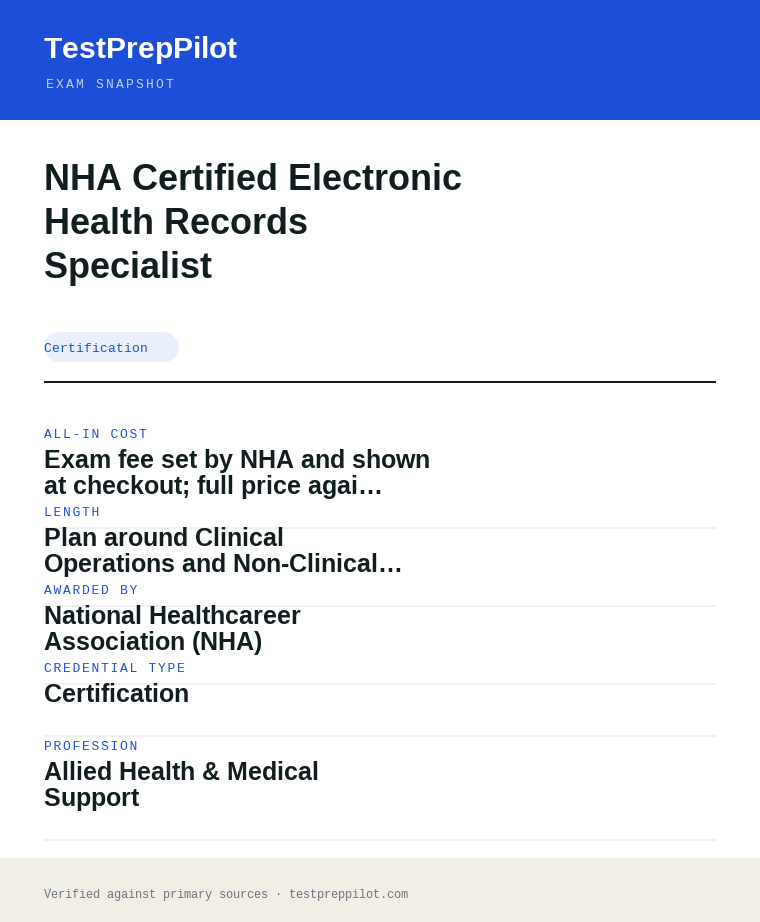
For the NHA Certified Electronic Health Records Specialist, the exam fee is Set by NHA and shown in the NHA store at checkout; paid per attempt, full price again for each retake; free reschedule if 24+ hours ahead; the all-in cost is typically Exam fee set by NHA and shown at checkout; full price again for each retake; most candidates spend Plan around Clinical Operations and Non-Clinical Operations, then allow 125 minutes on exam day preparing.
Cost breakdown
| Exam fee, one attempt (set by NHA; shown in the NHA store at checkout) | Paid at application; an institution or employer may cover it |
|---|---|
| Retake after a failed attempt | Full exam price again; no discounted retake is described in the Candidate Handbook |
| Reschedule at least 24 hours ahead, within 6 months | $0; missing the deadline forfeits the fee |
| Optional NHA study guide or practice assessment | Sold separately; not required for eligibility |
| Recertification after 2 years | 10 CE credits plus a recertification fee that NHA frames as about $8 per month; no amount is printed in the handbook |
| Typical total | One exam fee per attempt (amount set in the NHA store), plus 10 CE credits and a recertification fee every 2 years |
NHA prints no fee amounts in the Candidate Handbook, so confirm the current price at checkout. Prep materials are optional.
Timeline
- Meet eligibility (training or work route) Training within the past 5 years, or 1 year of work in the last 3 or 2 years in the last 5
- Apply in the NHA account and pay Pay within 2 hours of applying or the application is voided
- Schedule PSI or Live Remote Proctoring and take the exam 125 minutes (2 hours 5 minutes), one sitting
- Final score report Within 48 hours of testing at PSI or Live Remote Proctoring
- Retake if needed At least 30 days after a failed attempt
Typical prep: Plan around Clinical Operations and Non-Clinical Operations, then allow 125 minutes on exam day
The path
How do you register for the NHA Certified Electronic Health Records Specialist?
- 1
Check eligibility for your exam
Every NHA exam except the ExCPT requires a high school diploma or equivalent plus either a training program completed within the past 5 years or supervised work experience (1 year in the last 3, or 2 years in the last 5). The ExCPT work route is 1,200 hours of supervised pharmacy work in one year within the last 3 years. Phlebotomy and EKG add skills minimums (CPT: 30 venipunctures and 10 capillary sticks; CET: 10 EKGs).
- Confirm your diploma or GED status
- Match yourself to Pathway 1 (training) or Pathway 2 (work experience)
- California CCMA candidates on the work route need 2 years of medical assistant experience in the last 5 years
Students may sit up to 18 months before graduating (12 months for the ExCPT) and receive a Provisional Certification.
- 2
Create your NHA account and candidate profile
Register at nhanow.com. You must complete your own application because parents, teachers and school officials cannot register for you. If your school is an NHA-authorized testing institution you apply for a specific exam date through the school; otherwise you choose to register individually.
- Create the candidate profile with your name exactly as it appears on your government ID
- Choose institution-based or individual registration
- Read and accept the Attestation Agreement
Answering "Disagree" on the attestation puts the application in contingency status until an exception appeal is approved.
- 3
Apply for the exam and pay within 2 hoursPayment window: 2 hours
Select the certification under Apply for Exam in your NHA account and pay the exam fee shown at checkout, unless an institution or employer pays for you. You have 2 hours to finish payment after applying, or the application is voided and you must start again. NHA prints no fee amounts in its Candidate Handbook; the price appears in the NHA store.
- Open Apply for Exam in your NHA account
- Decide whether to share scores with your school
- Finish payment inside the 2-hour window and keep the confirmation email
Study guides and practice tests are optional and are not required to become eligible.
- 4
Schedule PSI or Live Remote ProctoringReschedule window: 6 months from the original date
Individual registrants take the exam at a PSI testing center or through Live Remote Proctoring (LRP), which needs a computer that meets the proctor system requirements and an internet connection that supports Voice over IP. You can reschedule without repaying within 6 months of the original date, but only if you change it at least 24 hours before the appointment.
- Choose a PSI center or LRP in your NHA account
- Run the system check if you chose LRP
- Reschedule inside your account at least 24 hours ahead if needed
Missing the 24-hour deadline forfeits the fee. PSI candidate support is 1.833.537.1330.
- 5
Verify your identity and sit the examExam time depends on the exam, from 125 minutes to 3 hours
Proctors, including remote proctors, check a current government-issued photo ID that shows your signature and permanent address. If the address on the ID differs from the one you registered, bring proof of address such as a current utility bill. You may be asked to re-attest to eligibility at the site.
- Bring a driver license, passport or similar ID that matches your NHA profile name
- Expect an ID check and roster initialing before testing
- Answer every question; pretest items are not identifiable
- 6
Read your score report and download your certificateWithin 48 hours at PSI or LRP
Candidates who test at PSI or by LRP see the final score report in their NHA account within 48 hours; exams taken at an institution give a preliminary report immediately. A passing score triggers an email telling you to print the certificate under My Achievements. Passing candidates are listed in the NHA online Verification Tool, which never shows scores or failed attempts.
- Log in and open the score report for pass or fail and domain feedback
- Print the certificate from My Achievements
- Share your score with employers only through the certificate or verification tool, not preliminary results
Scores are never given by phone.
The fine print
What are the retake and renewal rules for the NHA Certified Electronic Health Records Specialist?
- Proctoring & delivery
- Every NHA exam is computer-based and proctored, either at a PSI testing center or by Live Remote Proctoring, or at an NHA-authorized school or employer site. A current government-issued photo ID is verified before entry, and the address on the ID must match your registration or be backed by proof of address. Instructors cannot test at their own institution and must register individually.
- Retake policy
- After a failed attempt you must wait 30 days before retaking. You get three attempts with at least 30 days between each, and every failure after the third attempt requires a 1-year wait. Each retake means re-registering and paying the full exam price. Hand rescoring requests must be received within 60 days of the exam date and NHA may charge a fee.
- Score reporting
- NHA reports one scaled score from 200 to 500 and a passing standard of 390 on every exam, set by an Angoff-based standard-setting study so the same standard applies to every exam form. The report shows pass or fail plus Above, Near or Below the passing standard for each major content area; areas with 5 or fewer questions show N/A. When a new test plan launches, NHA can hold results briefly during a pilot scoring period.
- Recertification
- Certifications last 2 years and renew with 10 continuing education credits (2 CE hours equal 1 credit) plus a recertification fee; the ExCPT pharmacy technician credential instead needs 20 CE hours, including at least 1 hour of pharmacy law and 1 hour of patient safety. NHA allows a one-month grace period. A lapsed credential can be reinstated within 1 year with 15 credits (20 hours for ExCPT) plus renewal and reinstatement fees; after that you must retake the exam. NHA frames renewal as about $8 per month but does not print a fee in its handbook.
- Refunds & rescheduling
- NHA refunds an exam fee only when NHA, PSI or another remote proctoring provider cancels your exam and you do not reschedule. If severe weather closes a PSI site, PSI reschedules at no charge. Otherwise the fee is forfeited when you miss the 24-hour reschedule deadline or reschedule to a date more than 6 months after the original.
Context
NHA certifications in this guide compared
| Credential | Scored items and time | Largest domain | Renewal | |
|---|---|---|---|---|
| CCMA (clinical medical assistant) | 150 scored plus 30 pretest, 3 hours | Clinical Patient Care, 84 items | 10 CE credits every 2 years | |
| CMAA (medical administrative assistant) | 110 scored plus 25 pretest, 2 hours 15 minutes | Communication and Professionalism and Patient Encounter, 21 items each | 10 CE credits every 2 years | |
| CEHRS (electronic health records) | 100 scored plus 25 pretest, 125 minutes | Clinical Operations, 32 items | 10 CE credits every 2 years | |
| CPCT/A (patient care technician) | 100 scored plus 20 pretest, 2 hours | Patient Care, 45 items | 10 CE credits every 2 years | |
| ExCPT CPhT (pharmacy technician) | 100 scored plus 20 pretest, 2 hours 10 minutes | Dispensing Process, 43 items | 20 CE hours every 2 years |
What it pays
How much does this credential pay?
$50,250 median for medical records specialists (BLS, May 2024) — SOC 29-2072
The direct answer is that the occupation a CEHRS actually performs — medical records specialists, SOC 29-2072 — earned a median of $50,250 per year in May 2024, the most recent BLS Occupational Employment and Wage Statistics survey, and it is the correct BLS series to cite because BLS classifies by job duties rather than by certificate, and the CEHRS credential is one of several certifications that feed this occupation. That figure needs context before it is used for planning. The lowest 10 percent of medical records specialists earned less than $35,780 and the highest 10 percent more than $80,950, so the credential is an entry-and-mobility signal inside a working-class occupation rather than a wage multiplier on its own; employers pay for the certified holder partly because certification is the most common way a candidate demonstrates EHR competence without years on the job. The occupational headwind is favourable: BLS projects employment of medical records specialists to grow 7 percent from 2024 to 2034, much faster than the average for all occupations, with roughly 14,200 openings a year, most from replacement need. The growth is driven by an aging population's record volume, the continuing digitisation of health records, and the regulatory pressure for accurate, auditable clinical documentation. Where the CEHRS sits in that picture is worth being precise about: the credential is entry-to-mid level, focused on EHR use, HIPAA compliance, basic coding for reimbursement, and the revenue cycle, which positions a holder for roles like health information clerk, medical records coordinator, patient registrar, or a step onto an EHR implementation or health information management track. The honest caveat is that a dedicated health information management degree or an RHIT-class credential moves a career further than CEHRS alone, and the real value of the NHA credential is the speed with which it can be earned — the exam is a single 100-question sitting a trained candidate takes after weeks, not years — and the verification it gives a first EHR job.
| Measure | Figure | Source / note |
|---|---|---|
| Median annual wage, medical records specialists | $50,250 | BLS Occupational Outlook Handbook, May 2024 (SOC 29-2072, $24.16/hr) |
| Lowest 10 percent | less than $35,780 | BLS OOH Pay tab, May 2024 |
| Highest 10 percent | more than $80,950 | BLS OOH Pay tab, May 2024 |
| Employment, 2024 | 194,800 jobs | BLS OOH Quick Facts, 2024 |
| Projected annual openings | ~14,200 per year | BLS OOH Job Outlook, 2024-34 — mostly replacement need |
Job growth.7% projected change 2024-34 (much faster than average) with ~14,200 openings a year; growth is driven by record digitisation, an aging population, and regulatory demands for auditable documentation
Source: BLS Occupational Outlook Handbook — Medical Records Specialists
Your odds
What are the pass rates?
68.8% of CEHRS candidates passed in 2024 — NHA publishes annual pass rates, and the passing score is 390 on a 200-500 scale
The direct answer is that NHA's published pass-rate report shows 68.81 percent of the 1,834 CEHRS examinations administered in 2024 resulted in a passing score, and 65.18 percent of 1,746 in 2023 — the credential is close to a two-in-three pass, notably lower than the flagship clinical-assistant credentials on the same board (CCMA passed at 81.38 percent and CPT at 75.96 percent in 2024). That difference matters because it reflects the exam's content, not its difficulty as a trick: the CEHRS sits in a smaller candidate pool and leans harder on regulatory compliance, basic coding, and revenue-cycle concepts that a purely clerical background does not teach. NHA also publishes the scoring model, which is more useful than the rate: every NHA exam is scored on a scaled 200-to-500 scale and the passing score is 390, which is not a percentage of items correct — the raw-to-scaled conversion is set psychometrically so that equivalent ability passes regardless of which form of the test you draw. The exam is 100 questions (the official NHA description says a 100-question exam) with a 2-hour time limit, delivered at PSI testing centres or through live remote proctoring, with no scheduled break, and results are posted to your NHA account within about two days of scoring. There is no penalty for wrong answers, so the practical advice is to answer every item. The retake policy is published and lenient at the first two failures — a 30-day wait after the first and second failed attempts, and a 12-month wait after a third — with the full exam fee due each time. Read those two numbers together: a roughly 69 percent pass rate and a 390 cut on a 200-500 scale mean a well-prepared candidate should treat the exam as demanding but winnable, and a failing candidate has a defined, fee-bounded path back.
Read this before quoting the number.NHA publishes annual pass rates and the 390/500 scaled passing score for all its exams. The 2024 CEHRS pass rate is 68.81% (1,834 administrations); the 2023 figure was 65.18%. NHA's official description of the exam is 100 questions.
Your schedule
How long should I study for it?
40-80 hours over 4-8 weeks of focused study
Plan four to eight weeks at 5 to 10 hours a week for the CEHRS, and start from the premise that the exam rewards the language of regulation and reimbursement as much as EHR mechanics — HIPAA terms, ICD-10 and CPT basics, and the revenue cycle are where candidates who trained only on software screens lose points. The exam is 100 questions in 2 hours, scored on a 200-500 scale with a 390 passing standard, delivered at PSI centres or by live remote proctoring, and built from the NHA job-task analysis that was refreshed for the exam update launched June 17, 2020, so the five content areas — intake and patient registration, clinical documentation, clinical support, the revenue cycle, and regulatory compliance — should structure your study. Begin with the NHA CEHRS Online Study Guide or the published outline, because the official materials define the actual scope, and pair it with the NHA practice test once you are halfway through the content. A practical weekly rhythm works best: two weeks on intake, registration and patient demographics; two weeks on clinical documentation, including the medical chart, SOAP notes, e-prescribing and how records flow through a visit; one week on clinical support such as referrals, lab results and immunisation records; one week on the revenue cycle — ICD-10 and CPT basics, claim submission and billing audits — which is the most commonly cited weak area; and one week on regulatory compliance, dominated by HIPAA privacy and security, HITECH, and data-security practice. Use the last two weeks for timed practice tests and gap closure on the two areas that hurt most, and spend one session drilling answer-every-question discipline, because there is no wrong-answer penalty. If your employer or school is sponsoring the exam, confirm that through your NHA account before paying the fee yourself, and note that eligibility requires a high school diploma or GED plus either an EHR training programme completed within the last five years or one year of supervised EHR work experience within the last three years (or two years within five).
- Weeks 1-25-10 hrs/week
Intake, registration, and the EHR workflow
- Study patient intake: registration, insurance verification, consent forms, and demographic collection
- Map how a record moves from intake through a visit to discharge — the CEHRS is a workflow exam as much as a software exam
- Learn the medical chart and its components, including SOAP notes and progress notes
- Set up your NHA account and confirm your eligibility pathway and exam sponsorship
- Weeks 3-45-10 hrs/week
Clinical documentation and clinical support
- Study documentation standards: accurate, complete and timely charting and the common errors auditors look for
- Cover e-prescribing, medication lists, and how controlled information flows through the EHR
- Study clinical support: referrals, lab results, immunisation records, and communication with physicians
- Start the NHA practice test to baseline your position against the 390 scaled passing score
- Week 56-8 hrs
Revenue cycle and basic coding
- Learn the revenue cycle end to end: registration, charge capture, coding, claim submission, and billing audits
- Cover ICD-10 and CPT at the level the exam requires — recognition and application, not professional coder depth
- Drill insurance and reimbursement terminology, including the common denial reasons
- Practise translating a documented visit into the correct billing codes
- Week 66-8 hrs
Regulatory compliance — HIPAA and HITECH
- Study the HIPAA Privacy and Security Rules, the minimum necessary standard, and permitted disclosures
- Cover HITECH, meaningful-use concepts, and breach-notification basics
- Drill security practice: access controls, passwords, audit trails, and what a specialist must never do
- This is the highest-miss content area — give it a full week, not a long weekend
- Weeks 7-86-8 hrs/week
Timed practice and gap closure
- Take two full-length timed practice exams under the 2-hour limit
- Return to the outline for every missed item and re-drill that content area
- Sweep the revenue-cycle and compliance terminology once more — the two most common weak areas
- Schedule the exam at a PSI centre or via remote proctoring and rest the day before
Adjusting the pace
Working in a medical office already.Three to four weeks. Your daily work covers intake, documentation and records flow; spend the recovered time on the two areas office work under-trains — basic coding and the fine print of HIPAA compliance — and on the NHA practice test.
Coming from a general administrative background.Eight to ten weeks at 5 hrs/week. Add two weeks on medical terminology and the basics of insurance and coding before touching the domain-specific content; the exam assumes you can read a chart and a claim.
How to study
How do I prepare most effectively?
The strategy that moves a CEHRS score is "study the official outline, drill the revenue cycle and compliance domains hardest, and take timed practice exams against the 390 scaled cut," because the exam tests applied workflow knowledge — HIPAA judgement, code recognition, and documentation standards — rather than EHR software buttons, and the two domains candidates most often under-prepare are the ones the pass rate suggests are hardest. The single biggest error is treating the exam like a software test and studying a specific EHR product, when NHA tests the profession, not the vendor. The pass-rate evidence points the same way: 68.81 percent of the 1,834 CEHRS candidates passed in 2024, a rate several points below the flagship clinical-assistant credentials on the same board, and the gap is best explained by content, not by trick questions — the paper leans on regulatory compliance, basic ICD-10 and CPT recognition, and revenue-cycle decisions, all of which a purely clerical or software-trained background does not teach. The study plan should therefore follow the five content domains from the current job-task analysis in a deliberate order: intake and registration first, then clinical documentation, then clinical support, then a full week on the revenue cycle, and a full week on regulatory compliance, because those last two are where the losses concentrate. The second pillar is calibration: the passing score is 390 on the NHA scaled 200-to-500 range, not a percentage a candidate can compute from a raw practice mark, so the official NHA practice test — scored on the real scale — is the only honest readiness check, and it should be taken mid-plan and again in the final week. The third pillar is the exam-day discipline the format demands: 100 questions in 2 hours with no break and no penalty for guessing means a candidate should answer everything, flag the hard items, and rehearse the full-length timing at least once, because the common failure is spending five minutes on one HIPAA scenario and then rushing the final twenty questions. The candidate who builds the plan around the domains, calibrates against the 390 cut, and rehearses the 2-hour clock is the one the 68.8 percent pass rate stops being a worry for.
Study the official outline and study guide, not a software manual
NHA publishes the CEHRS outline and an interactive study guide built from the current job-task analysis (the exam was updated June 17, 2020). A candidate who studies a specific EHR product learns buttons; the exam tests intake, documentation, coding, compliance and revenue-cycle decisions that transfer across every system. The official outline defines exactly what can be asked.
Give regulatory compliance a full week
HIPAA privacy and security, minimum necessary, permitted disclosures, and breach basics are the highest-density source of lost points, and they are the questions that feel unfamiliar to someone whose training was purely clerical. Drill the scenarios — when a disclosure is permitted, what an audit trail records, what a specialist may never do — until the rules are reflexive.
Learn basic coding as recognition, not fluency
The CEHRS does not ask you to be a professional coder, but it does expect you to recognise ICD-10 and CPT categories and apply them to a documented visit for reimbursement. Learn the structure of the code sets, the common codes for the services you see daily, and how a documentation error produces a denial. This domain overlaps the revenue cycle and repays every hour.
Score the practice test against the real cut
The passing score is 390 on a scaled 200-500 range, not a percentage you can compute from a practice test's raw marks. Use the NHA practice test as the calibration tool: it reports your readiness on the same scale, so you know whether you are above or below the line, and you can re-drill the weakest reported domains before paying the exam fee.
Answer every question and manage the 2-hour clock
There is no penalty for wrong answers and no scheduled break, so a blank item is a guaranteed miss. Run at least one timed full-length session to confirm you can finish 100 items in 2 hours, and use the flag-and-return feature on the hardest compliance or coding items rather than sitting on them.
What to buy
Which study resources are worth paying for?
The buying decision for the CEHRS is dominated by official and near-free resources: the NHA CEHRS page, the online study guide, and the practice test define the actual scope, and the exam fee itself is the main cost. The exam runs about $117 (confirm the current figure in your NHA account, since it can vary by site and promotion), with a roughly $75-150 price band for optional study materials, and the renewal costs about $185 every two years plus 10 continuing education credits — which is a small, predictable lifetime cost that a candidate should budget for at the start, not discover after passing. The buying rule is to spend on the official practice test before anything else, because it is the only resource scored on the real 390/500 scale and therefore the only one that tells a candidate whether they are above or below the line before paying the exam fee; the online study guide is worth the money for the official scope it enforces, especially for candidates training outside an accredited programme. Textbooks such as The Electronic Health Record for the Physician's Office are useful supplements for documentation depth, but they are supplements — the outline and the practice test are the curriculum. Commercial flashcard apps and third-party question banks exist and can help with terminology, but their accuracy varies, their scoring does not map onto the NHA scaled scale, and none of them is the exam; the official outline stays the source of truth. NHA itself states that buying prep materials is not required to sit the exam and does not guarantee a pass, which is the right caveat: the highest-value preparation is a structured study plan against the official outline, and the practice test as the calibration point, with paid products in their proper secondary role.
| Resource | Price | Format | Best for |
|---|---|---|---|
| NHA CEHRS exam | ~$117 (confirm current fee in your NHA account) | PSI test centre or live remote proctoring | The exam itself — 100 questions, 2 hours, 390/500 to pass |
| NHA CEHRS Online Study Guide | ~$75-150 depending on package | Interactive online course | The official scope, built from the current job-task analysis |
| NHA practice test | ~$30-60 depending on bundle | Online, scored on the real 390/500 scale | Readiness calibration against the actual passing standard |
| EHR textbook (e.g. The Electronic Health Record for the Physician's Office, Elsevier) | ~$80-120 | Print or eBook | Supplemental depth on documentation and workflow |
| Free NHA resources and CE library | Free | Web pages, outlines, and renewal CE content | Scope-checking and post-certification renewal |
Prices checked 2026-08 in USD and approximate; NHA exam and study-material pricing varies by package and promotion, so confirm in your NHA account before purchase. NHA states that buying prep materials is not required to sit the exam and does not guarantee a pass. We do not rank by commission.
Avoid these
What mistakes do candidates most often make?
The mistakes that cost CEHRS candidates points cluster around three themes: studying a software product instead of the profession, under-preparing the regulatory-compliance and revenue-cycle domains, and walking into the exam without a timed rehearsal against the 390 scaled cut. The 2024 pass rate of 68.8 percent shows the exam is winnable but not trivial, and every one of these errors is exactly the kind a focused study plan removes. The software-study error is the most insidious because it feels like preparation: a candidate who learns the buttons of a specific EHR product has trained for a vendor, while the exam tests intake, documentation, coding, compliance and revenue-cycle decisions that transfer across every system, so the hours spent on product familiarity are largely wasted against the paper. The under-preparation error is the most consequential because it targets the highest-miss content: HIPAA privacy and security, HITECH, minimum necessary, permitted disclosures, and breach basics are the most commonly dropped items, and the revenue cycle — ICD-10 and CPT recognition plus the billing workflow — is the domain where clerical-trained candidates lose points, so both deserve dedicated study blocks rather than being folded into a general review. The rehearsal error is the most mechanical: 100 questions in 2 hours with no scheduled break and no penalty for guessing is a pacing test as much as a knowledge test, and a candidate who has never run the full-length timing meets the clock for the first time on the scored attempt, typically rushing the final quarter of the paper. Add the two administrative mistakes — paying the retake fee without using the domain breakdown to target the gaps, and ignoring the two-year renewal with its 10 CE credits until the certificate lapses — and the list covers most of the difference between the roughly 69 percent who pass and the third who do not. Every one of these is fixable with the official outline, the practice test, and a plan.
✕Studying one EHR software instead of the professional role
✓NHA tests the profession — intake, documentation, coding, compliance and revenue-cycle decisions that apply across every EHR system — not the buttons of a specific product. Build your study around the official CEHRS outline and study guide, and treat any software familiarity as a side benefit rather than the curriculum.
✕Under-preparing regulatory compliance
✓HIPAA privacy and security questions are among the hardest on the paper and the most commonly missed. Give compliance a dedicated study block, drill the scenario questions — when a disclosure is permitted, what the minimum-necessary standard means, what an audit trail shows — until the rules are reflexive rather than recognisable.
✕Skipping basic coding and the revenue cycle
✓ICD-10 and CPT recognition and the billing workflow are a full content area, and office training often skips them. Learn the code-set structure, the common codes for daily services, and how documentation drives claims; this domain overlaps with compliance and repays every hour you give it.
✕Taking the exam without a timed practice run
✓100 questions in 2 hours with no break is a pacing test as much as a knowledge test. Run at least one full-length timed session and score it against the 390 scaled standard so you know where you stand; then re-drill the reported weak domains before paying the exam fee.
✕Ignoring the retake and renewal rules
✓A failed attempt costs the full fee and a 30-day wait (12 months after a third failure), and the certification itself must be renewed every two years with 10 continuing education credits plus the renewal fee. Log the expiry date the week you pass, and bank CE credits from real work rather than scrambling in year two.
What you'll face
What question types will I see?
The CEHRS is a computer-delivered exam of 100 questions — single-answer multiple choice, mostly scenario-based — with a 2-hour time limit, no scheduled break, no penalty for wrong answers, and a passing standard of 390 on the NHA scaled 200-to-500 range. The content is organised into five domains from the current job-task analysis: intake and patient registration; clinical documentation; clinical support; the revenue cycle; and regulatory compliance, with HIPAA and HITECH carrying heavy weight. Practically, the paper breaks into three families: direct-knowledge items on terminology, requirements, and documentation standards; application items that present a patient or record scenario and ask what a specialist should do next; and compliance-judgement items that ask whether an action, disclosure or record change is permitted — the family with the highest miss rate, because the HIPAA scenarios invert the comfortable answer and reward knowing the principle behind the rule. Because every question is equal and there is no penalty for guessing, the pacing rule is simple: answer everything, flag the hard compliance or coding items for a second pass, and keep the whole paper moving at about 72 seconds per question, which is achievable only if a candidate has rehearsed the full-length timing at least once. The five-domain structure has a diagnostic payoff that candidates underuse: the NHA score report shows performance against the exam domains, so a failing candidate can read exactly where the 390 line was lost — most often the revenue cycle and regulatory compliance — and a passing candidate knows where the first job should concentrate. The samples below are editor-written illustrations of the published styles, not live items, and the same standing note applies: study the official outline, calibrate against the practice test, and treat the 390 cut as the number that matters.
Patient registration, insurance verification, consent forms, and demographic collection; scenario items about what must be verified or documented at registration.
The medical chart, SOAP notes, progress notes, e-prescribing, and documentation standards — accuracy, completeness, and the errors auditors detect.
Referrals, lab results, immunisation records, and how clinical information flows between the EHR and physicians or other departments.
Charge capture, ICD-10 and CPT recognition, claim submission, and billing audits; the domain where clerical-trained candidates most often drop points.
HIPAA Privacy and Security Rules, HITECH, minimum necessary, permitted disclosures, and data-security practice; the highest-miss area.
Try these
Q1A certified EHR specialist receives a request for a patient's complete medical record from a family member who is not listed on the patient's authorization. The patient is an adult who is conscious and competent. What is the correct action?
Answer:B
Under the HIPAA Privacy Rule, a competent adult patient's protected health information is not released simply because a family member asks for it; the request must go through the patient's authorization or a permitted disclosure pathway. A assumes a relationship grants access, which the rule does not. C invents a partial-release discretion that does not exist. D is wrong because documenting the request does not make the disclosure permitted.
Q2Which of the following best describes the minimum necessary standard under the HIPAA Privacy Rule?
Answer:A
The minimum necessary standard requires covered entities to make reasonable efforts to limit uses and disclosures of protected health information to the minimum needed to accomplish the intended purpose. B confuses it with record-retention rules, C misreads the word "necessary" as a staffing rule, and D confuses it with data-collection minimisation at intake.
Q3A claim is returned as denied because the procedure code on the claim does not match the documented service in the chart. What is the most likely cause from the specialist's perspective?
Answer:B
When a denied claim reflects a mismatch between the documented service and the submitted CPT code, the root cause is a coding or documentation error — the chart does not support the code, or the code does not describe the service. A refers to eligibility, C to plan benefits, and D to physician signature requirements, none of which explains a code-to-service mismatch on the claim.
Samples are editor-written illustrations of the published blueprint, not live exam items.
The big day
What should I expect on exam day?
The CEHRS is a 2-hour, 100-question computer test with a 390 passing standard on the NHA 200-500 scale, delivered either at a PSI testing centre or through live remote proctoring, and the whole session is governed by one NHA rule: no scheduled break, no personal items, and no way back after submit. At a centre, arrive 30 minutes early, present a government-issued photo ID whose name matches your NHA account exactly, and put your phone, watch, earbuds, bags and notes in the locker — you will be issued an erasable noteboard and a computer workstation, and the timer starts when you begin. For remote proctoring, the week before is the critical window: run NHA's system check on the exact machine you will use, clear your desk, close the door, and have your phone ready for the check-in photographs of your face, your ID and the whole room; a second monitor must be unplugged and turned away. Once the clock starts, the 100 items are single-answer multiple choice with the domains mixed, so use the flag-and-return feature on the hard compliance and coding items rather than sitting on them, and answer every question — there is no wrong-answer penalty, and a blank scores as a miss. Budget roughly 72 seconds per question and check your pace at the halfway mark; the common failure is spending five minutes on one hard HIPAA scenario and then rushing the final twenty items. Results are posted to your NHA account within about two days of scoring for online candidates, and the score report against the five domains tells you exactly where you stand. If you pass, your certification is active from that date and expires two years later, so diary the renewal immediately. If you fail, you are allowed a retake after 30 days (12 months after a third failure) at the full fee — use the domain breakdown to target the specific gaps rather than re-sitting on the same knowledge.
Bring
- Government-issued photo ID matching your NHA account name exactly
- Your confirmation with the test date, time and site or remote-proctoring link
- For remote proctoring: a phone for check-in photos, a fully cleared desk, and a private room with a door you can close
- For remote proctoring: the system-tested computer, webcam, microphone and stable connection you will actually use
- Nothing else — NHA provides the noteboard and the workstation
Leave at home
- Phones, smartwatches, fitness trackers, earbuds and all electronics — locker at a centre, out of the room for remote proctoring
- All notes, study guides and cheat sheets — the exam is closed-book
- Your own paper and pens; a test centre issues an erasable noteboard and remote proctoring provides a digital whiteboard only
- Bags, coats, food and drink beyond what the centre or proctor permits
- Second monitors and any other person in the room for remote proctoring
How the day runs
Rules in the room
- Passing score is 390 on the NHA scaled 200-500 range; it is not a percentage of items correct.
- 100 questions, 2 hours, single-answer multiple choice, no scheduled break, and the timer does not stop.
- No penalty for wrong answers — answer every question; blanks score as misses.
- Government-issued photo ID matching your NHA account name exactly is required; a mismatch loses the seat.
- Closed-book at a centre (erasable noteboard provided) and a clean room plus digital whiteboard only for remote proctoring.
- Retakes: 30-day wait after the first and second failures, 12 months after a third, with the full exam fee due each time.
Afterwards.Your scaled result and pass/fail status post to your NHA account within about two days of scoring, along with a domain-level performance breakdown that is genuinely diagnostic — on a pass, use it to target your first job hunt, and on a fail, use it to re-drill the exact domains that dragged you under the 390 line before the 30-day retake window opens. On a pass you can add the CEHRS credential to your title immediately, claim the digital badge, and expect the certificate in the mail within weeks; the certification is valid for two years, renewed with 10 NHA-approved continuing education credits plus the renewal fee (about $185), and NHA's CE library is free to active holders, so log the expiry date now and bank credits from real work. The credential sits at the entry-to-mid level of the medical-records occupation — median $50,250 (BLS, May 2024) — and the domain report doubles as a roadmap for the next step, whether that is the health-information-management track, an RHIT-class credential, or simply a stronger first EHR role.
Reference
What are the key facts about the NHA Certified Electronic Health Records Specialist?
NHA Certified Electronic Health Records Specialist is a certification credential; awarded by National Healthcareer Association (NHA); the exam fee is Set by NHA and shown in the NHA store at checkout; paid per attempt, full price again for each retake; free reschedule if 24+ hours ahead; typical preparation is Plan around Clinical Operations and Non-Clinical Operations, then allow 125 minutes on exam day.
| Credential | NHA Certified Electronic Health Records Specialist |
|---|---|
| Abbreviation | CEHRS |
| Type | Certification |
| Profession | Allied Health & Medical Support |
| Specialty | Medical Office |
| Awarded by | National Healthcareer Association (NHA) |
| Difficulty | Moderate |
| Typical prep time | Plan around Clinical Operations and Non-Clinical Operations, then allow 125 minutes on exam day |
| All-in cost | Exam fee set by NHA and shown at checkout; full price again for each retake |
| Test plan | CEHRS test plan based on the 2019 job analysis: 100 scored items, 25 pretest items, 125 minutes |
| Scoring | Scaled 200-500; 390 passes. Scores come from scored items only; pretest items do not count |
| Retakes | 30-day wait; three attempts; 1-year wait after each failure past the third; full exam price each time |
| Rescheduling | Free within 6 months of the original date if changed at least 24 hours before the appointment |
| Score report | Final report in the NHA account within 48 hours at PSI or Live Remote Proctoring |
| Validity | 2 years; renew with 10 CE credits plus a recertification fee |
| Scope | National / Multi-state |
Real questions
Frequently asked questions about the NHA Certified Electronic Health Records Specialist
How many questions are on the NHA CEHRS exam?
The NHA CEHRS exam has 125 questions in total: 100 scored items and 25 unscored pretest items, according to the CEHRS test plan. Pretest items look identical to scored ones and do not count toward your result. The scored items split 32 Clinical Operations, 28 Non-Clinical Operations, 15 Revenue Cycle/Finance, 15 Regulatory Compliance and 10 Reporting.
What is a passing score on the CEHRS exam?
A passing score on the CEHRS exam is a scaled score of 390 on NHA's 200 to 500 scale. NHA uses scaling so the standard holds across exam forms, and it does not publish how many raw items you need. Your score report places each domain Above, Near or Below the passing standard.
How long is the NHA CEHRS exam?
The NHA CEHRS exam is 125 minutes, or 2 hours and 5 minutes, for all 125 questions. That is one minute per item, including the 25 pretest questions you cannot identify. The test plan states the time limit, and an approved accommodation may extend it. Practise a full timed set before exam day.
Is the CEHRS exam hard?
NHA does not publish exam pass rates in its Candidate Handbook, so no official figure exists to quote. NHA does publish the passing standard: a scaled score of 390 on a 200 to 500 scale, set by subject matter experts using a modified Angoff method. Difficulty therefore depends on your training and how closely you study the free test plan. The CEHRS is a shorter paper than the CCMA, but Regulatory Compliance and Revenue Cycle questions can surprise candidates who only know the software screens.
Can I take the CEHRS exam without a training program?
Yes, if you have supervised work experience in electronic health records. NHA requires a high school diploma or GED plus 1 year of supervised work in the last 3 years, or 2 years in the last 5. Otherwise you need completion of a relevant training program within the past 5 years.
How long until I get my CEHRS results?
Results appear in your NHA account within 48 hours when you test at a PSI center or by Live Remote Proctoring. Tests taken at an authorized school give a preliminary report immediately. If you pass, NHA emails you to print the certificate under My Achievements. NHA never gives scores by phone and treats preliminary results as non-final.
Does the CEHRS certification expire?
Your NHA credential is valid for 2 years and renews with 10 continuing education credits, where 2 hours of CE equal 1 credit, plus a recertification fee. NHA allows a one-month grace period. An expired credential can be reinstated within 1 year with 15 credits and reinstatement fees; after 1 year you must retake the exam.
How soon can I retake the CEHRS exam after failing?
You can retake an NHA exam 30 days after a failed attempt. NHA allows three attempts with at least 30 days between each, and every failure after the third requires waiting 1 year. Each retake means registering again and paying the full exam price, so study the Above, Near and Below feedback on your score report before booking.
What is the passing score on NHA certification exams?
The passing score on every NHA certification exam is a scaled score of 390 on a 200 to 500 scale. NHA uses scaled scores because each exam has multiple forms, and scaling keeps the 390 standard consistent whichever form you receive. The score is not a percentage of questions correct, and NHA does not publish the raw-score conversion.
How long must I wait to retake an NHA exam?
You must wait 30 days after a failed NHA attempt before retaking. You are allowed three attempts with at least 30 days between them, and each failure after the third requires a 1-year wait. Every retake needs a new registration and the full exam price, so use the Above, Near or Below feedback on your score report to focus your study.
Do NHA certifications expire?
NHA certifications are valid for 2 years and must be renewed with 10 continuing education credits plus a recertification fee. ExCPT pharmacy technicians complete 20 CE hours instead, including 1 hour of pharmacy law and 1 hour of patient safety. A lapsed credential can be reinstated within 1 year; after that you must retake the exam.
In short
Is the NHA Certified Electronic Health Records Specialist worth it?
- The NHA CEHRS has 100 scored and 25 pretest questions in 125 minutes.
- Clinical Operations is 32 scored items and Non-Clinical Operations is 28.
- A scaled score of 390 on the 200-500 scale passes.
- Retake after 30 days; three attempts before a 1-year wait applies.
- Renew every 2 years with 10 CE credits.
Same awarding body
What other credentials does National Healthcareer Association (NHA) award?
Worth comparing
How does the NHA Certified Electronic Health Records Specialist compare with similar credentials?
Trust
Where does this information come from?
Everything above is taken from the awarding body's own published material. Fees, question counts and domain weights are revised regularly — check the official page before you pay.
- National Healthcareer Association (NHA) Awarding body
- Official NHA Certified Electronic Health Records Specialist exam page Exam page
- National Healthcareer Association (NHA) certification programme Programme rules
Research confidence: medium · Last reviewed 2026-08