Allied Health & Medical Support • Certification
NHA Mental Health Technician Certification
NHA does not offer a Mental Health Technician exam; AMCA's 75-question MHTC is the closest published match.
Researched and maintained by TestPrepPilot Editorial BoardBehavioral-health & allied-health certifications desk · Figures last verified August 2026
The short version
What is the NHA Mental Health Technician Certification and is it worth it?
NHA has no Mental Health Technician exam, so there is no NHA fee, question count or pass rate to report. AMCA's MHTC is the best-documented alternative: 75 questions in 2 hours for $119 per its 2027 program outline. NHA's own direct-care option is the CPCT/A, with 100 scored items in 2 hours.
- Knowing up front that NHA offers no mental health technician exam saves you from paying for the wrong credential.
- AMCA publishes weights: Psychological Development 27%, Process and Procedure 23%, Pharmacology 22%, Medical Office/Patient Care Skills 21%, Practice Settings 7%.
- AMCA's MHTC can be taken online, on paper or with live remote proctoring, per its outline.
- The NHA CPCT/A is a real NHA exam that covers patient care, phlebotomy and EKG for direct-care roles.
What is it?
What exactly is the NHA Mental Health Technician Certification?
NHA does not offer a Mental Health Technician exam; AMCA's 75-question MHTC is the closest published match.
NHA does not offer a Mental Health Technician certification; the Candidate Handbook updated October 5, 2026 lists eight NHA exams and none is a mental health technician exam. The closest published credential is the American Medical Certification Association (AMCA) Mental Health Technician Certification (MHTC): 75 questions in 2 hours, covering Psychological Development, Process and Procedure, Pharmacology, Medical Office/Patient Care Skills and Practice Settings. Candidates searching for an NHA mental health credential should confirm which body their employer or program accepts, and NHA's CPCT/A is its nearest direct-care option.
The path in brief
- Ask your employer or program which body issues the mental health technician credential it accepts
- If it is AMCA, download the MHTC program outline and blueprint
- If you want an NHA credential, compare the CPCT/A or CCMA test plans
- Register only with the body that issues the exam you need
- Confirm renewal rules with that body before you pay
Before you book
Who is eligible to sit the NHA Mental Health Technician Certification?
NHA publishes no eligibility rules for a mental health technician credential because it does not offer one. Eligibility for the AMCA MHTC is defined by AMCA, and its program outline does not state a prerequisite. For NHA's direct-care alternative, the CPCT/A, you need a diploma or GED plus a training program within 5 years or supervised work experience.
Who it is for: Job seekers and students who searched for an NHA mental health technician exam and need to find the credential employers actually accept.
The test itself
What is the format of the NHA Mental Health Technician Certification?
The NHA Mental Health Technician Certification is administered by AMCA (MHTC, the closest published exam); NHA issues no mental health technician credential and runs NHA: not applicable. AMCA MHTC: 2 hours.
| Administered by | AMCA (MHTC, the closest published exam); NHA issues no mental health technician credential |
|---|---|
| Questions | NHA: no exam exists. AMCA MHTC (closest published match): 75 questions |
| Time limit | NHA: not applicable. AMCA MHTC: 2 hours |
| Pass mark | No NHA passing score exists because NHA has no such exam; AMCA states 70% or higher for its MHTC, while every NHA exam passes at a scaled 390 on 200-500 |
| Exam fee | NHA: no fee because no exam exists. AMCA MHTC: $119 per its 2027 program outline |
| Format | NHA: not applicable. AMCA MHTC: online or paper-and-pencil, with live remote proctoring available |
Content outline
What topics are on the NHA Mental Health Technician Certification?
The NHA Mental Health Technician Certification is weighted across 5 domains; the largest are Psychological Development (27%), Process & Procedure (23%), Pharmacology (22%).
Weightings come from the official exam outline. Study time is best allocated in roughly these proportions rather than evenly across domains.
- Process & Procedure 23%
AMCA MHTC blueprint: 18 of 75 items. This is AMCA content, not an NHA outline.
- Psychological Development 27%
AMCA MHTC blueprint: 20 of 75 items.
- Pharmacology 22%
AMCA MHTC blueprint: 16 of 75 items.
- Medical Office/Patient Care Skills 21%
AMCA MHTC blueprint: 16 of 75 items.
- Practice Settings 7%
AMCA MHTC blueprint: 5 of 75 items.
Money & time
How much does the NHA Mental Health Technician Certification cost?
For the NHA Mental Health Technician Certification, the exam fee is NHA: no fee because no exam exists. AMCA MHTC: $119 per its 2027 program outline; the all-in cost is typically Exam fee set by NHA and shown at checkout; full price again for each retake; most candidates spend Starts with confirming the issuing body; AMCA MHTC prep then follows its five-domain blueprint preparing.
Cost breakdown
| Exam fee, one attempt (set by NHA; shown in the NHA store at checkout) | Paid at application; an institution or employer may cover it |
|---|---|
| Retake after a failed attempt | Full exam price again; no discounted retake is described in the Candidate Handbook |
| Reschedule at least 24 hours ahead, within 6 months | $0; missing the deadline forfeits the fee |
| AMCA MHTC exam, if you choose it (per AMCA's 2027 outline) | $119 |
| Recertification after 2 years | Not applicable to NHA; check the issuing body |
| Typical total | One exam fee per attempt (amount set in the NHA store), plus any renewal fee set by the body that issues your credential |
NHA prints no fee amounts in the Candidate Handbook, so confirm the current price at checkout. Prep materials are optional.
Timeline
- Confirm which credential your employer or program accepts One phone call or email before you pay
- Review the issuing body's outline and blueprint Study period set by you; AMCA lists 75 questions in 2 hours
- Register and sit the exam with the issuing body 2 hours for the AMCA MHTC
- Consider an NHA exam instead CPCT/A: 2 hours, results within 48 hours
Typical prep: Starts with confirming the issuing body; AMCA MHTC prep then follows its five-domain blueprint
The path
How do you register for the NHA Mental Health Technician Certification?
- 1
Check eligibility for your exam
Every NHA exam except the ExCPT requires a high school diploma or equivalent plus either a training program completed within the past 5 years or supervised work experience (1 year in the last 3, or 2 years in the last 5). The ExCPT work route is 1,200 hours of supervised pharmacy work in one year within the last 3 years. Phlebotomy and EKG add skills minimums (CPT: 30 venipunctures and 10 capillary sticks; CET: 10 EKGs).
- Confirm your diploma or GED status
- Match yourself to Pathway 1 (training) or Pathway 2 (work experience)
- California CCMA candidates on the work route need 2 years of medical assistant experience in the last 5 years
Students may sit up to 18 months before graduating (12 months for the ExCPT) and receive a Provisional Certification.
- 2
Create your NHA account and candidate profile
Register at nhanow.com. You must complete your own application because parents, teachers and school officials cannot register for you. If your school is an NHA-authorized testing institution you apply for a specific exam date through the school; otherwise you choose to register individually.
- Create the candidate profile with your name exactly as it appears on your government ID
- Choose institution-based or individual registration
- Read and accept the Attestation Agreement
Answering "Disagree" on the attestation puts the application in contingency status until an exception appeal is approved.
- 3
Apply for the exam and pay within 2 hoursPayment window: 2 hours
Select the certification under Apply for Exam in your NHA account and pay the exam fee shown at checkout, unless an institution or employer pays for you. You have 2 hours to finish payment after applying, or the application is voided and you must start again. NHA prints no fee amounts in its Candidate Handbook; the price appears in the NHA store.
- Open Apply for Exam in your NHA account
- Decide whether to share scores with your school
- Finish payment inside the 2-hour window and keep the confirmation email
Study guides and practice tests are optional and are not required to become eligible.
- 4
Schedule PSI or Live Remote ProctoringReschedule window: 6 months from the original date
Individual registrants take the exam at a PSI testing center or through Live Remote Proctoring (LRP), which needs a computer that meets the proctor system requirements and an internet connection that supports Voice over IP. You can reschedule without repaying within 6 months of the original date, but only if you change it at least 24 hours before the appointment.
- Choose a PSI center or LRP in your NHA account
- Run the system check if you chose LRP
- Reschedule inside your account at least 24 hours ahead if needed
Missing the 24-hour deadline forfeits the fee. PSI candidate support is 1.833.537.1330.
- 5
Verify your identity and sit the examExam time depends on the exam, from 125 minutes to 3 hours
Proctors, including remote proctors, check a current government-issued photo ID that shows your signature and permanent address. If the address on the ID differs from the one you registered, bring proof of address such as a current utility bill. You may be asked to re-attest to eligibility at the site.
- Bring a driver license, passport or similar ID that matches your NHA profile name
- Expect an ID check and roster initialing before testing
- Answer every question; pretest items are not identifiable
- 6
Read your score report and download your certificateWithin 48 hours at PSI or LRP
Candidates who test at PSI or by LRP see the final score report in their NHA account within 48 hours; exams taken at an institution give a preliminary report immediately. A passing score triggers an email telling you to print the certificate under My Achievements. Passing candidates are listed in the NHA online Verification Tool, which never shows scores or failed attempts.
- Log in and open the score report for pass or fail and domain feedback
- Print the certificate from My Achievements
- Share your score with employers only through the certificate or verification tool, not preliminary results
Scores are never given by phone.
The fine print
What are the retake and renewal rules for the NHA Mental Health Technician Certification?
- Proctoring & delivery
- Every NHA exam is computer-based and proctored, either at a PSI testing center or by Live Remote Proctoring, or at an NHA-authorized school or employer site. A current government-issued photo ID is verified before entry, and the address on the ID must match your registration or be backed by proof of address. Instructors cannot test at their own institution and must register individually.
- Retake policy
- After a failed attempt you must wait 30 days before retaking. You get three attempts with at least 30 days between each, and every failure after the third attempt requires a 1-year wait. Each retake means re-registering and paying the full exam price. Hand rescoring requests must be received within 60 days of the exam date and NHA may charge a fee.
- Score reporting
- NHA reports one scaled score from 200 to 500 and a passing standard of 390 on every exam, set by an Angoff-based standard-setting study so the same standard applies to every exam form. The report shows pass or fail plus Above, Near or Below the passing standard for each major content area; areas with 5 or fewer questions show N/A. When a new test plan launches, NHA can hold results briefly during a pilot scoring period.
- Recertification
- Certifications last 2 years and renew with 10 continuing education credits (2 CE hours equal 1 credit) plus a recertification fee; the ExCPT pharmacy technician credential instead needs 20 CE hours, including at least 1 hour of pharmacy law and 1 hour of patient safety. NHA allows a one-month grace period. A lapsed credential can be reinstated within 1 year with 15 credits (20 hours for ExCPT) plus renewal and reinstatement fees; after that you must retake the exam. NHA frames renewal as about $8 per month but does not print a fee in its handbook.
- Refunds & rescheduling
- NHA refunds an exam fee only when NHA, PSI or another remote proctoring provider cancels your exam and you do not reschedule. If severe weather closes a PSI site, PSI reschedules at no charge. Otherwise the fee is forfeited when you miss the 24-hour reschedule deadline or reschedule to a date more than 6 months after the original.
Context
NHA certifications in this guide compared
| Credential | Scored items and time | Largest domain | Renewal | |
|---|---|---|---|---|
| CCMA (clinical medical assistant) | 150 scored plus 30 pretest, 3 hours | Clinical Patient Care, 84 items | 10 CE credits every 2 years | |
| CMAA (medical administrative assistant) | 110 scored plus 25 pretest, 2 hours 15 minutes | Communication and Professionalism and Patient Encounter, 21 items each | 10 CE credits every 2 years | |
| CEHRS (electronic health records) | 100 scored plus 25 pretest, 125 minutes | Clinical Operations, 32 items | 10 CE credits every 2 years | |
| CPCT/A (patient care technician) | 100 scored plus 20 pretest, 2 hours | Patient Care, 45 items | 10 CE credits every 2 years | |
| ExCPT CPhT (pharmacy technician) | 100 scored plus 20 pretest, 2 hours 10 minutes | Dispensing Process, 43 items | 20 CE hours every 2 years |
What it pays
How much does this credential pay?
$42,590 median for psychiatric technicians (BLS SOC 29-2053, May 2024) — the closest official fit for the mental health technician role
The salary answer for a mental health technician runs through the occupation the role actually performs, and the closest official fit is psychiatric technicians, which BLS classifies under SOC 29-2053 with a May 2024 median annual wage of $42,590, about $20.48 an hour. The honest framing is that no certification changes this occupation-level number in the government data; BLS classifies workers by job duties rather than by certificate, so the wage covers all psychiatric technicians, credentialed or not, and a credential improves your position in the hiring queue and your eligibility for the higher-paying settings rather than moving the median itself. BLS reports the lowest 10 percent of psychiatric technicians earned less than $32,980 and the highest 10 percent more than $60,150, and the May 2024 medians varied sharply by setting — state psychiatric and substance-abuse hospitals at $50,510, offices of mental-health practitioners at $44,720, outpatient mental-health and substance-abuse centers at $43,360, private psychiatric hospitals at $38,570, and residential mental-health and substance-abuse facilities at $38,120 — so the setting decision is worth more to a technician than the certification decision, and state-hospital work pays the most. The occupational outlook is genuinely strong: BLS counted 144,500 psychiatric technician jobs in 2024 and projects 20 percent growth from 2024 to 2034, much faster than the average for all occupations, with the combined psychiatric-technician-and-aide group adding about 28,700 positions over the decade and roughly 21,200 openings a year, driven by the growing number of people with mental illness and substance-use disorders. The practical takeaway is that this is a fast-growing, entry-accessible occupation with a real distribution — from about $33,000 to more than $60,000 depending on setting, shift and region — and the credential is a hiring signal rather than a wage floor, which is the honest way to read every salary figure in this space.
| Measure | Figure | Source / note |
|---|---|---|
| Median annual wage, psychiatric technicians | $42,590 | BLS Occupational Outlook Handbook, May 2024 |
| Lowest 10 percent | less than $32,980 | BLS OOH Pay tab, May 2024 |
| Highest 10 percent | more than $60,150 | BLS OOH Pay tab, May 2024 |
| Employment, 2024 | 144,500 jobs | BLS OOH Quick Facts, 2024 |
| Projected change, 2024-34 | +20% (much faster than average) | BLS OOH Job Outlook; ~21,200 openings/year for techs and aides |
| Credential status | Optional but employer-preferred | No single national credential is universally required; employers set the bar |
Job growth.+20% projected change 2024-34 for psychiatric technicians (much faster than average), with roughly 21,200 openings a year for technicians and aides combined, driven by growing demand for mental-health and substance-use services.
Source: BLS Occupational Outlook Handbook — Psychiatric Technicians and Aides
Your odds
What are the pass rates?
No NHA CMHT pass rate exists to report — NHA does not list a Mental Health Technician exam in its current catalog; the CMHT designation is offered by other certifying bodies, and no unified national pass rate is published
The direct answer on pass rates requires an uncomfortable but necessary correction: as of the 2026-08 review, the National Healthcareer Association does not list a Certified Mental Health Technician (CMHT) exam in its NCCA-accredited catalog — its published certifications are the CCMA, CMAA, CET, CPhT, CPT, CPCT/A, CBCS, CEHRS and ExCPT — so there is no NHA CMHT pass rate, fee, question count or renewal term to report, and we will not invent one. The CMHT designation that candidates search for is real, but it is offered by other bodies, and each publishes differently. The National Career Certification Board (NCCB) offers a CMHT examination of 80 questions in 2 hours, proctored online with AI software, requiring a score of 70 percent or higher to pass, priced at $175, with the certificate delivered as a PDF and no renewal published on its certificate page; the American Medical Certification Association (AMCA) offers a Mental Health Technician Certification (MHTC) of 100 questions in 2 hours, often bundled into training courses; and the National Association of Mental Health Technicians and state-level bodies also issue credentials under the mental-health-technician title, some with two-year renewal cycles. None of these bodies publishes a first-attempt pass-rate percentage that we could verify, so we state plainly that no official CMHT pass rate is published anywhere we could find, and we treat the claim that no single figure exists as the honest answer. What is verifiable is the role’s testable content — crisis prevention and de-escalation, patient observation and documentation, mental-health disorders and treatment modalities, therapeutic communication, safety, and ethics — which is what any serious preparation should cover, and the BLS occupational data that describes the career this credential supports. The practical planning rule is to confirm which certifying body a prospective employer or training program expects before paying for any exam, because the title is not standardised.
Read this before quoting the number.NHA does not currently list a CMHT in its catalog, so no NHA CMHT pass rate, exam format or fee is published. The CMHT title is offered by other bodies (NCCB, AMCA, NAHT) which do not publish first-attempt pass-rate percentages we could verify. Confirm the issuing body an employer expects before paying for any exam; we have not invented a pass rate.
Source: NHA candidate handbook (certification list) and NCCB CMHT page
Your schedule
How long should I study for it?
50-90 hours over 6-10 weeks of focused study
A realistic study plan for a mental health technician credential runs 6 to 10 weeks at 8 to 12 hours a week, because the published CMHT examinations in the market are narrow, scenario-heavy tests of direct-care competency — NCCB’s CMHT is 80 questions in 2 hours and AMCA’s MHTC is 100 questions in 2 hours — and the content is dominated by the skills a technician actually uses on a unit: crisis prevention and de-escalation, patient observation and documentation, vital signs, mental-health disorders and treatment modalities, therapeutic communication, safety and ethics. The most effective sequence: first, confirm which certifying body your employer or training program expects — the title is not standardised, and preparing for the wrong body’s exam is the single most common waste of money in this space — and get that body’s content outline if it publishes one; second, weight the first four weeks to the clinical core: crisis intervention and de-escalation (the highest-risk, most-tested content), observation and documentation, vital signs and basic care, and the common mental-health disorders with their symptoms, medications and precautions; third, cover the safety and ethics content deliberately — patient rights, HIPAA, mandated reporting, scope of practice and the response to abuse or neglect — because these are small domains that are highly coachable and a common pass-or-fail margin; fourth, practise the scenario style, because both published exams present situations — an agitated patient, a safety risk, a documentation decision — and reward the correct immediate action; and fifth, rehearse the timed format for the specific body you are sitting with, whether that is NCCB’s 80-question, 2-hour online-proctored exam or AMCA’s 100-question, 2-hour exam. Candidates who work in a behavioral-health setting can compress the plan and focus on the formal terminology and the exam format; candidates coming from outside direct care should budget the upper end and add a structured pass over disorders, medications and precautions. The plan should preserve a clean buffer before any job-application deadline, because credential processing varies by body.
- Week 18-10 hrs
Confirm the credential and baseline
- Confirm which certifying body your employer or training program expects (NCCB, AMCA, NAHT or state body)
- Get that body’s content outline if it publishes one, and take a baseline practice test
- Map the study plan to the direct-care content: crisis, observation, documentation, safety
- Weeks 2-310-12 hrs/week
Crisis prevention and de-escalation
- Study crisis intervention: recognising escalation, verbal de-escalation, and when to call for help
- Learn seclusion and restraint alternatives and the facility safety protocols
- Practise the scenario items that pair an agitated patient with the correct first response
- Week 410-12 hrs
Observation, documentation and vital signs
- Learn patient observation: what to watch, what to document, and the observation levels
- Cover documentation: incident reports, behavior logs, and objective charting
- Drill vital signs and basic care as they appear on the exam
- Weeks 5-610-12 hrs/week
Disorders, medications and treatment modalities
- Study the common disorders: depression, bipolar, schizophrenia, anxiety, substance use
- Learn the major medication classes, their side effects and the technician’s role
- Cover treatment modalities: group, individual, and the therapeutic milieu
- Weeks 7-88-10 hrs/week
Safety, ethics and scenario drilling
- Cover patient rights, HIPAA, mandated reporting, scope of practice and abuse response
- Drill the scenario style in volume and log every miss
- Take a full timed practice exam for the specific body you are sitting with
- Weeks 9-108-10 hrs
Timed rehearsal and readiness
- Two full timed practice exams at the real format (80 questions/2h for NCCB, 100 questions/2h for AMCA)
- Re-drill the weakest content areas from the error log
- Confirm the exam logistics, fee and ID requirements for the chosen body
Adjusting the pace
Already working in a behavioral-health setting.Four to six weeks. Your shift covers crisis and observation content; focus on the formal terminology, the safety-and-ethics domain, and the specific body’s exam format.
Career changer from outside direct care.Ten to twelve weeks. Add a structured pass over disorders, medications and precautions before the scenario drilling.
Pursuing the credential through a training program.Follow the program’s timeline — the AMCA MHTC is often bundled into courses — and confirm which exam the program prepares you for before paying separately for another body’s credential.
How to study
How do I prepare most effectively?
The dominant prep strategy for a mental health technician credential is to confirm the certifying body first and then drill the scenario-based direct-care content, because the CMHT title is not standardised and the published exams in the market reward knowing the correct immediate action in a behavioral-health situation rather than memorising facts. First, settle the issuing body before buying anything: NHA does not currently offer the CMHT, so candidates who assume otherwise waste money on the wrong prep, and employers and training programs usually specify whether they expect the NCCB CMHT, the AMCA MHTC or a state-recognized credential. Second, make crisis prevention and de-escalation the highest-yield topic: recognising escalation, verbal de-escalation, the safe response to an agitated patient, and knowing when to call for help are the most tested and highest-stakes skills in the content. Third, learn observation and documentation deliberately, because the role is built on watching and recording — what to observe, what to document, how to write objective notes and incident reports — and the exams test the documentation decision as often as the clinical one. Fourth, build fluency in the common disorders and their medications: depression, bipolar, schizophrenia, anxiety and substance use, with the major drug classes, their side effects and the technician’s role in monitoring them, because disorder-and-medication items recur across the published outlines. Fifth, do not skip the safety-and-ethics domain: patient rights, HIPAA, mandated reporting, scope of practice and the response to abuse or neglect are small but highly coachable and a common pass-or-fail margin. Finally, rehearse the timed format for the specific body you are sitting with, because an 80-question, 2-hour online-proctored exam (NCCB) and a 100-question, 2-hour exam (AMCA) pace differently, and the scenario style rewards practised judgement over reading speed.
Confirm the certifying body before studying
NHA does not currently offer the CMHT; the title belongs to NCCB, AMCA and other bodies. Confirm which one an employer or program expects before buying prep or paying a fee.
Make crisis prevention and de-escalation the priority
Recognising escalation, verbal de-escalation and the safe response to an agitated patient are the highest-stakes, most-tested skills in the content.
Learn observation and documentation deliberately
The role is built on watching and recording: what to observe, how to write objective notes and incident reports, and the documentation decision the exam tests.
Build disorder and medication fluency
Depression, bipolar, schizophrenia, anxiety and substance use, with the major drug classes and their side effects, recur across the published outlines.
Do not skip safety and ethics
Patient rights, HIPAA, mandated reporting, scope of practice and abuse response are small but coachable — and a common pass-or-fail margin.
Rehearse the specific body’s format
NCCB’s 80-question/2-hour online exam and AMCA’s 100-question/2-hour exam pace differently; train at the real format.
What to buy
Which study resources are worth paying for?
Preparation resources for a mental health technician credential split into the certifying body’s own materials, the training programs that bundle the exam, and third-party review products, and the buying logic is anchored by one caution: because NHA does not currently offer the CMHT, generic "NHA mental health" prep products that appear in search results are often mislabelled or target a body the candidate does not intend to use, so confirm the issuing body before spending. The NCCB CMHT is a self-contained online exam — a $19.95 practice exam and a $175 certification exam, both taken through the NCCB exam center with AI proctoring — and the practice exam is the closest official prep for that body, while AMCA’s MHTC is most often encountered bundled inside mental-health-technician training courses, where the course tuition covers the exam and the study materials together. Training programs, from a few hundred to a couple of thousand dollars depending on the school and whether they include clinical hours, are the common pathway because many employers and states look for a program-based credential plus externship experience; for a candidate who already works in a behavioral-health setting, the marginal purchase is usually the certifying body’s own practice exam plus a review of the direct-care content areas. Third-party review guides and question banks run roughly $20-60 and are useful for drilling the scenario style, but the market is thin and candidates should verify that a product matches the body’s exam format. The honest rule: confirm the expected credential, buy the certifying body’s practice material, use a third-party bank only for volume, and consider a training program only if eligibility or employer expectations require it. Prices below are approximate and dated to 2026; we rank nothing by commission.
| Resource | Price | Format | Best for |
|---|---|---|---|
| NCCB CMHT practice exam | $19.95 | Online, 2 practice tests each usable up to 3 times | The closest official prep for the NCCB CMHT |
| NCCB CMHT certification exam | $175 | Online, AI-proctored, 80 questions in 2 hours | The NCCB credential itself; 70% to pass |
| AMCA MHTC (often bundled into courses) | Course-dependent | 100 questions in 2 hours, typically part of training | The AMCA credential, commonly required by programs |
| Behavioral-health technician training program | ~$300-2,000 | Classroom or online plus externship | The eligibility path for new technicians |
| Third-party review guides and question banks | ~$20-60 | Books or online drilling | Volume drilling — verify the product matches the chosen body |
Prices approximate and dated to 2026 and change frequently; we rank nothing by commission. Confirm the certifying body an employer or training program expects before paying, because NHA does not currently offer the CMHT and prep products are often mislabelled.
Avoid these
What mistakes do candidates most often make?
The most common mistake in this credential space is assuming NHA offers the CMHT and preparing for an exam that does not exist, because NHA’s current NCCA-accredited catalog lists the CCMA, CMAA, CET, CPhT, CPT, CPCT/A, CBCS, CEHRS and ExCPT and no Mental Health Technician credential — so a candidate who searches for "NHA CMHT prep" can spend money on mislabelled products and then discover the employer expected a different body’s credential entirely. The second mistake is skipping the issuing-body confirmation and paying for the wrong exam, when employers and training programs usually specify whether they expect the NCCB CMHT, the AMCA MHTC or a state-recognized credential, and each has a different format, fee and renewal term. A third recurring error is studying clinical facts without the crisis-and-de-escalation scenarios, because the published exams present agitated-patient and safety situations and reward knowing the correct immediate action — de-escalate, ensure safety, observe, document, escalate when needed — and candidates who memorise disorder definitions without practising the scenario style lose the items that decide the pass. Candidates also routinely under-prepare documentation: observation logs, behavior charts and incident reports are scored, and the role is built on recording behaviour objectively, so a candidate who documents vaguely in practice loses points on the exam. Another pattern is neglecting the safety-and-ethics domain — patient rights, HIPAA, mandated reporting and abuse response — which is small but coachable and a common margin. Finally, some candidates misread the passing bar (NCCB requires 70 percent on its 80-question exam) as a low hurdle and under-prepare, when the scenario content is specialised enough that the effective difficulty is higher than the percentage suggests.
✕Assuming NHA offers the CMHT
✓NHA’s current catalog lists CCMA, CMAA, CET, CPhT, CPT, CPCT/A, CBCS, CEHRS and ExCPT — no CMHT. Confirm the real issuing body before buying prep.
✕Paying for the wrong body’s exam
✓Employers and programs specify NCCB CMHT, AMCA MHTC or a state credential. Confirm which is expected, because each has a different format, fee and renewal term.
✕Studying facts without the crisis scenarios
✓The exams present agitated-patient and safety situations. Drill the scenario style — de-escalate, ensure safety, observe, document, escalate — not just disorder definitions.
✕Under-preparing documentation
✓Observation logs, behavior charts and incident reports are scored. Practise writing objective, specific notes rather than vague summaries.
✕Neglecting safety and ethics
✓Patient rights, HIPAA, mandated reporting and abuse response are small but coachable — and a common pass-or-fail margin.
✕Misreading the 70% pass bar as low
✓NCCB requires 70% on 80 questions, but the scenario content is specialised; the effective difficulty is higher than the percentage suggests.
What you'll face
What question types will I see?
The published mental health technician examinations in the market are multiple-choice, scenario-heavy tests of direct-care competency: the National Career Certification Board CMHT is 80 questions in 2 hours, proctored online with AI software and requiring 70 percent to pass, and the American Medical Certification Association MHTC is 100 questions in 2 hours, often bundled into training courses. Because the title is not standardised and NHA does not currently offer a CMHT, there is no single official blueprint, but the published exams converge on the same content areas: crisis prevention and de-escalation, patient observation and documentation, vital signs and basic care, mental-health disorders and treatment modalities, therapeutic communication, safety and ethics. The dominant item style is the scenario: an agitated or escalating patient, a safety risk on the unit, a documentation decision, or a communication situation with the correct immediate action to choose — and the exams reward recognising the situation and picking the safe, professional next step. A second recurring style is the knowledge item: the signs and symptoms of the common disorders (depression, bipolar, schizophrenia, anxiety, substance use), the major medication classes and their side effects, the observation levels, and the patient-rights and HIPAA rules. The samples below illustrate three of the recurring formats — a crisis-response scenario, a documentation decision, and a safety-and-ethics item — and they are editor-written illustrations of the content the published exams cover, not live exam items from any body, because no single public item bank exists across the multiple issuers. The practical pacing differs by body — about 90 seconds per question on NCCB’s 80-question exam and about 72 seconds per question on AMCA’s 100-question exam — so a candidate should rehearse at the format of the specific body they intend to sit.
An agitated or escalating patient with the correct first response: verbal de-escalation, ensuring safety, observation, and calling for help when needed.
What to observe, how to document objectively, and the incident-report and behavior-log decisions the role is built on.
Signs and symptoms of the common disorders, the major medication classes and their side effects, and the technician’s monitoring role.
Patient rights, HIPAA, mandated reporting, scope of practice and the response to abuse or neglect.
Try these
Q1A patient in the day room is becoming increasingly agitated, raising their voice and pacing. What is the most appropriate first response?
Answer:A
Early escalation of agitation is best met with calm verbal de-escalation by a staff member — a non-threatening approach, a calm tone, and space for the patient to de-escalate — which is the first step before any stronger measure. B jumps past the least-restrictive response, C ignores a rising risk, and D isolates the patient without addressing the agitation. The item tests the crisis-response style that dominates the content: recognise the escalation and take the safe, least-restrictive next step.
Q2A technician observes a patient refusing medication and stating they do not trust the staff. How should the observation be documented?
Answer:A
Medication refusal is a significant, reportable event and must be documented objectively — what the patient did, what they said, the time and who was present — so the care team can respond. B charts a judgment rather than a fact, C omits a reportable event, and D leaves no record. The item tests the documentation-decision style: objective, complete and timely recording is a core competency of the role.
Q3Which action best reflects the patient-rights and confidentiality obligations of a mental health technician?
Answer:B
Confidentiality obligations require sharing protected information only with the care team on a need-to-know basis. A discloses to unauthorised callers, C creates an access risk, and D corrupts the record by mixing patients. The item tests the safety-and-ethics domain — the HIPAA and patient-rights rules that anchor professional practice in every behavioral-health setting.
Samples are editor-written illustrations of the content published exams cover; no single official item bank exists because the CMHT title is offered by multiple bodies, so these are not live exam items.
The big day
What should I expect on exam day?
The honest exam-day answer for this credential is that it depends on which body you sit with, because NHA does not currently offer a CMHT and the published mental health technician examinations in the market are administered differently: the NCCB CMHT is taken online through the NCCB exam center with AI-powered proctoring — 80 questions in 2 hours, requiring 70 percent to pass, with the certificate delivered as a PDF via email — while the AMCA MHTC is most often administered as part of a training course, 100 questions in 2 hours. The first thing to confirm, then, is which exam you are actually registered for and what its delivery mode is: for the NCCB online exam, you purchase the exam, take it within 30 days at your convenience, and the AI proctor monitors the session, so the practical preparation is a private room, a working webcam and microphone, a stable connection and your identity documents ready; for a course-administered exam, the logistics are set by the school or program. For an online-proctored session, clear the desk and the room of notes and other people, close other applications, and complete any system check before starting, because the proctoring software will scan the environment. Pace the exam according to the body: about 90 seconds per question across NCCB’s 80 questions, and about 72 seconds per question across AMCA’s 100 questions, answering every question because there is no stated penalty for guessing. The results are immediate for the NCCB exam — you pass with 70 percent or higher and can view your certificate in the exam center — while course-administered exams report per the program. On a pass, confirm what your employer or state requires beyond the certificate, because supervision, background checks and state registration vary by setting.
Bring
- Your identity documents for the proctored session (photo ID matching your registration)
- For online proctoring: a tested webcam, microphone and stable connection on the exact machine you will use
- Your exam-center login and the purchase or registration confirmation
- A quiet, private room with a clear desk for the proctored session
Leave at home
- Notes, books and cheat sheets — the desk must be clear for proctoring
- Phones, smartwatches and earbuds, out of reach during the session
- Other people in the room during an online-proctored exam
- Second monitors and other open applications, which proctoring software flags
How the day runs
Rules in the room
- The exam format and passing bar depend on the issuing body: NCCB CMHT is 80 questions in 2 hours at 70%; AMCA MHTC is 100 questions in 2 hours.
- NHA does not currently offer a CMHT, so there is no NHA exam-day protocol to state.
- Online-proctored sessions require a private room, a clear desk and a working webcam and microphone.
- Answer every question; no penalty for guessing is published by either body.
- NCCB results are immediate; course-administered exams report per the program.
Afterwards.On a pass, the immediate next step is confirming what sits alongside the credential in the real world: employers and states vary on supervision requirements, background checks and registration for mental health technicians, so the certificate is a hiring signal rather than a complete licence to practice in every setting. On a fail, both published bodies allow retakes — NCCB by purchasing the exam again and taking it at your convenience within the retake terms, AMCA per the program — so use the exam-day experience to target the weaker content areas, which for most candidates are the crisis-response scenarios and the documentation items, and re-sit once practice clears the bar. The honest closing note is about the occupation itself: psychiatric technicians earned a BLS median of $42,590 in May 2024 with 20 percent projected growth, the setting decision (state hospital versus residential facility) moves the wage more than any credential does, and the fastest long-run moves for many technicians are toward psychiatric-mental-health nursing or counseling licensure, which is where the career’s real wage growth lives.
Reference
What are the key facts about the NHA Mental Health Technician Certification?
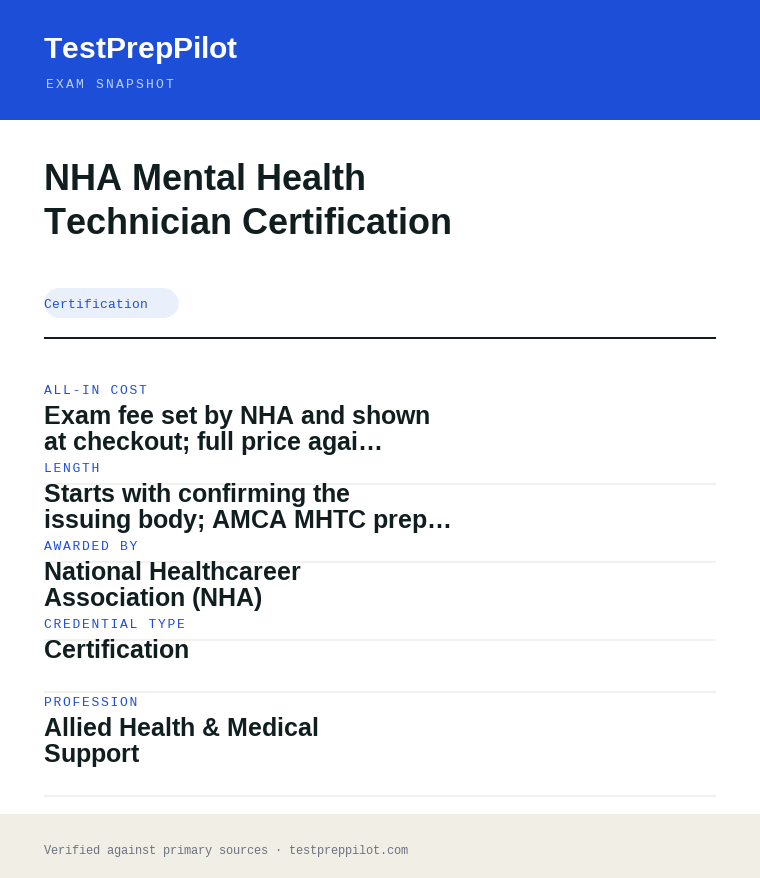
NHA Mental Health Technician Certification is a certification credential; awarded by National Healthcareer Association (NHA); the exam fee is NHA: no fee because no exam exists. AMCA MHTC: $119 per its 2027 program outline; typical preparation is Starts with confirming the issuing body; AMCA MHTC prep then follows its five-domain blueprint.
| Credential | NHA Mental Health Technician Certification |
|---|---|
| Type | Certification |
| Profession | Allied Health & Medical Support |
| Specialty | Nursing Support |
| Awarded by | National Healthcareer Association (NHA) |
| Difficulty | Not applicable (NHA offers no exam) |
| Typical prep time | Starts with confirming the issuing body; AMCA MHTC prep then follows its five-domain blueprint |
| All-in cost | Exam fee set by NHA and shown at checkout; full price again for each retake |
| NHA exam status | None: the NHA Candidate Handbook updated October 5, 2026 lists 8 certifications and no mental health technician exam |
| Closest published exam | AMCA Mental Health Technician Certification (MHTC): 75 questions, 2 hours, per the 2027 program outline |
| AMCA cost | $119 per the AMCA 2027 program outline; confirm at registration |
| AMCA delivery | Online or paper-and-pencil, with live remote proctoring available |
| NHA direct-care alternative | CPCT/A: 100 scored plus 20 pretest items, 2 hours, scaled 390 to pass |
| Retakes and renewal | Set by the issuing body; NHA rules (30-day wait, 2-year renewal) apply only to NHA exams |
| Scope | National / Multi-state |
Real questions
Frequently asked questions about the NHA Mental Health Technician Certification
Does NHA offer a Mental Health Technician certification?
No. NHA does not offer a Mental Health Technician exam. The NHA Candidate Handbook updated October 5, 2026 lists eight certifications: CCMA, CPT, CET, CBCS, CEHRS, CMAA, CPCT/A and the ExCPT pharmacy technician. If a job posting asks for a CMHT, check which organization issues the version the employer accepts.
What is the closest mental health technician exam?
The American Medical Certification Association (AMCA) offers a Mental Health Technician Certification (MHTC). Its 2027 program outline lists 75 questions in 2 hours, a $119 cost, and five domains: Psychological Development, Process and Procedure, Pharmacology, Medical Office/Patient Care Skills, and Practice Settings. Other organizations also issue CMHT-titled credentials.
How many questions are on the mental health technician exam?
It depends on the issuing body, because NHA has no such exam. AMCA's MHTC has 75 questions and allows 2 hours. By comparison, NHA's CPCT/A, its nearest direct-care exam, has 100 scored plus 20 pretest questions in 2 hours. Always check the test plan of the specific exam you register for.
What is the passing score for a mental health technician exam?
NHA has no mental health technician passing score because it has no such exam; its other exams all pass at a scaled 390 on a 200 to 500 scale. AMCA states a passing score of 70 percent or higher on its exams. Do not assume a score from one body applies to another.
Is there an NHA exam for behavioral health or psychiatric technicians?
No. NHA's catalog does not include a behavioral health or psychiatric technician exam. The nearest NHA options are the CPCT/A for patient care technicians and the CCMA for clinical medical assistants. Employers hiring psychiatric technicians often set their own training requirements, so ask the hiring facility which credential it prefers.
Should I take the NHA CPCT/A instead?
The NHA CPCT/A may be worth taking if you want a national direct-care credential, but it does not cover mental health content in its test plan. Its five domains are Patient Care, Compliance, Safety, and Professional Responsibility, Phlebotomy, Infection Control and EKG. Choose it only if employers in your area ask for it.
How do I avoid paying for the wrong mental health credential?
Ask the employer or program for the exact credential name and issuing organization before paying anyone. Titles such as CMHT and MHTC are used by different bodies with different questions, fees and renewal rules. Register through the issuing body directly, not through a site that merely mentions NHA.
What is the passing score on NHA certification exams?
The passing score on every NHA certification exam is a scaled score of 390 on a 200 to 500 scale. NHA uses scaled scores because each exam has multiple forms, and scaling keeps the 390 standard consistent whichever form you receive. The score is not a percentage of questions correct, and NHA does not publish the raw-score conversion.
How long must I wait to retake an NHA exam?
You must wait 30 days after a failed NHA attempt before retaking. You are allowed three attempts with at least 30 days between them, and each failure after the third requires a 1-year wait. Every retake needs a new registration and the full exam price, so use the Above, Near or Below feedback on your score report to focus your study.
Do NHA certifications expire?
NHA certifications are valid for 2 years and must be renewed with 10 continuing education credits plus a recertification fee. ExCPT pharmacy technicians complete 20 CE hours instead, including 1 hour of pharmacy law and 1 hour of patient safety. A lapsed credential can be reinstated within 1 year; after that you must retake the exam.
In short
Is the NHA Mental Health Technician Certification worth it?
- NHA lists eight certifications and none is a Mental Health Technician exam.
- AMCA's MHTC has 75 questions in 2 hours at $119 per its 2027 outline.
- The AMCA blueprint weights are 27%, 23%, 22%, 21% and 7% across five domains.
- NHA's nearest direct-care exam, the CPCT/A, is 100 scored plus 20 pretest items in 2 hours.
Same awarding body
What other credentials does National Healthcareer Association (NHA) award?
Worth comparing
How does the NHA Mental Health Technician Certification compare with similar credentials?
Trust
Where does this information come from?
Everything above is taken from the awarding body's own published material. Fees, question counts and domain weights are revised regularly — check the official page before you pay.
- National Healthcareer Association (NHA) Awarding body
- Official NHA Mental Health Technician Certification exam page Exam page
- National Healthcareer Association (NHA) certification programme Programme rules
Research confidence: medium · Last reviewed 2026-08