Allied Health & Medical Support • Certification
PTCB Billing and Reimbursement Assessment
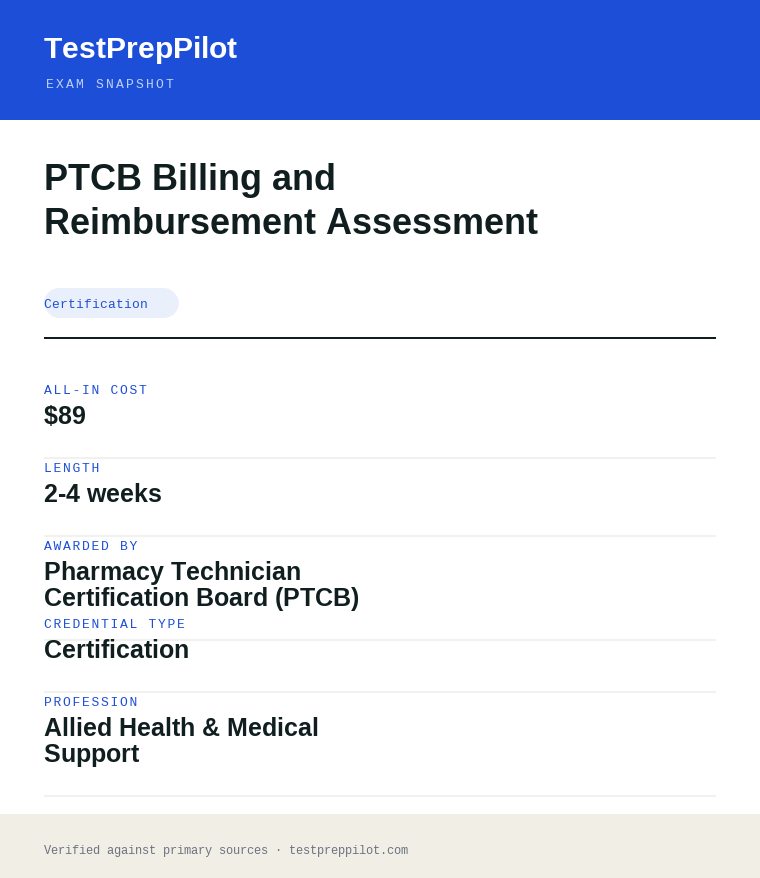
PTCBs certificate for technicians who manage claims, reimbursement, and prior authorization.
Researched and maintained by TestPrepPilot Editorial BoardPharmacy-technician & allied-health certifications desk · Figures last verified August 2026
The short version
What is the PTCB Billing and Reimbursement Assessment and is it worth it?
The Billing and Reimbursement Certificate Exam is a computer-based test with 75 multiple-choice questions and a 90-minute seat time (5-minute tutorial, 80-minute exam, 5-minute survey). The fee is $89. A scaled score of 300 (on a 0-400 scale) is required to pass, and the certificate does not expire. You must hold an active PTCB CPhT to sit it.
- Demonstrates revenue-cycle and claims expertise employers value
- Reduces claim rejections and prior-authorization delays in practice
- Counts toward the CPhT-Adv advanced designation
- Low $89 cost and no renewal requirement
- Stacks with other PTCB certificates for career advancement
What is it?
What exactly is the PTCB Billing and Reimbursement Assessment?
PTCBs certificate for technicians who manage claims, reimbursement, and prior authorization.
The PTCB Billing and Reimbursement Certificate validates a technicians ability to process pharmacy and medical claims, navigate payer systems, and resolve rejections. It covers insurance programs, third-party adjudication, prior authorization, and audit readiness. The certificate is assessment-based: candidates must hold an active CPhT and pass a 75-question exam. It counts toward the CPhT-Adv ladder and signals advanced revenue-cycle competence to employers in retail, hospital, and specialty pharmacy.
The path in brief
- Hold an active PTCB CPhT
- Complete a PTCB-Recognized education program (optional but recommended)
- Apply and pay $89 in your PTCB account
- Schedule at Pearson VUE or online proctoring
- Pass at scaled 300
- Use it toward CPhT-Adv
Before you book
Who is eligible to sit the PTCB Billing and Reimbursement Assessment?
Who it is for: CPhTs working claims, reimbursement, or prior authorization
The test itself
What is the format of the PTCB Billing and Reimbursement Assessment?
The PTCB Billing and Reimbursement Assessment is administered by Online proctored or 1,400+ Pearson VUE test centers and runs 90 minutes (5-min tutorial, 80-min exam, 5-min survey), contains 75 multiple-choice questions and requires Scaled 300 of 0-400 to pass.
| Administered by | Online proctored or 1,400+ Pearson VUE test centers |
|---|---|
| Questions | 75 multiple-choice |
| Time limit | 90 minutes (5-min tutorial, 80-min exam, 5-min survey) |
| Pass mark | Scaled 300 of 0-400 |
| Exam fee | $89 |
| Format | Computer-based multiple choice |
Content outline
What topics are on the PTCB Billing and Reimbursement Assessment?
The PTCB Billing and Reimbursement Assessment is weighted across 5 domains; the largest are Pharmacy Claims Processing and Adjudication (36.67%), Programs and Eligibility (26.67%), Prior Authorization (18.33%).
Weightings come from the official exam outline. Study time is best allocated in roughly these proportions rather than evenly across domains.
- Programs and Eligibility 26.67%
- Pharmacy Claims Processing and Adjudication 36.67%
- Prior Authorization 18.33%
- Medical Claims Processing 8.33%
- Audits and Compliance 10.00%
Money & time
How much does the PTCB Billing and Reimbursement Assessment cost?
For the PTCB Billing and Reimbursement Assessment, the exam fee is $89; the all-in cost is typically $89; most candidates spend 2-4 weeks preparing.
Cost breakdown
| Certificate exam fee | $89 |
|---|---|
| PTCB-Recognized prep (optional) | Varies |
| Typical total | $89 |
The $89 fee covers the single exam attempt; the certificate does not require renewal. Active CPhT status must be maintained separately.
Timeline
- Confirm CPhT active 1 day
- Apply and pay 1 day
- Study 2-4 weeks
- Test 90 minutes
Typical prep: 2-4 weeks
The path
How do you register for the PTCB Billing and Reimbursement Assessment?
- 1
Confirm eligibility
For CPhT: complete a PTCB-recognized education program or 500 hours of work experience. For CSPT: be an active CPhT with sterile-compounding experience.
- 2
Apply and pay
Log in to your PTCB account, apply, and pay the fee (CPhT $129; CSPT $199 total).
- 3
Receive authorization
An email grants a one-year candidacy window and authorization to schedule.
- 4
Schedule and test
Book Pearson VUE (in-person or online) within 90 days of authorization and sit the exam.
The fine print
What are the retake and renewal rules for the PTCB Billing and Reimbursement Assessment?
- Proctoring & delivery
- Delivered in person at 1,400+ Pearson VUE centers (including military bases) or online via live proctor. A matching government-issued photo ID is required.
- Retake policy
- CPhT retakes require a new $129 fee. CSPT retake is $149. A $20 authorization-extension fee applies if needed.
- Score reporting
- Unofficial results appear on screen immediately; official results post to your PTCB account within three weeks.
- Recertification
- CPhT renews every three years with 20 continuing education hours (including one hour of pharmacy law and one of patient safety). CSPT renews with the CPhT and a competency attestation. Renewal fee is $55.
What it pays
How much does this credential pay?
$43,460 median for pharmacy technicians (BLS SOC 29-2052, May 2024)
There is no Bureau of Labor Statistics occupation called "billing and reimbursement specialist," so the salary case for the PTCB Billing and Reimbursement Certificate runs through the occupation it is held on top of: pharmacy technician, which BLS classifies under SOC 29-2052 with a May 2024 median annual wage of $43,460, about $20.90 an hour. The honest framing is that this certificate is an advanced credential for technicians who already hold the PTCB CPhT, so the wage it affects is the pharmacy-technician wage, and the certificate’s value is as a specialty signal that positions a technician for billing, prior-authorization and reimbursement roles within the occupation rather than as a separate wage band. BLS reports the lowest 10 percent of pharmacy technicians earned less than $35,100 and the highest 10 percent more than $59,450, and the May 2024 medians varied by setting — ambulatory healthcare services at $49,920, hospitals at $49,310, general merchandise retailers at $46,180, grocery and specialty food retailers at $38,810, and pharmacies and drug retailers at $37,900 — so a technician who specialises in billing and reimbursement tends to sit toward the hospital and ambulatory end of that distribution, where the pay is highest. BLS counted 490,400 pharmacy technician jobs in 2024 and projects 6 percent growth from 2024 to 2034, faster than the average for all occupations, with about 49,000 openings a year, driven by an ageing population’s medication needs and by technicians taking on responsibilities such as collecting patient information, handling prescription transfers and verifying the work of other technicians as pharmacists move into more patient-care activities. The certification itself requires a current CPhT, which in turn is renewed every two years with 20 continuing-education hours including at least 1 hour of pharmacy law, so the honest budget picture includes the recurring CPhT maintenance cost alongside the one-time certificate fee.
| Measure | Figure | Source / note |
|---|---|---|
| Median annual wage, pharmacy technicians | $43,460 | BLS Occupational Outlook Handbook, May 2024 ($20.90/hr) |
| Lowest 10 percent | less than $35,100 | BLS OOH Pay tab, May 2024 |
| Highest 10 percent | more than $59,450 | BLS OOH Pay tab, May 2024 |
| Employment, 2024 | 490,400 jobs | BLS OOH Quick Facts, 2024 |
| Projected annual openings | ~49,000 per year | BLS OOH Job Outlook, 2024-34 |
| Credential relationship | Advanced certificate on top of the CPhT | Requires an active PTCB CPhT; one step toward CPhT-Adv |
Job growth.+6% projected change 2024-34 for pharmacy technicians (faster than average), with about 49,000 openings a year; the certificate positions technicians for the billing and prior-authorization roles where hospital and ambulatory settings pay the most.
Source: BLS Occupational Outlook Handbook — Pharmacy Technicians
Your odds
What are the pass rates?
PTCB publishes no pass-rate statistic for the Billing and Reimbursement Certificate — but it publishes the format: 75 questions, 1 hour 20 minutes, passing scaled score 300 on a 0-400 scale
The direct answer on pass rates is that PTCB does not publish a pass-rate figure for the Billing and Reimbursement Certificate exam, and we will not invent one — the honest planning question is answered by the published mechanics instead. What PTCB does publish is the complete exam specification: the Billing and Reimbursement Certificate Exam is a computer-based test of 75 multiple-choice questions, delivered at a Pearson test center or through online proctored testing, with 1 hour and 20 minutes of testing time inside a 1 hour 30 minute appointment that includes a 5-minute tutorial and a 5-minute post-exam survey, scored on a 0-400 scale with a passing scaled score of 300, with the official score report presented on screen immediately following the exam. Because the certificate sits on top of the CPhT, the pass-rate context is best read through the foundation credential: PTCB reports first-attempt pass rates for the main Pharmacy Technician Certification Exam (PTCE) historically in the roughly 70-75 percent range, which tells a candidate that the underlying certification is demanding but passable, and the certificate exams are typically more specialised — they test a narrower, work-experience-grounded scope, and candidates who hold the active CPhT and work in the billing domain start with a significant advantage. The content outline is published and precise: Programs and Eligibility at 26.67 percent of the exam, Pharmacy Claims Processing and Adjudication at 36.67 percent, Medical Claims Processing and Adjudication at 8.33 percent, Prior Authorization at 18.33 percent, and Audits and Compliance at 10 percent, which tells a candidate exactly where the points are — more than a third of the paper is pharmacy-claims processing, and almost a fifth is prior authorization. The practical reading is that this is a passable but specialised exam whose difficulty lives in the breadth of payer rules, codes and documentation requirements rather than in a punishing pass line, and the candidates who pass are the ones who work the published outline rather than study generically.
Read this before quoting the number.PTCB publishes no pass-rate statistic for the Billing and Reimbursement Certificate; we state that plainly rather than guessing. The verifiable official figures are the 75-question, 1-hour-20-minute format and the passing scaled score of 300 on the 0-400 scale, with the report presented on screen after the exam.
Your schedule
How long should I study for it?
30-70 hours over 4-8 weeks of focused study
A realistic Billing and Reimbursement Certificate study plan runs 4 to 8 weeks at 6 to 10 hours a week, because the exam is a narrow 75-question test of a work-based specialty and the fastest score gains come from weighting study time to the two domains that carry most of the paper. The PTCB content outline is the scope map: Programs and Eligibility is 26.67 percent of the exam, Pharmacy Claims Processing and Adjudication 36.67 percent, Medical Claims Processing and Adjudication 8.33 percent, Prior Authorization 18.33 percent, and Audits and Compliance 10 percent, so a candidate who studies the five domains equally will under-prepare the claims-processing block that effectively decides the pass. The study window should split into a content phase covering the domains in weight order — starting with the insurance programs and eligibility vocabulary (Medicare Parts A, B and D, Medicare Advantage, Medicaid MCO and fee-for-service, private HMO and PPO plans, PBMs, patient assistance programs), then the pharmacy-claims workflow (data entry, verification, adjudication, rejection troubleshooting, coordination of benefits, drug-cost measures including AWP and acquisition cost, and 340B), then prior authorization (the process, the information required, rejection resolution), then medical claims and the audits-and-compliance material (MACs, HCPCS and ICD codes, incident-to billing, CMS and HRSA audit types including ADR, TPE, CERT and RAC) — followed by a drilling phase with practice questions and at least two full timed practice exams at the real 75-question, 80-minute format. Candidates who work daily in pharmacy billing can compress the content phase and go straight to drilling; candidates coming from general pharmacy work should budget the upper end and add a focused pass over the payer-program and prior-authorization vocabulary that general retail experience often skips. The final week should be light review of the error log and the highest-yield sequence — verify eligibility, authorise, submit, resolve the rejection — rather than new material.
- Week 18-10 hrs
Programs and eligibility (26.67%)
- Study Medicare Parts A/B/D, Medicare Advantage, Medicaid MCO and FFS, and private HMO/PPO plans
- Learn the third-party reimbursement types: PBMs, patient assistance programs, MPPPs
- Cover eligibility requirements for Medicare, Medicaid, TRICARE, financial assistance and 340B
- Weeks 2-310-12 hrs/week
Pharmacy claims processing (36.67%)
- Learn the claim lifecycle: data entry, verification, adjudication, rejection troubleshooting
- Study coordination of benefits and formulary coverage determination
- Master the drug-cost measures: AWP, dispensing fees, acquisition cost and 340B cost
- Week 48-10 hrs
Prior authorization (18.33%)
- Learn the prior-authorization process and the required information
- Drill rejection troubleshooting and the appeals and external-review paths
- Practise the scenario items that pair a denied request with the next correct step
- Week 58-10 hrs
Medical claims and audits (18.33%)
- Cover medical claims: MACs, HCPCS and ICD codes, incident-to billing, MUE
- Study audit types: desktop, ADR, TPE, CERT and RAC, and the required documentation
- Learn the federal laws and accreditation bodies behind compliance items
- Weeks 6-88-10 hrs/week
Drilling and timed rehearsal
- Two full 75-question practice exams under the 80-minute limit
- Analyse every miss by domain and re-drill the weakest areas
- Final pass over the claims workflow and the highest-yield vocabulary
Adjusting the pace
Working in pharmacy billing daily.Four to six weeks. Your job covers most of the claims and prior-authorization content; spend the recovered time on the medical-claims and audit domains your role does not touch.
General pharmacy technician adding the specialty.Six to eight weeks. Add a focused pass over payer-program vocabulary, drug-cost measures and prior-authorization workflow before the drilling phase.
Studying while working full time.Eight weeks at 6-8 hours a week. Protect the weekly timed section and keep the claims-processing domain the constant focus, because it is over a third of the exam.
How to study
How do I prepare most effectively?
The strategy that reliably passes the Billing and Reimbursement Certificate is "learn the payer vocabulary, drill the claims workflow in order, and rehearse the timed format," because the PTCB outline weights Pharmacy Claims Processing and Adjudication at 36.67 percent and Programs and Eligibility at 26.67 percent, and the exam rewards knowing how a claim moves from eligibility through adjudication to resolution. Start by reading the PTCB content outline and baselining with a timed practice exam, logging every miss to a domain. Second, build the payer-program vocabulary deliberately: Medicare Parts A, B and D, Medicare Advantage, Medicaid MCO versus fee-for-service, private HMO and PPO plans, pharmacy benefit managers, patient assistance programs and 340B eligibility are the raw material of a large share of the items, and the terminology is exact. Third, drill the pharmacy-claims workflow as a sequence — verify eligibility and benefits, enter the claim, adjudicate, troubleshoot the rejection, resolve coordination of benefits — because scenario items test the next correct step in the order, and candidates who know the sequence answer faster than candidates who know isolated facts. Fourth, master the prior-authorization process and the specific information it requires, because it is almost a fifth of the exam and is the domain where general pharmacy experience is least likely to have built fluency. Fifth, do not skip the smaller domains: medical claims (MACs, HCPCS and ICD codes, incident-to billing) and audits and compliance (ADR, TPE, CERT and RAC) together are a meaningful minority of the paper, and an entire neglected domain can be the margin between 300 and below. Finally, rehearse the full 75-question, 80-minute format at least twice, because the pacing — about 64 seconds per question — and the exam interface need to be trained, and confirm your eligibility pathway and supervisor attestation early, because a delayed application compresses the study window.
Build the payer-program vocabulary
Medicare Parts A/B/D, Medicare Advantage, Medicaid MCO vs FFS, HMO/PPO, PBMs, patient assistance programs and 340B are the raw material of many items. Learn the terminology exactly.
Drill the claims workflow as a sequence
Verify eligibility, enter the claim, adjudicate, troubleshoot the rejection, resolve coordination of benefits. Scenario items test the next correct step in the order.
Master the prior-authorization process
Almost 20% of the exam. Learn the process, the required information, rejection troubleshooting, and the appeals and external-review paths.
Do not skip medical claims and audits
MACs, HCPCS and ICD codes, incident-to billing, and the ADR/TPE/CERT/RAC audit types are a meaningful minority; an entire neglected domain can be the margin.
Rehearse the timed format
75 questions in 80 minutes is about 64 seconds per question. Run two full timed practice exams so pacing and the interface are trained.
Confirm eligibility and the attestation early
The active CPhT requirement and the supervisor attestation are part of the application; submit them early so a delayed approval does not compress your study window.
What to buy
Which study resources are worth paying for?
Billing and Reimbursement Certificate preparation splits into the official PTCB materials, third-party pharmacy-billing products, and the workplace training most candidates already have, and the buying logic is anchored by one fact: the PTCB content outline is free and defines the five domains with their exact weights, so it is the syllabus no matter what else you buy. PTCB publishes the exam content outline and a list of PTCB-recognized education and training programs for the certificate; candidates who complete a recognized program often find the material already bundled, while candidates qualifying through work experience can study from the outline directly. On the third-party side, pharmacy-billing question banks and books run roughly $25-80 and are useful for volume drilling, but the market is thinner than for the main PTCE, so candidates should verify that a product maps to the certificate outline rather than to the broader CPhT blueprint. The PTCB-recognized education and training programs vary in price from a few hundred dollars to over a thousand depending on whether they are bundled with a degree program; for an experienced billing technician they are usually unnecessary, because the eligibility pathway through 12 months of work experience with a 50 percent billing component already covers the content. Online courses, $50-150, add structure for candidates coming from general pharmacy work. The honest rule: the free content outline plus one timed practice exam should come first, a third-party bank second only if you need volume, and a paid course only if self-study has not cleared the 300 scaled score in practice. The exam application fee itself is $89, and the real recurring cost is the underlying CPhT — renewed every two years with 20 continuing-education hours including at least 1 hour of pharmacy law. Prices below are approximate and dated to 2026; we rank nothing by commission.
| Resource | Price | Format | Best for |
|---|---|---|---|
| PTCB content outline and recognized-program directory | Free | Official PDFs and web directory | The authoritative scope — read the outline first |
| PTCB-recognized education and training program | ~$200-1,000+ | Course, often bundled with a degree | The eligibility pathway for new billing technicians |
| Third-party billing question banks and books | ~$25-80 | Online drilling or printed books | Volume drilling — verify the product maps to the certificate outline |
| Online billing-and-reimbursement courses | ~$50-150 | Video course with practice | General pharmacy technicians adding the specialty |
| The certificate exam itself | $89 per application | Pearson centre or online proctored, 75 questions in 1h20m | Required — on top of an active CPhT |
Prices approximate and dated to 2026 and change frequently; we rank nothing by commission. The certificate exam fee is $89, separate from the CPhT renewal cycle (20 CE hours every 2 years, including 1 pharmacy-law hour). Confirm the current fee and the eligibility pathway at ptcb.org before applying.
Avoid these
What mistakes do candidates most often make?
The most common mistake on the Billing and Reimbursement Certificate is studying it like the main PTCE, because the certificate is a narrow, work-based specialty exam and the broader CPhT prep materials do not cover the claims, prior-authorization and audit content at the depth the outline requires — candidates who only drilled the PTCE blueprint face an exam that assumes fluency in payer programs and adjudication. The second is skipping the payer-program vocabulary: Medicare Parts A, B and D, Medicare Advantage, Medicaid MCO versus fee-for-service, PBMs and 340B are the raw material of a large share of the items, and candidates who work in one retail chain routinely overestimate how much of the national payer landscape they know. A third recurring error is learning isolated facts about claims instead of the workflow order, when scenario items test the next correct step in the sequence — verify eligibility, enter the claim, adjudicate, troubleshoot the rejection, resolve coordination of benefits — and candidates who know the pieces but not the order lose the items. Candidates also routinely under-prepare prior authorization, which is almost a fifth of the exam, because general pharmacy experience rarely builds fluency in the process, the required information, or the appeals and external-review paths. Another pattern is neglecting the smaller domains — medical claims (MACs, HCPCS and ICD codes, incident-to billing) and audits and compliance (ADR, TPE, CERT, RAC) — when together they are a meaningful minority of the paper and an entire neglected domain can be the margin. Finally, some candidates delay the eligibility paperwork — the active-CPhT requirement and the supervisor attestation form — and then lose scheduling weeks to application processing, or they misread the passing scaled score of 300 on the 0-400 scale as a simple percentage and misjudge their practice performance.
✕Studying it like the main PTCE
✓The certificate is a narrow specialty exam. Use the PTCB Billing and Reimbursement content outline, not general CPhT prep — claims, prior authorization and audits need dedicated coverage.
✕Skipping the payer-program vocabulary
✓Medicare Parts A/B/D, Medicare Advantage, Medicaid MCO vs FFS, PBMs and 340B are heavily tested. Learn the terminology exactly rather than assuming your chain’s workflow covers it.
✕Learning claim facts instead of the workflow order
✓Scenario items test the next correct step: verify, enter, adjudicate, troubleshoot, resolve coordination of benefits. Drill the sequence, not isolated facts.
✕Under-preparing prior authorization
✓It is almost 20% of the exam. Learn the process, the required information, rejection troubleshooting and the appeals paths.
✕Neglecting medical claims and audits
✓MACs, HCPCS and ICD codes, incident-to billing, and the ADR/TPE/CERT/RAC audit types are a meaningful minority — give each a focused pass.
✕Delaying the eligibility paperwork
✓You need an active CPhT and the supervisor attestation. Submit early, because a delayed application compresses your study window and can push the exam date.
What you'll face
What question types will I see?
The PTCB Billing and Reimbursement Certificate Exam is a computer-based test of 75 multiple-choice questions with 1 hour and 20 minutes of testing time, scored on a 0-400 scale with a passing scaled score of 300 and the official score report presented on screen immediately following the exam, delivered at Pearson test centers or through online proctored testing. The content follows the PTCB outline across five domains — Programs and Eligibility (26.67 percent), Pharmacy Claims Processing and Adjudication (36.67 percent), Medical Claims Processing and Adjudication (8.33 percent), Prior Authorization (18.33 percent), and Audits and Compliance (10 percent) — and the items run from terminology and definition questions to scenario-based items that describe a billing situation and ask for the correct next step, the correct code, or the correct resolution. The scenario style dominates the claims and prior-authorization domains: a rejected claim, a coverage question, an eligibility problem, a coordination-of-benefits situation, or a prior-authorization denial with the next correct action to choose. Because the exam rewards knowing the workflow order and the exact terminology, a prepared candidate is answering about payer programs, adjudication logic and documentation requirements rather than recalling generic pharmacy facts. The practical pacing is about 64 seconds per question across the 75 items, and candidates who work in the billing domain will recognise the scenarios from daily practice while candidates from general pharmacy work will find the vocabulary the steepest part. The samples below illustrate three of the recurring formats — a terminology item, a claims-workflow scenario, and a prior-authorization decision; they are editor-written illustrations of the published content outline and are not live exam items.
Medicare parts, Medicaid delivery models, private plan types, PBMs and reimbursement types — exact-definition questions that reward memorised vocabulary.
A claim, a rejection, a coverage question or a coordination-of-benefits situation asking for the correct next step in the adjudication sequence.
A denied or required authorization with the next correct action — the required information, the rejection-troubleshooting step, or the appeal path.
HCPCS and ICD codes, incident-to billing, MACs, and the ADR/TPE/CERT/RAC audit types with their documentation requirements.
Try these
Q1Which Medicare part primarily covers prescription drugs dispensed at retail pharmacies?
Answer:D
Medicare Part D is the prescription-drug coverage plan, offered through private insurers, and it is the part that covers outpatient prescription drugs dispensed at retail pharmacies. Part A covers inpatient hospital care, Part B covers physician services and some outpatient items, and Part C (Medicare Advantage) is the private-plan alternative that bundles coverage but is not itself the drug benefit. The item tests the payer-program terminology that anchors the Programs and Eligibility domain — exact distinctions that are heavily tested.
Q2A pharmacy claim is rejected at adjudication because the patient’s eligibility under the plan ended. What is the most appropriate next step?
Answer:B
An eligibility-rejection means the coverage information on file is not valid, so the correct next step is to verify the patient’s current coverage and eligibility — the patient may have moved to a different plan, or the eligibility record may simply be stale — and then proceed with the correct payer. A bills without verifying, C resubmits the same invalid claim, and D abandons the adjudication process entirely. The item tests the claims-workflow scenario style: recognise the rejection type and take the correct next step in the sequence.
Q3Which of the following is required information when submitting a prior authorization request?
Answer:B
A prior-authorization request requires the identifying and clinical information needed to make a coverage decision: patient and prescriber information, the drug, and the dose. A omits the clinical content, C is supply-chain data that does not support a coverage decision, and D is payment data unrelated to the authorization. The item tests the prior-authorization domain — knowing exactly what information the process requires, which is one of the most directly testable skills on the exam.
Samples are editor-written illustrations of the published blueprint, not live exam items.
The big day
What should I expect on exam day?
The Billing and Reimbursement Certificate Exam is a 75-question, 1-hour-20-minute computer-based exam delivered at a Pearson test center or through online proctored testing from your own computer, with the appointment running 1 hour 30 minutes once the 5-minute tutorial and 5-minute post-exam survey are included, and the passing scaled score is 300 on a 0-400 scale with the official score report presented on screen immediately after the exam. The first thing to confirm is your application: you must hold an active PTCB CPhT and complete one of the eligibility pathways — a PTCB-recognized education and training program plus 6 months of pharmacy-technician experience with a 50 percent billing component, or 12 months of full-time employment with a 50 percent billing component — and upload the supervisor attestation form at application, so your authorization to schedule arrives by email only after approval. Bring an approved form of identification whose name matches your PTCB account exactly, because you will not be allowed to test without it; arrive 30 minutes before the appointment at a Pearson center, or check in 30 minutes early for online proctoring. The exam is linear and single-answer multiple choice: pace at about 64 seconds per question, flag anything over 80 seconds if the interface allows review, and answer every question. You cannot return to previous questions in the PTCB exam interface once you advance, so deliberate before moving on. On a pass, you can download your certificate through the Credly platform and claim the digital badge; the certificate itself does not require renewal, but you must maintain your active CPhT — renewed every two years with 20 continuing-education hours including at least 1 hour of pharmacy law — for the credential to remain meaningful.
Bring
- An approved form of identification matching your PTCB account name exactly
- Your authorization-to-schedule email and appointment confirmation
- For online proctoring: a tested webcam, microphone and connection on the exact machine you will use
- Your PTCB account login, in case check-in cannot locate the registration
Leave at home
- Phones, smartwatches, fitness trackers and earbuds — locker at a center, out of the room online
- Notes, cheat sheets and study materials (prohibited)
- Bags, coats and personal calculators — the test interface provides its own tools
- For online proctoring, any other person in the room
How the day runs
Rules in the room
- The exam is 75 multiple-choice questions with 1 hour and 20 minutes of testing time.
- The passing scaled score is 300 on a 0-400 scale; the report appears on screen after the exam.
- The exam does not allow returning to previous questions once you advance.
- An active PTCB CPhT and an approved eligibility pathway are required before the exam can be scheduled.
- The certificate itself does not require renewal; the underlying CPhT renews every 2 years with 20 CE hours including 1 pharmacy-law hour.
Afterwards.Your official score report is presented on screen immediately after the exam. On a pass, download your certificate through the Credly platform, claim the digital badge, and note that the certificate itself does not require renewal — but the active PTCB CPhT it depends on does, with 20 continuing-education hours including at least 1 hour of pharmacy law every two years, so log the CPhT expiry and bank the CE hours early. On a fail, PTCB allows retakes by paying the application fee again with no waiting period between attempts, so use the exam-day experience and any score feedback to target the weaker domains — for most candidates that is the medical-claims and audit material — and re-sit once timed practice clears 300 on the current format. The certificate also counts toward the Advanced Certified Pharmacy Technician (CPhT-Adv) credential, which requires four certificate programs or three certificates plus the CSPT certification and three years of work experience, so a pass is a concrete step on a longer credential ladder rather than a dead-end purchase.
Reference
What are the key facts about the PTCB Billing and Reimbursement Assessment?
PTCB Billing and Reimbursement Assessment is a certification credential; awarded by Pharmacy Technician Certification Board (PTCB); the exam fee is $89; typical preparation is 2-4 weeks.
| Credential | PTCB Billing and Reimbursement Assessment |
|---|---|
| Type | Certification |
| Profession | Allied Health & Medical Support |
| Specialty | Pharmacy Support |
| Awarded by | Pharmacy Technician Certification Board (PTCB) |
| Difficulty | Moderate |
| Typical prep time | 2-4 weeks |
| All-in cost | $89 |
| Eligibility | Active PTCB CPhT required |
| Delivery | Online proctored or Pearson VUE |
| Retake | Repay $89; no formal limit stated |
| Validity | Does not require renewal |
| Scale | Pass at scaled 300 (0-400 range) |
| Scope | National / Multi-state |
Real questions
Frequently asked questions about the PTCB Billing and Reimbursement Assessment
How hard is the Billing and Reimbursement exam?
It is moderately difficult, focused on claims adjudication and payer rules rather than clinical pharmacology. CPhTs with billing exposure pass comfortably with a few weeks of review.
How long should I study?
Most candidates study 2-4 weeks using the PTCB content outline and a recognized program. Prior billing experience shortens prep.
Does the certificate expire?
No. PTCB certificate programs do not require renewal; you keep the credential as long as your underlying CPhT stays active.
Is it worth it?
For technicians in claims, revenue cycle, or specialty pharmacy it is worth it: it builds toward CPhT-Adv and reduces costly claim errors. The $89 cost is low.
What if I fail?
You reapply and repay the $89 fee. PTCB does not publish a hard attempt limit for certificate exams.
In short
Is the PTCB Billing and Reimbursement Assessment worth it?
- 75 questions, 90 minutes; $89
- Pass scaled 300 of 0-400; CPhT required
- No renewal; counts toward CPhT-Adv
- Focuses on claims, reimbursement, prior auth
Same awarding body
What other credentials does Pharmacy Technician Certification Board (PTCB) award?
Trust
Where does this information come from?
Everything above is taken from the awarding body's own published material. Fees, question counts and domain weights are revised regularly — check the official page before you pay.
- Pharmacy Technician Certification Board (PTCB) Awarding body
- Official PTCB Billing and Reimbursement Assessment exam page Exam page
- Pharmacy Technician Certification Board (PTCB) certification programme Programme rules
Research confidence: high · Last reviewed 2026-08