Allied Health & Medical Support • Certification
ARRT Vascular Sonography Certification
The ARRT vascular sonography credential for arterial and venous ultrasound.
Researched and maintained by TestPrepPilot Editorial BoardAllied health & diagnostic sonography certifications desk · Figures last verified August 2026
The short version
What is the ARRT Vascular Sonography Certification and is it worth it?
The ARRT Vascular Sonography exam has 175 scored questions plus 50 pilot items in 225 minutes of test time, with a scaled passing score of 75. Procedures accounts for 85 scored questions, and arterial and venous peripheral vasculature carry 25 each.
- Procedures carries 85 of 175 scored questions, split across four vascular subcategories with exact counts.
- The 225-minute test time is published in the handbook, so pacing can be trained in advance.
- The postprimary route is clearly tied to a supporting sonography credential, through ARRT or ARDMS.
- The credential sits alongside ARRT sonography and breast sonography for a complete ultrasound pathway.
What is it?
What exactly is the ARRT Vascular Sonography Certification?
The ARRT vascular sonography credential for arterial and venous ultrasound.
The ARRT Vascular Sonography (VS) credential is a postprimary credential for sonographers who image blood vessels. The content specification places 175 scored questions across Patient Care (20), Image Production (70) and Procedures (85). Procedures covers abdominal and pelvic, arterial peripheral, venous peripheral, and extracranial cerebral vasculature. The exam has 50 pilot items on top of the scored items, for 225 minutes of test time.
The path in brief
- Confirm the eligibility route for your discipline in the ARRT handbook
- Create your ARRT online account and submit the application
- Schedule your Pearson VUE appointment within the exam window
- Sit the exam and read the preliminary scaled score
- Read your official score report and maintain the credential
Before you book
Who is eligible to sit the ARRT Vascular Sonography Certification?
Confirm the supporting-credential requirement in the 2026 Postprimary Eligibility Pathway Handbook. Routes that use an ARDMS supporting credential carry the higher application fee.
Who it is for: Postprimary candidates who hold a sonography supporting credential and want the vascular credential.
The test itself
What is the format of the ARRT Vascular Sonography Certification?
The ARRT Vascular Sonography Certification is administered by ARRT (eligibility and scoring); Pearson VUE (test centers) and runs 225 minutes of test time, contains 175 scored questions plus 50 unscored pilot items (225 total) questions and requires Scaled score of 75 on a 1-99 scale to pass.
| Administered by | ARRT (eligibility and scoring); Pearson VUE (test centers) |
|---|---|
| Questions | 175 scored questions plus 50 unscored pilot items (225 total) |
| Time limit | 225 minutes of test time |
| Pass mark | Scaled score of 75 on a 1-99 scale |
| Exam fee | $225 application fee per exam attempt (postprimary routes that use an NMTCB or ARDMS supporting category: $450) |
| Format | Computer-based, with multiple selection, ordering and image-based items. |
Content outline
What topics are on the ARRT Vascular Sonography Certification?
The ARRT Vascular Sonography Certification covers 8 content domains.
No percentage weights are listed for these domains here, so the outline is shown as structure only. Check the certifying body's published outline before allocating study time.
- Patient Interactions and Management
Patient Care: 20 scored questions.
- Basic Principles of Ultrasound
Image Production: 23 scored questions.
- Image Formation
Image Production: 12 scored questions.
- Evaluation and Selection of Representative Images
Image Production: 35 scored questions.
- Abdominal/Pelvic Vasculature
Procedures: 19 scored questions.
- Arterial Peripheral Vasculature
Procedures: 25 scored questions.
- Venous Peripheral Vasculature
Procedures: 25 scored questions.
- Extracranial Cerebral Vasculature and Other Sonographic Procedures
Procedures: 16 scored questions.
Money & time
How much does the ARRT Vascular Sonography Certification cost?
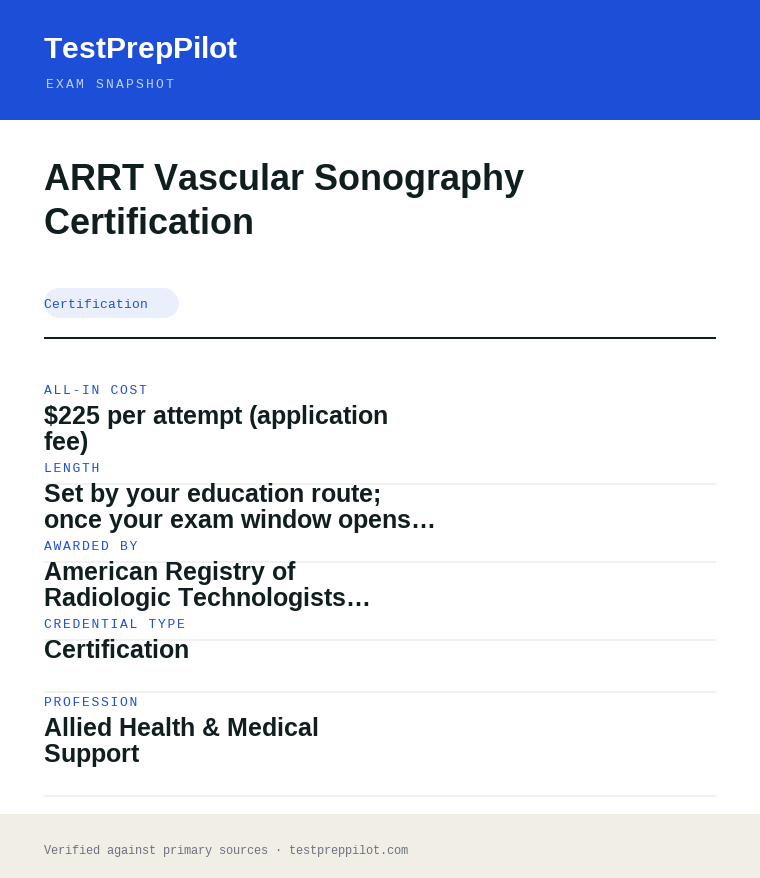
For the ARRT Vascular Sonography Certification, the exam fee is $225 application fee per exam attempt (postprimary routes that use an NMTCB or ARDMS supporting category: $450); the all-in cost is typically $225 per attempt (application fee); most candidates spend Set by your education route; once your exam window opens you have 365 calendar days to test preparing.
Cost breakdown
| Application fee, one exam attempt (primary or standard postprimary route) | $225 |
|---|---|
| Postprimary application using an NMTCB or ARDMS supporting category | $450 |
| Reapplication fee for a retake | Listed on the ARRT website; each attempt needs a new application and fee |
| Pearson VUE reschedule or cancellation | Charged by Pearson each time you change the appointment |
| Typical total | $225 per attempt (up to $450 on routes that use an NMTCB or ARDMS supporting category), plus reschedule and CE costs |
Continuing education costs are set by the CE provider. The renewal fee is set by ARRT and changes, so check the current schedule.
Timeline
- Eligibility and application Depends on your education route; ARRT assigns your exam window after approval
- Exam window Up to 365 calendar days from the window start date
- Official score report About 10 business days after the exam
- Certificate by mail (if passed) About two weeks after the results notice
Typical prep: Set by your education route; once your exam window opens you have 365 calendar days to test
The path
How do you register for the ARRT Vascular Sonography Certification?
- 1
Establish eligibility on the primary or postprimary pathway
Confirm which handbook covers your discipline. Primary pathway candidates complete an ARRT-recognized education program. Postprimary candidates must already hold the supporting credential the handbook matrix requires, and some routes accept a supporting credential earned through NMTCB or ARDMS in place of ARRT.
- Open the Primary Eligibility Pathway Handbook or the Postprimary Eligibility Pathway Handbook
- Find your discipline in the eligibility matrix
- Note any supporting-credential footnote that applies to you
Postprimary candidates whose supporting credential comes from NMTCB or ARDMS pay the higher application fee.
- 2
Create an ARRT online account and submit the application
Applications are submitted through the ARRT online account. Include any ADA accommodation request at the same time, because ARRT assigns your exam window after the application is processed and will not accept an accommodation request after that point.
- Create or sign in to your ARRT online account
- Select your discipline and eligibility pathway
- Pay the application fee for one exam attempt
Each exam attempt needs its own application and fee.
- 3
Receive your Candidate Status Report and exam windowUp to 365 calendar days
After ARRT approves the application, your Candidate Status Report shows your exam window. The window runs for 365 calendar days from its start date. If it closes without a scheduled and taken exam, the application fee is forfeited and you must reapply.
- Check the start and end dates of your exam window
- Note the three-attempts-in-three-years limit that starts when the first window opens
- 4
Schedule your appointment with Pearson VUE
Exams are taken at Pearson VUE test centers. You can schedule once ARRT has released your candidate information, which the handbook says is about 24 hours after you receive it. Cancel or reschedule at least 24 hours before the appointment, because Pearson charges a fee each time you change it.
- Book a test center through the Pearson VUE site or phone line listed in the handbook
- Check the time allowed for the tutorial, nondisclosure agreement and survey
- Plan to arrive 30 minutes early
Pearson charges a fee for each reschedule.
- 5
Sit the exam and read the preliminary resultTutorial and agreement add about 10 minutes to the exam itself
The exam is computer-based and begins with a tutorial. You receive a preliminary scaled score at the test center, which is not the final result. The official result follows in your online account.
- Bring the required identification
- Accept the nondisclosure agreement before the exam begins
- Use the on-screen timer and flag questions you want to review
- 6
Receive the official score report and, if you pass, your certificateAbout 10 business days, then about two weeks for the mailed packet
ARRT emails when official results are available in your online account, normally within about 10 business days. A passing candidate receives a certificate packet by mail about two weeks after that notice.
- Log in to your online account to read the section breakdown
- Watch for the email notice, which is also copied to the Message Center
Results can be delayed up to six months if fees are unpaid or information is incomplete.
The fine print
What are the retake and renewal rules for the ARRT Vascular Sonography Certification?
- Proctoring & delivery
- Computer-based exams delivered at Pearson VUE test centers. The exam begins with a tutorial, and you must accept the nondisclosure agreement before testing starts.
- Retake policy
- Three attempts to pass an ARRT exam within three years of the date your first exam window opens. Each attempt needs a new application and fee, and the reapplication fee is listed on the ARRT website. After the limit, you must requalify.
- Score reporting
- A preliminary scaled score is shown at the test center. The official score report appears in your online account within about 10 business days. The scale runs from 1 to 99 and a scaled score of 75 passes. Sonography and MRI add section minimums of 7.5 in specific sections.
- Recertification
- Maintenance has two parts: an annual renewal each year and continuing education each biennium. Radiologic technologists must report 24 approved CE credits per biennium, with 16 of those credits sonography-specific for sonographers. Registered Radiologist Assistants must report 50 credits. Renewal fees are set by ARRT and should be checked on its website.
- Refunds & rescheduling
- ARRT does not refund fees and does not transfer them to another discipline. Fees also apply to reschedules made through Pearson VUE.
What it pays
How much does this credential pay?
$89,340 median for diagnostic medical sonographers (SOC 29-2032, BLS May 2024) — the occupation that employs most RVT credential holders
The closest official occupation to the Registered Vascular Technologist role is Diagnostic Medical Sonographers, SOC 29-2032, which had a May 2024 median wage of $89,340, with the lowest 10 percent earning less than $64,760 and the highest 10 percent more than $123,170. That fit is deliberate: BLS describes diagnostic medical sonographers as operating ultrasound equipment to create images of the inside of the body, and the RVT credential certifies sonographers who perform and interpret vascular ultrasound studies — cerebrovascular, venous, peripheral arterial and abdominal — which is a specialty within the sonographer occupation. BLS projects 13 percent employment growth for diagnostic medical sonographers from 2024 to 2034, much faster than the 3 percent all-occupations average, with about 5,800 openings a year, driven by an aging population and the expanding uses of ultrasound across medical specialties. Two caveats belong in the same paragraph. First, a naming clarification matters for anyone researching this credential: the RVT is issued by ARDMS (part of Inteleos), not by ARRT, and candidates must pass two exams — the Sonography Principles and Instrumentation (SPI) exam and the Vascular Technology (VT) specialty exam — within five years of each other, so the credential cost and timeline are double what a single-exam certificate implies. Second, the wage distribution reflects the whole sonographer occupation, not RVT holders specifically; BLS does not measure a certificate premium, and we will not invent one, but employers in IAC-accredited vascular labs and hospitals routinely treat the RVT as a near-universal hiring requirement for vascular roles, which keeps its holders employable at the occupation’s median and above.
| Measure | Figure | Source / note |
|---|---|---|
| Median annual wage, diagnostic medical sonographers | $89,340 | BLS OOH, SOC 29-2032, May 2024 |
| Lowest 10 percent | less than $64,760 | BLS OOH Pay tab, May 2024 |
| Highest 10 percent | more than $123,170 | BLS OOH Pay tab, May 2024 |
| Employment, 2024 | 90,000 jobs | BLS OOH Quick Facts, 2024 |
| Projected annual openings | ~5,800 per year | BLS OOH Job Outlook, 2024-34 |
Job growth.13% projected change 2024-34 (much faster than average), with ~5,800 openings a year; the RVT is the standard credential for vascular sonography roles within this occupation
Source: BLS Occupational Outlook Handbook — Diagnostic Medical Sonographers
Your odds
What are the pass rates?
ARDMS publishes pass rates for the VT exam — 66% of first-time test-takers passed in 2023, with a 59% overall rate including retakers
ARDMS publishes annual pass rates for its exams, and the Vascular Technology (VT) specialty exam shows a first-time pass rate of 66 percent in 2023 with a 59 percent overall rate including retakers; the series is stable, with first-time rates of 66 percent in 2022, 68 percent in 2021, 73 percent in 2020 and 73 percent in 2019. That pattern is a useful planning datum: the VT exam is genuinely difficult, and it is the hardest of the two exams required for the RVT credential, so the 66-percent figure should shape how seriously you take preparation rather than discourage you. The VT exam contains approximately 170 multiple-choice items, including hotspot-style Advanced Item Type questions where you mark answers directly on images, and it is completed in three hours at a Pearson VUE test centre. Scoring is scaled on a 300-to-700 scale with a passing score of 555, which is explicitly not a percentage of correct answers and not a curve. The 2026 VT exam fee is $300 (including a $100 non-refundable processing fee), and the SPI prerequisite exam is $250; candidates must pass both exams within five years of each other, in any order, to earn the RVT. After a failed attempt you must wait 60 days before retesting. Because ARDMS publishes both first-time and overall rates, the honest reading is that roughly two in three prepared first-time candidates pass, and the retaker-inclusive rate is lower — which argues for taking the exam when you are genuinely ready rather than on a deadline.
Read this before quoting the number.ARDMS publishes first-time and overall pass rates for the VT exam — 66% first-time and 59% overall in 2023. The ~170-item, three-hour structure, scaled passing score of 555, $300 fee and the SPI prerequisite at $250 are the published figures this narrative relies on alongside it.
Source: ARDMS/Inteleos — Vascular Technology (VT) exam page and pass-rate data
Your schedule
How long should I study for it?
120-180 hours over 12-16 weeks across both exams of focused study
Plan for twelve to sixteen weeks and 120 to 180 hours of study for the two-exam RVT pathway, and weight the Vascular Technology exam to its published content outline — Pathology is the largest domain at roughly 32 percent, followed by Normal Anatomy at 21 percent — while treating the SPI physics exam as a separate, earlier milestone rather than an afterthought. The RVT credential is not a single exam: you must pass the Sonography Principles and Instrumentation (SPI) exam, approximately 110 items in two hours at $250, and the Vascular Technology (VT) specialty exam, approximately 170 items in three hours at $300, within five years of each other, and most candidates take SPI first because every VT answer sits on top of physics you cannot fake. The VT content outline runs to seven domains: Pathology, Perfusion and Function at 32 percent; Normal Anatomy, Perfusion and Function at 21 percent; Quality Assurance, Safety and Physical Principles at 14 percent; Physiologic Examinations at 12 percent; Preparation, Documentation and Communication at 8 percent; Ultrasound-guided Procedures and Intraoperative Assessment at 7 percent; and Surgically Altered Anatomy and Pathology at 6 percent. The plan below assumes you meet an eligibility pathway — commonly a two-year patient-care allied-health program plus twelve months of clinical vascular experience, or a bachelor’s degree plus twelve months of experience. If you are not already scanning in a vascular lab, the clinical-experience requirement is the gate you must clear first, because velocity criteria and pathology recognition only make sense on real patients.
- Weeks 1-310-12 hrs/week
SPI physics — the prerequisite exam
- Master the physics foundation: ultrasound principles, transducers, Doppler, artifacts and instrumentation
- Take the SPI exam early in the pathway — it is approximately 110 items in two hours at $250
- Work SPI practice items until physics is comfortable, because VT assumes it
- Book SPI for the end of this block; the score is valid for the five-year credential window
- Weeks 4-610-12 hrs/week
VT — Normal anatomy and hemodynamics (21%)
- Learn normal cerebrovascular, venous, peripheral arterial and abdominal vascular anatomy
- Master the hemodynamic basics: resistance, compliance, velocity and waveform analysis
- Work carotid, venous, arterial and abdominal duplex scanning protocols
- Connect each study to the anatomy that determines what you are looking at
- Weeks 7-1010-12 hrs/week
VT — Pathology and physiologic exams (44% combined)
- Work pathology recognition: stenosis, occlusion, aneurysm, DVT, venous insufficiency and more
- Drill velocity criteria — carotid stenosis grading, NASCET/ECST measurement, ABI interpretation
- Learn physiologic examinations: segmental pressures, plethysmography, ABI and TCD principles
- This block is the largest share of the paper; give it more calendar than any other
- Weeks 11-138-10 hrs/week
VT — QA, safety, documentation and the remaining domains
- Cover quality assurance, safety and physical principles (14%) and documentation (8%)
- Work ultrasound-guided procedures and intraoperative assessment (7%)
- Learn surgically altered anatomy and pathology, including grafts and bypasses (6%)
- Practise hotspot-style items where you mark answers directly on images
- Weeks 14-168-10 hrs/week
Timed rehearsal and gap closing
- Take two or three full three-hour timed VT practice exams
- Re-lab every miss to a content domain — most errors cluster in pathology and velocity criteria
- Re-drill the hotspot format and the physiologic exam items
- One quiet day before the exam; you receive a pass/fail result and scaled score at the centre
Adjusting the pace
Working as a vascular sonographer already.Eight to ten weeks. Your day job covers scanning and protocols; spend the recovered time on velocity criteria precision, SPI physics refresh and the hotspot format, which clinical work under-trains.
Passed SPI in a previous cycle.Your SPI score is valid within the five-year window; focus entirely on VT. Confirm the five-year clock before committing, and rebuild physics only where VT items assume it.
From general sonography (RDMS background).Your instrumentation and imaging base transfers; the gap is vascular-specific velocity criteria, hemodynamics and physiologic exams. Budget the full twelve to sixteen weeks with a vascular-first weighting.
How to study
How do I prepare most effectively?
The strategy that reliably moves an RVT score is "learn the physics once, then weight everything to the VT outline — pathology and anatomy are more than half the paper — and drill the velocity criteria to reflex", and the single biggest error is treating the credential as one exam when it is two, with the SPI physics prerequisite carrying its own fee and schedule. The VT content outline is the planning document: Pathology at 32 percent and Normal Anatomy at 21 percent together are more than half the scored items, so a candidate who studies vascular topics in proportion to those weights is preparing correctly, while one who spends the calendar evenly across all seven domains is under-preparing the deciding areas. The second proven approach is velocity-criteria memorisation done as application: carotid stenosis grading, NASCET/ECST measurement and ABI interpretation come up as scenario items, and the candidates who pass are the ones who can state a velocity threshold and then apply it to a described waveform. Third, practise the hotspot item format early, because marking answers directly on an image is a different skill from selecting text and it unsettles candidates who have never seen it. Fourth, treat SPI physics as a genuine milestone rather than a hurdle to jump — schedule it early, pass it, and let it fund the physics the VT exam assumes. Finally, rehearse the three-hour VT format under real timing, because 170 items with image-based questions is a stamina event and the scaled-555 pass gives no credit for unfinished items.
Treat it as two exams, and pass SPI early
The RVT requires the SPI physics exam and the VT specialty exam within five years of each other. Schedule SPI early, at $250, and pass it, because every VT answer sits on physics you cannot fake — and the VT fee of $300 should not be spent on an unprepared physics base.
Weight study to the VT outline
Pathology is 32% and Normal Anatomy is 21% — together more than half the paper. Allocate your calendar in those proportions, with physiologic exams next at 12%, rather than spreading hours evenly across all seven domains.
Drill velocity criteria to application
Carotid stenosis grading, NASCET/ECST measurement, ABI interpretation and venous criteria come up as scenario items. Learn the thresholds, then practise applying them to described waveforms and images until the judgement is a reflex.
Practise the hotspot format early
VT includes Advanced Item Type hotspot questions where you mark answers directly on images. This is a different skill from selecting text, and practising it before exam day removes a whole category of avoidable disorientation.
Learn pathology recognition from real scans
The largest single domain rewards pattern recognition — stenosis, DVT, aneurysm, venous insufficiency, grafts. The best practice is correlating described findings with the physics that produce them, which is why clinical vascular experience matters so much to the outcome.
Rehearse the three-hour VT format
Approximately 170 items in three hours with image-based questions is a stamina event. Run full timed practice exams so pacing is trained, and treat the scaled-555 pass as the target rather than any percentage estimate.
What to buy
Which study resources are worth paying for?
The RVT buying decision is defined by two official exam fees and a long tail of optional resources: the SPI exam at $250, the VT exam at $300, and then the study materials you choose. Because the credential requires both exams within five years, the total official cost is $550 before any study resource, and the realistic outlay including a membership and preparation materials is higher. The table below compares the main options with prices current to this review. The one category to treat with suspicion is braindump-style question banks: ARDMS rotates and refreshes its item pools, and the image-based hotspot format rewards genuine pattern recognition rather than memorised questions.
| Resource | Price | Format | Best for |
|---|---|---|---|
| SPI exam registration (ARDMS) | $250 | Computer-based at Pearson VUE | The physics prerequisite every RVT candidate must pass |
| VT exam registration (ARDMS) | $300 (includes $100 non-refundable processing) | Computer-based at Pearson VUE | The specialty exam — the larger and harder of the two |
| ARDMS VT content outline and practice test | Free outline; ~$45 for the official practice test | Official PDFs and online simulation | The authoritative blueprint plus a 30-question interface rehearsal |
| Vascular ultrasound textbooks (e.g. Pellerito & Polak, Zwiebel) | ~$120-250 | Textbook | Depth on anatomy, hemodynamics, pathology and velocity criteria |
| RVT question banks and mock exams | ~$50-150 | Online timed practice | Rehearsing the three-hour VT format and the hotspot items |
Prices checked 2026-08 in USD before tax; the SPI and VT fees are separate, both exams must be passed within five years of each other, and a $50 non-refundable surcharge applies when scheduling outside the US, Canada and Mexico.
Avoid these
What mistakes do candidates most often make?
The most common RVT mistakes come from misunderstanding the credential’s shape: treating it as a single exam when it is two, taking the VT exam before the physics foundation is solid, and studying vascular topics evenly instead of weighting to the published outline, where Pathology and Normal Anatomy together are more than half the paper. Candidates also routinely under-practise the hotspot image-answer format, misapply velocity criteria under time pressure, and sit the VT exam before their clinical scanning experience justifies the attempt — the 60-day retake wait then becomes a costly second round.
✕Treating the RVT as a single exam
✓The credential requires both the SPI physics exam ($250) and the VT specialty exam ($300) within five years of each other. Plan two milestones, schedule SPI early, and budget both fees — a candidate who discovers the second exam late has mis-planned the whole pathway.
✕Studying all seven domains evenly
✓The VT outline is not flat: Pathology is 32% and Normal Anatomy is 21%. Weight your calendar to the big domains and treat QA, documentation and surgically altered anatomy as the smaller 6-14% areas they are.
✕Under-practising the hotspot format
✓VT includes Advanced Item Type hotspot questions where you mark answers directly on images. Practise this format early — it is a different skill from selecting text, and first-time disorientation is an avoidable source of lost points.
✕Applying velocity criteria from memory, not judgement
✓Carotid grading, NASCET/ECST and ABI items come as scenarios with waveforms and numbers. Learn the thresholds, then practise applying them to described findings until the decision is a reflex — recall alone fails when the item inverts the numbers.
✕Sitting VT before clinical experience justifies it
✓The eligibility pathways require substantial clinical vascular experience, and the exam rewards pattern recognition from real scans. If your scanning hours are thin, extend the timeline rather than the attempt — the 60-day retake wait and $300 fee are poor teachers.
What you'll face
What question types will I see?
The Vascular Technology (VT) exam for the RVT credential is approximately 170 multiple-choice items in three hours at a Pearson VUE test centre, scored on a scaled 300-to-700 scale with a passing score of 555, and it includes hotspot-style Advanced Item Type questions where you mark answers directly on images. The credential also requires the separate SPI physics exam — approximately 110 items in two hours — within the same five-year window, so the full pathway is two exams, not one. The VT paper is organised around seven content domains, with Pathology, Perfusion and Function the largest at 32 percent, followed by Normal Anatomy, Perfusion and Function at 21 percent, Quality Assurance, Safety and Physical Principles at 14 percent, Physiologic Examinations at 12 percent, Preparation, Documentation and Communication at 8 percent, Ultrasound-guided Procedures and Intraoperative Assessment at 7 percent, and Surgically Altered Anatomy and Pathology at 6 percent. The dominant question style is scenario- and image-based: a described clinical situation, a waveform, or an image with a request to identify the finding, grade the stenosis, select the next protocol step, or choose the correct physiologic interpretation. Because the scaled 555 is not a percentage of correct answers, candidates should aim to answer accurately across all seven domains rather than target a raw count. The samples below are editor-written illustrations of the published blueprint’s question styles, not live exam items.
Identify stenosis, occlusion, aneurysm, DVT, venous insufficiency and graft complications from described findings, waveforms or images — the largest single domain on the paper.
Normal cerebrovascular, venous, peripheral arterial and abdominal vascular anatomy, plus resistance, compliance, velocity and waveform fundamentals that everything else sits on.
Carotid stenosis grading, NASCET/ECST measurement, ABI interpretation and venous criteria applied to described numbers and waveforms — the classic scenario currency of the exam.
Segmental pressures, plethysmography, ABI and transcranial Doppler principles and interpretation.
Quality assurance and safety, ultrasound-guided procedures, documentation and surgically altered anatomy — smaller individually, but a meaningful share of the total.
Advanced Item Type questions where you mark answers directly on an image — a distinct skill that must be practised before exam day.
Try these
Q1During a carotid duplex examination, the peak systolic velocity in the internal carotid artery is measured at 350 cm/s, and plaque is visible that narrows the lumen by an estimated 50-69%. Which grade of stenosis does this finding support?
Answer:C
Under the standard velocity criteria used in the practice this exam reflects, a peak systolic velocity of 350 cm/s in the internal carotid artery falls in the range consistent with 70-99% stenosis, even though the visible plaque estimate suggested 50-69% — the velocity and the B-mode estimate must be reconciled, and the elevated PSV drives the grading upward. A is wrong because a normal ICA has substantially lower velocities. B under-reads the velocity evidence. D is wrong because occlusion means no flow, whereas this carotid has a high-velocity jet through a residual lumen.
Q2A lower-extremity venous duplex study is ordered to rule out deep vein thrombosis. Which sonographic finding is most consistent with acute DVT?
Answer:B
The classic acute DVT finding is a dilated vein that does not compress under transducer pressure, with hypoechoic (or anechoic) thrombus in the lumen. A is wrong because a fully compressible vein with no thrombus is the normal finding that excludes DVT. C describes chronic changes — echogenic, recanalised, with wall thickening. D is internally contradictory: absent flow without the compression finding would prompt further assessment, not itself confirm acute DVT.
Q3A vascular technologist is performing an ankle-brachial index (ABI) examination. Which measurement arrangement is correct for the ABI calculation?
Answer:B
The standard ABI is calculated per leg as the higher of the dorsalis pedis and posterior tibial systolic pressures at the ankle, divided by the higher of the two brachial systolic pressures — which the option summarises as the highest ankle pressure over the highest brachial pressure, using the arm value on the same side as the highest arm pressure. A misstates it by implying a single global ratio. C is wrong because ABI is a ratio, not a difference. D is wrong because the denominator is the brachial systolic pressure, not the diastolic, and the numerator is not a four-ankle average.
Samples are editor-written illustrations of the published blueprint, not live exam items.
The big day
What should I expect on exam day?
The Vascular Technology (VT) exam is approximately 170 multiple-choice items in three hours at a Pearson VUE test centre, scored on a scaled 300-to-700 scale with a passing score of 555, and it is the harder of the two exams required for the RVT credential — the SPI physics exam, approximately 110 items in two hours, is the other. Exam day means travelling to a Pearson VUE centre with a valid, government-issued photo ID matching your registration, arriving early for check-in and the secure-room process, and leaving phones, smartwatches and all personal items in a locker — the exam is closed-book, calculators are prohibited, and the only permitted aid is the whiteboard the centre provides for manual calculations. The three-hour clock starts when the exam loads, and the pacing plan must account for the paper’s shape: the hotspot image items and the velocity-criteria scenarios take more time per item than straightforward recall, so the practical approach is to work briskly, flag the image items you cannot resolve, and protect time for the final stretch. You receive a pass or fail decision and a scaled score at the centre after the exam, so you walk out knowing the outcome; the official score report is also posted to your Inteleos portal within a week. After a failed attempt you must wait 60 days before retesting.
Bring
- A valid, government-issued photo ID matching your registration name exactly
- Your exam confirmation and scheduling details
- Water and a snack for before the exam, per the centre’s rules
- Transport plan that gets you to the centre 30-45 minutes early for check-in
Leave at home
- Phones, smartwatches, fitness trackers and earbuds — locker at the centre
- All notes, study materials and printed references — the exam is fully closed-book
- Calculators, which are prohibited; manual calculations go on the centre’s whiteboard
- Bags, coats, food and drink beyond what the centre permits
- Loose paper — the centre supplies any permitted scratch material
How the day runs
Rules in the room
- Approximately 170 multiple-choice items in three hours; the clock does not stop once it starts.
- A scaled score of 555 on the 300-to-700 scale is required to pass; it is not a percentage of correct answers.
- The exam is computer-based at Pearson VUE test centres and fully closed-book.
- Calculators are prohibited; the centre provides a whiteboard for manual calculations.
- The exam includes hotspot Advanced Item Type questions where you mark answers directly on images.
- After a failed attempt, you must wait 60 days before retesting.
- The credential requires the SPI physics exam as well, passed within five years of the VT exam; the VT fee is $300 and SPI is $250.
Afterwards.You receive a pass or fail decision and a scaled score at the testing centre, with the official report posted to your Inteleos portal within a week. On a pass, remember the credential is not complete until the SPI exam is also passed within the five-year window — if you took VT first, diary the SPI deadline immediately. The RVT is then maintained on ARDMS’s three-year cycle: 30 ARDMS-approved CME credits per cycle, with an annual renewal fee paid each year by the December 31 deadline, so plan the CME schedule across the three years rather than scrambling in the final months. On a fail, the 60-day wait before retesting is a deliberate cooling-off window — use it to re-drill the pathology and velocity-criteria domains, practise the hotspot format, and re-sit when practice scores justify it. The credential sits in a strong market: BLS projects 13 percent growth for diagnostic medical sonographers through 2034 with a $89,340 median, and the RVT is the near-universal hiring standard for vascular lab and hospital vascular roles, so the credential translates directly into employability in a growing occupation.
Reference
What are the key facts about the ARRT Vascular Sonography Certification?
ARRT Vascular Sonography Certification is a certification credential; awarded by American Registry of Radiologic Technologists (ARRT); the exam fee is $225 application fee per exam attempt (postprimary routes that use an NMTCB or ARDMS supporting category: $450); typical preparation is Set by your education route; once your exam window opens you have 365 calendar days to test.
| Credential | ARRT Vascular Sonography Certification |
|---|---|
| Abbreviation | VS |
| Type | Certification |
| Profession | Allied Health & Medical Support |
| Specialty | Medical Imaging |
| Awarded by | American Registry of Radiologic Technologists (ARRT) |
| Difficulty | Moderate |
| Typical prep time | Set by your education route; once your exam window opens you have 365 calendar days to test |
| All-in cost | $225 per attempt (application fee) |
| Content specification | Vascular Sonography content specification, approved January 2023 and implemented January 1, 2024. |
| Scoring | Scaled 1-99; scaled score of 75 passes |
| Attempts | Three attempts within three years of the first exam window opening |
| Exam window | 365 calendar days from the window start date |
| Score report | Preliminary at the test center; official in the online account within about 10 business days |
| Maintenance | Annual renewal and 24 approved CE credits per biennium |
| Scope | National / Multi-state |
Real questions
Frequently asked questions about the ARRT Vascular Sonography Certification
How hard is the Vascular Sonography exam?
Difficulty depends on your preparation and your background. The passing standard is a scaled score of 75 on a 1 to 99 scale, and it is not a percentage. The number of correct answers needed changes from one exam version to another. Pass-rate figures also change year to year, so check ARRT for the current published figure before relying on any number from an older article.
How long is the Vascular Sonography exam?
The exam has 175 scored questions and 50 unscored pilot items, for 225 total, with 225 minutes of test time. Your appointment also includes a tutorial, a nondisclosure agreement and a survey, so allow the full appointment time on exam day.
How many times can I take the Vascular Sonography exam?
You have three attempts to pass an ARRT exam within three years of the date your first exam window opens. Each attempt requires a separate application and fee, so a failed attempt has a direct cost as well as a time cost. Plan your study before you apply.
Does the Vascular Sonography credential expire?
Your ARRT credential is kept current through an annual renewal and biennial continuing education, not by a one-time pass. Radiologic technologists must report 24 approved CE credits per biennium. Renewal fees are set by ARRT, so check its current fee schedule each year rather than relying on an older figure.
How long until I know whether I passed?
You receive a preliminary scaled score at the test center. ARRT then emails that official results are in your online account, normally within about 10 business days. If you pass, a certificate packet arrives by mail about two weeks after that notice.
How should I study for the Vascular Sonography exam?
Give the three vascular procedure subcategories most of your time, and practice image evaluation, which carries 35 questions. ARRT does not endorse specific study materials, but it publishes the content specification for each discipline, and most programs use it as the study guide. Start from that outline, identify the subcategories where you are weakest, and use study products as supplements rather than as official content.
What is the difference between the primary and postprimary pathways?
The primary pathway is for entry-level credentials such as Radiography, Nuclear Medicine, Radiation Therapy and Sonography, and it requires completion of an ARRT-recognized education program. The postprimary pathway is for advanced credentials such as CT, MRI, Mammography, Cardiac Interventional and Vascular Interventional Radiography. Postprimary candidates must hold a supporting credential, and the handbook matrix shows which one each discipline requires.
How many attempts do I get?
You have three attempts to pass an ARRT exam within three years of the date your first exam window opens. Each attempt requires its own application and fee. If you do not pass within those limits, you must requalify before you can test again.
In short
Is the ARRT Vascular Sonography Certification worth it?
- ARRT Vascular Sonography has 175 scored questions plus 50 pilot items in 225 minutes.
- Procedures carries 85 scored questions across four vascular subcategories.
- The postprimary route needs a sonography supporting credential, through ARRT or ARDMS.
- Maintain with annual renewal and 24 approved CE credits per biennium.
Same awarding body
What other credentials does American Registry of Radiologic Technologists (ARRT) award?
Worth comparing
How does the ARRT Vascular Sonography Certification compare with similar credentials?
Trust
Where does this information come from?
Everything above is taken from the awarding body's own published material. Fees, question counts and domain weights are revised regularly — check the official page before you pay.
- American Registry of Radiologic Technologists (ARRT) Awarding body
- Official ARRT Vascular Sonography Certification exam page Exam page
- American Registry of Radiologic Technologists (ARRT) certification programme Programme rules
Research confidence: high · Last reviewed 2026-08