Allied Health & Medical Support • Certification
BCEN Trauma Certified Registered Nurse
The trauma nursing credential spanning injury prevention through rehabilitation.
Researched and maintained by TestPrepPilot Editorial BoardNursing & healthcare certification desk · Figures last verified August 2026
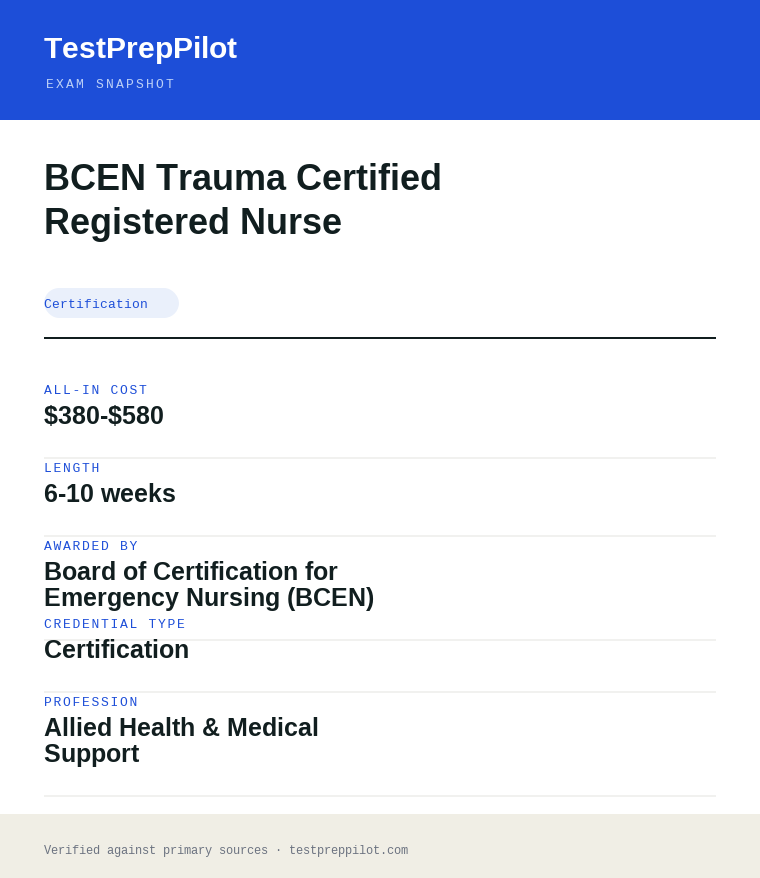
The short version
What is the BCEN Trauma Certified Registered Nurse and is it worth it?
The TCRN is a 175-question, 3-hour computer-based exam (150 scored, 25 unscored) at PSI centers or via Live Remote Proctoring. The fee is $380 non-member, $285 ENA member, or $195 military. A current RN license is required; the credential is valid for four years.
- Recognized by trauma centers and ACS Trauma Quality Programs
- Signals trauma-system and population-specific expertise
- Supports trauma program coordinator and educator roles
- Complements the CEN for ED trauma nurses
- Criterion-referenced, not curved
What is it?
What exactly is the BCEN Trauma Certified Registered Nurse?
The trauma nursing credential spanning injury prevention through rehabilitation.
The Trauma Certified Registered Nurse (TCRN) validates RN expertise in the care of trauma patients across the continuum from injury prevention through rehabilitation. It covers trauma assessment, systems, and population-specific care. Trauma centers and the ACS Trauma Quality Programs recognize the TCRN. A current RN license is required; trauma experience is recommended.
The path in brief
- Hold a current RN license
- Apply and pay BCEN
- Open 90-day window
- Study trauma assessment, systems, and populations
- Schedule with PSI and pass
- Renew every 4 years by CE or exam
Before you book
Who is eligible to sit the BCEN Trauma Certified Registered Nurse?
Who it is for: Trauma center and ED RNs
The test itself
What is the format of the BCEN Trauma Certified Registered Nurse?
The BCEN Trauma Certified Registered Nurse is administered by PSI centers or Live Remote Proctoring and runs 3 hours, contains 175 (150 scored, 25 unscored) questions and requires Scaled 0-900 to pass.
| Administered by | PSI centers or Live Remote Proctoring |
|---|---|
| Questions | 175 (150 scored, 25 unscored) |
| Time limit | 3 hours |
| Pass mark | Scaled 0-900 |
| Exam fee | $380 non-member / $285 ENA member / $195 military |
| Format | Computer-based multiple choice |
Content outline
What topics are on the BCEN Trauma Certified Registered Nurse?
The BCEN Trauma Certified Registered Nurse covers 5 content domains.
No percentage weights are listed for these domains here, so the outline is shown as structure only. Check the certifying body's published outline before allocating study time.
- Injury Prevention & System
- Trauma Assessment & Resuscitation
- Population-Specific Trauma
- Rehabilitation & Disposition
- Professional Issues
Study materials
Which study guide should you use for the BCEN Trauma Certified Registered Nurse?
Start with the exam sponsor's official content outline. If you also want one structured resource to work through, these are the Mometrix titles that match this exam.
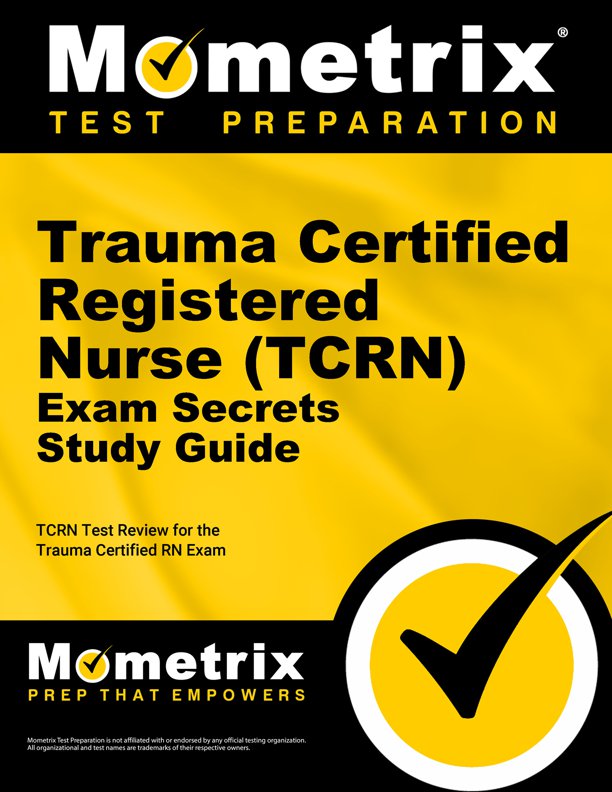
Affiliate links We may earn a commission if you buy through these links, at no extra cost to you. Mometrix has no say in what our exam guides cover. How we make money.
Money & time
How much does the BCEN Trauma Certified Registered Nurse cost?
For the BCEN Trauma Certified Registered Nurse, the exam fee is $380 non-member / $285 ENA member / $195 military; the all-in cost is typically $380-$580; most candidates spend 6-10 weeks preparing.
Cost breakdown
| Initial exam (non-member) | $380 |
|---|---|
| Initial exam (ENA member) | $285 |
| Retest (within 1 year) | $200 |
| Recertification by CE | $250 |
| Typical total | $380-$580 |
Same BCEN fee schedule as the CEN; military and voucher discounts may apply.
Timeline
- Apply and pay 1 day
- Study 6-10 weeks
- Test 3 hours
- Maintain Every 4 years
Typical prep: 6-10 weeks
The path
How do you register for the BCEN Trauma Certified Registered Nurse?
- 1
Create a BCEN account
Set up or log in to your BCEN account and open the certification you want under My Certification.
- 2
Submit the application
Complete the online application; RN licensure is verified automatically for the CEN and similar for other credentials.
- 3
Pay the exam fee
Pay by credit card, ACH, or voucher. ENA members, military, and voucher-program candidates receive discounted pricing.
- 4
Receive your eligibility email
An eligibility email arrives once payment clears, opening a 90-day window to schedule with PSI.
- 5
Schedule and sit the exam
Book a PSI test center or Live Remote Proctoring appointment and sit the 3-hour computer-based exam.
The fine print
What are the retake and renewal rules for the BCEN Trauma Certified Registered Nurse?
- Proctoring & delivery
- Delivered at PSI testing centers worldwide or via Live Remote Proctoring. A government-issued photo ID matching the application name is required. Walk-ins are not allowed; scheduling within the 90-day window is mandatory.
- Retake policy
- A discounted retest fee of $200 applies within one year of the initial exam date. BCEN Test Assurance (optional, about $70) bundles a free second attempt.
- Score reporting
- Pass/fail results are provided immediately at the test center. Scaled scores use a 0-900 system; BCEN does not publish an exact numeric pass point but most passing scores fall near 680-700.
- Recertification
- Credentials are valid for four years. Renew by completing 100 contact hours of continuing education (75 clinical/emergency-focused, 25 professional development) or by re-examination. A recertification fee applies.
Context
BCEN emergency nursing credentials
| Credential | Focus | Exam fee (non-member) | |
|---|---|---|---|
| CEN | General emergency nursing | $380 | |
| CFRN | Flight/air medical | $380 | |
| CPEN | Pediatric emergency | $380 | |
| CTRN | Transport (ground/air) | $380 | |
| TCRN | Trauma | $380 |
What it pays
How much does this credential pay?
$93,600 median for registered nurses (BLS SOC 29-1141, May 2024)
The TCRN is a specialty certification held on top of an active RN license, so the salary it affects is the registered nurse wage, and BLS classifies that occupation under SOC code 29-1141. The May 2024 median was $93,600 a year, about $45.00 an hour, with the lowest 10 percent earning less than $66,030 and the highest 10 percent more than $135,320; the 25th percentile sat near $78,610 and the 75th near $107,960, so a typical RN is earning in the low six figures once past the early years. BLS reported mean annual pay of about $98,430, employment of 3,391,000 jobs in 2024, and projected growth of 5 percent from 2024 to 2034, with about 189,100 openings a year, most from replacement need as experienced nurses retire. Three points matter when reading these numbers against the TCRN specifically. First, BLS does not publish a wage for certified trauma nurses, so the certification premium is not in the government data — the honest evidence from national nursing compensation surveys is that roughly 60 percent of nurses who certify receive no direct pay increase, and where employers do pay a differential it is typically $1-2 an hour or a one-time bonus, set by the employer and the clinical ladder rather than by any government line. Second, trauma nursing is a specialty within the RN occupation, and for nurses at Level I and Level II trauma centres the TCRN is often expected or differential-eligible on a clinical ladder, so its economic value is career advancement and eligibility for trauma roles rather than a separate wage band. Third, the wage distribution within the RN occupation already rewards the settings where trauma nurses work — hospital-based nursing pays above the occupation median — so the credential compounds an existing earnings position rather than creating one. The honest summary is that the TCRN supports a stable, well-paid occupation with strong replacement demand, but the certification’s financial return depends on the employer and the role requirement, not on a government-reported pay bump.
| Measure | Figure | Source / note |
|---|---|---|
| Median annual wage, registered nurses | $93,600 | BLS Occupational Outlook Handbook, May 2024 ($45.00/hr) |
| Lowest 10 percent | less than $66,030 | BLS OOH Pay tab, May 2024 |
| 25th percentile | about $78,610 | BLS OOH Pay tab, May 2024 |
| 75th percentile | about $107,960 | BLS OOH Pay tab, May 2024 |
| Highest 10 percent | more than $135,320 | BLS OOH Pay tab, May 2024 |
| Employment, 2024 | 3,391,000 jobs | BLS OOH Quick Facts, 2024 |
| Projected annual openings | ~189,100 per year | BLS OOH Job Outlook, 2024-34 - mostly replacement need |
Job growth.+5% projected change 2024-34; about 189,100 openings a year, mostly replacement as experienced nurses retire. BLS does not publish a separate wage or outlook for certified trauma nurses; the TCRN premium comes from employer pay practice and clinical-ladder eligibility rather than government data.
Source: BLS Occupational Outlook Handbook - Registered Nurses
Your odds
What are the pass rates?
BCEN publishes pass and fail counts, not a first-time rate - for 2025, 1,260 of 2,333 TCRN exams delivered passed (~54%), against 8,741 active certificants
BCEN publishes certification exam statistics as an ABSNC accreditation requirement, and the honest way to read them is that they report exams passed and failed by calendar year, not a first-time pass rate - the figures mix first-time candidates and repeaters, so the number candidates usually search for is not the number BCEN publishes. For calendar year 2025, BCEN reported 2,333 TCRN exams delivered, 1,260 passed and 884 failed, which is about a 54 percent pass rate on administrations delivered, with 1,079 recertifications and 8,741 total TCRN certificants. Because the published table does not separate first-time from repeat candidates, we cannot state an official first-time rate from BCEN’s own data, and we will not invent one; independent prep vendors that have analysed BCEN’s numbers put the pass rate on exams delivered in the low-to-mid 50s percent range in recent years, materially lower than the roughly 90 percent first-time rate of the NCLEX-RN, which is exactly what a candidate should expect from a criterion-referenced specialty exam taken by working nurses rather than a licensing gate. The passing standard itself is published: the TCRN is scored against 150 scored items (175 total, with 25 unscored pretest items), and the passing point is 96 of the 150 scored items, set by BCEN’s standard-setting study and restated in independent candidate summaries. The content follows the five published domains — Clinical Practice at 44 percent, Continuum of Care for Trauma Patients at 24 percent, Professional Issues at 12 percent, Trauma Systems and Safety at 10 percent, and Disaster Preparedness at 10 percent — covering the full trauma continuum from prevention and resuscitation through rehabilitation. We have used BCEN’s published counts and the 96/150 standard rather than any rumoured rate.
Read this before quoting the number.BCEN publishes exam-passed and exam-failed counts by calendar year, not a first-time pass rate. The 2025 TCRN figures imply roughly 54% of exams delivered passed (1,260/2,333). The passing standard is 96 of the 150 scored items per BCEN’s passing-point study. We have not invented a first-time rate BCEN does not publish.
Your schedule
How long should I study for it?
90-130 hours over 10-14 weeks of focused study
A realistic TCRN study plan runs ten to fourteen weeks at roughly 8-10 hours a week, because the exam assumes working trauma experience and tests applied judgment across the full trauma continuum rather than textbook recall, so the plan must spend as much time on scenario practice and case review as on content coverage. The exam is 175 questions in three hours, of which 150 are scored, delivered by computer at a PSI test centre or through Live Remote Proctoring, and the passing standard is 96 of the 150 scored items. The content outline organises the material into five domains — Clinical Practice at 44 percent, Continuum of Care for Trauma Patients at 24 percent, Professional Issues at 12 percent, Trauma Systems and Safety at 10 percent, and Disaster Preparedness at 10 percent — and the clinical items span the body systems a trauma nurse manages: neurologic, thoracic, abdominal, genitourinary, obstetrical, musculoskeletal, surface and burns, plus shock in its several forms, haemostatic resuscitation, substance use and the psychosocial issues of trauma. That design is the defining feature: candidates who read the systems as lists of facts under-prepare, because the exam rewards rapid prioritisation, recognition of time-critical injuries such as airway compromise, haemorrhage and shock, and knowledge of current trauma guidelines. The plan below covers the clinical domains in the first eight weeks, weights the continuum-of-care and professional content in weeks 9-10, then pivots to timed full-length practice and gap closing in the final weeks, because endurance across a three-hour, 175-item paper is real and the hardest items cluster late. Experienced trauma and critical-care nurses should compress the clinical weeks and start question volume early; nurses new to trauma should extend the plan and lean on the official BCEN practice exam, which mirrors the real format and gives the most honest readiness signal.
- Weeks 1-29-11 hrs/week
Neurologic and thoracic trauma
- Neurologic: traumatic brain injury, spinal injury and the neurologic assessment of the trauma patient
- Thoracic: airway management, chest trauma, tension pneumothorax and haemothorax
- Drill the time-critical presentations — airway, haemorrhage, shock — until the first intervention for each is reflex
- Take the BCEN sample questions or one section-length practice set and tag every miss to a content area
- Weeks 3-49-11 hrs/week
Abdominal, genitourinary, obstetrical and musculoskeletal trauma
- Abdominal: blunt and penetrating abdominal trauma, haemorrhage and the trauma laparotomy sequence
- Genitourinary and obstetrical: pelvic and GU injury, and trauma in the pregnant patient
- Musculoskeletal: fractures, amputations, compartment syndrome and crush injury
- Practise the prioritisation item type: given several patients, who do you manage first — and why
- Weeks 5-69-11 hrs/week
Shock, haemostatic resuscitation and burns
- Shock: hypovolaemic, cardiogenic, obstructive and distributive — recognition and management
- Haemostatic resuscitation: blood products, massive-transfusion protocols and the trauma bay
- Surface and burns: burn assessment, fluid resuscitation and the burn-injured trauma patient
- Study the fluid and transfusion mathematics, which recur as calculation items
- Weeks 7-88-10 hrs/week
Continuum of care and psychosocial issues
- Continuum of care (24%): the trauma patient from prevention and prehospital care through rehabilitation
- Psychosocial issues: post-traumatic stress, acute stress disorder, coping and end-of-life considerations
- Substance use and its interaction with trauma care
- Run the official BCEN practice exam and compare your readiness against the 96/150 standard
- Weeks 9-108-10 hrs/week
Trauma systems, safety and disaster preparedness
- Trauma systems and safety (10%): the trauma centre levels, triage criteria and system processes
- Disaster preparedness (10%): mass-casualty response, triage tags and incident command
- Professional issues (12%): legal and ethical duties, documentation and advocacy
- Drill the mass-casualty triage scenarios until the tagging order is reflex
- Weeks 11-1410-12 hrs/week
Full-length timed practice and gap closing
- Three full 175-question, three-hour practice exams under real timing
- Re-tag every miss to a content area and attack the bottom two areas with focused review
- Drill the priority-and-triage item style until the framework is automatic
- Stop learning new content; consolidate, correct and re-test instead
Adjusting the pace
Trauma or critical-care nurse with 3+ years.Eight to ten weeks. Compress the clinical coverage and start full practice exams early; your gap is likely the continuum-of-care, professional-issues and disaster content rather than clinical knowledge.
ED or ICU nurse moving into trauma nursing.Twelve to fourteen weeks at 8-10 hrs/week. BCEN recommends about two years of relevant experience; give yourself the full clinical coverage and at least two full practice exams.
Working nurse studying around shifts.Fourteen to sixteen weeks at 6-8 hrs/week. Use shift-based spacing — short daily question sets and longer weekend blocks — because the scenario format rewards distributed practice over cramming.
How to study
How do I prepare most effectively?
The TCRN is a scenario-based, criterion-referenced specialty exam, so the dominant preparation strategy is to practise the decision-making format rather than accumulate clinical facts — the exam presents a trauma patient and asks what you do next, and candidates who study the five domains as a list of topics under-prepare for items that reward rapid prioritisation and recognition of the time-critical injuries. The highest-yield habits are, first, learning the time-critical trauma presentations cold — airway and breathing emergencies, haemorrhage and the shock states, and the chest, abdominal and pelvic injuries that kill quickly — because a large share of items test whether you recognise the emergency and act within the window. Second, practise the priority-and-triage item style specifically, because many items present several patients or several actions and ask which is first; a stable framework of airway, breathing, circulation and then unstable-versus-stable beats improvising a new rationale per item. Third, do not skip the non-clinical domains: Continuum of Care is 24 percent of the exam, Professional Issues 12 percent, Trauma Systems and Safety 10 percent, and Disaster Preparedness 10 percent, and candidates who treat these as padding give away nearly half the paper. Fourth, use the official BCEN practice exam, because it is built to the real content outline and item format and gives the most honest readiness signal of anything on the market. Fifth, review every rationale, right and wrong, and tag each miss to a content area so the last weeks target real gaps rather than comfort topics. Finally, run full 175-question, three-hour simulations, because endurance across the paper is real and the harder items cluster in the back half, and drill the haemostatic-resuscitation and fluid content that appears as both scenario and calculation items.
Learn the time-critical trauma presentations cold
Airway and breathing emergencies, haemorrhage and the shock states, and the chest, abdominal and pelvic injuries that kill quickly dominate the items that separate passing from failing. Know the recognition signs and the first intervention for each, because delay is the failure pattern the exam is built to expose.
Practise the priority-and-triage item style
Many items ask which patient to manage first or which action comes first. Rely on stable frameworks — airway, breathing, circulation, then unstable versus stable — rather than improvising a new rationale each time. Candidates who improvise are the ones who fall for the plausible-but-not-urgent distractor.
Do not skip the non-clinical domains
Continuum of Care (24%), Professional Issues (12%), Trauma Systems and Safety (10%) and Disaster Preparedness (10%) together approach half the paper. Working nurses routinely under-prepare these because they feel non-clinical; a focused pass turns them into reliable points.
Use the official BCEN practice exam for calibration
BCEN’s practice exam mirrors the real content outline, item format and difficulty better than any third-party product. Take it mid-preparation to find your real gaps, and again near the end as a readiness check against the 96/150 standard.
Review every rationale and tag every miss
For each item you get right, confirm you were right for the right reason; the TCRN inverts scenarios and tests the same principle from the other side. Keep a miss log by content area and let it drive the final weeks.
Simulate the full three-hour paper
175 questions in 180 minutes is a genuine endurance test. Run at least two full-length timed practice exams before test day so the pacing and the back-half fatigue are familiar. Candidates who only do short sets fade where the harder items cluster.
What to buy
Which study resources are worth paying for?
The TCRN resource market splits into BCEN’s own materials, third-party question banks, review courses, and the reference texts you already use at work, and the buying logic is anchored by BCEN’s official practice exam because it is the only product built to the real content outline and item format. The exam itself costs $380 for non-members and $285 for Society of Trauma Nurses (STN) members, with a reduced military rate of $195 and a $200 retest, and a test-assurance option that covers a retake for an additional fee; the recertification fee is $280. On preparation, BCEN sells an official practice exam and review tools that mirror the real format and are the calibration gold standard even if they cost more than a third-party subscription. The major commercial question banks and review courses run roughly $100-300 for subscriptions of one to three months and are the main source of volume for the scenario item style; the best of them track the current TCRN content outline and the five-domain structure, which matters because the exam reorganised around the current outline and older materials written to a previous structure are still on sale. Review books and reference texts, $50-200, add structured coverage of the clinical spectrum and are most useful to nurses coming from outside trauma care. The footnote that anchors the comparison: prices below are list prices as of mid-2026 and change frequently, we rank nothing by commission, and the single most cost-effective decision for most candidates is one official BCEN practice exam plus one commercial question bank, because the combination covers calibration and volume without stacking courses. Confirm the STN membership discount before paying the full $380, since membership can cut the exam fee by $95.
| Resource | Price | Format | Best for |
|---|---|---|---|
| BCEN official practice exam | Priced on the BCEN store (fee-based) | Computer-based, real outline and format | The calibration gold standard — use mid-prep and near the end |
| TCRN exam (BCEN) | $380 non-member; $285 STN member; ~$195 military; $200 retest | PSI test centre or Live Remote Proctoring | The real exam; membership cuts $95 off the fee |
| Commercial question banks | ~$100-300 for 1-3 month subscriptions | Online, scenario-based practice with rationales | High-volume drilling of the prioritisation item style |
| TCRN review course | ~$150-500 depending on package | Live or recorded course, often with CE credit | Structured coverage for nurses new to trauma care |
| Trauma reference text (work) | Free or already owned | Print or digital | The clinical foundation — reorganise it by the five domains |
Prices checked 2026-08 in USD before tax and change frequently; we rank nothing by commission. The TCRN exam fee is $380 for non-members and $285 for STN members per BCEN, with a $280 recertification fee. Confirm current pricing and the membership discount at the source before paying.
Avoid these
What mistakes do candidates most often make?
TCRN failures are strikingly patternable, and almost none of them are about not knowing trauma nursing — they are about preparing for the wrong test, skipping the prioritisation item style, and under-preparing the non-clinical domains. The single most common error is studying the five domains as lists of facts, when the exam presents scenario items that reward rapid recognition of time-critical injuries and selection of the next action; a candidate who can define shock but cannot pick the first intervention within the window loses the item. The second is improvising prioritisation instead of using a stable framework, which is how candidates fall for the plausible-but-not-urgent distractor on the many items that ask which patient to manage first. The third is preparing entirely with short question sets and never running a full 175-question, three-hour simulation, so the back-half fatigue and pacing surprise them on test day. The fourth is treating the non-clinical domains as padding: Continuum of Care, Professional Issues, Trauma Systems and Safety, and Disaster Preparedness together approach half the paper, and working nurses routinely under-prepare them because they feel non-clinical, even though a focused pass converts them into reliable points. The fifth is relying on materials written to an older outline structure, which matters because the exam is organised around the current five-domain blueprint and outdated prep is still on sale. And the sixth is a logistics failure: a mismatched ID or an unapproved application means no exam and a forfeited fee. None of these are knowledge gaps in trauma medicine; every one is correctable with the right practice format and a few hours of targeted review, which is why most candidates who retake after closing the specific gap pass on the next attempt.
✕Studying the domains as lists of facts
✓The TCRN is scenario-based: it presents a trauma patient and asks what you do next. Convert most of your hours into answered, reviewed items in the scenario style, and drill the time-critical presentations until the first intervention for each is reflex.
✕Improvising prioritisation on the fly
✓Many items ask which patient to manage first or which action comes first. Use a fixed framework — airway, breathing, circulation, then unstable versus stable — instead of a new rationale per item. The plausible-but-not-urgent distractor is exactly what the framework filters out.
✕Never running a full three-hour simulation
✓175 questions in 180 minutes is a real endurance test. Run at least two full-length timed practice exams before test day so pacing and back-half fatigue are familiar. Candidates who only do short sets fade where the harder items cluster.
✕Treating the non-clinical domains as padding
✓Continuum of Care (24%), Professional Issues (12%), Trauma Systems and Safety (10%) and Disaster Preparedness (10%) approach half the paper. A focused pass over these converts them into reliable points that unprepared candidates give away.
✕Using materials written to an older outline
✓The exam is organised around the current five-domain blueprint. Check that your books and question bank track the current content outline and the 96/150 passing standard; older material is still on sale and leaves you aiming at the wrong target.
✕Losing the seat to an ID or application slip
✓Your government-issued photo ID must match your BCEN registration name exactly, and your application must be approved with a valid testing window. Confirm both the week before, because a turned-away candidate forfeits the fee and the seat.
What you'll face
What question types will I see?
The TCRN is a computer-based exam of 175 multiple-choice questions in three hours, of which 150 are scored and 25 are unscored pretest items, scored pass-fail against a published standard of 96 of the 150 scored items. Every item is multiple choice, but the dominant style is the clinical scenario: a trauma patient presentation — often with vital signs, a mechanism of injury and a chief complaint — followed by a question asking for the next assessment, the priority action, the likely cause, or the correct intervention. That scenario design is what makes the exam feel hard even for experienced nurses, because the distractors are real, plausible interventions that are simply not the first or most urgent one. A second recurring style is the prioritisation item, which presents several patients or several actions and asks which is first; these reward a stable framework of airway, breathing, circulation and then unstable versus stable rather than content recall. A smaller share of items test discrete facts inside a clinical context — a massive-transfusion ratio, a triage category, a burn-calculation rule — but even these are usually framed with a patient stem. The content follows the five published domains — Clinical Practice at 44 percent, Continuum of Care for Trauma Patients at 24 percent, Professional Issues at 12 percent, Trauma Systems and Safety at 10 percent, and Disaster Preparedness at 10 percent — covering the full trauma continuum from prevention and resuscitation through rehabilitation. Because scoring is criterion-referenced against the 96/150 standard, you do not compete against other candidates, and there is no partial credit — an item is right or wrong, which is why pacing and the prioritisation framework carry so much weight. The three samples below illustrate the scenario, prioritisation and discrete-in-context styles; they are editor-written to the published content outline and are not live exam items.
A trauma patient presentation asking for the next assessment, the priority action, the likely cause or the correct intervention. Distractors are real but later or less urgent interventions.
Several patients or several actions, one correct first move. These reward the ABCs-then-stability framework and punish improvisation.
A fact tested inside a patient stem — a massive-transfusion ratio, a triage category, a burn-calculation rule. Still multiple choice, still single-answer, but the trauma framing adds the context.
Continuum of Care, Professional Issues, Trauma Systems and Safety, and Disaster Preparedness items — prevention, rehabilitation, documentation, legal-ethical duties, triage systems and mass-casualty response.
Try these
Q1A 45-year-old man is brought in after a high-speed frontal collision. He is confused, with a blood pressure of 88/60 mm Hg, heart rate 128, respiratory rate 26, and a seat-belt sign across the abdomen. Which is the priority intervention?
Answer:B
Hypotension with tachycardia, a confused mental state and a seat-belt sign point to intra-abdominal haemorrhage in shock: the priority is haemostatic resuscitation — activating the massive-transfusion protocol and giving blood products rather than relying on crystalloid alone — because the patient is in uncompensated shock with a likely surgical source of bleeding. A delays resuscitation for imaging, C under-treats with crystalloid alone in the era of haemostatic resuscitation, and D addresses one possible injury while the physiology worsens. The item tests recognising the time-critical haemorrhage-and-shock presentation and acting within the window, which is exactly the judgment the TCRN rewards.
Q2Four patients arrive from a motor-vehicle collision. Which patient should the trauma team assess FIRST?
Answer:B
This is a prioritisation item, and the framework resolves it: airway, breathing, circulation, then unstable versus stable. The patient with stridor and developing facial swelling has an airway emergency — the highest priority regardless of how the others present — because airway compromise kills faster than any of the alternatives. A, C and D are stable patients with real but non-urgent needs. Candidates who pick A are choosing the loudest complaint rather than the highest-risk problem, which is exactly the distractor design of this item type.
Q3During a mass-casualty incident, the trauma nurse is triaging patients. A patient with a peripheral pulse but a respiratory rate of 8 and capillary refill over 4 seconds should be tagged as:
Answer:C
A respiratory rate of 8 is below the threshold of 10 and capillary refill above 4 seconds violates the perfusion criterion in mass-casualty triage systems, so the patient meets immediate (red) criteria — life-threatening but survivable with intervention. Green is for minor injuries, yellow for delayed, and black for the deceased or expectant where resources are overwhelmed. The item tests the disaster-preparedness domain — the mass-casualty triage rules and the tagging order, which are exact and frequently tested.
Samples are editor-written illustrations of the published blueprint, not live exam items.
The big day
What should I expect on exam day?
The TCRN is a computer-based exam delivered by appointment through PSI, either at a PSI test centre or through Live Remote Proctoring (LRP) on your own computer, and the direct exam-day answer is that you will sit 175 multiple-choice questions in three hours — 150 scored, 25 unscored — with the passing standard at 96 of the 150 scored items, and you will get a pass-fail result at the end of the appointment. At a test centre, arrive early enough to complete check-in, which requires a valid government-issued photo ID with a name matching your BCEN registration exactly; a mismatch means no exam and a forfeited fee. For LRP, complete the system check on the exact machine and network you will use, and clear the room — the proctor scans it before you begin. Personal items, phones, smartwatches and study materials are not permitted in the testing room, and you cannot bring your own scratch paper; the centre provides note-taking material if any is allowed. The three hours pass quickly at roughly one question per minute, so pace the paper and keep moving past items you are unsure of rather than dwelling, because there is no penalty for answering and the clock does not pause for breaks. A small number of the 175 items are unscored pretest questions that you cannot identify, so answer everything. You will not know during the exam whether you are passing; the result is delivered at the end. If you pass, your TCRN is valid for four years, renewed by completing 100 continuing-education contact hours or by retaking the exam, with a recertification fee, so diary the renewal date the week you pass. Confirm the application and testing-window logistics before you schedule, because the seat is booked through PSI within the window BCEN grants.
Bring
- A valid government-issued photo ID (passport or driver’s license) with a name matching your BCEN registration exactly
- Your BCEN application approval and appointment confirmation with the PSI test-centre address or LRP session link
- Prescription glasses if needed; the test centre provides a locker for everything else
- For LRP: the system-tested computer, webcam, microphone and a completely clear, private room
Leave at home
- Phones, smartwatches, fitness trackers, calculators and any electronic device — locked at the centre, out of the room for LRP
- All notes, books, cheat sheets and scratch paper; the centre provides note-taking material if allowed
- Bags, coats and outerwear beyond what you can store in the locker
- Any other person in the room for LRP, and any second monitor or unapproved device
How the day runs
Rules in the room
- 175 multiple-choice questions in three hours; 150 are scored and 25 are unscored pretest items.
- Passing standard is 96 of the 150 scored items, set by BCEN’s passing-point study.
- Valid government photo ID with a name matching your BCEN registration exactly is required, or you are turned away and the fee is forfeited.
- No personal items in the room; no calculators; the centre provides note-taking material if any is allowed.
- No scheduled breaks in the three-hour appointment, and the clock does not stop if you leave.
- For LRP, the room must be private and clear, and the system must pass the check on the exact machine you will use.
Afterwards.You receive a pass-fail result at the end of the appointment, and BCEN provides a score report that shows how you performed relative to the content areas of the exam — read it, because on a pass it tells you where your continuing-education hours are best spent, and on a fail it is the diagnosis for the retake. On a pass, your TCRN credential is valid for four years; renewal is by completing 100 contact hours of continuing education or by retaking the exam, with a recertification fee, so log the expiry date immediately and start banking CE from real work rather than scrambling in year four. On a fail, you must wait 90 days before re-testing, so plan the retake deliberately: use the score report to identify the one or two content areas that dragged you below 96 of 150 — for many candidates that is the continuum-of-care or disaster-preparedness material — spend a focused block drilling those areas with scenario practice, run a full timed simulation, and re-sit. Candidates who close the specific gap rather than re-reading everything are the ones who pass on the next attempt, which is why the score report is the most valuable document you will receive after either outcome.
Reference
What are the key facts about the BCEN Trauma Certified Registered Nurse?
BCEN Trauma Certified Registered Nurse is a certification credential; awarded by Board of Certification for Emergency Nursing (BCEN); the exam fee is $380 non-member / $285 ENA member / $195 military; typical preparation is 6-10 weeks.
| Credential | BCEN Trauma Certified Registered Nurse |
|---|---|
| Abbreviation | TCRN |
| Type | Certification |
| Profession | Allied Health & Medical Support |
| Specialty | EMS |
| Awarded by | Board of Certification for Emergency Nursing (BCEN) |
| Difficulty | Moderate |
| Typical prep time | 6-10 weeks |
| All-in cost | $380-$580 |
| Eligibility | Current RN license |
| Delivery | PSI or live remote proctoring |
| Retake | $200 within one year |
| Validity | 4 years |
| Scale | 0-900 scaled |
| Scope | National / Multi-state |
Real questions
Frequently asked questions about the BCEN Trauma Certified Registered Nurse
How hard is the TCRN?
It is moderately difficult with a trauma-specific focus. ED and trauma nurses with relevant experience and a 6-10 week plan do well.
How long should I study?
Plan 6-10 weeks reviewing trauma systems, assessment, and population-specific care from the BCEN outline.
Does the TCRN expire?
Yes, every four years, renewed by 100 CE hours or re-examination.
Is the TCRN worth it?
For trauma center nurses and program coordinators it is worth it; it is recognized by ACS Trauma Quality Programs.
What if I fail?
Retest for $200 within one year, or add BCEN Test Assurance at initial application for a bundled retake.
Do I need emergency experience to sit the CEN?
No minimum experience is required, but BCEN recommends about two years in emergency or trauma nursing before testing.
Are BCEN exams available outside the U.S.?
Yes. Exams are offered at PSI centers worldwide and online via Live Remote Proctoring; they are English-only.
In short
Is the BCEN Trauma Certified Registered Nurse worth it?
- 175 questions, 3 hours; $380 non-member / $285 ENA member
- Trauma-focused; current RN license required
- Valid 4 years; renew by CE or exam
- Recognized by ACS Trauma Quality Programs
Same awarding body
What other credentials does Board of Certification for Emergency Nursing (BCEN) award?
Worth comparing
How does the BCEN Trauma Certified Registered Nurse compare with similar credentials?
Trust
Where does this information come from?
Everything above is taken from the awarding body's own published material. Fees, question counts and domain weights are revised regularly — check the official page before you pay.
- Board of Certification for Emergency Nursing (BCEN) Awarding body
- Official BCEN Trauma Certified Registered Nurse exam page Exam page
Research confidence: high · Last reviewed 2026-08