Allied Health & Medical Support • Certification
NREMT Advanced Emergency Medical Technician Certification
The intermediate ALS credential between EMT and Paramedic.
Researched and maintained by TestPrepPilot Editorial BoardAllied-health & clinical-support certifications desk · Figures last verified August 2026
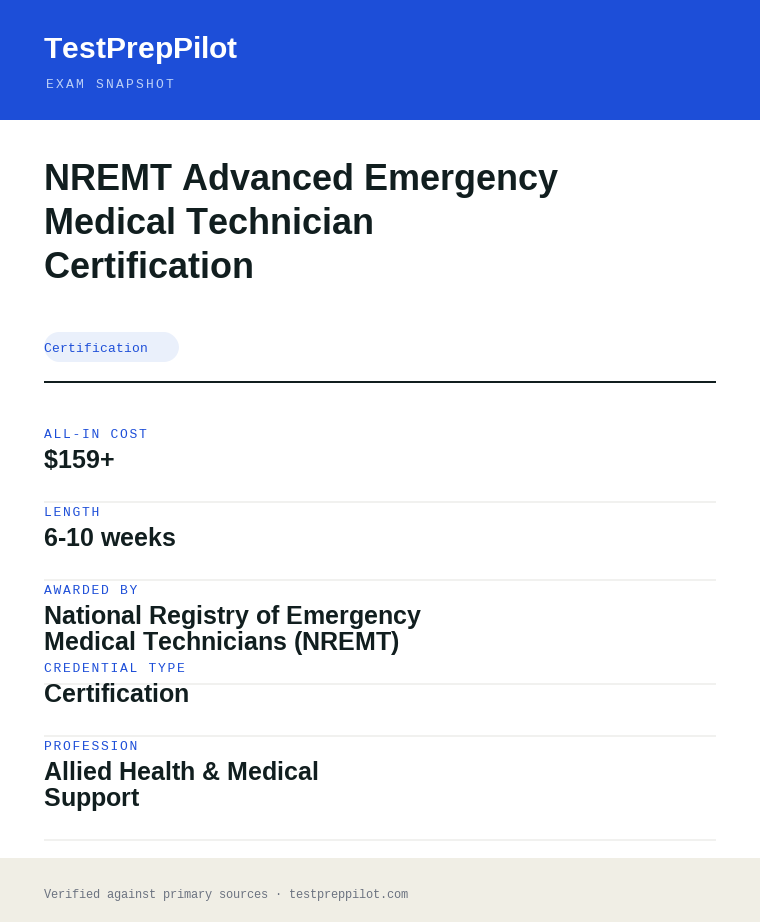
The short version
What is the NREMT Advanced Emergency Medical Technician Certification and is it worth it?
The NREMT AEMT cognitive exam is a fixed linear computer test of 135 questions with a 3-hour limit, delivered at Pearson VUE or OnVUE. The fee is $159 per attempt; the passing standard is a scaled 950 on a 100-1500 scale.
- National standard for intermediate ALS (AEMT) providers
- Adds IV/IO, meds, and advanced airway beyond EMT
- No separate psychomotor exam since July 2024
- Stepping stone to Paramedic
- Portable across states using the National Registry
What is it?
What exactly is the NREMT Advanced Emergency Medical Technician Certification?
The intermediate ALS credential between EMT and Paramedic.
The NREMT Advanced EMT (AEMT) certification sits between EMT and Paramedic, adding IV/IO access, medication administration, and advanced airway skills. Since July 2024 the NREMT AEMT is a single fixed linear cognitive exam; the separate psychomotor exam was discontinued. It is the national standard for intermediate-level ALS providers.
The path in brief
- Complete an AEMT program
- Apply and pay the $159 fee
- Receive your ATT
- Study the ALS blueprint with clinical-judgment scenarios
- Schedule at Pearson VUE/OnVUE
- Pass at the scaled 950 standard
Before you book
Who is eligible to sit the NREMT Advanced Emergency Medical Technician Certification?
Who it is for: Intermediate ALS EMS providers
The test itself
What is the format of the NREMT Advanced Emergency Medical Technician Certification?
The NREMT Advanced Emergency Medical Technician Certification is administered by Pearson VUE or OnVUE and runs 3 hours, contains 135 questions and requires Scaled 950 / 1500 to pass.
| Administered by | Pearson VUE or OnVUE |
|---|---|
| Questions | 135 |
| Time limit | 3 hours |
| Pass mark | Scaled 950 / 1500 |
| Exam fee | $159 per attempt |
| Format | Linear computer-based |
Content outline
What topics are on the NREMT Advanced Emergency Medical Technician Certification?
The NREMT Advanced Emergency Medical Technician Certification covers 6 content domains.
No percentage weights are listed for these domains here, so the outline is shown as structure only. Check the certifying body's published outline before allocating study time.
- Airway, Respiration & Ventilation
- Cardiology & Resuscitation
- Trauma
- Medical, Obstetrics & Gynecology
- EMS Operations
- Clinical Judgment
Money & time
How much does the NREMT Advanced Emergency Medical Technician Certification cost?
For the NREMT Advanced Emergency Medical Technician Certification, the exam fee is $159 per attempt; the all-in cost is typically $159+; most candidates spend 6-10 weeks preparing.
Cost breakdown
| NREMT AEMT exam | $159 |
|---|---|
| Retake (per attempt) | $159 |
| Recertification | $26 |
| Typical total | $159-$185 |
A $50 late fee applies after March 31 for recertification.
Timeline
- Complete AEMT program Weeks-months
- Apply and pay 1 day
- Study 6-10 weeks
- Test 3 hours
- Maintain Every 2 years
Typical prep: 6-10 weeks
The path
How do you register for the NREMT Advanced Emergency Medical Technician Certification?
- 1
Create an NREMT account
Register or log in and select the certification level you are pursuing.
- 2
Verify eligibility
Your program director or state verifies training/licensure; submit any required documentation.
- 3
Pay the application fee
Pay the per-attempt exam fee (e.g., $104 EMT, $159 AEMT, $175 Paramedic).
- 4
Receive your ATT
An Authorization to Test posts to your account, valid up to 90 days.
- 5
Schedule with Pearson VUE
Book a Pearson VUE center or OnVUE online proctoring appointment and sit the exam.
The fine print
What are the retake and renewal rules for the NREMT Advanced Emergency Medical Technician Certification?
- Proctoring & delivery
- Delivered at Pearson VUE testing centers or via OnVUE online proctoring. A government-issued photo ID matching the ATT is required. The cognitive exam is separate from any state psychomotor skills exam (psychomotor discontinued for AEMT/Paramedic as of July 2024).
- Retake policy
- Failed attempts require a new application and fee; a 15-day wait applies between attempts. EMT candidates may attempt up to six times before remediation.
- Score reporting
- Pass/fail is determined against a fixed standard (scaled 950 on a 100-1500 scale). Scores post in your NREMT account; official score reports follow.
- Recertification
- National certification renews every two years via the National Continued Competency Program (CE) or by re-examination. The recertification fee is $26; a $50 late fee applies after March 31.
What it pays
How much does this credential pay?
$46,350 median for EMTs and paramedics (BLS, May 2024)
There is no Bureau of Labor Statistics occupation called "Advanced EMT" — the NREMT AEMT certification validates the intermediate EMS level, and the wage question belongs to the occupation you perform with it. The closest official BLS occupation is EMTs and Paramedics, SOC 29-2041, which had a May 2024 median wage of $46,350, with the lowest 10 percent under $30,970 and the highest 10 percent above $65,260. The fit is direct: AEMT-certified providers work on ambulances and in emergency settings between the EMT and paramedic levels, and BLS counts the levels as one occupation, so the median blends them; the AEMT typically earns between the EMT and paramedic rates within the combined series. BLS counted 273,100 EMT and paramedic jobs in 2024 and projects 8 percent growth from 2024 to 2034, faster than the average for all occupations, with about 27,300 openings a year. The limitation to state plainly: BLS reports the levels as one occupation, so no government series isolates the AEMT wage, and paramedic-specific figures come from employer surveys rather than government data; read the number as the market for the occupation, with the AEMT between the two levels.
| Measure | Figure | Source / note |
|---|---|---|
| Median annual wage, EMTs and paramedics | $46,350 | BLS OOH, SOC 29-2041, May 2024 |
| Lowest 10 percent | Under $30,970 | BLS OOH, SOC 29-2041, May 2024 |
| Highest 10 percent | Above $65,260 | BLS OOH, SOC 29-2041, May 2024 |
| Projected openings per year | ~27,300 | BLS OOH, SOC 29-2041, 2024-2034 |
Job growth.BLS projects 8 percent growth for EMTs and paramedics from 2024 to 2034, about 27,300 openings per year.
Source: BLS Occupational Outlook Handbook - EMTs and Paramedics
Your odds
What are the pass rates?
NREMT publishes pass rates by certification level and education pathway — the AEMT pass rate is published and sits below the EMT level
The National Registry of Emergency Medical Technicians publishes aggregate pass-rate data by certification level and education pathway in its annual reports, and the AEMT first-attempt pass rate has historically been the lowest or among the lowest of the NREMT levels in recent published cycles — typically in the mid-50s to low-60s percent range, with the figure varying by pathway and year. We present this as NREMT's own reporting and note that the exact number changes each cycle. The cognitive exam itself is a computer-adaptive test: the AEMT exam delivers roughly 100-110 questions in up to 2 hours, adapting to the candidate's performance, and the passing standard is set psychometrically. Certification also requires passing the psychomotor examination through an approved pathway and meeting the education and clinical requirements. The practical reading of the published pass rates: the AEMT is a demanding intermediate step, and preparation must combine the education program, the clinical experience and systematic study of the current National EMS Education Standards.
Read this before quoting the number.NREMT publishes pass rates by level and pathway that change each cycle; the figure above is the recent published range, not a fixed number.
Source: NREMT - Advanced EMT certification and pass-rate reporting
Your schedule
How long should I study for it?
100-150 hours of exam study over 8-10 weeks (on top of the AEMT program and clinical requirements) of focused study
The NREMT AEMT pathway is a two-part certification: a computer-adaptive cognitive exam (roughly 100-110 questions in up to 2 hours) and a psychomotor examination, on top of completing an accredited AEMT education program and meeting the clinical requirements. The cognitive exam follows the National EMS Education Standards at the AEMT level: airway, respiration and ventilation; cardiology; trauma; medical emergencies; obstetrics and pediatrics; and EMS operations, with the intermediate scope of practice. A defensible plan runs 100 to 150 hours of exam-focused study over 8 to 10 weeks, on top of the program itself. Weeks 1-3: airway and cardiology — the highest-weight content, including the intermediate airway skills and the medication administration the AEMT scope adds. Weeks 4-6: medical emergencies, trauma and the pharmacology the AEMT level introduces. Weeks 7-8: obstetrics, pediatrics and EMS operations, plus the psychomotor skills practice. Weeks 9-10: question-bank drilling and adaptive-style practice exams. The plan is heavy because the AEMT scope sits between the EMT and paramedic levels, and the published pass rates show the exam is demanding.
- Weeks 1-340
Airway and cardiology
- Airway, respiration and ventilation at the AEMT level
- Cardiology, ECG and resuscitation
- The medications the AEMT scope adds
- Weeks 4-640
Medical and trauma
- Medical emergencies and pharmacology
- Trauma and shock management
- The intermediate assessment skills
- Weeks 7-830
Special populations and operations
- Obstetrics, pediatrics and geriatrics
- EMS operations and scene management
- Psychomotor skills practice
- Weeks 9-1030
Drill and adaptives
- Question-bank drilling in volume
- Adaptive-style practice exams
- Psychomotor exam rehearsal
Adjusting the pace
EMT upgrading.The EMS environment is familiar; the new content is the expanded medical scope and the medications.
Recently completed AEMT program.The clinical knowledge is fresh; focus study on the exam style and the psychomotor rehearsal.
How to study
How do I prepare most effectively?
The AEMT cognitive exam rewards depth across the intermediate scope, so the dominant strategy is systematic coverage of the National EMS Education Standards with question-bank drilling, because the adaptive exam draws broadly. Second, master the medication content the AEMT level introduces: the AEMT scope adds medication administration and the pharmacology knowledge, a distinct block that EMT-upgraders must study as new material. Third, practise the adaptive format: the exam adjusts to your performance, so get comfortable with finishing strong rather than counting questions. Fourth, prepare the psychomotor component deliberately — it is a separate skills exam, and candidates who study only for the cognitive exam are caught out by the practical stations. Finally, use the current published pass rates as a planning signal: the numbers reflect a demanding exam, and structured study programs pass at higher rates than the overall cohort.
Cover the full AEMT scope
The adaptive exam draws broadly; systematic coverage is essential.
Master the new medication content
The AEMT scope adds pharmacology; EMT-upgraders must study it.
Practise the adaptive style
Finish strong regardless of item count.
Rehearse the psychomotor exam
It is a separate skills exam; cognitive-only study gets caught out.
Meet eligibility precisely
The accredited program and clinical hours gate the certification.
What to buy
Which study resources are worth paying for?
AEMT certification costs are dominated by the education program: accredited AEMT programs range from roughly $1,500 to $6,000 depending on the institution, with community-college and hospital-based programs at the lower end, often building on an EMT certificate. The NREMT exam fees are modest — the cognitive exam fee is roughly $140-$150 per attempt, and the psychomotor exam has its own fee set by the approved evaluator. Study materials — AEMT textbooks ($100-$200), question banks ($50-$150) and review courses — add a few hundred dollars. Free resources include the National EMS Education Standards and the NREMT candidate handbook. A realistic total budget is $2,000 to $8,000 including the program. Prices below are list prices as of mid-2026 and change frequently; we rank nothing by commission.
| Resource | Price | Format | Best for |
|---|---|---|---|
| Accredited AEMT program | $1,500-$6,000 | Classroom + clinical + field hours | The education and eligibility core |
| NREMT cognitive exam | ~$140-$150 | Computer-adaptive exam | The cognitive certification |
| Psychomotor exam | Fee set by evaluator | Skills stations | The practical certification component |
| Textbooks and question banks | $100-$300 | Books and online practice | Structured content and drilling |
| National EMS Education Standards | Free | Official reference | The scope the exam follows |
List prices as of mid-2026, subject to change; program and evaluator fees vary widely; no commission or affiliate ranking is implied.
Avoid these
What mistakes do candidates most often make?
The most common AEMT mistake is studying only for the cognitive exam and neglecting the psychomotor component: candidates who pass the written review then fail the practical stations, because certification requires both. The fix is rehearsing the skills in parallel with the cognitive study. The second mistake is treating the AEMT like a repeat of the EMT: the intermediate scope adds medications and expanded assessment, and EMT-upgraders who skip the new content fail those items. Third, candidates underestimate the breadth and study favourite topics; the adaptive exam draws across the full scope. Fourth, some candidates rush the eligibility path and arrive without the accredited program and clinical hours documented. Finally, ignoring the published pass rates as a planning signal is a mistake in the other direction — the numbers reflect a demanding exam, and structured study is the response, not fear.
✕Neglecting the psychomotor exam
✓Rehearse the skills stations in parallel with cognitive study.
✕Treating it like a repeat of EMT
✓The AEMT adds medications and expanded assessment; study the new content.
✕Studying favourite topics
✓The adaptive exam draws across the full scope; cover the standards.
✕Rushing the eligibility path
✓Complete and document the accredited program and clinical hours.
✕Ignoring the pass-rate signal
✓Respond with structured study and adaptive practice, not fear.
What you'll face
What question types will I see?
The NREMT AEMT cognitive exam is a computer-adaptive test of roughly 100-110 questions in up to 2 hours, with multiple-choice items covering the National EMS Education Standards at the intermediate level: airway, cardiology, trauma, medical emergencies, obstetrics and pediatrics, and EMS operations. The items are scenario-heavy — a described patient presentation followed by the correct assessment, treatment or priority decision — and the adaptive design adjusts difficulty to the candidate's performance. Samples below are editor-written illustrations of the published standards, not live exam items; they show the clinical-decision style of the real items.
Presentations with the correct assessment, treatment or priority.
Pharmacology, physiology and procedure questions.
Scene management and EMS system practices.
Try these
Q1An AEMT is caring for a patient with severe allergic reaction and developing airway compromise. The most appropriate treatment consideration is:
Answer:A
Anaphylaxis with airway compromise requires epinephrine per protocol and airway preparation — the priority treatment. Transport without treatment, observation or delay each fail the urgent care the situation requires.
Q2Which medication is within the AEMT scope of practice for an asthma patient with wheezing, per typical protocols?
Answer:A
Bronchodilators such as albuterol are within the AEMT scope for wheezing and asthma, per protocol. Sedatives, narcotics and anticoagulants are outside the typical AEMT scope.
Q3During a resuscitation, the AEMT notices the compressor is tiring and the compressions are becoming shallow. The appropriate action is to:
Answer:A
High-quality CPR requires rotating the compressor to prevent fatigue-driven deterioration while confirming depth and rate. Continuing shallow compressions, pausing or adjusting ventilation each compromise perfusion.
Samples are editor-written illustrations of the published standards, not live exam items.
The big day
What should I expect on exam day?
The AEMT cognitive exam is a computer-adaptive test taken at a Pearson VUE centre or through the approved testing platform, with roughly 100-110 questions in up to 2 hours; the psychomotor exam is scheduled separately through an approved evaluator. For the cognitive exam, bring the required ID matching your registration and your exam confirmation; arrive early — late arrivals may forfeit the appointment and fee. Because the exam is adaptive, do not count questions: it ends when NREMT is confident in your result. Your result is reported on completion, with the official record following. On a pass of both components, you are certified by NREMT, and most states then issue state AEMT licensure. On a fail, NREMT's retest policy defines the waiting period and reapplication. The afterwards matters: state licensure and continuing-education requirements begin immediately, and the certification must be maintained per NREMT and state rules.
Bring
- Required identification matching your registration
- Exam confirmation and any required forms
Leave at home
- Personal electronics and study materials
- Any assumption that item count indicates performance — the exam is adaptive
How the day runs
Rules in the room
- The cognitive exam is computer-adaptive and ends when NREMT is confident
- Both the cognitive and psychomotor components are required
- State licensure follows NREMT certification in most states
Afterwards.On passing both components, maintain NREMT certification and state licensure with the required continuing education. On a fail, follow the NREMT retest policy after additional study and skills practice.
Reference
What are the key facts about the NREMT Advanced Emergency Medical Technician Certification?
NREMT Advanced Emergency Medical Technician Certification is a certification credential; awarded by National Registry of Emergency Medical Technicians (NREMT); the exam fee is $159 per attempt; typical preparation is 6-10 weeks.
| Credential | NREMT Advanced Emergency Medical Technician Certification |
|---|---|
| Abbreviation | AEMT |
| Type | Certification |
| Profession | Allied Health & Medical Support |
| Specialty | EMS |
| Awarded by | National Registry of Emergency Medical Technicians (NREMT) |
| Difficulty | Challenging |
| Typical prep time | 6-10 weeks |
| All-in cost | $159+ |
| Eligibility | AEMT program or state licensure pathway |
| Delivery | Pearson VUE or OnVUE |
| Psychomotor | Discontinued July 2024 |
| Retake | 15-day wait; repay $159 |
| Validity | 2 years; renew by CE or exam |
| Scope | National / Multi-state |
Real questions
Frequently asked questions about the NREMT Advanced Emergency Medical Technician Certification
How hard is the AEMT?
It is challenging. The fixed 135-question linear format with clinical-judgment scenarios tests deeper ALS reasoning than the EMT, so a structured study plan is important.
How long should I study?
Plan 6-10 weeks reviewing the ALS blueprint, IV/IO access, pharmacology, and scenario items under timed conditions.
Does the AEMT certification expire?
Yes, every two years, renewed by CE through the National Continued Competency Program or by re-examination.
Is the AEMT worth it?
For providers wanting ALS skills without the full paramedic scope, it is worth it and is a recognized national credential. Many use it as a step to Paramedic.
What if I fail?
Retest after a 15-day wait by reapplying and paying $159; a new application is required each attempt.
In short
Is the NREMT Advanced Emergency Medical Technician Certification worth it?
- Fixed 135-question exam, 3 hours; $159
- Adds IV/IO, meds, advanced airway to EMT
- No psychomotor exam since July 2024
- Pass at scaled 950 / 1500
Same awarding body
What other credentials does National Registry of Emergency Medical Technicians (NREMT) award?
Worth comparing
How does the NREMT Advanced Emergency Medical Technician Certification compare with similar credentials?
Trust
Where does this information come from?
Everything above is taken from the awarding body's own published material. Fees, question counts and domain weights are revised regularly — check the official page before you pay.
Research confidence: high · Last reviewed 2026-08