Allied Health & Medical Support • Certification
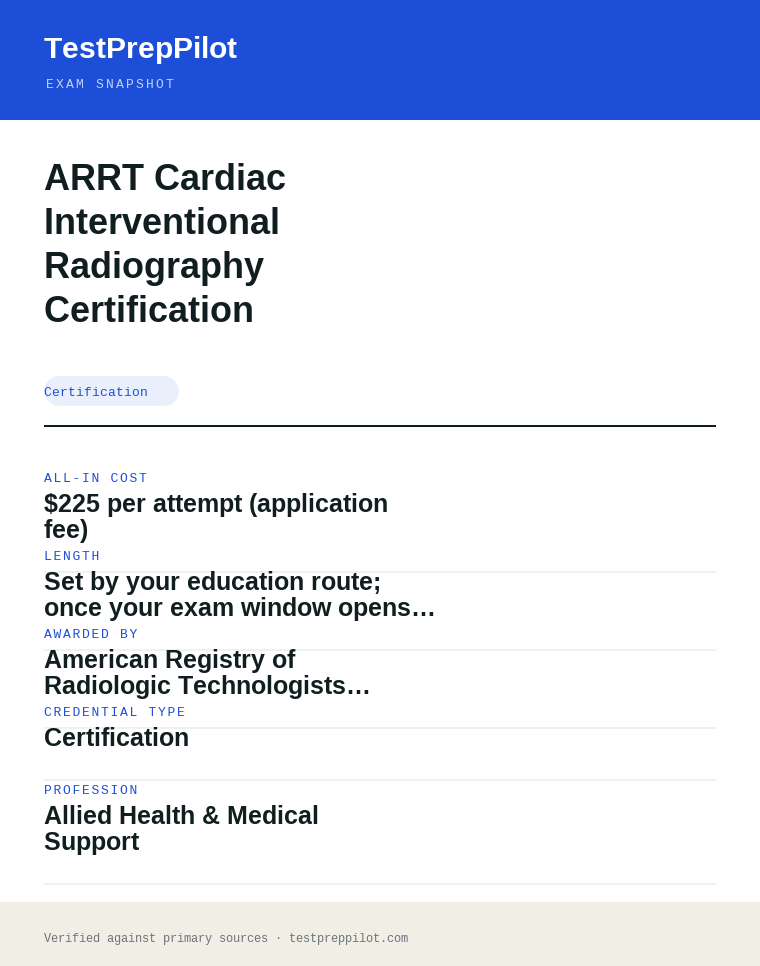
ARRT Cardiac Interventional Radiography Certification
The ARRT CI credential for technologists who assist with cardiac catheterization and intervention.
Researched and maintained by TestPrepPilot Editorial BoardRadiologic & medical imaging certifications desk · Figures last verified August 2026
The short version
What is the ARRT Cardiac Interventional Radiography Certification and is it worth it?
The ARRT Cardiac Interventional exam has 145 scored questions plus 40 pilot items, with 195 minutes of test time and a scaled passing score of 75. Interventional procedures carry 50 scored questions, and the postprimary route needs a supporting credential.
- Interventional procedures (50 scored questions) are the single largest subcategory, so they should anchor the study plan.
- The 195-minute test time and the 3-hour-35-minute appointment are published in the handbook.
- Patient Care carries 40 questions, which is high for a postprimary exam.
- The content specification counts make the exam structure easy to map.
What is it?
What exactly is the ARRT Cardiac Interventional Radiography Certification?
The ARRT CI credential for technologists who assist with cardiac catheterization and intervention.
The ARRT Cardiac Interventional Radiography (CI) credential is a postprimary credential for technologists who assist in cardiac catheterization and interventional procedures. The content specification places 145 scored questions across Patient Care (40), Image Production (20) and Procedures (85). Procedures splits into diagnostic and electrophysiology procedures (35) and interventional procedures (50). The exam has 40 pilot items, for 185 total items and 195 minutes of test time.
The path in brief
- Confirm the eligibility route for your discipline in the ARRT handbook
- Create your ARRT online account and submit the application
- Schedule your Pearson VUE appointment within the exam window
- Sit the exam and read the preliminary scaled score
- Read your official score report and maintain the credential
Before you book
Who is eligible to sit the ARRT Cardiac Interventional Radiography Certification?
Confirm the supporting-credential requirement in the 2026 Postprimary Eligibility Pathway Handbook, including any footnote that allows a credential earned through NMTCB or ARDMS.
Who it is for: Postprimary candidates with a supporting credential who work in cardiac catheterization labs.
The test itself
What is the format of the ARRT Cardiac Interventional Radiography Certification?
The ARRT Cardiac Interventional Radiography Certification is administered by ARRT (eligibility and scoring); Pearson VUE (test centers) and runs 195 minutes of test time; appointment about 3 hours 35 minutes, contains 145 scored questions plus 40 unscored pilot items (185 total) questions and requires Scaled score of 75 on a 1-99 scale to pass.
| Administered by | ARRT (eligibility and scoring); Pearson VUE (test centers) |
|---|---|
| Questions | 145 scored questions plus 40 unscored pilot items (185 total) |
| Time limit | 195 minutes of test time; appointment about 3 hours 35 minutes |
| Pass mark | Scaled score of 75 on a 1-99 scale |
| Exam fee | $225 application fee per exam attempt (postprimary routes that use an NMTCB or ARDMS supporting category: $450) |
| Format | Computer-based, with multiple selection, ordering and image-based items. |
Content outline
What topics are on the ARRT Cardiac Interventional Radiography Certification?
The ARRT Cardiac Interventional Radiography Certification covers 4 content domains.
No percentage weights are listed for these domains here, so the outline is shown as structure only. Check the certifying body's published outline before allocating study time.
- Patient Interactions and Management
Patient Care: 40 scored questions.
- Image Acquisition and Equipment
Image Production: 20 scored questions.
- Diagnostic and Electrophysiology Procedures
Procedures: 35 scored questions.
- Interventional Procedures
Procedures: 50 scored questions.
Money & time
How much does the ARRT Cardiac Interventional Radiography Certification cost?
For the ARRT Cardiac Interventional Radiography Certification, the exam fee is $225 application fee per exam attempt (postprimary routes that use an NMTCB or ARDMS supporting category: $450); the all-in cost is typically $225 per attempt (application fee); most candidates spend Set by your education route; once your exam window opens you have 365 calendar days to test preparing.
Cost breakdown
| Application fee, one exam attempt (primary or standard postprimary route) | $225 |
|---|---|
| Postprimary application using an NMTCB or ARDMS supporting category | $450 |
| Reapplication fee for a retake | Listed on the ARRT website; each attempt needs a new application and fee |
| Pearson VUE reschedule or cancellation | Charged by Pearson each time you change the appointment |
| Typical total | $225 per attempt (up to $450 on routes that use an NMTCB or ARDMS supporting category), plus reschedule and CE costs |
Continuing education costs are set by the CE provider. The renewal fee is set by ARRT and changes, so check the current schedule.
Timeline
- Eligibility and application Depends on your education route; ARRT assigns your exam window after approval
- Exam window Up to 365 calendar days from the window start date
- Official score report About 10 business days after the exam
- Certificate by mail (if passed) About two weeks after the results notice
Typical prep: Set by your education route; once your exam window opens you have 365 calendar days to test
The path
How do you register for the ARRT Cardiac Interventional Radiography Certification?
- 1
Establish eligibility on the primary or postprimary pathway
Confirm which handbook covers your discipline. Primary pathway candidates complete an ARRT-recognized education program. Postprimary candidates must already hold the supporting credential the handbook matrix requires, and some routes accept a supporting credential earned through NMTCB or ARDMS in place of ARRT.
- Open the Primary Eligibility Pathway Handbook or the Postprimary Eligibility Pathway Handbook
- Find your discipline in the eligibility matrix
- Note any supporting-credential footnote that applies to you
Postprimary candidates whose supporting credential comes from NMTCB or ARDMS pay the higher application fee.
- 2
Create an ARRT online account and submit the application
Applications are submitted through the ARRT online account. Include any ADA accommodation request at the same time, because ARRT assigns your exam window after the application is processed and will not accept an accommodation request after that point.
- Create or sign in to your ARRT online account
- Select your discipline and eligibility pathway
- Pay the application fee for one exam attempt
Each exam attempt needs its own application and fee.
- 3
Receive your Candidate Status Report and exam windowUp to 365 calendar days
After ARRT approves the application, your Candidate Status Report shows your exam window. The window runs for 365 calendar days from its start date. If it closes without a scheduled and taken exam, the application fee is forfeited and you must reapply.
- Check the start and end dates of your exam window
- Note the three-attempts-in-three-years limit that starts when the first window opens
- 4
Schedule your appointment with Pearson VUE
Exams are taken at Pearson VUE test centers. You can schedule once ARRT has released your candidate information, which the handbook says is about 24 hours after you receive it. Cancel or reschedule at least 24 hours before the appointment, because Pearson charges a fee each time you change it.
- Book a test center through the Pearson VUE site or phone line listed in the handbook
- Check the time allowed for the tutorial, nondisclosure agreement and survey
- Plan to arrive 30 minutes early
Pearson charges a fee for each reschedule.
- 5
Sit the exam and read the preliminary resultTutorial and agreement add about 10 minutes to the exam itself
The exam is computer-based and begins with a tutorial. You receive a preliminary scaled score at the test center, which is not the final result. The official result follows in your online account.
- Bring the required identification
- Accept the nondisclosure agreement before the exam begins
- Use the on-screen timer and flag questions you want to review
- 6
Receive the official score report and, if you pass, your certificateAbout 10 business days, then about two weeks for the mailed packet
ARRT emails when official results are available in your online account, normally within about 10 business days. A passing candidate receives a certificate packet by mail about two weeks after that notice.
- Log in to your online account to read the section breakdown
- Watch for the email notice, which is also copied to the Message Center
Results can be delayed up to six months if fees are unpaid or information is incomplete.
The fine print
What are the retake and renewal rules for the ARRT Cardiac Interventional Radiography Certification?
- Proctoring & delivery
- Computer-based exams delivered at Pearson VUE test centers. The exam begins with a tutorial, and you must accept the nondisclosure agreement before testing starts.
- Retake policy
- Three attempts to pass an ARRT exam within three years of the date your first exam window opens. Each attempt needs a new application and fee, and the reapplication fee is listed on the ARRT website. After the limit, you must requalify.
- Score reporting
- A preliminary scaled score is shown at the test center. The official score report appears in your online account within about 10 business days. The scale runs from 1 to 99 and a scaled score of 75 passes. Sonography and MRI add section minimums of 7.5 in specific sections.
- Recertification
- Maintenance has two parts: an annual renewal each year and continuing education each biennium. Radiologic technologists must report 24 approved CE credits per biennium, with 16 of those credits sonography-specific for sonographers. Registered Radiologist Assistants must report 50 credits. Renewal fees are set by ARRT and should be checked on its website.
- Refunds & rescheduling
- ARRT does not refund fees and does not transfer them to another discipline. Fees also apply to reschedules made through Pearson VUE.
What it pays
How much does this credential pay?
Radiologic technologists earned a May 2024 BLS median of $77,660, and the CI credential is the specialized pathway into cardiac catheterization labs.
The salary conclusion for the Cardiac Interventional credential is a specialization premium story: the BLS Occupational Outlook Handbook reports a May 2024 median annual wage of $77,660 for radiologic technologists and technicians within SOC 29-2034 Radiologic and MRI Technologists, and the CI designation is the standard qualification for technologists who staff cardiac catheterization and electrophysiology labs, which sit above the general radiography median because the work is invasive, high-acuity and performed in hospital settings with on-call responsibility. The BLS classifies by job duty, not by certificate, so the R.T.(R)(CI) designation itself does not appear in the wage data — but cardiac cath labs, which almost exclusively employ CI-certified technologists, pay a premium over the median for candidates who can scrub into coronary and electrophysiology cases, and the credential converts a general radiographer into a cardiac-specialty technologist in a way that shows up in base pay, shift differentials and call pay. The broader occupation is a large one — 272,000 radiologic and MRI technologists in 2024 — with BLS projecting about 5 percent growth from 2024 to 2034 and roughly 15,400 openings a year, so the entry pool is deep and the CI credential is one of the ways a technologist differentiates into a higher-acuity, higher-paying setting. Two caveats anchor the picture: first, the CI exam is post-primary, so it requires an existing ARRT primary credential first, and the salary story has two steps — the primary radiography credential and then the cardiac specialization; second, the earnings premium depends on the employer and market, with metropolitan cardiac programs paying the most while smaller facilities may pay flat across modalities. For a candidate asking whether CI pays, the direct answer is yes, reliably above the radiography median, and the credential is one of the highest-premium post-primary specializations an employed radiographer can add, even though the exam itself is the hardest of the ARRT post-primary tests.
| Measure | Figure | Source / note |
|---|---|---|
| Median annual wage | $77,660 | BLS OOH, Radiologic and MRI Technologists (SOC 29-2034), radiologic technologist component, May 2024 |
| Employment, 2024 | 272,000 jobs | BLS OOH Quick Facts, 2024 |
| Projected annual openings | ~15,400 per year | BLS OOH Job Outlook, 2024-34 |
| CI-specific premium | Above the radiography median | Cardiac cath and EP labs pay more in most markets, plus call and shift differentials |
Job growth.BLS projects about 5 percent growth for radiologic and MRI technologists (2024-2034), with roughly 15,400 openings per year from growth plus replacement demand.
Source: BLS Occupational Outlook Handbook - Radiologic and MRI Technologists
Your odds
What are the pass rates?
ARRT reported a 52.9% first-attempt pass rate for the CI exam in 2025 — the hardest ARRT post-primary exam; scaled 75 on a 1-99 scale is the standard.
The direct answer on pass rates is well documented and worth reading carefully: ARRT publishes pass-rate statistics in its Annual Exam Report, and the 2025 report lists a 52.9 percent first-attempt pass rate for Cardiac Interventional Radiography, with a mean scaled score of 74.9 for all candidates — a mean that sits below the passing standard of 75, which is the arithmetic signature of a hard exam where more than half of all candidates fail. The 2025 report counted 180 candidates sitting the exam, 115 of them first-time test-takers, and the 2024 report showed 48.4 percent passing with a mean scaled score of 74.4, so the CI exam has been the most difficult ARRT post-primary credential for consecutive years, well below the 2025 pass rates for Vascular Interventional (61.2 percent), Breast Sonography (78.1 percent) and the primary Radiography exam (85.8 percent). The passing standard is a scaled score of 75 on ARRT’s 1-to-99 scale, which is not 75 percent correct, because ARRT scales the raw score to equate form difficulty across versions, and the exam totals 145 scored items across four categories reported in the 2025 report: Interventional Procedures (50 items), Patient Interactions and Management (40), Diagnostic and Electrophysiology Procedures (35), and Image Acquisition and Equipment (20), with unscored pilot items mixed in. The historical record shows pass rates in the 48 to 64 percent range across the past decade, with 2024 at 48, 2023 at 57, 2022 at 48 and 2025 at 53. ARRT allows up to three attempts within three years, with a new application and fee per attempt. The read for a candidate is blunt: this is the hardest exam in the ARRT post-primary family, the mean candidate fails, and only weight-ordered, procedure-heavy preparation with multiple full mocks is realistic.
Read this before quoting the number.Pass-rate figures are ARRT-published and vary by year; confirm the current report on the ARRT website. The scaled passing score of 75 applies to all ARRT exams, and for CI the all-candidate mean has sat at or below 75 in recent years.
Source: ARRT Annual Exam Report and ARRT Cardiac Interventional Radiography content specifications
Your schedule
How long should I study for it?
140-180 hours over 12-14 weeks of focused study
An efficient ARRT Cardiac Interventional study plan is 12-14 weeks of about 140-180 total hours, because the exam is not only broad but the hardest post-primary credential ARRT offers — the 2025 first-attempt pass rate was 52.9 percent and the all-candidate mean scaled score sat at 74.9, below the passing 75 — so the plan must assume the bar is higher and the margin thinner than on any sibling exam. The 145 scored items span four categories, and the two procedure categories carry most of the paper: Interventional Procedures (50 items), Patient Interactions and Management (40), Diagnostic and Electrophysiology Procedures (35), and Image Acquisition and Equipment (20). The published content specifications are the scope map, and studying the categories in proportion to their item counts is the single highest-yield planning decision, with the interventional procedure content receiving the largest block because it is 34 percent of the paper and the most clinically demanding. Candidates already working in a cardiac cath or EP lab arrive with a large advantage in the procedure content; candidates moving from general radiography without cardiac exposure should budget the upper end and add structured education early, because coronary anatomy, hemodynamics, device selection and electrophysiology are genuinely new rather than review. The post-primary eligibility gates must be finished before the study window: an existing ARRT primary credential, the structured education requirement for cardiac interventional radiography, and the documented clinical experience required by the post-primary pathway. The final four weeks should be question-bank and mock-exam work at the real format, with at least three full timed mocks, because the appointment runs several hours with mixed pilot questions and the exam report shows that the majority of candidates fail — pacing and procedure depth are what separate the passing minority.
- Week 1-230
Patient care and image acquisition
- Study patient interactions in the cath lab: consent, monitoring, sedation, hemodynamic stability and contrast administration
- Cover image acquisition and equipment: fluoroscopy, cine, digital subtraction, image chains and quality control
- Drill radiation protection and dose management for cardiac procedures
- Week 3-540
Diagnostic and electrophysiology procedures (35 items)
- Study coronary angiography, ventriculography, and the diagnostic studies of the cardiac catheterization lab
- Cover electrophysiology studies, pacing, ablation concepts and device procedures
- Drill cardiac anatomy, physiology and hemodynamic monitoring
- Week 6-950
Interventional procedures (50 items)
- Study coronary angioplasty and stenting, thrombectomy, and the interventional techniques of the cath lab
- Cover device selection, deployment, complication management and post-procedure care
- Work case-based review of when each intervention is indicated and how it is performed, including emergencies
- Week 1015
Gap closing and first mock
- Re-test the Week 1-2 patient care and image acquisition items
- Re-drill the procedure distinctions that the miss log shows are recurring
- Take one full timed mock exam
- Week 11-1435
Mocks and readiness
- Take three more full-length timed mocks scoring above scaled 75
- Re-drill the miss log until clean, weighted to the interventional procedure category
- Confirm Pearson VUE booking, photo ID requirements and the testing window deadline
Adjusting the pace
Working in a cardiac cath or EP lab.Fastest path; the procedure content matches daily work, so weight time toward the physics, equipment and image-acquisition categories and full-length mocks.
General radiographer adding CI.Budget the full 14 weeks and start the structured education early; coronary anatomy, hemodynamics and electrophysiology are new rather than review.
Holding the VI credential.Interventional foundations transfer, but the cardiac-specific anatomy, EP procedures and hemodynamics need a dedicated pass; concentrate the plan there.
How to study
How do I prepare most effectively?
The dominant prep strategy for ARRT Cardiac Interventional is studying the content outline in proportion to question weight and drilling a current question bank at high volume, because the 145 scored items follow the published category counts and the exam is the hardest post-primary credential ARRT offers — the 2025 first-attempt pass rate was 52.9 percent — which means candidates cannot rely on the margin that passes easier specialties. First, download the current ARRT CI content specifications and use them as the master checklist: score the four categories — Interventional Procedures (50 items), Patient Interactions and Management (40), Diagnostic and Electrophysiology Procedures (35), and Image Acquisition and Equipment (20) — and allocate study time in the same proportions, giving the interventional procedure content the largest block because it is 34 percent of the paper. Second, finish the post-primary eligibility gates early: the existing ARRT primary credential, the structured education requirement, and the documented clinical experience, because the testing window opens only after application approval and a late application compresses study time on an exam that already fails most candidates. Third, drill a current question bank — 800 to 1,500 items with explanations — and build a miss log tied to the content outline, because bank rehearsal converts the outline into recall and the explanations fix the procedure distinctions the exam tests. Fourth, run at least three or four full-length timed mocks at the real format, because the appointment runs several hours with pilot items mixed in and the exam report shows that candidates who cannot sustain the pace are the majority. Fifth, prioritise the image-based and case-based items: the exam includes identifying anatomy and device placement on images and working through full interventional scenarios, so study with images and rehearse the decision sequence of a cardiac case from access to closure. Finally, book the exam inside the testing window early, so the appointment lands when the miss log is clean rather than when the window forces it.
Study the outline in weight order
Interventional procedures (50 items) and patient interactions (40) carry 62 percent of the paper; allocate time proportionally to the four published categories.
Finish eligibility gates early
Hold the ARRT primary credential, complete the structured education and documented clinical experience before the study window; the testing window only opens at application approval.
Drill a current bank with a miss log
800-1,500 items with explanations, tied to the content outline, converts study into recall and fixes the procedure distinctions.
Run full-length timed mocks — many of them
Three or four mocks at the real format build the pacing and stamina the multi-hour appointment demands on an exam where most candidates fail.
Study images and full case sequences
Anatomy, device placement and case-decision items reward visual recognition and working a case from access to closure; use an atlas and case reviews.
What to buy
Which study resources are worth paying for?
ARRT Cardiac Interventional prep resources split into the free official set, current question banks, and structured courses, and the buying logic is dominated by two facts: ARRT revises its content specifications on a published cycle, so material published for earlier revisions risks testing candidates against an outdated outline, and the CI exam is the hardest post-primary credential ARRT offers, with a 52.9 percent first-attempt pass rate in 2025, so under-investing in preparation is a bad bet. The free ARRT stack — the content specifications document, the post-primary eligibility pathway handbook, and the candidate resources on the ARRT website — covers the scope definition completely at zero cost and should anchor every plan. The paid question bank is the standard purchase, with prices typically $60-150 for a subscription that includes explanations, image items and mock exams; for an exam this hard, the bank is closer to a necessity than an option, and a bank with image-based and case-based items is worth the premium. Structured courses and live review workshops run $200-600 and add video instruction and pacing, which helps candidates who want external structure or who are weak in the cardiac anatomy and electrophysiology content, and a cardiac-interventional review text with case studies runs $100-200 as a supplement. The footnote that anchors the comparison: prices below are list prices as of mid-2026 and change frequently, and we rank nothing by commission. Employers are the hidden variable: many cardiac catheterization programs pay for or reimburse CI prep materials because the credential directly expands what the lab can offer, so candidates should ask their manager before buying anything, and a cheap readiness check is taking the free sample items ARRT and its vendors publish before purchasing — and treating a low score as the signal that the full study plan, not a shorter one, is warranted.
| Resource | Price | Format | Best for | |
|---|---|---|---|---|
| ARRT content specifications (official) | Free (PDF) | Official document | The authoritative scope map | Download first and tag every miss to its category |
| ARRT post-primary pathway handbook | Free (PDF) | Official document | Eligibility, structured education and clinical documentation rules | Read before applying to avoid a late application |
| Cardiac interventional question bank | $60-150 | Online, current items + mocks | Bank-driven rehearsal at volume | The core purchase — non-negotiable for the hardest post-primary exam |
| Cardiac interventional review text | $100-200 | Print and eBook with case studies | Ordered cardiac anatomy, EP and procedure reference | Candidates needing the case-decision layer taught |
| Structured review course | $200-600 | Video + live sessions | External pacing and instruction | Candidates weak in cardiac anatomy or wanting structure |
| Employer-sponsored prep | Often $0 (reimbursed) | Department-funded | Paid bank or course through the employer | Candidates employed in cardiac cath or EP labs |
List prices as of mid-2026 and change frequently; we rank nothing by commission. Verify that any paid material matches the current ARRT Cardiac Interventional content specification revision before purchase.
Avoid these
What mistakes do candidates most often make?
The most common mistake on the ARRT Cardiac Interventional exam is preparing at the same intensity as an easier post-primary credential, because the CI exam had a 52.9 percent first-attempt pass rate in 2025 and the all-candidate mean scaled score sat at 74.9, below the passing 75 — a candidate who studies enough to pass Vascular Interventional or Breast Sonography is not studying enough for CI. The second is studying the four categories in review-book order instead of weight order, which starves the Interventional Procedures (50 items) and Patient Interactions (40) categories that carry 62 percent of the 145 scored items. A third recurring error is treating the scaled score of 75 as 75 percent correct — candidates who aim for 75 percent over-study the easier content and under-prepare the procedure and hemodynamics items, when the scaled score is not a percentage and the mean candidate is already failing. Candidates also routinely underestimate the post-primary eligibility timeline, letting the structured education and clinical documentation run until they collide with the testing window and compress study time on an exam that already fails most candidates. Another pattern is skipping the image-based and case-based items, losing the anatomy, device-placement and full-case-decision questions that reward visual recognition and applied reasoning. Finally, some candidates fail to run enough full-length mocks, so the multi-hour appointment with pilot items mixed in surprises them on pacing. Each of these is fixable in one deliberate cycle, and the common thread is that CI rewards more preparation than the sibling exams demand, and the candidates who pass are the ones who treated it that way.
✕Preparing at the intensity of an easier exam
✓The CI exam fails most first-time candidates — 52.9 percent passed in 2025 and the mean scaled score was below 75. Budget 12-14 weeks and 140-180 hours, with four full mocks, not the plan that passes an easier post-primary exam.
✕Studying in review-book order
✓Allocate time by question weight: Interventional Procedures (50) and Patient Interactions (40) first, then diagnostic and EP procedures (35), then image acquisition (20).
✕Aiming for 75 percent correct
✓The scaled score of 75 is not a percentage of items correct, and the all-candidate mean is already below 75; target mastery of the weighted procedure categories instead.
✕Letting eligibility gates run late
✓Hold the primary credential, finish the structured education and documented clinical experience before the study window; the testing window only opens at application approval.
✕Skipping image-based and case-based items
✓Anatomy, device placement and full-case items reward visual recognition and applied reasoning; study with an atlas and work case sequences from access to closure.
✕Running too few full-length mocks
✓Run three or four timed mocks at the real format; the pilot items and multi-hour appointment reward the stamina and pacing that separate the passing minority.
What you'll face
What question types will I see?
The ARRT Cardiac Interventional exam is 145 scored items plus unscored pilot questions delivered by computer at Pearson VUE centers, in a multi-hour appointment, and the published format is four-option, single-best-answer multiple choice with a small share of alternative formats such as image-based items and multiple-select items. The scored content follows the four categories reported in the ARRT Annual Exam Report: Interventional Procedures (50 items), Patient Interactions and Management (40), Diagnostic and Electrophysiology Procedures (35), and Image Acquisition and Equipment (20). The interventional and patient-interaction categories together carry 62 percent of the paper, and the items reward knowing the full arc of a cardiac case — access, diagnostic findings, device selection, deployment, complication management and post-procedure care — plus the hemodynamics and monitoring that keep the patient stable through it. The exam includes image-based items in which candidates identify coronary anatomy, recognise device placement, or interpret a pressure waveform or angiogram, which is why studying with images matters and why case-based review is a standard prep method. The electrophysiology layer, including EP studies, pacing and ablation concepts, is the content most likely to separate candidates who came from general radiography, because it sits outside the imaging-tech curriculum and the report shows it as a distinct scored block. Because the pilot items are indistinguishable from scored ones, every question must be treated as live, and because this exam fails most first-time candidates, practice should move from recall items to full case scenarios and multiple timed mocks as the exam approaches. The samples below illustrate the published item style across three of the categories — a patient-care item, a diagnostic-procedure item and an interventional-procedure item — with four options each. The sample items are editor-written illustrations of the published blueprint, not live exam items.
Four options per item; the dominant format across all four categories.
Identify anatomy, device placement, or interpret angiograms and pressure waveforms; rewards image and case study.
A described patient and cath-lab scenario asks for the indicated device, step, or complication response; rewards full-case reasoning.
Try these
Q1During a cardiac catheterization, the patient’s blood pressure drops and the monitor shows ventricular tachycardia. What is the priority action?
Answer:A
Ventricular tachycardia with hypotension is a life-threatening rhythm disturbance in the cath lab, and the priority is immediate physician notification and readiness to respond with resuscitation measures as directed (A). Completing the current angiogram (B) delays a time-critical response. Administering contrast (C) does not treat the rhythm and can worsen the situation. Continuing quietly (D) ignores the emergency. This item tests the Patient Interactions and Management category: rhythm and hemodynamic emergencies are core cath-lab scenarios, and the correct response is immediate notification and prepared action.
Q2In a diagnostic coronary angiogram, the left coronary artery is cannulated and contrast is injected. Which coronary vessel is most commonly the first major branch of the left coronary artery?
Answer:C
The left main coronary artery divides into the left anterior descending and the circumflex arteries, and the circumflex is most commonly described as the first major branch after the left main bifurcation (C). The left anterior descending (A) is the other major branch and is not typically counted as the first major branch of the whole left system. The right coronary artery (B) arises from the right aortic sinus, not the left coronary system. The posterior descending artery (D) usually arises from the right coronary or circumflex depending on dominance and is not a first branch of the left coronary. This item tests the Diagnostic Procedures category: coronary anatomy is the foundation of the cath-lab items, and precise vessel identification is exactly the knowledge the exam rewards.
Q3During a percutaneous coronary intervention, the balloon catheter is inflated to deploy a coronary stent. After deflation, what is the standard next step in the procedure?
Answer:A
After stent deployment, the standard practice is to confirm the result with angiography and perform post-dilation if the result is suboptimal — such as incomplete apposition or residual stenosis (A). Removing the guidewire without imaging (B) forfeits the verification step and the ability to act on it. Closing the access site before confirming the stent result (C) ends the case prematurely. A second contrast bolus without imaging the stent (D) provides no verification. This item tests the Interventional Procedures category: the post-deployment sequence — verify, post-dilate if needed, then proceed — is a standard cath-lab decision, and the exam rewards knowing the full procedural arc rather than isolated steps.
Samples are editor-written illustrations of the published blueprint, not live exam items.
The big day
What should I expect on exam day?
The ARRT Cardiac Interventional exam is a computer-based appointment at a Pearson VUE testing center, and the direct exam-day answer is that you will sit 145 scored questions plus unscored pilot items in a multi-hour appointment, and a scaled score of 75 on the 1-99 scale is required to pass — a bar that fails most candidates, with a 52.9 percent first-attempt pass rate in 2025. Arrive with two forms of government-issued photo ID, because Pearson VUE enforces the two-ID rule strictly; check your ARRT Candidate Status Report and the center’s booking confirmation for any additional instructions. The appointment begins with a tutorial and the ARRT nondisclosure agreement, then the clock starts on the test items, with the pilot items indistinguishable from scored ones — answer every question as if it counts. Expect the environment to be quiet and proctored with a visible countdown clock; pace yourself so the case-based procedure items, which run longer because they describe full clinical scenarios, do not crowd the final categories. There are no scheduled breaks, and the exam cannot be paused, so the full-length mock discipline — and the stamina built by running four mocks — matters. A preliminary score appears on screen immediately after submission, with the official report following through the ARRT account within about two to four weeks; pass results feed the annual renewal cycle ($65 per credential as of 2026) and the 24-CEU biennial obligation shared across ARRT credentials. If you do not pass, you may reapply — each attempt requires a new application and the $225 fee, with a maximum of three attempts within three years, and the testing window resets with each new Authorization to Test.
Bring
- Two forms of government-issued photo ID
- ARRT Candidate Status Report and booking confirmation
- Approved glasses or hearing aids if used
- Snacks for before the appointment (not in the test room)
Leave at home
- Phone, smartwatch, and other electronics (stored per center rules)
- Study materials and notes
- Scratch paper from home (the center supplies its own)
- Any item on the Pearson VUE prohibited list
How the day runs
Rules in the room
- Two forms of government-issued photo ID required
- No scheduled breaks; the test clock runs continuously
- No personal electronics in the test room
- Answer every item; pilot questions are indistinguishable from scored ones
Afterwards.A passing scaled score of 75 certifies the R.T.(R)(CI) designation. Maintain it with the $65 annual renewal and 24 CEUs per biennium (shared across ARRT credentials), plus the ten-year Continuing Qualifications Requirements. If you fail, you may reapply with a new application and fee, up to three attempts within three years — and because this exam fails most candidates on the first attempt, treat a re-sit as a targeted repair cycle using the score-report category breakdown, not as a second roll of the dice.
Reference
What are the key facts about the ARRT Cardiac Interventional Radiography Certification?
ARRT Cardiac Interventional Radiography Certification is a certification credential; awarded by American Registry of Radiologic Technologists (ARRT); the exam fee is $225 application fee per exam attempt (postprimary routes that use an NMTCB or ARDMS supporting category: $450); typical preparation is Set by your education route; once your exam window opens you have 365 calendar days to test.
| Credential | ARRT Cardiac Interventional Radiography Certification |
|---|---|
| Abbreviation | CI |
| Type | Certification |
| Profession | Allied Health & Medical Support |
| Specialty | Medical Imaging |
| Awarded by | American Registry of Radiologic Technologists (ARRT) |
| Difficulty | Challenging |
| Typical prep time | Set by your education route; once your exam window opens you have 365 calendar days to test |
| All-in cost | $225 per attempt (application fee) |
| Content specification | Cardiac Interventional Radiography content specification, approved July 2022 and implemented July 1, 2023. |
| Scoring | Scaled 1-99; scaled score of 75 passes |
| Attempts | Three attempts within three years of the first exam window opening |
| Exam window | 365 calendar days from the window start date |
| Score report | Preliminary at the test center; official in the online account within about 10 business days |
| Maintenance | Annual renewal and 24 approved CE credits per biennium |
| Scope | National / Multi-state |
Real questions
Frequently asked questions about the ARRT Cardiac Interventional Radiography Certification
How hard is the Cardiac Interventional Radiography exam?
Difficulty depends on your preparation and your background. The passing standard is a scaled score of 75 on a 1 to 99 scale, and it is not a percentage. The number of correct answers needed changes from one exam version to another. Pass-rate figures also change year to year, so check ARRT for the current published figure before relying on any number from an older article.
How long is the Cardiac Interventional Radiography exam?
The exam has 145 scored questions and 40 unscored pilot items, for 185 total, with 195 minutes of test time and an appointment of about 3 hours and 35 minutes. Your appointment also includes a tutorial, a nondisclosure agreement and a survey, so allow the full appointment time on exam day.
How many times can I take the Cardiac Interventional Radiography exam?
You have three attempts to pass an ARRT exam within three years of the date your first exam window opens. Each attempt requires a separate application and fee, so a failed attempt has a direct cost as well as a time cost. Plan your study before you apply.
Does the Cardiac Interventional Radiography credential expire?
Your ARRT credential is kept current through an annual renewal and biennial continuing education, not by a one-time pass. Radiologic technologists must report 24 approved CE credits per biennium. Renewal fees are set by ARRT, so check its current fee schedule each year rather than relying on an older figure.
How long until I know whether I passed?
You receive a preliminary scaled score at the test center. ARRT then emails that official results are in your online account, normally within about 10 business days. If you pass, a certificate packet arrives by mail about two weeks after that notice.
How should I study for the Cardiac Interventional Radiography exam?
Interventional procedures is the largest subcategory, so study it first, then diagnostic and electrophysiology procedures, then patient care. ARRT does not endorse specific study materials, but it publishes the content specification for each discipline, and most programs use it as the study guide. Start from that outline, identify the subcategories where you are weakest, and use study products as supplements rather than as official content.
What is the difference between the primary and postprimary pathways?
The primary pathway is for entry-level credentials such as Radiography, Nuclear Medicine, Radiation Therapy and Sonography, and it requires completion of an ARRT-recognized education program. The postprimary pathway is for advanced credentials such as CT, MRI, Mammography, Cardiac Interventional and Vascular Interventional Radiography. Postprimary candidates must hold a supporting credential, and the handbook matrix shows which one each discipline requires.
How many attempts do I get?
You have three attempts to pass an ARRT exam within three years of the date your first exam window opens. Each attempt requires its own application and fee. If you do not pass within those limits, you must requalify before you can test again.
In short
Is the ARRT Cardiac Interventional Radiography Certification worth it?
- ARRT Cardiac Interventional has 145 scored questions plus 40 pilot items, in 195 minutes of test time.
- Interventional Procedures carries 50 scored questions, the largest single subcategory.
- Patient Care carries 40 scored questions, a large share for a postprimary exam.
- Maintain with annual renewal and 24 approved CE credits per biennium.
Same awarding body
What other credentials does American Registry of Radiologic Technologists (ARRT) award?
Worth comparing
How does the ARRT Cardiac Interventional Radiography Certification compare with similar credentials?
Trust
Where does this information come from?
Everything above is taken from the awarding body's own published material. Fees, question counts and domain weights are revised regularly — check the official page before you pay.
- American Registry of Radiologic Technologists (ARRT) Awarding body
- Official ARRT Cardiac Interventional Radiography Certification exam page Exam page
- American Registry of Radiologic Technologists (ARRT) certification programme Programme rules
Research confidence: high · Last reviewed 2026-08