Allied Health & Medical Support • Certification
ARRT Magnetic Resonance Imaging Certification
The ARRT MR credential for technologists who image with magnetic resonance.
Researched and maintained by TestPrepPilot Editorial BoardAllied health & medical imaging certifications desk · Figures last verified August 2026
The short version
What is the ARRT Magnetic Resonance Imaging Certification and is it worth it?
The ARRT MRI exam has 200 scored questions plus 30 pilot items in 230 minutes, with a scaled passing score of 75 overall. You also need a section score of 7.5 or greater in MRI Screening and Safety. The postprimary route needs a supporting credential, and each attempt costs $225 or $450 depending on that credential.
- Image Production carries 106 of 200 scored questions, so physics and sequencing deserve the most study time.
- The MRI Screening and Safety section has its own minimum score, so safety preparation cannot be left until the end.
- The content specification gives exact counts for every subcategory.
- The 230-minute test time is the same length as the primary Radiography exam.
What is it?
What exactly is the ARRT Magnetic Resonance Imaging Certification?
The ARRT MR credential for technologists who image with magnetic resonance.
The ARRT Magnetic Resonance Imaging (MR) credential is a postprimary credential for technologists who perform MRI exams. The MRI content specification places 200 scored questions across Patient Care (16), Safety (21), Image Production (106) and Procedures (57). Image Production is the largest block, covering physical principles, sequence parameters and data acquisition. Candidates must reach a scaled score of 75 overall and a section score of 7.5 or greater in MRI Screening and Safety.
The path in brief
- Confirm the eligibility route for your discipline in the ARRT handbook
- Create your ARRT online account and submit the application
- Schedule your Pearson VUE appointment within the exam window
- Sit the exam and read the preliminary scaled score
- Read your official score report and maintain the credential
Before you book
Who is eligible to sit the ARRT Magnetic Resonance Imaging Certification?
Confirm the supporting-credential requirement in the 2026 Postprimary Eligibility Pathway Handbook. The handbook footnotes state which supporting credentials can come from ARRT, NMTCB or ARDMS.
Who it is for: Postprimary candidates with a supporting credential who want the MR credential for MRI practice.
The test itself
What is the format of the ARRT Magnetic Resonance Imaging Certification?
The ARRT Magnetic Resonance Imaging Certification is administered by ARRT (eligibility and scoring); Pearson VUE (test centers) and runs 230 minutes of test time; appointment about 4 hours 10 minutes, contains 200 scored questions plus 30 unscored pilot items (230 total) questions and requires Scaled score of 75 on a 1-99 scale to pass.
| Administered by | ARRT (eligibility and scoring); Pearson VUE (test centers) |
|---|---|
| Questions | 200 scored questions plus 30 unscored pilot items (230 total) |
| Time limit | 230 minutes of test time; appointment about 4 hours 10 minutes |
| Pass mark | Scaled score of 75 on a 1-99 scale |
| Exam fee | $225 application fee per exam attempt (postprimary routes that use an NMTCB or ARDMS supporting category: $450) |
| Format | Computer-based, with multiple selection, ordering and image-based items. Section minimums apply in addition to the overall score. |
Content outline
What topics are on the ARRT Magnetic Resonance Imaging Certification?
The ARRT Magnetic Resonance Imaging Certification covers 8 content domains.
No percentage weights are listed for these domains here, so the outline is shown as structure only. Check the certifying body's published outline before allocating study time.
- Patient Interactions and Management
Patient Care: 16 scored questions.
- MRI Screening and Safety
Safety: 21 scored questions. Requires a section score of 7.5 or greater to pass.
- Physical Principles of Image Formation
Image Production: 40 scored questions.
- Sequence Parameters and Options
Image Production: 36 scored questions.
- Data Acquisition, Processing, and Storage
Image Production: 30 scored questions.
- Neurological Procedures
Procedures: 25 scored questions.
- Body Procedures
Procedures: 15 scored questions.
- Musculoskeletal Procedures
Procedures: 17 scored questions.
Money & time
How much does the ARRT Magnetic Resonance Imaging Certification cost?
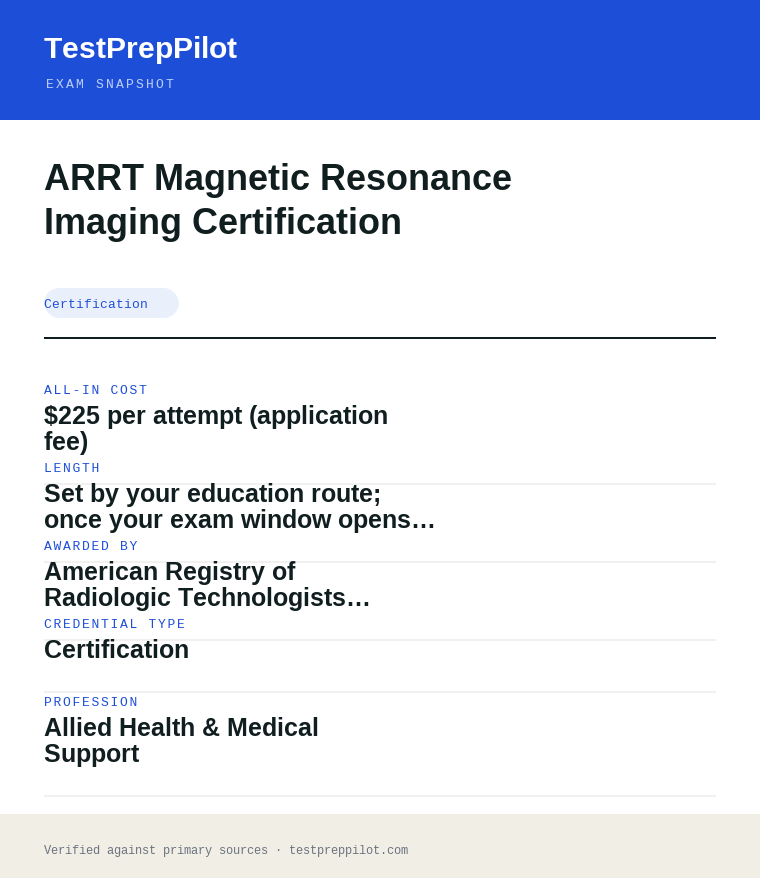
For the ARRT Magnetic Resonance Imaging Certification, the exam fee is $225 application fee per exam attempt (postprimary routes that use an NMTCB or ARDMS supporting category: $450); the all-in cost is typically $225 per attempt (application fee); most candidates spend Set by your education route; once your exam window opens you have 365 calendar days to test preparing.
Cost breakdown
| Application fee, one exam attempt (primary or standard postprimary route) | $225 |
|---|---|
| Postprimary application using an NMTCB or ARDMS supporting category | $450 |
| Reapplication fee for a retake | Listed on the ARRT website; each attempt needs a new application and fee |
| Pearson VUE reschedule or cancellation | Charged by Pearson each time you change the appointment |
| Typical total | $225 per attempt (up to $450 on routes that use an NMTCB or ARDMS supporting category), plus reschedule and CE costs |
Continuing education costs are set by the CE provider. The renewal fee is set by ARRT and changes, so check the current schedule.
Timeline
- Eligibility and application Depends on your education route; ARRT assigns your exam window after approval
- Exam window Up to 365 calendar days from the window start date
- Official score report About 10 business days after the exam
- Certificate by mail (if passed) About two weeks after the results notice
Typical prep: Set by your education route; once your exam window opens you have 365 calendar days to test
The path
How do you register for the ARRT Magnetic Resonance Imaging Certification?
- 1
Establish eligibility on the primary or postprimary pathway
Confirm which handbook covers your discipline. Primary pathway candidates complete an ARRT-recognized education program. Postprimary candidates must already hold the supporting credential the handbook matrix requires, and some routes accept a supporting credential earned through NMTCB or ARDMS in place of ARRT.
- Open the Primary Eligibility Pathway Handbook or the Postprimary Eligibility Pathway Handbook
- Find your discipline in the eligibility matrix
- Note any supporting-credential footnote that applies to you
Postprimary candidates whose supporting credential comes from NMTCB or ARDMS pay the higher application fee.
- 2
Create an ARRT online account and submit the application
Applications are submitted through the ARRT online account. Include any ADA accommodation request at the same time, because ARRT assigns your exam window after the application is processed and will not accept an accommodation request after that point.
- Create or sign in to your ARRT online account
- Select your discipline and eligibility pathway
- Pay the application fee for one exam attempt
Each exam attempt needs its own application and fee.
- 3
Receive your Candidate Status Report and exam windowUp to 365 calendar days
After ARRT approves the application, your Candidate Status Report shows your exam window. The window runs for 365 calendar days from its start date. If it closes without a scheduled and taken exam, the application fee is forfeited and you must reapply.
- Check the start and end dates of your exam window
- Note the three-attempts-in-three-years limit that starts when the first window opens
- 4
Schedule your appointment with Pearson VUE
Exams are taken at Pearson VUE test centers. You can schedule once ARRT has released your candidate information, which the handbook says is about 24 hours after you receive it. Cancel or reschedule at least 24 hours before the appointment, because Pearson charges a fee each time you change it.
- Book a test center through the Pearson VUE site or phone line listed in the handbook
- Check the time allowed for the tutorial, nondisclosure agreement and survey
- Plan to arrive 30 minutes early
Pearson charges a fee for each reschedule.
- 5
Sit the exam and read the preliminary resultTutorial and agreement add about 10 minutes to the exam itself
The exam is computer-based and begins with a tutorial. You receive a preliminary scaled score at the test center, which is not the final result. The official result follows in your online account.
- Bring the required identification
- Accept the nondisclosure agreement before the exam begins
- Use the on-screen timer and flag questions you want to review
- 6
Receive the official score report and, if you pass, your certificateAbout 10 business days, then about two weeks for the mailed packet
ARRT emails when official results are available in your online account, normally within about 10 business days. A passing candidate receives a certificate packet by mail about two weeks after that notice.
- Log in to your online account to read the section breakdown
- Watch for the email notice, which is also copied to the Message Center
Results can be delayed up to six months if fees are unpaid or information is incomplete.
The fine print
What are the retake and renewal rules for the ARRT Magnetic Resonance Imaging Certification?
- Proctoring & delivery
- Computer-based exams delivered at Pearson VUE test centers. The exam begins with a tutorial, and you must accept the nondisclosure agreement before testing starts.
- Retake policy
- Three attempts to pass an ARRT exam within three years of the date your first exam window opens. Each attempt needs a new application and fee, and the reapplication fee is listed on the ARRT website. After the limit, you must requalify.
- Score reporting
- A preliminary scaled score is shown at the test center. The official score report appears in your online account within about 10 business days. The scale runs from 1 to 99 and a scaled score of 75 passes. Sonography and MRI add section minimums of 7.5 in specific sections.
- Recertification
- Maintenance has two parts: an annual renewal each year and continuing education each biennium. Radiologic technologists must report 24 approved CE credits per biennium, with 16 of those credits sonography-specific for sonographers. Registered Radiologist Assistants must report 50 credits. Renewal fees are set by ARRT and should be checked on its website.
- Refunds & rescheduling
- ARRT does not refund fees and does not transfer them to another discipline. Fees also apply to reschedules made through Pearson VUE.
What it pays
How much does this credential pay?
$88,180 median for magnetic resonance imaging technologists (SOC 29-2035, BLS May 2024) — a direct match for the ARRT MRI credential
Unlike many certifications on this site, the ARRT MRI credential maps to a dedicated BLS occupation: Magnetic Resonance Imaging Technologists, SOC 29-2035, had a May 2024 median wage of $88,180, with the lowest 10 percent earning less than $64,910 and the highest 10 percent more than $121,420. This is a genuine match rather than a proxy — BLS describes MRI technologists as operating MRI scanners, monitoring patient safety and comfort, and viewing images to ensure quality, which is precisely what an R.T.(MR)(ARRT) does, and most MRI jobs are filled by ARRT-certified technologists, so the wage distribution is effectively the credential’s market. BLS projects 7 percent employment growth for MRI technologists from 2024 to 2034, faster than the 5 percent combined figure for radiologic and MRI technologists and faster than the 3 percent all-occupations average, with the combined occupation producing about 15,400 openings a year. The occupational logic is straightforward: the growing older population drives more MRI exams for cancer, brain, spine and musculoskeletal conditions, and each exam needs a technologist who can operate the scanner safely. The caveats matter. First, the MRI credential is a postprimary pathway — most candidates already hold an ARRT credential such as radiography, or a supporting credential from ARDMS or NMTCB — so the realistic salary story is a technologist adding a specialty, which typically moves pay up the distribution rather than starting from the bottom. Second, BLS groups MRI technologists with radiologic technologists in its combined outlook, but the MRI-specific 7 percent projection and the $88,180 median are published separately for SOC 29-2035. Third, the credential’s value is tied to the clinical-experience requirement: ARRT requires roughly 125 MRI procedure repetitions for postprimary candidates, so the exam presupposes you are already working in the modality.
| Measure | Figure | Source / note |
|---|---|---|
| Median annual wage, MRI technologists | $88,180 | BLS OOH, SOC 29-2035, May 2024 |
| Lowest 10 percent | less than $64,910 | BLS OOH Pay tab, May 2024 |
| Highest 10 percent | more than $121,420 | BLS OOH Pay tab, May 2024 |
| Employment, 2024 | 44,100 MRI technologist jobs | BLS OOH, SOC 29-2035, 2024 |
| Projected growth, MRI technologists | 7% (2024-34) | BLS OOH Job Outlook, 2024-34 |
Job growth.7% projected change 2024-34 for MRI technologists (faster than average), with the combined radiologic and MRI occupation producing ~15,400 openings a year
Source: BLS Occupational Outlook Handbook — Radiologic and MRI Technologists
Your odds
What are the pass rates?
ARRT publishes pass rates — 73.1% of first-time MRI candidates passed in 2024, across 3,071 first-time test-takers, per the ARRT 2024 Annual Report of Exams
ARRT publishes annual exam pass rates, and the most recent figure for the MRI postprimary exam is a 73.1 percent first-time pass rate across 3,071 first-time candidates, from the ARRT 2024 Annual Report of Exams. That figure is a useful planning datum: it tells you the exam is demanding but passable for prepared candidates, and it is broadly consistent with the reported pass rates in the mid-70s for the years around it. The exam itself changed structure on 1 February 2025: the current MRI content specifications list 200 scored questions plus 30 unscored pilot items — 230 total items candidates see, with no indication of which are unscored — delivered at a Pearson VUE test centre within a 230-minute appointment window that includes the tutorial, nondisclosure agreement, exam and post-exam survey. The passing standard is a scaled score of 75 on ARRT’s 1-to-99 scaled scoring scale, which is not a percentage of questions correct; ARRT equates exam forms so that the scaled 75 represents the same level of ability across different forms. The postprimary application fee is $225 with an ARRT supporting credential, or $450 if you use an ARDMS or NMTCB supporting credential, with a $200 reapplication fee. Candidates get three attempts within three years before requalification is required, and postprimary candidates must document roughly 125 MRI procedure repetitions, so the eligibility gate and the exam fee are both real. Because ARRT publishes the pass rate and the candidate count, this is one of the better-calibrated exams on this site — but remember the 73.1 percent is first-time candidates, and the overall figure including retakers is lower.
Read this before quoting the number.ARRT publishes first-time pass rates in its Annual Report of Exams — 73.1% for MRI across 3,071 first-time candidates in 2024. The 200 scored plus 30 unscored pilot structure, 230-minute appointment, scaled passing score of 75 and $225/$450 fee tiers are the published figures this narrative relies on alongside it.
Source: ARRT — MRI exam and Annual Report of Exams (pass-rate data)
Your schedule
How long should I study for it?
120-180 hours over 12-16 weeks of focused study
Plan for twelve to sixteen weeks and 120 to 180 hours of study, and weight it to the blueprint rather than to intuition — the current MRI content specifications put Image Production at 53 percent of the 200 scored questions, roughly 106 items, which is more than every other content area combined, so a candidate who starts with procedures is studying in the wrong proportions. The exam is 200 scored questions plus 30 unscored pilot items in a 230-minute appointment, and a scaled score of 75 is required to pass. The four content areas in the specifications effective 1 February 2025 are Image Production at 53 percent, Procedures at 28.5 percent, Safety at 10.5 percent and Patient Care at 8 percent — and candidates routinely report that Image Production, meaning MRI physics, pulse sequences and artifacts, is where first-attempt failures come from, so it must be the largest block of your study calendar. The plan below runs in five blocks: physics and sequences first, then parameters and quality, then procedures, then safety and patient care, closing with timed rehearsal — a shape that puts the 53 percent domain first and the smaller domains last. It assumes you already meet the postprimary eligibility: a supporting ARRT credential or an ARDMS/NMTCB credential, roughly 125 documented MRI procedure repetitions, and structured education in MRI. If you have not completed the clinical experience requirement, that is the gate you must clear first — the exam tests physics and safety at a depth that only makes sense once you have spent real time at the console.
- Weeks 1-310-12 hrs/week
Image Production — physics and sequences (53%)
- Master the physical principles: magnetism, RF excitation, signal formation, T1 and T2 relaxation, and contrast weighting
- Work pulse sequences in depth: spin echo and gradient echo families, TR/TE/flip angle effects, and k-space
- Learn image artifacts by cause — motion, chemical shift, aliasing, susceptibility — and their corrections
- Build a physics-first habit: every session starts with sequences and parameters before any other content
- Weeks 4-610-12 hrs/week
Image Production — parameters and quality (continued)
- Understand how parameter choices trade off SNR, contrast, spatial resolution and scan time
- Cover hardware: magnets, gradients, RF coils, and their effect on image quality
- Work image quality concepts and QA procedures
- Drill scenario items that ask which parameter change produces a stated image effect
- Weeks 7-99-11 hrs/week
Procedures (28.5%)
- Work anatomy and pathology recognition across brain, spine, musculoskeletal and body protocols
- Learn standard protocols and when to use each sequence for a stated clinical indication
- Cover contrast administration and gadolinium considerations
- Connect each procedure back to the physics: why this sequence for this indication
- Weeks 10-118-10 hrs/week
Safety (10.5%) and Patient Care (8%)
- Master MRI safety: zone designations, screening, implants, projectile hazards, SAR and heating
- Learn emergency procedures, contrast reactions and infection control
- Cover patient communication, positioning and comfort in the bore
- These are smaller areas but high-stakes — a wrong safety answer is never a coin flip
- Weeks 12-1410-12 hrs/week
Timed rehearsal and gap closing
- Take two or three full-length timed practice exams replicating the 230-minute appointment
- Re-lab every miss to a content area — most errors will cluster in Image Production, by design
- Re-drill the physics and sequence content with fresh practice sets
- Final pass over safety zones, contraindications and the highest-density physics facts
Adjusting the pace
Working as an MRI technologist daily.Eight to ten weeks. Your day job covers procedures and patient care; spend the recovered time almost entirely on Image Production physics, which working technologists uniformly under-study relative to its 53% weight.
Coming from ARRT radiography.Your radiography base covers patient care and safety concepts; the entire physics-and-sequence world of MRI is new. Budget the full twelve to sixteen weeks and start with physics, not procedures.
Using an ARDMS or NMTCB supporting credential.You pay the higher $450 application tier, so confirm your supporting credential and pathway documentation early, and expect to spend more of the plan on MRI physics, which sonography and nuclear medicine backgrounds touch only lightly.
How to study
How do I prepare most effectively?
The strategy that reliably moves an ARRT MRI score is "weight your study to the blueprint — Image Production is 53 percent — and practise the scenario style that the exam actually uses", and the single biggest error is treating procedures as the largest domain when the content specifications put physics and sequences above everything else combined. Candidates who follow the published weights and build physics-first study habits consistently outperform those who start with anatomy and protocols. The second proven approach is scenario-based practice rather than recall drilling: the exam asks which parameter change produces a stated image effect, which sequence fits a given clinical indication, and what the correct next step is in a described safety situation, so practice questions must be answered in that applied style to be useful. Third, learn safety as decision rules rather than facts: zone designations, screening questions, and contraindication logic are the highest-stakes items on the paper, and a structured decision path beats memorised lists under pressure. Fourth, use the official ARRT content specifications as your roadmap and ignore anyone who teaches to an older weighting — the February 2025 update moved to 30 pilot items and clarified the Image Production dominance. Finally, rehearse the 230-minute appointment end to end, because stamina and pacing across 230 items are skills in their own right and the scaled-75 cut gives no partial credit for good intentions, and confirm the supporting-credential fee tier ($225 or $450) before you apply so the eligibility paperwork does not delay the attempt.
Weight study time to the published blueprint
Image Production is 53% of the 200 scored questions — roughly 106 items — with Procedures at 28.5%, Safety at 10.5% and Patient Care at 8%. Allocate study hours in those proportions; a candidate who treats procedures as the biggest domain is mis-training by design.
Practise in the scenario style
The exam asks applied questions: which parameter change produces this image effect, which sequence for this indication, what is the correct next step in this safety situation. Answer practice questions in that style rather than drilling isolated facts, so the reasoning is trained, not just the recall.
Learn safety as decision rules
MRI safety — zones, screening, implants, projectiles, SAR — carries fewer questions than the physics areas but is the highest-stakes content on the paper. Learn it as a structured decision path you can walk under pressure rather than a list to memorise.
Study from the current content specifications
The February 1, 2025 update set 200 scored plus 30 unscored pilot items and clarified the domain weights. Use the official content specifications as your roadmap and treat anything teaching an older weighting with suspicion.
Rehearse the full 230-minute appointment
230 total items in a 230-minute appointment window is a stamina event. Run full-length timed practice sets replicating the structure, because pacing across the physics-heavy first half is what protects the procedures items at the end.
Connect procedures back to physics
Every procedure question has a physics answer underneath — why spin echo for this anatomy, why this TR/TE for this tissue. When you learn a protocol, learn the sequence logic behind it; the exam asks both halves.
What to buy
Which study resources are worth paying for?
The ARRT MRI buying decision is defined by two official costs and one mandatory habit: the $225 postprimary application fee (or $450 with an ARDMS/NMTCB supporting credential), the reapplication fee of $200 after a failed attempt, and the habit of studying from the official content specifications, which are free. Because the exam is blueprint-driven and the physics weighting is unusual, the most valuable purchase is a resource that actually teaches MRI physics and sequences at registry depth, and the most common wasted purchase is a generic radiologic-technology question bank that under-weights Image Production. The table below compares the main options with prices current to this review, and the honest cost ranking is: the content specifications and your own clinical experience are the value core, a physics textbook such as MRI in Practice is the single best paid purchase, and question banks are optional calibration. Three buying rules follow from how the exam actually works. First, because Image Production is 53 percent of the scored questions, a physics-first resource is worth more per dollar than a broad imaging question bank. Second, the $225 versus $450 fee tier depends on your supporting credential, so confirm the tier before applying and check the reapplication fee of $200 into your budget if a retake is plausible. Third, the one thing no purchase can replace is the ~125 procedure repetitions of clinical experience, which the eligibility review and the safety and procedures content both assume.
| Resource | Price | Format | Best for |
|---|---|---|---|
| ARRT postprimary MRI application | $225 with ARRT credential; $450 with ARDMS/NMTCB credential; $200 reapplication | Pearson VUE computer-based exam | The exam itself — required |
| ARRT MRI content specifications | Free | Official PDF roadmap | The authoritative blueprint; the first thing to download |
| MRI in Practice (Westbrook, Talbot) | ~$60-90 | Textbook | The standard MRI physics reference; the backbone of the Image Production domain |
| ARRT MRI question banks and mock exams | ~$50-150 | Online timed practice | Rehearsing the scenario style and the 230-item stamina |
| Your clinical MRI experience | Cost of employment | On-the-job scanning | The required ~125 procedure repetitions and the only place safety and procedures become real |
Prices checked 2026-08 in USD before tax; the 230-minute appointment includes the tutorial, nondisclosure agreement, exam and post-exam survey, and candidates get three attempts within three years before requalification is required.
Avoid these
What mistakes do candidates most often make?
The most common ARRT MRI mistakes all come from studying the wrong blueprint: treating procedures as the largest domain when Image Production is 53 percent of the scored questions, and drilling facts when the exam asks applied scenario reasoning. Candidates also routinely mislearn safety as a list instead of a decision path, neglect the required clinical-experience and structured-education gates, and underestimate the 230-minute appointment as a stamina event — running out of pacing in the physics-heavy first half and rushing the procedures items at the end. A sixth pattern is treating the published 73.1 percent first-time pass rate as either trivial or frightening, when the right reading is that the exam is demanding but passable with physics-first, scenario-based preparation, and the margin is a scaled score that gives no credit for near misses. The common thread across these failures is preparing in a way that ignores the published weights: the paper rewards physics-first weighting, applied scenario reasoning, safety decision paths and the eligibility gates, and every mistake above is a way of avoiding one of those demands. A candidate who weights the calendar to Image Production, practises the scenario style, learns safety as decisions and confirms the clinical-experience requirement has addressed the entire list at once.
✕Studying procedures as the biggest domain
✓The content specifications put Image Production at 53% of the 200 scored questions — roughly 106 items — versus 28.5% for procedures. Weight your calendar to physics, sequences and artifacts first; candidates who start with anatomy and protocols are mis-training by design.
✕Drilling facts instead of scenarios
✓The exam asks applied questions — which parameter change produces this effect, which sequence for this indication, what is the correct next step. Answer practice items in that applied style so the reasoning is trained, not just the recall of isolated facts.
✕Memorising safety instead of learning decisions
✓Safety carries fewer questions but is the highest-stakes content. Learn zone designations, screening and contraindications as a decision path you can walk under pressure, not a list to recite — the exam rewards correct action in a described situation.
✕Ignoring the eligibility gates
✓The postprimary pathway requires a supporting credential and roughly 125 documented MRI procedure repetitions. Confirm your pathway documentation and clinical-experience record early; the exam fee is wasted if the eligibility review fails after months of study.
✕Underestimating the 230-minute appointment
✓230 items in a 230-minute appointment is a stamina event, and the physics-heavy first half consumes disproportionate time. Rehearse full-length timed sets so pacing protects the procedures items at the end instead of the clock dictating your last hour.
What you'll face
What question types will I see?
The ARRT MRI postprimary exam is 230 total items — 200 scored questions plus 30 unscored pilot items — delivered on computer at a Pearson VUE testing centre within a 230-minute appointment, and a scaled score of 75 is required to pass. The exam is almost entirely multiple choice, and it is dominated by scenario and application items: questions present a described situation and ask which parameter change produces a stated image effect, which sequence fits a clinical indication, what the correct next step is in a safety situation, or which protocol to select for a given anatomy and pathology. The four content areas in the specifications effective 1 February 2025 are Image Production at 53 percent, Procedures at 28.5 percent, Safety at 10.5 percent and Patient Care at 8 percent, and Image Production alone accounts for roughly 106 of the 200 scored questions, so the paper is more physics-heavy than any other ARRT postprimary credential. The 30 unscored pilot items are randomly distributed and indistinguishable from scored items, so every question must be treated as if it counts. Scaled scoring means the passing 75 is not a percentage of items correct, and the scaled standard is held constant across exam forms by equating. The samples below are editor-written illustrations of the published blueprint’s question styles, not live exam items.
Which parameter change produces this image effect — TR, TE, flip angle, slice thickness, matrix — or which sequence fits the indication. The core currency of the 53% physics domain.
Identify the artifact from a described appearance — motion, chemical shift, aliasing, susceptibility — and select the correction. Reward the cause-and-correct pairing rather than the name alone.
Anatomy, pathology and protocol selection: which sequence for this brain, spine, musculoskeletal or body indication, and how to manage contrast. Connect each answer to the physics underneath.
Zone designations, screening, implants and projectile logic in a described situation. The highest-stakes items on the paper; they reward a decision path, not a memorised list.
Communication, positioning, comfort and emergency response around the scan. Smaller in count but never optional — every candidate answers some of these.
Try these
Q1A technologist increases the repetition time (TR) in a spin echo sequence. Which effect would be expected on T1-weighted contrast?
Answer:B
T1 weighting depends on using a short TR so that differences in T1 relaxation between tissues produce contrast. Increasing TR allows more complete longitudinal recovery, which reduces the T1-dependent contrast between tissues — so T1 weighting decreases. A is the direct inversion. C is wrong because TR is a primary determinant of T1 weighting. D overstates the change: at very long TR the image moves toward proton-density weighting, but a single increase does not eliminate T1 contrast entirely.
Q2A patient with a metallic implant is being screened before an MRI scan. Which step is the correct first action?
Answer:B
The correct sequence in MRI safety is always to complete screening and determine whether the implant is MR Safe, MR Conditional or MR Unsafe before scanning begins. A is wrong because implant size alone never determines safety. C is wrong because scanning before screening is the exact failure mode that produces projectile and heating incidents. D is wrong because contrast administration is irrelevant to implant screening and would itself require screening first.
Q3For evaluating the menisci of the knee, which approach is standard in MRI protocols?
Answer:A
Meniscal evaluation uses thin slices and high resolution, with T1 and proton-density/T2 sequences acquired in multiple planes (typically sagittal and coronal) to detect tears and morphology — the standard protocol approach. B is wrong because a single thick-slice sequence cannot resolve meniscal detail. C is wrong because multiplanar imaging is precisely what meniscal work requires. D is wrong because fat suppression and multiple planes are standard for optimising meniscal contrast, and one-plane T2-only acquisition is insufficient.
Samples are editor-written illustrations of the published blueprint, not live exam items.
The big day
What should I expect on exam day?
The ARRT MRI exam is 230 total items — 200 scored plus 30 unscored pilot — delivered on computer at a Pearson VUE testing centre within a 230-minute appointment window, which includes the tutorial, nondisclosure agreement, exam and post-exam survey, so plan to be at the centre for roughly four hours. The passing standard is a scaled score of 75, and ARRT allows three attempts within three years before requalification is required. Exam day means travelling to a Pearson VUE centre with a valid, government-issued photo ID matching your registration, arriving early for check-in and the secure-room process, and leaving all personal items in a locker — no phones, no notes, no reference material of any kind, because the exam is fully closed-book. The 230-minute appointment gives you a real but manageable pace of roughly one minute per scored item once you subtract the tutorial and survey, and the pacing plan should account for the paper’s shape: the Image Production content is physics-heavy and demands more time per item, so the practical approach is to answer briskly, flag the difficult parameter and artifact items, and protect time for the procedures and safety items later in the paper. Results are not immediate — ARRT posts pass or fail to your account within a few business days, and you receive an email when the result is ready.
Bring
- A valid, government-issued photo ID matching your registration name exactly
- Your ARRT confirmation and exam scheduling details
- Water and a snack for before or between any breaks, per the centre’s rules
- Transport plan that gets you to the centre 30-45 minutes early for check-in
Leave at home
- Phones, smartwatches, fitness trackers and earbuds — locker at the centre
- All notes, study materials, formula sheets and printed references — the exam is closed-book
- Bags, coats, food and drink beyond what the centre permits
- Any electronic reference devices, tablets or calculators unless the centre policy explicitly allows them
- Loose paper — the centre supplies any permitted scratch material
How the day runs
Rules in the room
- 230 total items — 200 scored plus 30 unscored pilot items — within a 230-minute appointment window that includes the tutorial, nondisclosure agreement, exam and survey.
- A scaled score of 75 is required to pass; it is not a percentage of items correct.
- The exam is computer-based at Pearson VUE testing centres and fully closed-book.
- The 30 unscored pilot items are indistinguishable from scored items — treat every question as if it counts.
- Candidates get three attempts within three years before requalification is required.
- The postprimary application fee is $225 with an ARRT credential, or $450 with an ARDMS/NMTCB supporting credential, with a $200 reapplication fee.
- Results are posted to your ARRT account within a few business days; you receive an email when they are ready.
Afterwards.Your pass or fail is posted to your ARRT account within a few business days, with an email notification when it is ready — there is no on-the-spot result at this exam. On a pass, your R.T.(MR)(ARRT) credential is registered and must be maintained through ARRT’s annual renewal and the continuing-education cycle of 24 CE credits every two years, so diary the renewal date from day one. On a fail, ARRT’s three-attempts-within-three-years policy means the retake is not a scramble — take stock, spend the gap re-drilling Image Production, which carries 53 percent of the scored questions and is where most first-attempt losses happen, and reapply with the $200 reapplication fee when practice scores are consistently above where you were. The credential sits in a strong market: BLS projects 7 percent growth for MRI technologists through 2034 and a $88,180 median, and the MRI credential is the standard signal for hospital MRI roles, so candidates who pass typically find the credential pays for itself quickly in hiring preference and the pay movement that comes with adding a specialty.
Reference
What are the key facts about the ARRT Magnetic Resonance Imaging Certification?
ARRT Magnetic Resonance Imaging Certification is a certification credential; awarded by American Registry of Radiologic Technologists (ARRT); the exam fee is $225 application fee per exam attempt (postprimary routes that use an NMTCB or ARDMS supporting category: $450); typical preparation is Set by your education route; once your exam window opens you have 365 calendar days to test.
| Credential | ARRT Magnetic Resonance Imaging Certification |
|---|---|
| Abbreviation | MR |
| Type | Certification |
| Profession | Allied Health & Medical Support |
| Specialty | Medical Imaging |
| Awarded by | American Registry of Radiologic Technologists (ARRT) |
| Difficulty | Challenging |
| Typical prep time | Set by your education route; once your exam window opens you have 365 calendar days to test |
| All-in cost | $225 per attempt (application fee) |
| Content specification | MRI content specification, approved January 2024 and implemented February 1, 2025. ARRT has published proposed MRI revisions for a later date, so check the discipline page before scheduling. |
| Scoring | Scaled 1-99; scaled score of 75 passes |
| Attempts | Three attempts within three years of the first exam window opening |
| Exam window | 365 calendar days from the window start date |
| Score report | Preliminary at the test center; official in the online account within about 10 business days |
| Maintenance | Annual renewal and 24 approved CE credits per biennium |
| Scope | National / Multi-state |
Real questions
Frequently asked questions about the ARRT Magnetic Resonance Imaging Certification
How hard is the Magnetic Resonance Imaging exam?
Difficulty depends on your preparation and your background. The passing standard is a scaled score of 75 on a 1 to 99 scale, and it is not a percentage. The number of correct answers needed changes from one exam version to another. Pass-rate figures also change year to year, so check ARRT for the current published figure before relying on any number from an older article.
How long is the Magnetic Resonance Imaging exam?
The exam has 200 scored questions and 30 unscored pilot items, for 230 total, with 230 minutes of test time and an appointment of about 4 hours and 10 minutes. Your appointment also includes a tutorial, a nondisclosure agreement and a survey, so allow the full appointment time on exam day.
How many times can I take the Magnetic Resonance Imaging exam?
You have three attempts to pass an ARRT exam within three years of the date your first exam window opens. Each attempt requires a separate application and fee, so a failed attempt has a direct cost as well as a time cost. Plan your study before you apply.
Does the Magnetic Resonance Imaging credential expire?
Your ARRT credential is kept current through an annual renewal and biennial continuing education, not by a one-time pass. Radiologic technologists must report 24 approved CE credits per biennium. Renewal fees are set by ARRT, so check its current fee schedule each year rather than relying on an older figure.
How long until I know whether I passed?
You receive a preliminary scaled score at the test center. ARRT then emails that official results are in your online account, normally within about 10 business days. If you pass, a certificate packet arrives by mail about two weeks after that notice.
How should I study for the Magnetic Resonance Imaging exam?
Treat MRI Screening and Safety as a must-pass section, and spend most of the remaining time on the three Image Production subcategories. ARRT does not endorse specific study materials, but it publishes the content specification for each discipline, and most programs use it as the study guide. Start from that outline, identify the subcategories where you are weakest, and use study products as supplements rather than as official content.
What is the difference between the primary and postprimary pathways?
The primary pathway is for entry-level credentials such as Radiography, Nuclear Medicine, Radiation Therapy and Sonography, and it requires completion of an ARRT-recognized education program. The postprimary pathway is for advanced credentials such as CT, MRI, Mammography, Cardiac Interventional and Vascular Interventional Radiography. Postprimary candidates must hold a supporting credential, and the handbook matrix shows which one each discipline requires.
How many attempts do I get?
You have three attempts to pass an ARRT exam within three years of the date your first exam window opens. Each attempt requires its own application and fee. If you do not pass within those limits, you must requalify before you can test again.
In short
Is the ARRT Magnetic Resonance Imaging Certification worth it?
- ARRT MRI has 200 scored questions plus 30 pilot items in 230 minutes, with a scaled passing score of 75.
- MRI Screening and Safety has a section minimum of 7.5 in addition to the overall passing score.
- Image Production carries 106 of the 200 scored questions.
- The postprimary route needs a supporting credential; the application fee is $225, or $450 on some routes.
Same awarding body
What other credentials does American Registry of Radiologic Technologists (ARRT) award?
Worth comparing
How does the ARRT Magnetic Resonance Imaging Certification compare with similar credentials?
Trust
Where does this information come from?
Everything above is taken from the awarding body's own published material. Fees, question counts and domain weights are revised regularly — check the official page before you pay.
- American Registry of Radiologic Technologists (ARRT) Awarding body
- Official ARRT Magnetic Resonance Imaging Certification exam page Exam page
- American Registry of Radiologic Technologists (ARRT) certification programme Programme rules
Research confidence: high · Last reviewed 2026-08