Allied Health & Medical Support • Certification
ARRT Sonography Certification
The ARRT sonography credential for diagnostic ultrasound in abdominal, obstetric, gynecologic and superficial imaging.
Researched and maintained by TestPrepPilot Editorial BoardMedical imaging & sonography certifications desk · Figures last verified August 2026
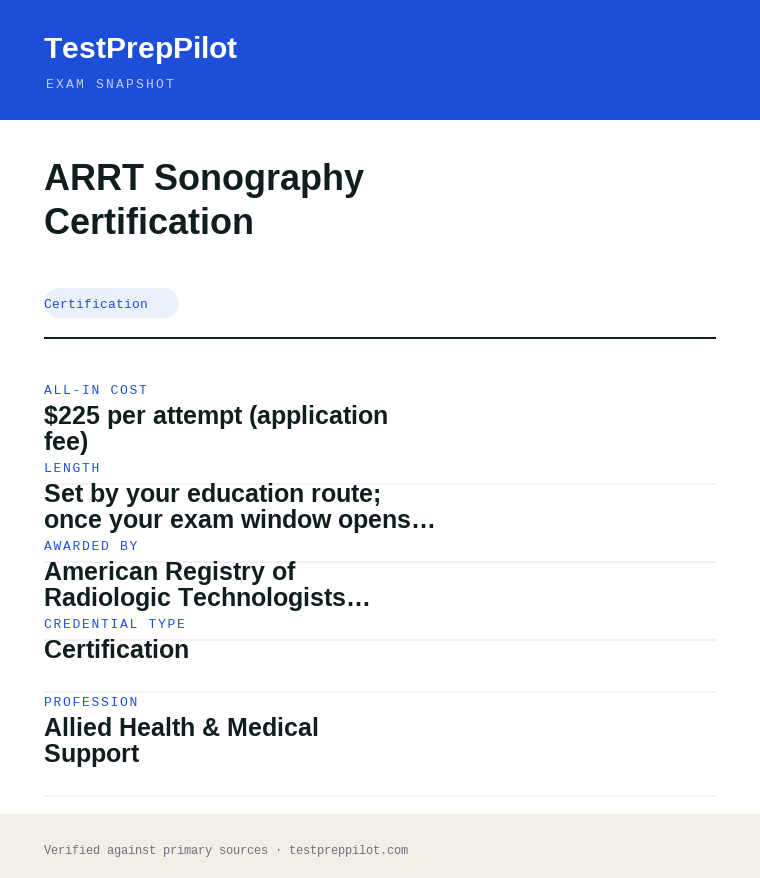
The short version
What is the ARRT Sonography Certification and is it worth it?
The ARRT Sonography exam has 360 scored questions and 40 pilot items across two test sessions. Procedures accounts for 216 scored questions, and abdomen alone is 75. Sonography also has a section requirement: you must reach a section score of 7.5 on the abdomen and OB-GYN sections in addition to the 75 overall.
- Procedures carries 216 of the 360 scored questions, so abdomen and obstetrics deserve the most study time.
- The content specification names each procedure subcategory with its question count.
- Section requirements for abdomen and OB-GYN are stated in advance, so they can be prepared for specifically.
- The credential is the foundation for several other ARRT and ARDMS sonography pathways.
What is it?
What exactly is the ARRT Sonography Certification?
The ARRT sonography credential for diagnostic ultrasound in abdominal, obstetric, gynecologic and superficial imaging.
The ARRT Sonography credential certifies diagnostic medical sonographers. The content specification places 360 scored questions across Patient Care (26), Image Production (118) and Procedures (216). Procedures covers abdomen, obstetrics in each trimester, gynecology, and superficial structures. The exam is delivered in two sessions, with 40 pilot items in addition to the scored items.
The path in brief
- Confirm the eligibility route for your discipline in the ARRT handbook
- Create your ARRT online account and submit the application
- Schedule your Pearson VUE appointment within the exam window
- Sit the exam and read the preliminary scaled score
- Read your official score report and maintain the credential
Before you book
Who is eligible to sit the ARRT Sonography Certification?
Sonography is a primary-pathway credential. Confirm the education and clinical requirements in the 2026 Primary Eligibility Pathway Handbook before applying.
Who it is for: Students in an ARRT-recognized sonography program and sonographers who need the ARRT credential.
The test itself
What is the format of the ARRT Sonography Certification?
The ARRT Sonography Certification is administered by ARRT (eligibility and scoring); Pearson VUE (test centers) and runs Two test sessions; confirm session timing in the 2026 Primary Eligibility Pathway Handbook, contains 360 scored questions plus 40 unscored pilot items (400 total), delivered in two sessions questions and requires Scaled score of 75 on a 1-99 scale to pass.
| Administered by | ARRT (eligibility and scoring); Pearson VUE (test centers) |
|---|---|
| Questions | 360 scored questions plus 40 unscored pilot items (400 total), delivered in two sessions |
| Time limit | Two test sessions; confirm session timing in the 2026 Primary Eligibility Pathway Handbook |
| Pass mark | Scaled score of 75 on a 1-99 scale |
| Exam fee | $225 application fee per exam attempt (postprimary routes that use an NMTCB or ARDMS supporting category: $450) |
| Format | Computer-based, with multiple selection, ordering and image-based items. Section minimums apply in addition to the overall score. |
Content outline
What topics are on the ARRT Sonography Certification?
The ARRT Sonography Certification covers 9 content domains.
No percentage weights are listed for these domains here, so the outline is shown as structure only. Check the certifying body's published outline before allocating study time.
- Patient Interactions and Management
Patient Care: 26 scored questions.
- Basic Principles of Ultrasound
Image Production: 45 scored questions.
- Image Formation
Image Production: 47 scored questions.
- Evaluation and Selection of Representative Images
Image Production: 26 scored questions.
- Abdomen
Procedures: 75 scored questions. Requires a section score of 7.5 or greater.
- First Trimester Obstetrics
Procedures: 20 scored questions.
- Second/Third Trimester and High Risk Obstetrics
Procedures: 57 scored questions. OB-GYN section requires a score of 7.5 or greater together with gynecology.
- Gynecology
Procedures: 32 scored questions.
- Superficial Structures and Other Sonographic Procedures
Procedures: 32 scored questions.
Study materials
Which study guide should you use for the ARRT Sonography Certification?
Start with the exam sponsor's official content outline. If you also want one structured resource to work through, these are the Mometrix titles that match this exam.

Affiliate links We may earn a commission if you buy through these links, at no extra cost to you. Mometrix has no say in what our exam guides cover. How we make money.
Money & time
How much does the ARRT Sonography Certification cost?
For the ARRT Sonography Certification, the exam fee is $225 application fee per exam attempt (postprimary routes that use an NMTCB or ARDMS supporting category: $450); the all-in cost is typically $225 per attempt (application fee); most candidates spend Set by your education route; once your exam window opens you have 365 calendar days to test preparing.
Cost breakdown
| Application fee, one exam attempt (primary or standard postprimary route) | $225 |
|---|---|
| Postprimary application using an NMTCB or ARDMS supporting category | $450 |
| Reapplication fee for a retake | Listed on the ARRT website; each attempt needs a new application and fee |
| Pearson VUE reschedule or cancellation | Charged by Pearson each time you change the appointment |
| Typical total | $225 per attempt (up to $450 on routes that use an NMTCB or ARDMS supporting category), plus reschedule and CE costs |
Continuing education costs are set by the CE provider. The renewal fee is set by ARRT and changes, so check the current schedule.
Timeline
- Eligibility and application Depends on your education route; ARRT assigns your exam window after approval
- Exam window Up to 365 calendar days from the window start date
- Official score report About 10 business days after the exam
- Certificate by mail (if passed) About two weeks after the results notice
Typical prep: Set by your education route; once your exam window opens you have 365 calendar days to test
The path
How do you register for the ARRT Sonography Certification?
- 1
Establish eligibility on the primary or postprimary pathway
Confirm which handbook covers your discipline. Primary pathway candidates complete an ARRT-recognized education program. Postprimary candidates must already hold the supporting credential the handbook matrix requires, and some routes accept a supporting credential earned through NMTCB or ARDMS in place of ARRT.
- Open the Primary Eligibility Pathway Handbook or the Postprimary Eligibility Pathway Handbook
- Find your discipline in the eligibility matrix
- Note any supporting-credential footnote that applies to you
Postprimary candidates whose supporting credential comes from NMTCB or ARDMS pay the higher application fee.
- 2
Create an ARRT online account and submit the application
Applications are submitted through the ARRT online account. Include any ADA accommodation request at the same time, because ARRT assigns your exam window after the application is processed and will not accept an accommodation request after that point.
- Create or sign in to your ARRT online account
- Select your discipline and eligibility pathway
- Pay the application fee for one exam attempt
Each exam attempt needs its own application and fee.
- 3
Receive your Candidate Status Report and exam windowUp to 365 calendar days
After ARRT approves the application, your Candidate Status Report shows your exam window. The window runs for 365 calendar days from its start date. If it closes without a scheduled and taken exam, the application fee is forfeited and you must reapply.
- Check the start and end dates of your exam window
- Note the three-attempts-in-three-years limit that starts when the first window opens
- 4
Schedule your appointment with Pearson VUE
Exams are taken at Pearson VUE test centers. You can schedule once ARRT has released your candidate information, which the handbook says is about 24 hours after you receive it. Cancel or reschedule at least 24 hours before the appointment, because Pearson charges a fee each time you change it.
- Book a test center through the Pearson VUE site or phone line listed in the handbook
- Check the time allowed for the tutorial, nondisclosure agreement and survey
- Plan to arrive 30 minutes early
Pearson charges a fee for each reschedule.
- 5
Sit the exam and read the preliminary resultTutorial and agreement add about 10 minutes to the exam itself
The exam is computer-based and begins with a tutorial. You receive a preliminary scaled score at the test center, which is not the final result. The official result follows in your online account.
- Bring the required identification
- Accept the nondisclosure agreement before the exam begins
- Use the on-screen timer and flag questions you want to review
- 6
Receive the official score report and, if you pass, your certificateAbout 10 business days, then about two weeks for the mailed packet
ARRT emails when official results are available in your online account, normally within about 10 business days. A passing candidate receives a certificate packet by mail about two weeks after that notice.
- Log in to your online account to read the section breakdown
- Watch for the email notice, which is also copied to the Message Center
Results can be delayed up to six months if fees are unpaid or information is incomplete.
The fine print
What are the retake and renewal rules for the ARRT Sonography Certification?
- Proctoring & delivery
- Computer-based exams delivered at Pearson VUE test centers. The exam begins with a tutorial, and you must accept the nondisclosure agreement before testing starts.
- Retake policy
- Three attempts to pass an ARRT exam within three years of the date your first exam window opens. Each attempt needs a new application and fee, and the reapplication fee is listed on the ARRT website. After the limit, you must requalify.
- Score reporting
- A preliminary scaled score is shown at the test center. The official score report appears in your online account within about 10 business days. The scale runs from 1 to 99 and a scaled score of 75 passes. Sonography and MRI add section minimums of 7.5 in specific sections.
- Recertification
- Maintenance has two parts: an annual renewal each year and continuing education each biennium. Radiologic technologists must report 24 approved CE credits per biennium, with 16 of those credits sonography-specific for sonographers. Registered Radiologist Assistants must report 50 credits. Renewal fees are set by ARRT and should be checked on its website.
- Refunds & rescheduling
- ARRT does not refund fees and does not transfer them to another discipline. Fees also apply to reschedules made through Pearson VUE.
What it pays
How much does this credential pay?
Expect diagnostic-medical-sonographer pay at a May 2024 median of $89,340 (BLS) — the ARDMS credential gates the occupation, and the SPI plus specialty-exam pathway is the industry-standard route
The direct answer is that the ARDMS (American Registry for Diagnostic Medical Sonography) credential is the professional gate for the occupation, diagnostic medical sonographers (SOC 29-2032), at a May 2024 median annual wage of $89,340, with the lowest 10 percent under about $61,000 and the highest 10 percent above about $126,000. The honest framing is that the credential is effectively required in practice: most employers and many states require ARDMS certification or an equivalent for sonography positions, so the credential is the hard gate to the occupation, and the pay is set by the healthcare labour market (hospital, outpatient, clinic) rather than by the credential itself. BLS counted about 72,000 diagnostic medical sonographers in 2024 and projects about 6 percent employment growth from 2024 to 2034, with roughly 4,500 annual openings. The credential path is two-part: candidates must first pass the Sonography Principles and Instrumentation (SPI) exam, then pass at least one specialty exam — abdomen (AB), obstetrics and gynecology (OB/GYN), vascular technology (RVT), or others — to earn the RDMS credential in that specialty. The practical read: sonography is a well-paid allied-health career with a structured credential path, and the SPI-plus-specialty sequence is the industry standard; candidates typically complete an accredited sonography program (2-year associate or 4-year degree) before the exams, and the credential renews with continuing education. For candidates deciding whether to pursue it, the sonography pathway is a structured educational commitment with a strong pay and growth profile behind it.
| Measure | Figure | Source / note |
|---|---|---|
| Median annual wage, diagnostic medical sonographers | $89,340 | BLS Occupational Outlook Handbook, May 2024 (SOC 29-2032) |
| Lowest 10 percent | less than $61,000 | BLS OOH, May 2024 |
| Highest 10 percent | more than $126,000 | BLS OOH, May 2024 |
| Projected growth, 2024-34 | +6% | BLS Employment Projections |
| The credential path | Professional gate | SPI exam + specialty exam (e.g. abdomen, OB/GYN, vascular) |
Job growth.BLS projects about 6% growth for diagnostic medical sonographers from 2024 to 2034, with roughly 4,500 annual openings.
Your odds
What are the pass rates?
ARDMS publishes pass rates — recent SPI and specialty exam pass rates have run in the 60-70% range for first-time candidates, and the SPI is a 110-question, 2-hour exam
The core fact is that ARDMS does publish pass-rate data: the Registry reports pass rates for its exams, and the SPI and the sonography specialty exams have run in the 60 to 70 percent range for first-time candidates in recent years — a demanding but passable exam, with the exact figures varying by exam and cohort. The SPI exam itself is a computer-based test of 110 multiple-choice questions with 2 hours allowed, scored pass/fail through ARDMS’s standard-setting process, covering ultrasound physics, instrumentation, and safety. The specialty exams (abdomen, OB/GYN, vascular, etc.) are separate, longer exams (typically 170 questions with about 3 hours) covering the specialty’s anatomy, pathology, and scanning content. The credential requires passing the SPI plus at least one specialty exam, and candidates must meet ARDMS’s prerequisites — typically graduation from an accredited sonography program with clinical hours, or an equivalent pathway. The published pass-rate pattern is useful for planning: candidates who complete an accredited program and follow a structured 6-to-12-week review with question-bank practice sit within the range of the published pass rates. The honest preparation implication is to treat the SPI as the physics foundation — candidates who pass it early build momentum for the specialty exam — and to use the ARDMS exam content outline and question banks as the calibration tools.
Read this before quoting the number.ARDMS publishes pass rates by exam; recent first-time pass rates have run in the 60-70% range.
Source: ARDMS — exam pass rates
Your schedule
How long should I study for it?
80-120 hours per exam; SPI-first sequence of focused study
Plan for roughly 6 to 12 weeks per exam and 80 to 120 hours of study each for the SPI and your specialty exam, sequenced as SPI-first, with question-bank practice as the calibration tool. The SPI covers ultrasound physics and instrumentation — sound principles, transducers, instrumentation, image formation, and safety — and is the foundation every specialty builds on. The specialty exams (abdomen, OB/GYN, vascular) cover the specialty’s anatomy, physiology, pathology, and scanning protocols. The most effective sequence is: first, complete the SPI content review with the physics text and question bank; second, take a full-length SPI practice exam and pass it before booking; third, pass the SPI; fourth, begin the specialty exam review, studying the anatomy and pathology content and drilling the case-style questions; and fifth, take full-length specialty practice exams before booking. The highest-yield habits are the question-bank drilling and the case-based specialty items, which mirror the real exam. Budget the physics foundation the most time — candidates who rush the SPI struggle on the specialty exam’s instrumentation items. After certification, factor the continuing-education requirement — ARDMS credentials renew with CEUs every few years — and plan additional specialties, which many sonographers add to expand role options and pay.
- Weeks 1-450
SPI content
- Study ultrasound physics and instrumentation
- Drill the SPI question bank
- Take a full-length SPI practice exam
- Weeks 5-630
SPI exam
- Re-study weak physics areas
- Take the SPI exam
- Weeks 7-1060
Specialty content
- Study the specialty anatomy and pathology
- Drill case-based specialty questions
- Take full-length specialty practice exams
- Final weeks20
Specialty exam
- Re-study weak areas
- Book and take the specialty exam
Adjusting the pace
Specialty options.Abdomen, OB/GYN, vascular technology, and other specialties, each with its own exam.
Post-primary pathway.Radiologic technologists can add sonography credentials through ARDMS post-primary eligibility.
How to study
How do I prepare most effectively?
The strategy that reliably passes the ARDMS exams is "pass the SPI first as the physics foundation, then drill the specialty case-based items with question banks," and the single biggest error is taking the specialty exam before solid physics grounding. A second proven approach is using the ARDMS exam content outlines as the syllabus, since the exams are built from them, and question banks as the calibration tool. Third, master the physics fundamentals — the SPI rewards precision on instrumentation and image-formation items, and candidates who rush it struggle across the specialty exam. Fourth, drill the specialty case-based questions, which mirror the real exam’s anatomy-pathology-scenario format. Fifth, take full-length practice exams under real timing, since the 170-question specialty format is a stamina test. Finally, respect the continuing-education requirement from the start — ARDMS credentials renew with CEUs — and plan additional specialties, since multi-specialty sonographers are more employable and better paid.
Pass SPI first
The physics foundation underpins every specialty exam.
Use the content outlines as the syllabus
The exams are built from the ARDMS content outlines.
Drill the case-based items
The specialty exams reward anatomy-pathology-scenario questions.
Run full-length practice exams
The 170-question specialty format is a stamina test.
Plan the CEUs and extra specialties
Multi-specialty sonographers are more employable and better paid.
What to buy
Which study resources are worth paying for?
ARDMS exam preparation runs $200 to $600 per exam depending on the prep package, with question banks and full-length practice exams as the highest-value spend. The comparison below separates the exam fees, official resources, and the major prep options, with prices current to this review. The buying rule is to budget for a question bank plus full-length practice exams, since the exam format rewards the practice-anchored approach.
| Resource | Price | Format | Best for |
|---|---|---|---|
| SPI exam registration (ARDMS) | ~$250 | Computer-based at Pearson VUE | The SPI exam |
| Specialty exam registration | ~$250-300 | Computer-based at Pearson VUE | The specialty exam |
| ARDMS exam content outlines | Free | Official PDFs | The authoritative syllabus |
| Question banks (e.g. Davies, ExamEdge) | ~$100-250 | Online practice questions | Question drilling |
| Full-length practice exams | ~$50-150 | Online timed exams | Format calibration |
Prices approximate and dated to this review; the credential requires CEUs for renewal.
Avoid these
What mistakes do candidates most often make?
The most common mistake is taking the specialty exam before solid physics grounding, which surfaces on the instrumentation items; the second is studying content without question-bank calibration, which the exam format punishes. A third recurring error is being weak on the case-based specialty items, which dominate the real exam. Candidates also routinely skip full-length practice exams and fail on stamina in the 170-question format, and many under-plan the continuing-education renewal. Finally, some candidates treat the credential as one-and-done, missing the multi-specialty expansion that drives employability and pay in the field.
✕Specialty before physics
✓Pass the SPI first; it is the foundation of every specialty.
✕Content without question banks
✓Calibrate with question-bank and full-length practice exams.
✕Weak on case-based items
✓Drill the anatomy-pathology-scenario questions.
✕Skipping full-length mocks
✓The 170-question format is a stamina test; rehearse it.
✕Missing CEUs and extra specialties
✓Plan renewal and multi-specialty expansion.
What you'll face
What question types will I see?
The SPI exam contains 110 multiple-choice questions in 2 hours covering ultrasound physics, instrumentation, and safety. The specialty exams contain about 170 questions in about 3 hours covering the specialty’s anatomy, physiology, pathology, and scanning protocols, with a large share of case-based items. The samples below are editor-written illustrations of the published content outlines, not live exam items.
Sound principles, transducers, instrumentation, image formation, and safety.
Organ anatomy and normal variants for the specialty.
Disease appearance and differential considerations.
Protocols, image optimisation, and patient safety.
Try these
Q1What is the primary determinant of axial resolution in ultrasound imaging?
Answer:A
Axial resolution is determined primarily by pulse length — shorter pulses give better axial resolution.
Q2Which transducer frequency range is typically used for abdominal imaging?
Answer:B
Abdominal imaging typically uses 2-5 MHz transducers for adequate penetration at depth.
Q3Which finding is most characteristic of a simple cyst on ultrasound?
Answer:B
A simple cyst appears anechoic with smooth walls and posterior acoustic enhancement.
Samples are editor-written illustrations of the published content outlines, not live exam items.
The big day
What should I expect on exam day?
The ARDMS exams are taken on computer at a Pearson VUE testing center: the SPI is 110 questions in 2 hours, and the specialty exams about 170 questions in about 3 hours, scored pass/fail through ARDMS’s standard-setting, with results typically available within a few weeks. The core rules: bring valid photo ID, arrive early, and follow testing-center rules. After passing the SPI and a specialty exam, ARDMS issues the RDMS credential in that specialty, renewable with continuing education. The most useful exam-day habits: pace the SPI at about a minute per question, pace the specialty exam at about a minute per question with the case items weighted, and flag and return to hard items. If you do not pass, ARDMS allows retakes after a waiting period. After the credential, track the CEU cycle and plan additional specialties to expand employability.
Bring
- Valid photo ID
- Arrival 30 minutes early
- A full-exam mindset for the 2-3 hour format
Leave at home
- Phone, smartwatch, and study materials (testing-center rules)
- Personal notes in the testing room
How the day runs
Rules in the room
- SPI: 110 questions, 2 hours
- Specialty: ~170 questions, ~3 hours
- Computer-based at Pearson VUE
- CEUs required for renewal
Afterwards.Passing the SPI plus a specialty exam earns the RDMS credential in that specialty, the industry-standard sonography certification, maintained with continuing education.
Reference
What are the key facts about the ARRT Sonography Certification?
ARRT Sonography Certification is a certification credential; awarded by American Registry of Radiologic Technologists (ARRT); the exam fee is $225 application fee per exam attempt (postprimary routes that use an NMTCB or ARDMS supporting category: $450); typical preparation is Set by your education route; once your exam window opens you have 365 calendar days to test.
| Credential | ARRT Sonography Certification |
|---|---|
| Abbreviation | S |
| Type | Certification |
| Profession | Allied Health & Medical Support |
| Specialty | Medical Imaging |
| Awarded by | American Registry of Radiologic Technologists (ARRT) |
| Difficulty | Challenging |
| Typical prep time | Set by your education route; once your exam window opens you have 365 calendar days to test |
| All-in cost | $225 per attempt (application fee) |
| Content specification | Sonography content specification, approved January 2023 and implemented January 1, 2024. |
| Scoring | Scaled 1-99; scaled score of 75 passes |
| Attempts | Three attempts within three years of the first exam window opening |
| Exam window | 365 calendar days from the window start date |
| Score report | Preliminary at the test center; official in the online account within about 10 business days |
| Maintenance | Annual renewal and 24 approved CE credits per biennium, with 16 sonography-specific credits for sonographers |
| Scope | National / Multi-state |
Real questions
Frequently asked questions about the ARRT Sonography Certification
How hard is the Sonography exam?
Difficulty depends on your preparation and your background. The passing standard is a scaled score of 75 on a 1 to 99 scale, and it is not a percentage. The number of correct answers needed changes from one exam version to another. Pass-rate figures also change year to year, so check ARRT for the current published figure before relying on any number from an older article.
How long is the Sonography exam?
The exam has 360 scored questions and 40 unscored pilot items, for 400 total, delivered in two test sessions. Procedures is in the first session, and the handbook gives the session timing. Your appointment also includes a tutorial, a nondisclosure agreement and a survey, so allow the full appointment time on exam day.
How many times can I take the Sonography exam?
You have three attempts to pass an ARRT exam within three years of the date your first exam window opens. Each attempt requires a separate application and fee, so a failed attempt has a direct cost as well as a time cost. Plan your study before you apply.
Does the Sonography credential expire?
Your ARRT credential is kept current through an annual renewal and biennial continuing education, not by a one-time pass. Radiologic technologists must report 24 approved CE credits per biennium. Renewal fees are set by ARRT, so check its current fee schedule each year rather than relying on an older figure.
How long until I know whether I passed?
You receive a preliminary scaled score at the test center. ARRT then emails that official results are in your online account, normally within about 10 business days. If you pass, a certificate packet arrives by mail about two weeks after that notice.
How should I study for the Sonography exam?
Study abdomen and obstetrics first, because both carry section minimums and together make up most of Procedures. ARRT does not endorse specific study materials, but it publishes the content specification for each discipline, and most programs use it as the study guide. Start from that outline, identify the subcategories where you are weakest, and use study products as supplements rather than as official content.
What is the difference between the primary and postprimary pathways?
The primary pathway is for entry-level credentials such as Radiography, Nuclear Medicine, Radiation Therapy and Sonography, and it requires completion of an ARRT-recognized education program. The postprimary pathway is for advanced credentials such as CT, MRI, Mammography, Cardiac Interventional and Vascular Interventional Radiography. Postprimary candidates must hold a supporting credential, and the handbook matrix shows which one each discipline requires.
How many attempts do I get?
You have three attempts to pass an ARRT exam within three years of the date your first exam window opens. Each attempt requires its own application and fee. If you do not pass within those limits, you must requalify before you can test again.
In short
Is the ARRT Sonography Certification worth it?
- ARRT Sonography has 360 scored questions plus 40 pilot items across two test sessions.
- Procedures carries 216 scored questions, and abdomen alone carries 75.
- The overall passing score is 75, and abdomen and OB-GYN each need a section score of 7.5.
- Maintain with annual renewal and 24 CE credits per biennium, 16 of them sonography-specific.
Same awarding body
What other credentials does American Registry of Radiologic Technologists (ARRT) award?
Worth comparing
How does the ARRT Sonography Certification compare with similar credentials?
Trust
Where does this information come from?
Everything above is taken from the awarding body's own published material. Fees, question counts and domain weights are revised regularly — check the official page before you pay.
- American Registry of Radiologic Technologists (ARRT) Awarding body
- Official ARRT Sonography Certification exam page Exam page
- American Registry of Radiologic Technologists (ARRT) certification programme Programme rules
Research confidence: medium · Last reviewed 2026-08