Allied Health & Medical Support • Certification
ARRT Mammography Certification
The ARRT mammography credential for breast imaging technologists.
Researched and maintained by TestPrepPilot Editorial BoardRadiologic & medical imaging certifications desk · Figures last verified August 2026
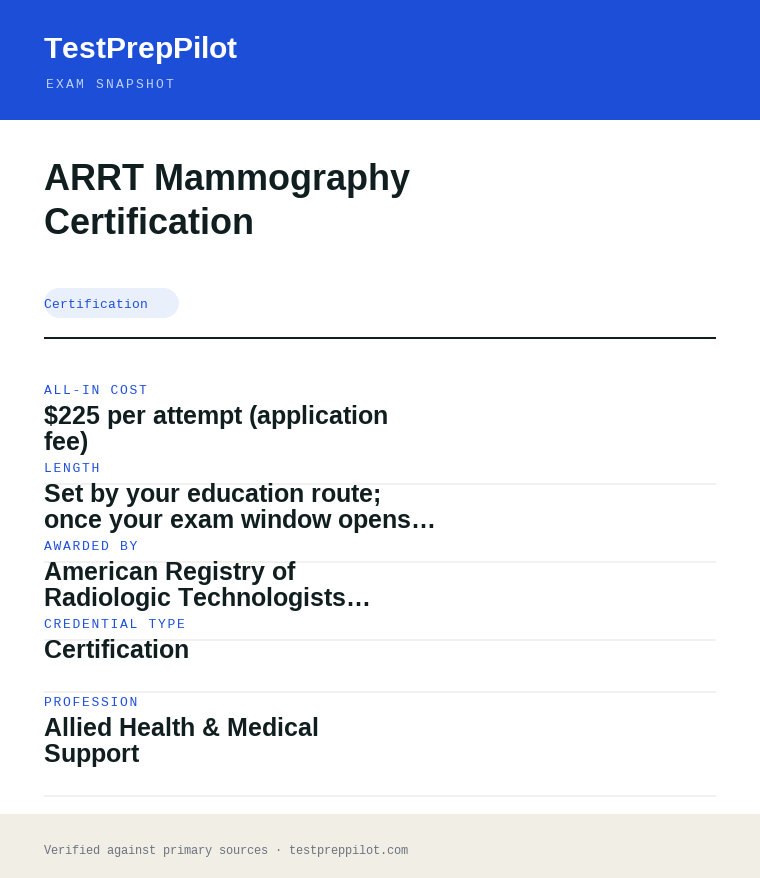
The short version
What is the ARRT Mammography Certification and is it worth it?
The ARRT Mammography exam has 115 scored questions plus 30 pilot items, with 150 minutes of test time and a scaled passing score of 75. Mammographic positioning and procedures is the largest subcategory at 39 questions.
- Mammographic positioning and procedures (39 scored questions) is the largest subcategory, so positioning technique should anchor the plan.
- The exam is the shortest of the ARRT postprimary exams at 150 minutes, per the handbook.
- The content specification gives counts for each subcategory.
- The credential is also required for ARRT Breast Sonography.
What is it?
What exactly is the ARRT Mammography Certification?
The ARRT mammography credential for breast imaging technologists.
The ARRT Mammography credential is a postprimary credential for technologists who perform breast imaging. The content specification places 115 scored questions across Patient Care (20), Image Production (30) and Procedures (65). Procedures covers anatomy, physiology and pathology (26 questions) and mammographic positioning and procedures (39). The exam has 30 pilot items on top of the scored items, for 150 minutes of test time.
The path in brief
- Confirm the eligibility route for your discipline in the ARRT handbook
- Create your ARRT online account and submit the application
- Schedule your Pearson VUE appointment within the exam window
- Sit the exam and read the preliminary scaled score
- Read your official score report and maintain the credential
Before you book
Who is eligible to sit the ARRT Mammography Certification?
Confirm the supporting-credential requirement in the 2026 Postprimary Eligibility Pathway Handbook. The handbook footnotes state which supporting credentials can come from ARRT or NMTCB.
Who it is for: Postprimary candidates with a supporting credential who perform mammography.
The test itself
What is the format of the ARRT Mammography Certification?
The ARRT Mammography Certification is administered by ARRT (eligibility and scoring); Pearson VUE (test centers) and runs 150 minutes of test time; appointment about 2 hours 50 minutes, contains 115 scored questions plus 30 unscored pilot items (145 total) questions and requires Scaled score of 75 on a 1-99 scale to pass.
| Administered by | ARRT (eligibility and scoring); Pearson VUE (test centers) |
|---|---|
| Questions | 115 scored questions plus 30 unscored pilot items (145 total) |
| Time limit | 150 minutes of test time; appointment about 2 hours 50 minutes |
| Pass mark | Scaled score of 75 on a 1-99 scale |
| Exam fee | $225 application fee per exam attempt (postprimary routes that use an NMTCB or ARDMS supporting category: $450) |
| Format | Computer-based, with multiple selection, ordering and image-based items. |
Content outline
What topics are on the ARRT Mammography Certification?
The ARRT Mammography Certification covers 4 content domains.
No percentage weights are listed for these domains here, so the outline is shown as structure only. Check the certifying body's published outline before allocating study time.
- Patient Interactions and Management
Patient Care: 20 scored questions.
- Image Acquisition and Quality Assurance
Image Production: 30 scored questions.
- Anatomy, Physiology, and Pathology
Procedures: 26 scored questions.
- Mammographic Positioning and Procedures
Procedures: 39 scored questions.
Money & time
How much does the ARRT Mammography Certification cost?
For the ARRT Mammography Certification, the exam fee is $225 application fee per exam attempt (postprimary routes that use an NMTCB or ARDMS supporting category: $450); the all-in cost is typically $225 per attempt (application fee); most candidates spend Set by your education route; once your exam window opens you have 365 calendar days to test preparing.
Cost breakdown
| Application fee, one exam attempt (primary or standard postprimary route) | $225 |
|---|---|
| Postprimary application using an NMTCB or ARDMS supporting category | $450 |
| Reapplication fee for a retake | Listed on the ARRT website; each attempt needs a new application and fee |
| Pearson VUE reschedule or cancellation | Charged by Pearson each time you change the appointment |
| Typical total | $225 per attempt (up to $450 on routes that use an NMTCB or ARDMS supporting category), plus reschedule and CE costs |
Continuing education costs are set by the CE provider. The renewal fee is set by ARRT and changes, so check the current schedule.
Timeline
- Eligibility and application Depends on your education route; ARRT assigns your exam window after approval
- Exam window Up to 365 calendar days from the window start date
- Official score report About 10 business days after the exam
- Certificate by mail (if passed) About two weeks after the results notice
Typical prep: Set by your education route; once your exam window opens you have 365 calendar days to test
The path
How do you register for the ARRT Mammography Certification?
- 1
Establish eligibility on the primary or postprimary pathway
Confirm which handbook covers your discipline. Primary pathway candidates complete an ARRT-recognized education program. Postprimary candidates must already hold the supporting credential the handbook matrix requires, and some routes accept a supporting credential earned through NMTCB or ARDMS in place of ARRT.
- Open the Primary Eligibility Pathway Handbook or the Postprimary Eligibility Pathway Handbook
- Find your discipline in the eligibility matrix
- Note any supporting-credential footnote that applies to you
Postprimary candidates whose supporting credential comes from NMTCB or ARDMS pay the higher application fee.
- 2
Create an ARRT online account and submit the application
Applications are submitted through the ARRT online account. Include any ADA accommodation request at the same time, because ARRT assigns your exam window after the application is processed and will not accept an accommodation request after that point.
- Create or sign in to your ARRT online account
- Select your discipline and eligibility pathway
- Pay the application fee for one exam attempt
Each exam attempt needs its own application and fee.
- 3
Receive your Candidate Status Report and exam windowUp to 365 calendar days
After ARRT approves the application, your Candidate Status Report shows your exam window. The window runs for 365 calendar days from its start date. If it closes without a scheduled and taken exam, the application fee is forfeited and you must reapply.
- Check the start and end dates of your exam window
- Note the three-attempts-in-three-years limit that starts when the first window opens
- 4
Schedule your appointment with Pearson VUE
Exams are taken at Pearson VUE test centers. You can schedule once ARRT has released your candidate information, which the handbook says is about 24 hours after you receive it. Cancel or reschedule at least 24 hours before the appointment, because Pearson charges a fee each time you change it.
- Book a test center through the Pearson VUE site or phone line listed in the handbook
- Check the time allowed for the tutorial, nondisclosure agreement and survey
- Plan to arrive 30 minutes early
Pearson charges a fee for each reschedule.
- 5
Sit the exam and read the preliminary resultTutorial and agreement add about 10 minutes to the exam itself
The exam is computer-based and begins with a tutorial. You receive a preliminary scaled score at the test center, which is not the final result. The official result follows in your online account.
- Bring the required identification
- Accept the nondisclosure agreement before the exam begins
- Use the on-screen timer and flag questions you want to review
- 6
Receive the official score report and, if you pass, your certificateAbout 10 business days, then about two weeks for the mailed packet
ARRT emails when official results are available in your online account, normally within about 10 business days. A passing candidate receives a certificate packet by mail about two weeks after that notice.
- Log in to your online account to read the section breakdown
- Watch for the email notice, which is also copied to the Message Center
Results can be delayed up to six months if fees are unpaid or information is incomplete.
The fine print
What are the retake and renewal rules for the ARRT Mammography Certification?
- Proctoring & delivery
- Computer-based exams delivered at Pearson VUE test centers. The exam begins with a tutorial, and you must accept the nondisclosure agreement before testing starts.
- Retake policy
- Three attempts to pass an ARRT exam within three years of the date your first exam window opens. Each attempt needs a new application and fee, and the reapplication fee is listed on the ARRT website. After the limit, you must requalify.
- Score reporting
- A preliminary scaled score is shown at the test center. The official score report appears in your online account within about 10 business days. The scale runs from 1 to 99 and a scaled score of 75 passes. Sonography and MRI add section minimums of 7.5 in specific sections.
- Recertification
- Maintenance has two parts: an annual renewal each year and continuing education each biennium. Radiologic technologists must report 24 approved CE credits per biennium, with 16 of those credits sonography-specific for sonographers. Registered Radiologist Assistants must report 50 credits. Renewal fees are set by ARRT and should be checked on its website.
- Refunds & rescheduling
- ARRT does not refund fees and does not transfer them to another discipline. Fees also apply to reschedules made through Pearson VUE.
What it pays
How much does this credential pay?
Radiologic and MRI technologists earned a May 2024 BLS median of $77,660, and the Mammography credential (R.T.(R)(M)) is the standard qualification for breast-imaging roles.
The salary conclusion for the Mammography credential follows the imaging-specialty pattern: the BLS Occupational Outlook Handbook reports a May 2024 median annual wage of $77,660 for SOC 29-2034 Radiologic and MRI Technologists, with the lowest 10 percent below $52,360 and the highest 10 percent above $106,990. The BLS classifies by job duty rather than certificate, so the (M) designation does not appear as its own wage line, but employers treat R.T.(R)(M) as the required or strongly preferred qualification for mammography positions, and breast-imaging technologists typically sit at or above the imaging median because the role demands specialized positioning skill, patient-communication ability, and image-quality judgment under the MQSA regulatory framework. Mammography work also tends to follow predictable outpatient schedules — many positions are in dedicated breast centers and imaging clinics with limited on-call — which candidates weigh against the slightly narrower scope of the role compared with general radiography. The BLS projects about 4 percent growth for radiologic and MRI technologists from 2024 to 2034 with roughly 10,800 openings per year, and breast-imaging demand tracks the aging population and the ongoing national screening-volume debate, which has kept mammography technologists steadily employed through policy shifts. Two caveats anchor the picture: first, the credential requires an existing ARRT primary credential plus breast-imaging structured education and documented clinical competencies, so it is an add-on for radiographers rather than an entry point; second, more than 75 percent of states license radiologic technologists separately, and some states add mammography-specific permit requirements, so certification and licensure are two different gates. For a candidate asking whether the Mammography credential pays, the direct answer is that it pays at or modestly above the imaging median and is one of the most portable specialization add-ons a radiographer can earn.
| Measure | Figure | Source / note |
|---|---|---|
| Median annual wage | $77,660 | BLS OOH, Radiologic and MRI Technologists (SOC 29-2034), May 2024 |
| Lowest 10% | $52,360 | Entry-level radiography positions |
| Highest 10% | $106,990 | Senior/specialist imaging technologists |
| Work pattern | Mostly outpatient | Breast centers and imaging clinics; limited on-call in most roles |
Job growth.BLS projects about 4 percent growth for radiologic and MRI technologists (2024-2034), with roughly 10,800 openings per year from growth plus replacement demand.
Source: BLS Occupational Outlook Handbook - Radiologic and MRI Technologists
Your odds
What are the pass rates?
ARRT publishes first-attempt pass rates in its Annual Exam Report; the passing standard for Mammography is a scaled score of 75 on the 1-99 scale.
The direct answer on pass rates is that ARRT publishes pass-rate statistics in its Annual Exam Report, and we deliberately do not restate a specific Mammography percentage here because the authoritative figure changes each year and should be read from the current report; for context, the 2024 report lists a 73.9 percent first-attempt pass rate for the related CT exam, and ARRT’s reported rates for post-primary imaging exams have clustered in the low-70s to low-80s range in recent years. What is stable and official is the passing standard: like every ARRT exam, Mammography requires a total scaled score of 75 on ARRT’s 1-to-99 scale, which is not 75 percent correct — ARRT’s scoring analysis for its exams shows the approximate percent-correct needed to reach scaled 75 typically lands in the mid-60s to low-70s because scaling adjusts for form difficulty. The exam itself is delivered by computer at Pearson VUE centers, with the structure defined by the current ARRT Mammography content specifications: a several-hundred-item total made up of scored questions plus unscored pilot items, with the appointment running about 2 hours 50 minutes including the tutorial and administrative steps (confirm the exact current question count on the ARRT website, because the specification was revised on ARRT’s published cycle). The content splits across the familiar ARRT category structure — Patient Care, Safety, Image Production, and Procedures — with the breast-imaging procedure and image-production categories carrying the largest weight, which tells candidates exactly where to aim their study. ARRT allows up to three attempts within three years of the first exam window opening, each with a new application and fee. The read for a candidate: the exam is passable with proportional, outline-driven study, but the clustered scoring near the passing mark means margin matters, and candidates with current breast-imaging clinical experience have a substantial advantage.
Read this before quoting the number.ARRT publishes pass rates per exam in its Annual Exam Report; confirm the current Mammography figure at the source. The scaled passing score of 75 applies to all ARRT exams.
Source: ARRT Annual Exam Report and ARRT Mammography content specifications
Your schedule
How long should I study for it?
80-110 hours over 6-8 weeks of focused study
An efficient ARRT Mammography study plan is 6-8 weeks of about 80-110 total hours, because candidates arrive with an existing ARRT primary credential and much of the patient-care, safety, and physics fundamentals are shared material — the study time should concentrate on breast-imaging-specific content: positioning, image quality and evaluation, pathology and anatomy of the breast, and the MQSA regulatory context. The published content specifications are the scope map, and studying the categories in proportion to their question weight is the highest-yield planning decision; the Procedures and Image Production categories carry most of the scored items. The eligibility gates should be finished before the study window: ARRT requires structured education in breast imaging plus documented clinical competencies in mammography, and the documentation task in particular is a scheduling bottleneck that eats into study time when left late. Candidates already working in a breast center have the fastest path because their daily positioning and image-evaluation work is the exam material; candidates crossing from general radiography without current mammography exposure should budget the upper end of the range and should seek clinical observation or a cross-training rotation before the exam. The final three weeks should be question-bank and mock-exam work at the real format, because the appointment’s length and the mixed pilot items reward rehearsal: two or three full timed mocks build the pacing discipline that clustered scoring rewards, and the image-evaluation items are best drilled against real breast-imaging images rather than text.
- Week 1-225
Breast imaging foundations
- Study breast anatomy, pathology, and imaging indications
- Cover MQSA regulations and the technologist’s role in the quality program
- Review positioning principles and compression technique
- Week 3-430
Procedures and image quality
- Drill positioning for craniocaudal, mediolateral oblique, and supplemental views
- Study image evaluation: artifacts, positioning errors, density, and contrast
- Work the quality-assurance and QC tasks tested on the exam
- Week 515
Patient care and safety
- Review patient communication, history-taking, and informed consent
- Study radiation safety and dose considerations in breast imaging
- Cover contrast and interventional procedures if the blueprint includes them
- Week 6-720
Question-bank drilling
- Drill 400-800 items from a current Mammography bank
- Log every miss and re-read the associated content outline topic
- Take one full-length timed mock
- Week 815
Mocks and readiness
- Take two more full-length timed mocks scoring above scaled 75
- Re-drill the miss log until clean
- Confirm Pearson VUE booking and photo ID requirements
Adjusting the pace
Current breast-center technologists.Fastest path; daily positioning and image-evaluation work is the exam material, so weight time toward the less familiar regulatory and QC content.
Cross-training radiographers.Budget the upper end and seek a clinical rotation or observation hours in mammography before the exam.
How to study
How do I prepare most effectively?
The dominant prep strategy for ARRT Mammography is studying the current content specifications in weight order and drilling a current question bank with a miss log, because the scored items follow the published category counts and the passing standard sits at a scaled 75 with clustered scoring. First, download the current ARRT Mammography content specifications and use them as the master checklist; allocate study time in proportion to question weight, which puts Procedures and Image Production first. Second, finish the eligibility gates early — the breast-imaging structured education and the documented clinical competencies — because both are application requirements and the documentation task is a scheduling bottleneck. Third, drill a current question bank, 400-800 items with explanations, and build a miss log tied to the outline; the bank rehearsal converts the outline into recall, and the explanations fix the positioning-error and image-evaluation distinctions the exam tests. Fourth, study with real breast-imaging images, because the exam includes image-evaluation items that reward recognizing positioning errors, artifacts, and density on a film or digital image — candidates who study from text alone lose those items. Fifth, run at least two full-length timed mocks at the real appointment length, because the mixed pilot items and the long format surprise candidates who only drill in short blocks. Finally, book the exam inside the testing window so the appointment lands when the miss log is clean. A further high-yield tactic is to learn the quality-control material as a checklist of the technologist’s daily, weekly, and annual tasks, because the MQSA-driven QC items reward knowing who does what on the QA calendar, and candidates who memorise the phantom-image and repeat-analysis tasks answer those items quickly. Use the ARRT annual report’s domain feedback after any failed attempt to re-target study, and treat the three-attempt, three-year limit as a budget to protect.
Study the outline in weight order
Procedures and Image Production carry the exam; allocate time proportionally, not front-to-back.
Finish eligibility gates early
Complete breast-imaging structured education and clinical competencies before the study window.
Drill a current bank with a miss log
400-800 items with explanations, tied to the content outline.
Study with real images
Positioning-error, artifact, and density items reward visual recognition; use an image library.
Learn QC as a task calendar
MQSA-driven quality-control items reward knowing the technologist’s daily/weekly/annual tasks.
What to buy
Which study resources are worth paying for?
ARRT Mammography prep resources split into the free official set, current question banks, and structured courses, and the buying logic is dominated by currency: ARRT revises content specifications on a published cycle, so material must match the current blueprint, and the first purchase rule is to verify the edition. The free ARRT stack — the content specifications, the candidate handbook, and the ARRT website resources — covers the scope definition completely at zero cost and should anchor every plan. The paid question bank is the standard purchase, typically $60-150 for a subscription with explanations and mock exams; the bank is the closest thing to the real item style and the image-evaluation items benefit from a bank that includes images. Structured courses and live review workshops run $200-600 and add video instruction, which helps candidates who are weak in positioning or who want external pacing. The footnote that anchors the comparison: prices below are list prices as of mid-2026 and change frequently, and we rank nothing by commission. Employers are the hidden variable: many imaging departments and breast centers reimburse mammography prep materials because the credential reduces cross-training cost, so candidates should ask their manager before buying anything. A cheap readiness check is taking the free sample items ARRT and its vendors publish before purchasing, because technologists with current breast-center experience often score higher than expected and need only the bank. Candidates should also note that the application fee is per attempt and that ARRT renewal is a shared $65 annual fee plus 24 CEUs per biennium across all ARRT credentials, so the Mammography add-on does not create a second CE bill.
| Resource | Price | Format | Best for |
|---|---|---|---|
| ARRT content specifications (official) | Free (PDF) | Official document | The authoritative scope map |
| Mammography question bank | $60-150 | Online, current items + mocks | Bank-driven rehearsal at volume |
| Structured review course | $200-600 | Video + live sessions | Candidates wanting external pacing |
| Employer-sponsored prep | Often $0 (reimbursed) | Department-funded | Candidates employed in imaging |
List prices as of mid-2026 and change frequently; we rank nothing by commission. Verify that any paid material matches the current ARRT Mammography content specification revision before purchase.
Avoid these
What mistakes do candidates most often make?
The most common mistake on the ARRT Mammography exam is studying from an outdated review book, because ARRT revises its content specifications on a published cycle and candidates prepared against an older outline meet re-weighted or replaced items; the second is studying the categories in book order instead of weight order, which starves the Procedures and Image Production domains that carry the bulk of the scored items. A third recurring error is treating the scaled score of 75 as 75 percent correct — candidates over-study easy material and under-prepare the hard image-evaluation items, when ARRT’s own analysis shows the percent-correct needed to reach scaled 75 is typically lower because scaling adjusts for form difficulty. Candidates also routinely underestimate the eligibility gates, letting the breast-imaging structured education and clinical competency documentation slide until they collide with exam scheduling. Another pattern is studying from text alone and skipping image-based rehearsal, which loses the positioning-error and artifact items that reward visual recognition. Finally, some candidates ignore the quality-control material because it feels administrative, and then miss the MQSA-driven QC items that appear on the exam.
✕Studying a pre-revision outline or review book
✓Download the current ARRT Mammography content specifications and buy material published after the revision.
✕Studying in review-book order
✓Allocate time by question weight: Procedures and Image Production first, then Patient Care and Safety.
✕Treating scaled 75 as 75 percent correct
✓Understand that scaling means the percent-correct needed is lower; target the weighted domains, not a raw percentage.
✕Studying from text only
✓Drill the image-evaluation items against real breast-imaging images; visual recognition is tested directly.
✕Skipping the QC material
✓Learn the MQSA-driven quality-control tasks as a calendar of the technologist’s daily, weekly, and annual duties.
What you'll face
What question types will I see?
The ARRT Mammography exam is a computer-based test delivered at Pearson VUE centers, with the total made up of scored questions plus unscored pilot items in the standard ARRT four-option, single-best-answer multiple-choice format; the current content specifications place the weight in the Procedure and Image Production categories, and the exam includes image-based items that reward visual recognition of anatomy, positioning errors, and artifacts. The sample items below illustrate the published style across three areas — a positioning item, an image-evaluation item, and a quality-control item. The sample items are editor-written illustrations of the published blueprint, not live exam items.
Four options per item; the standard ARRT format.
Identify positioning errors, anatomy, or findings on images.
MQSA-driven tasks: phantom images, repeat analysis, and the QC calendar.
Try these
Q1Which positioning error is most likely when the inframammary fold appears cut off on a craniocaudal (CC) view?
Answer:B
The inframammary fold should be visible on a proper CC view; when it is cut off, the usual cause is inadequate anterior traction of the breast away from the chest wall. Compression, angulation, and receptor height produce different failures.
Q2Which finding on a mammogram most directly indicates a positioning error on the mediolateral oblique (MLO) view?
Answer:A
The MLO view must demonstrate the pectoral muscle to the level of the nipple; a missing or short pectoral shadow is a classic positioning error. Density, markers, and contrast relate to technique, not positioning.
Q3Which quality-control task is performed by the technologist on a routine daily basis under a typical MQSA program?
Answer:B
Phantom image acquisition and review is a routine QC task in the technologist’s quality-assurance calendar. The annual physicist evaluation, accreditation, and peer review are performed by other roles on different schedules.
Samples are editor-written illustrations of the published blueprint, not live exam items.
The big day
What should I expect on exam day?
The ARRT Mammography exam is a computer-based appointment at a Pearson VUE testing center, and the direct exam-day answer is that you will sit a several-hundred-item test in the standard ARRT single-best-answer format, with an appointment of about 2 hours 50 minutes including the tutorial and administrative steps, and a scaled score of 75 on the 1-99 scale required to pass — confirm the exact current question count on the ARRT website, because the specification is revised on ARRT’s published cycle. Arrive with two forms of government-issued photo ID, because Pearson VUE enforces the two-ID rule strictly; check the ARRT Candidate Status Report and the center’s booking confirmation for any additional instructions. The appointment begins with a brief nondisclosure agreement window, then a tutorial, then the testing clock starts; there are no scheduled breaks and the exam cannot be paused, so full-length mock discipline matters. Pilot items are indistinguishable from scored ones, so answer every question as if it counts. Expect a quiet, proctored environment with a visible countdown clock; pace to leave margin for the image-based items. A preliminary scaled score appears on screen immediately after submission, with the official report following through the ARRT account within about two weeks; pass results feed the annual renewal cycle ($65 per credential) and the 24-CEU biennial obligation shared across ARRT credentials. If you do not pass, you may reapply — each attempt requires a new application and fee, with a maximum of three attempts within three years of the first exam window opening, and the testing window resets with each new Authorization to Test.
Bring
- Two forms of government-issued photo ID
- ARRT Candidate Status Report and booking confirmation
- Approved glasses or hearing aids if used
- Snacks for before the appointment (not in the test room)
Leave at home
- Phone, smartwatch, and other electronics (stored per center rules)
- Study materials and notes
- Scratch paper from home (the center supplies its own)
- Any item on the Pearson VUE prohibited list
How the day runs
Rules in the room
- Two forms of government-issued photo ID required
- No scheduled breaks; the testing clock runs continuously
- No personal electronics in the test room
- Answer every item; pilot questions are indistinguishable from scored ones
Afterwards.A passing scaled score of 75 certifies the R.T.(R)(M) designation. Maintain it with the $65 annual renewal and 24 CEUs per biennium (shared across ARRT credentials). If you fail, you may reapply with a new application and fee, up to three attempts within three years.
Reference
What are the key facts about the ARRT Mammography Certification?
ARRT Mammography Certification is a certification credential; awarded by American Registry of Radiologic Technologists (ARRT); the exam fee is $225 application fee per exam attempt (postprimary routes that use an NMTCB or ARDMS supporting category: $450); typical preparation is Set by your education route; once your exam window opens you have 365 calendar days to test.
| Credential | ARRT Mammography Certification |
|---|---|
| Abbreviation | M |
| Type | Certification |
| Profession | Allied Health & Medical Support |
| Specialty | Medical Imaging |
| Awarded by | American Registry of Radiologic Technologists (ARRT) |
| Difficulty | Moderate |
| Typical prep time | Set by your education route; once your exam window opens you have 365 calendar days to test |
| All-in cost | $225 per attempt (application fee) |
| Content specification | Mammography content specification, approved July 2024 and implemented September 1, 2025. |
| Scoring | Scaled 1-99; scaled score of 75 passes |
| Attempts | Three attempts within three years of the first exam window opening |
| Exam window | 365 calendar days from the window start date |
| Score report | Preliminary at the test center; official in the online account within about 10 business days |
| Maintenance | Annual renewal and 24 approved CE credits per biennium |
| Scope | National / Multi-state |
Real questions
Frequently asked questions about the ARRT Mammography Certification
How hard is the Mammography exam?
Difficulty depends on your preparation and your background. The passing standard is a scaled score of 75 on a 1 to 99 scale, and it is not a percentage. The number of correct answers needed changes from one exam version to another. Pass-rate figures also change year to year, so check ARRT for the current published figure before relying on any number from an older article.
How long is the Mammography exam?
The exam has 115 scored questions and 30 unscored pilot items, for 145 total, with 150 minutes of test time and an appointment of about 2 hours and 50 minutes. Your appointment also includes a tutorial, a nondisclosure agreement and a survey, so allow the full appointment time on exam day.
How many times can I take the Mammography exam?
You have three attempts to pass an ARRT exam within three years of the date your first exam window opens. Each attempt requires a separate application and fee, so a failed attempt has a direct cost as well as a time cost. Plan your study before you apply.
Does the Mammography credential expire?
Your ARRT credential is kept current through an annual renewal and biennial continuing education, not by a one-time pass. Radiologic technologists must report 24 approved CE credits per biennium. Renewal fees are set by ARRT, so check its current fee schedule each year rather than relying on an older figure.
How long until I know whether I passed?
You receive a preliminary scaled score at the test center. ARRT then emails that official results are in your online account, normally within about 10 business days. If you pass, a certificate packet arrives by mail about two weeks after that notice.
How should I study for the Mammography exam?
Practice positioning and procedures first, then anatomy and pathology, since they are the two largest Procedures blocks. ARRT does not endorse specific study materials, but it publishes the content specification for each discipline, and most programs use it as the study guide. Start from that outline, identify the subcategories where you are weakest, and use study products as supplements rather than as official content.
What is the difference between the primary and postprimary pathways?
The primary pathway is for entry-level credentials such as Radiography, Nuclear Medicine, Radiation Therapy and Sonography, and it requires completion of an ARRT-recognized education program. The postprimary pathway is for advanced credentials such as CT, MRI, Mammography, Cardiac Interventional and Vascular Interventional Radiography. Postprimary candidates must hold a supporting credential, and the handbook matrix shows which one each discipline requires.
How many attempts do I get?
You have three attempts to pass an ARRT exam within three years of the date your first exam window opens. Each attempt requires its own application and fee. If you do not pass within those limits, you must requalify before you can test again.
In short
Is the ARRT Mammography Certification worth it?
- ARRT Mammography has 115 scored questions plus 30 pilot items in 150 minutes.
- Mammographic positioning and procedures is the largest subcategory at 39 questions.
- The route needs a supporting credential; the application fee is $225, or $450 on some routes.
- Maintain with annual renewal and 24 approved CE credits per biennium.
Same awarding body
What other credentials does American Registry of Radiologic Technologists (ARRT) award?
Worth comparing
How does the ARRT Mammography Certification compare with similar credentials?
Trust
Where does this information come from?
Everything above is taken from the awarding body's own published material. Fees, question counts and domain weights are revised regularly — check the official page before you pay.
- American Registry of Radiologic Technologists (ARRT) Awarding body
- Official ARRT Mammography Certification exam page Exam page
- American Registry of Radiologic Technologists (ARRT) certification programme Programme rules
Research confidence: high · Last reviewed 2026-08