Allied Health & Medical Support • Certification
NREMT Paramedic Certification
The top national EMS credential for paramedics.
Researched and maintained by TestPrepPilot Editorial BoardAllied-health & clinical-support certifications desk · Figures last verified August 2026
The short version
What is the NREMT Paramedic Certification and is it worth it?
The NREMT Paramedic cognitive exam is a computer-adaptive test of 110-150 questions (20 unscored pretest) with a 3.5-hour limit at Pearson VUE or OnVUE. The fee is $175 per attempt; the passing standard is a scaled 950 on a 100-1500 scale. The separate psychomotor exam was discontinued in July 2024.
- Highest national EMS credential; required for paramedic licensure
- Validates ALS: 12-lead, advanced airway, complex pharmacology
- Computer-adaptive with clinical-judgment scenarios
- Portable across states using the National Registry
- Top of the EMS career ladder
What is it?
What exactly is the NREMT Paramedic Certification?
The top national EMS credential for paramedics.
The NREMT Paramedic (NRP) certification is the highest EMS level, validating advanced life support including 12-lead ECG, advanced airway, and complex pharmacology. The computer-adaptive cognitive exam is used by nearly every state as the gateway to paramedic licensure. It requires graduation from a paramedic program and is the pinnacle of the EMS ladder.
The path in brief
- Graduate from a paramedic program
- Apply and pay the $175 fee
- Receive your ATT
- Study the ALS blueprint with judgment scenarios
- Schedule at Pearson VUE/OnVUE
- Pass at the scaled 950 standard
Before you book
Who is eligible to sit the NREMT Paramedic Certification?
Who it is for: Paramedics (highest EMS level)
The test itself
What is the format of the NREMT Paramedic Certification?
The NREMT Paramedic Certification is administered by Pearson VUE or OnVUE and runs 3.5 hours, contains 110-150 (20 unscored) questions and requires Scaled 950 / 1500 to pass.
| Administered by | Pearson VUE or OnVUE |
|---|---|
| Questions | 110-150 (20 unscored) |
| Time limit | 3.5 hours |
| Pass mark | Scaled 950 / 1500 |
| Exam fee | $175 per attempt |
| Format | Computer-adaptive multiple choice |
Content outline
What topics are on the NREMT Paramedic Certification?
The NREMT Paramedic Certification is weighted across 6 domains; the largest are Clinical Judgment (34%-38%), Medical/Obstetrics/Gynecology (24%-28%), Cardiology and Resuscitation (10%-14%).
Weightings come from the official exam outline. Study time is best allocated in roughly these proportions rather than evenly across domains.
- Clinical Judgment 34%-38%
- Medical/Obstetrics/Gynecology 24%-28%
- Cardiology and Resuscitation 10%-14%
- Airway/Respiration/Ventilation 10%-14%
- Trauma 10%-14%
- EMS Operations 4%-8%
Money & time
How much does the NREMT Paramedic Certification cost?
For the NREMT Paramedic Certification, the exam fee is $175 per attempt; the all-in cost is typically $175+; most candidates spend 10-16 weeks preparing.
Cost breakdown
| NREMT Paramedic exam | $175 |
|---|---|
| Retake (per attempt) | $175 |
| Recertification | $26 |
| Typical total | $175-$201 |
A $50 late fee applies after March 31 for recertification. Some candidates take remedial training after three failures.
Timeline
- Complete paramedic program Months
- Apply and pay 1 day
- Study 10-16 weeks
- Test 3.5 hours
- Maintain Every 2 years
Typical prep: 10-16 weeks
The path
How do you register for the NREMT Paramedic Certification?
- 1
Create an NREMT account
Register or log in and select the certification level you are pursuing.
- 2
Verify eligibility
Your program director or state verifies training/licensure; submit any required documentation.
- 3
Pay the application fee
Pay the per-attempt exam fee (e.g., $104 EMT, $159 AEMT, $175 Paramedic).
- 4
Receive your ATT
An Authorization to Test posts to your account, valid up to 90 days.
- 5
Schedule with Pearson VUE
Book a Pearson VUE center or OnVUE online proctoring appointment and sit the exam.
The fine print
What are the retake and renewal rules for the NREMT Paramedic Certification?
- Proctoring & delivery
- Delivered at Pearson VUE testing centers or via OnVUE online proctoring. A government-issued photo ID matching the ATT is required. The cognitive exam is separate from any state psychomotor skills exam (psychomotor discontinued for AEMT/Paramedic as of July 2024).
- Retake policy
- Failed attempts require a new application and fee; a 15-day wait applies between attempts. EMT candidates may attempt up to six times before remediation.
- Score reporting
- Pass/fail is determined against a fixed standard (scaled 950 on a 100-1500 scale). Scores post in your NREMT account; official score reports follow.
- Recertification
- National certification renews every two years via the National Continued Competency Program (CE) or by re-examination. The recertification fee is $26; a $50 late fee applies after March 31.
What it pays
How much does this credential pay?
$46,350 median for EMTs and paramedics (BLS, May 2024)
There is no Bureau of Labor Statistics occupation called "NREMT paramedic" — the certification validates paramedic-level emergency care, and the wage question belongs to the occupation you perform with it. The closest official BLS occupation is EMTs and Paramedics, SOC 29-2041, which had a May 2024 median wage of $46,350, with the lowest 10 percent under $30,970 and the highest 10 percent above $65,260. The fit is direct: NREMT-certified paramedics work on ambulances and in emergency departments, all inside this occupation, and within the combined series paramedics typically earn at the higher end because of the advanced scope of practice. BLS counted 273,100 EMT and paramedic jobs in 2024 and projects 8 percent growth from 2024 to 2034, faster than the average for all occupations, with about 27,300 openings a year. The limitation to state plainly: BLS reports the two levels as one occupation, so the $46,350 median blends EMT and paramedic pay, and paramedic-specific figures come from employer surveys rather than government data; read the number as the market for the occupation, with paramedics typically above the midpoint. Note also that many paramedic roles are in public agencies with pay scales set by local government.
| Measure | Figure | Source / note |
|---|---|---|
| Median annual wage, EMTs and paramedics | $46,350 | BLS OOH, SOC 29-2041, May 2024 |
| Lowest 10 percent | Under $30,970 | BLS OOH, SOC 29-2041, May 2024 |
| Highest 10 percent | Above $65,260 | BLS OOH, SOC 29-2041, May 2024 |
| Projected openings per year | ~27,300 | BLS OOH, SOC 29-2041, 2024-2034 |
Job growth.BLS projects 8 percent growth for EMTs and paramedics from 2024 to 2034, about 27,300 openings per year.
Source: BLS Occupational Outlook Handbook - EMTs and Paramedics
Your odds
What are the pass rates?
NREMT publishes pass rates by certification level and education pathway — paramedic first-attempt pass rates are published and sit below the EMT level
The National Registry of Emergency Medical Technicians publishes aggregate pass-rate data by certification level and education pathway in its annual reports, and the paramedic first-attempt pass rate has historically been the lowest of the NREMT levels — typically in the high-50s to low-60s percent range in recent published cycles, with the figure varying by pathway and year. We present this as NREMT's own reporting and note that the exact number changes each cycle. The cognitive exam itself is a computer-adaptive test: the paramedic exam delivers roughly 80-150 questions in up to 2.5 hours, adapting to the candidate's performance, and the passing standard is set psychometrically so that the result reflects the same competence level regardless of the number of questions delivered. Certification also requires passing the psychomotor examination through an approved pathway and meeting the education and clinical requirements. The practical reading of the published pass rates: the paramedic exam is demanding, and preparation must combine a solid paramedic program, clinical experience and systematic study of the current National EMS Education Standards.
Read this before quoting the number.NREMT publishes pass rates by level and pathway that change each cycle; the figure above is the recent published range, not a fixed number.
Source: NREMT - Paramedic certification and pass-rate reporting
Your schedule
How long should I study for it?
150-250 hours of exam study over 10-14 weeks (on top of the paramedic program and clinical requirements) of focused study
The NREMT paramedic pathway is a two-part certification: a computer-adaptive cognitive exam (roughly 80-150 questions in up to 2.5 hours) and a psychomotor examination, on top of completing an accredited paramedic education program and meeting the clinical requirements. The cognitive exam follows the National EMS Education Standards, covering airway, respiration and ventilation; cardiology and resuscitation; trauma; medical emergencies; obstetrics and gynecology; and EMS operations. A defensible plan runs 150 to 250 hours of exam-focused study over 10 to 14 weeks, on top of the program itself. Weeks 1-3: airway, respiration and cardiology — the highest-weight content — with systematic review of the standards. Weeks 4-6: medical emergencies, toxicology and environmental emergencies, and trauma. Weeks 7-9: obstetrics, pediatrics, psychiatry and EMS operations, plus the psychomotor skills practice. Weeks 10-14: question-bank drilling and adaptive-style practice exams, plus scheduled psychomotor practice. The plan is heavy because the paramedic scope is broad and the published pass rates show the exam is demanding; clinical experience accelerates every phase.
- Weeks 1-350
Airway and cardiology
- Airway, respiration and ventilation
- Cardiology, ECG interpretation and resuscitation
- Systematic review of the education standards
- Weeks 4-650
Medical and trauma
- Medical emergencies, toxicology and environmental
- Trauma and shock management
- Medication and pharmacology review
- Weeks 7-950
Special populations and operations
- Obstetrics, pediatrics and psychiatry
- EMS operations and scene management
- Psychomotor skills practice
- Weeks 10-1460
Drill and adaptives
- Question-bank drilling in volume
- Adaptive-style practice exams
- Psychomotor exam rehearsal
Adjusting the pace
Recently completed paramedic program.The clinical knowledge is fresh; focus study on the exam style and the psychomotor rehearsal.
Experienced EMT upgrading.You know the EMS environment; the new content is the advanced medical scope and pharmacology.
How to study
How do I prepare most effectively?
The paramedic cognitive exam rewards depth across the full EMS scope, so the dominant strategy is systematic coverage of the National EMS Education Standards with question-bank drilling, because the adaptive exam draws broadly. Second, master cardiology: ECG interpretation and resuscitation algorithms are high-weight content, and candidates who are weak on rhythms lose a large block. Third, practise the adaptive format: the exam adjusts to your performance, so practise with question banks that mimic the item style and get comfortable with finishing strong rather than counting questions. Fourth, prepare the psychomotor component deliberately — it is a separate, skills-based exam, and candidates who study only for the cognitive exam are caught out by the practical stations. Fifth, use the current published pass rates as motivation, not fear: the numbers reflect an exam that rewards preparation, and candidates who complete structured study programs pass at higher rates. Finally, meet the eligibility requirements precisely — accredited program completion and clinical hours — because certification cannot proceed without them.
Cover the full EMS scope
The adaptive exam draws broadly; systematic coverage of the standards is essential.
Master cardiology
ECG interpretation and resuscitation are high-weight content.
Practise the adaptive style
Finish strong regardless of item count; the exam adapts to performance.
Rehearse the psychomotor exam
It is a separate skills exam; cognitive-only study gets caught out.
Meet eligibility precisely
Accredited program completion and clinical hours gate the certification.
What to buy
Which study resources are worth paying for?
Paramedic certification costs are dominated by the education program: accredited paramedic programs range from roughly $3,000 to $15,000 depending on the institution and format, with community-college and hospital-based programs at the lower end. The NREMT exam fees are modest by comparison — the cognitive exam fee is roughly $140-$150 per attempt, and the psychomotor exam has its own fee set by the approved evaluator. Study materials — paramedic textbooks ($100-$300), question banks ($50-$150) and review courses ($100-$500) — add a few hundred dollars. Free resources include the National EMS Education Standards, NREMT's candidate handbook and the official practice tools. A realistic total budget is $4,000 to $16,000 including the program. Prices below are list prices as of mid-2026 and change frequently; we rank nothing by commission.
| Resource | Price | Format | Best for |
|---|---|---|---|
| Accredited paramedic program | $3,000-$15,000 | Classroom + clinical + field hours | The education and eligibility core |
| NREMT cognitive exam | ~$140-$150 | Computer-adaptive exam | The cognitive certification |
| Psychomotor exam | Fee set by evaluator | Skills stations | The practical certification component |
| Textbooks and review courses | $100-$500 | Books and structured review | Structured content coverage |
| Question banks | $50-$150 | Online practice items | Adaptive-style drilling |
List prices as of mid-2026, subject to change; program and evaluator fees vary widely; no commission or affiliate ranking is implied.
Avoid these
What mistakes do candidates most often make?
The most common paramedic mistake is studying only for the cognitive exam and neglecting the psychomotor component: candidates who ace written review then fail the practical stations, because certification requires both. The fix is to rehearse the psychomotor skills in parallel with cognitive study. The second mistake is weak cardiology — ECG interpretation and resuscitation algorithms are high-weight content, and shallow preparation there costs the largest single block. Third, candidates underestimate the exam's breadth and study favourite topics; the adaptive exam draws across the full scope, so systematic coverage matters. Fourth, some candidates rush the eligibility path and arrive at the exam without the accredited program and clinical hours documented; certification cannot proceed. Finally, ignoring the published pass rates as a planning signal is a mistake in the other direction — the numbers reflect a demanding exam, and structured study with question banks and adaptive practice is the response, not fear.
✕Neglecting the psychomotor exam
✓Rehearse the skills stations in parallel with cognitive study.
✕Weak cardiology
✓ECG interpretation and resuscitation are the largest high-weight block.
✕Studying favourite topics
✓The adaptive exam draws across the full scope; cover the standards.
✕Rushing the eligibility path
✓Complete and document the accredited program and clinical hours.
✕Ignoring the pass-rate signal
✓Respond with structured study and adaptive practice, not fear.
What you'll face
What question types will I see?
The NREMT paramedic cognitive exam is a computer-adaptive test of roughly 80-150 questions in up to 2.5 hours, with items in multiple-choice form covering the National EMS Education Standards: airway, respiration and ventilation; cardiology and resuscitation; trauma; medical emergencies; obstetrics and gynecology; and EMS operations. The items are scenario-heavy — a described patient presentation followed by the correct assessment, treatment or priority decision — and the adaptive design adjusts difficulty to the candidate's performance. Samples below are editor-written illustrations of the published standards, not live exam items; they show the clinical-decision style of the real items.
Presentations with the correct assessment, treatment or priority.
Direct questions on pharmacology, physiology and procedures.
Scene management and EMS system practices.
Try these
Q1A patient with chest pain and shortness of breath has a 12-lead showing ST elevation in the inferior leads. The priority treatment consideration is:
Answer:A
ST-elevation myocardial infarction requires activating the STEMI pathway — alerting the receiving facility and preparing for reperfusion — as the priority. Symptom-only treatment, non-emergent transport or observation each delay the definitive care STEMI requires.
Q2A paramedic administers epinephrine to a patient in anaphylaxis. The expected therapeutic effect is:
Answer:A
Epinephrine reverses anaphylaxis through bronchodilation and vasoconstriction, restoring airway and vascular tone. Increased bleeding, bradycardia and sedation are not the therapeutic effects of epinephrine in anaphylaxis.
Q3During a resuscitation, the team leader notices the compressor is fatiguing and compressions are becoming shallow. The appropriate action is to:
Answer:A
High-quality CPR requires rotating the compressor to prevent fatigue-driven deterioration, while confirming depth and rate. Continuing shallow compressions, pausing for breaks or adjusting ventilation each compromise perfusion.
Samples are editor-written illustrations of the published standards, not live exam items.
The big day
What should I expect on exam day?
The paramedic cognitive exam is a computer-adaptive test taken at a Pearson VUE centre or through the approved testing platform, with roughly 80-150 questions in up to 2.5 hours; the psychomotor exam is scheduled separately through an approved evaluator. For the cognitive exam, bring the required ID matching your registration and your exam confirmation; arrive early — late arrivals may forfeit the appointment and fee. Because the exam is adaptive, do not count questions: it ends when NREMT is confident in your result, and finishing early is the design. Your result is reported on completion, with the official record following. On a pass of both components, you are certified by NREMT, and most states then issue state paramedic licensure. On a fail, NREMT's retest policy defines the waiting period and reapplication. The afterwards matters: state licensure and continuing-education requirements begin immediately, and the certification must be maintained per NREMT and state rules.
Bring
- Required identification matching your registration
- Exam confirmation and any required forms
Leave at home
- Personal electronics and study materials
- Any assumption that item count indicates performance — the exam is adaptive
How the day runs
Rules in the room
- The cognitive exam is computer-adaptive and ends when NREMT is confident
- Both the cognitive and psychomotor components are required
- State licensure follows NREMT certification in most states
Afterwards.On passing both components, maintain NREMT certification and state licensure with the required continuing education. On a fail, follow the NREMT retest policy after additional study and skills practice.
Reference
What are the key facts about the NREMT Paramedic Certification?
NREMT Paramedic Certification is a certification credential; awarded by National Registry of Emergency Medical Technicians (NREMT); the exam fee is $175 per attempt; typical preparation is 10-16 weeks.
| Credential | NREMT Paramedic Certification |
|---|---|
| Abbreviation | NRP |
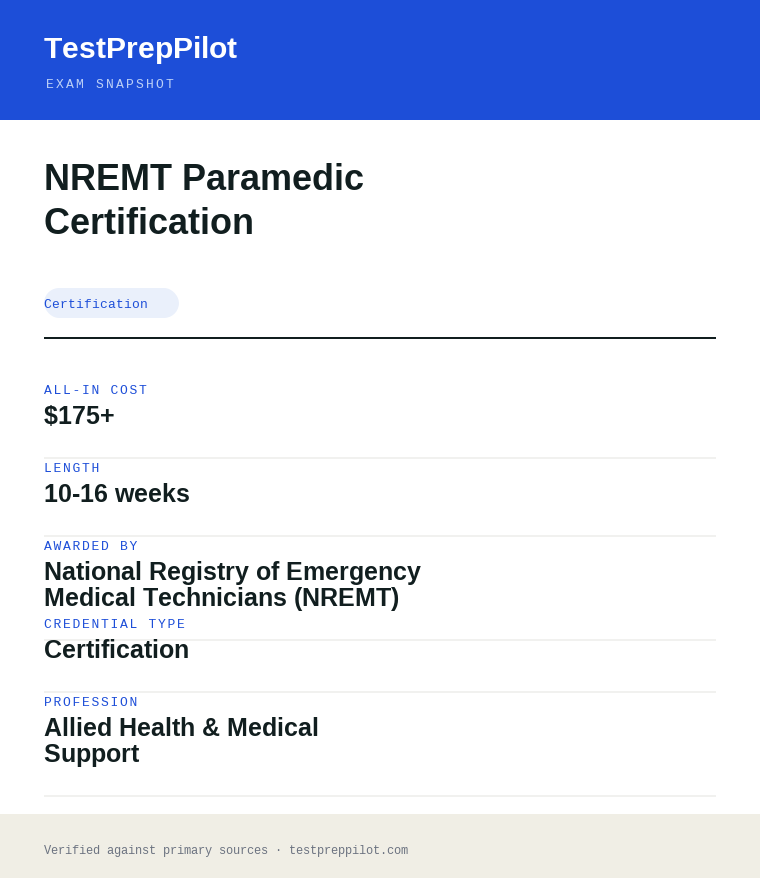
| Type | Certification |
| Profession | Allied Health & Medical Support |
| Specialty | EMS |
| Awarded by | National Registry of Emergency Medical Technicians (NREMT) |
| Difficulty | Hard |
| Typical prep time | 10-16 weeks |
| All-in cost | $175+ |
| Eligibility | Paramedic program graduation |
| Delivery | Pearson VUE or OnVUE |
| Psychomotor | Discontinued July 2024 |
| Retake | 15-day wait; repay $175 |
| Validity | 2 years; renew by CE or exam |
| Scope | National / Multi-state |
Real questions
Frequently asked questions about the NREMT Paramedic Certification
How hard is the NREMT Paramedic?
It is the hardest NREMT exam. The 3.5-hour adaptive test with clinical-judgment scenarios rewards deep ALS mastery; most candidates study 10-16 weeks.
How long should I study?
Plan 10-16 weeks using full-length timed practice exams and scenario drills across all ALS domains.
Does the Paramedic certification expire?
Yes, every two years, renewed by CE through the National Continued Competency Program or by re-examination.
Is the NREMT Paramedic worth it?
It is required for paramedic licensure in nearly every state and is the top EMS credential, so it is essential for the career.
What if I fail?
Retest after a 15-day wait by reapplying and paying $175; after three failures, remedial training may be required before more attempts.
In short
Is the NREMT Paramedic Certification worth it?
- Computer-adaptive 110-150 questions, 3.5 hours; $175
- Validates full ALS scope
- No psychomotor exam since July 2024
- Pass at scaled 950 / 1500
Same awarding body
What other credentials does National Registry of Emergency Medical Technicians (NREMT) award?
Worth comparing
How does the NREMT Paramedic Certification compare with similar credentials?
Trust
Where does this information come from?
Everything above is taken from the awarding body's own published material. Fees, question counts and domain weights are revised regularly — check the official page before you pay.
Research confidence: high · Last reviewed 2026-08