Admissions & Academic Testing • Exam
ACCUPLACER Advanced Algebra and Functions
The top ACCUPLACER math test: factoring, functions, logarithms and trigonometry in 20 adaptive questions.
Researched and maintained by TestPrepPilot Editorial BoardCollege readiness & admissions assessments desk · Figures last verified August 2026
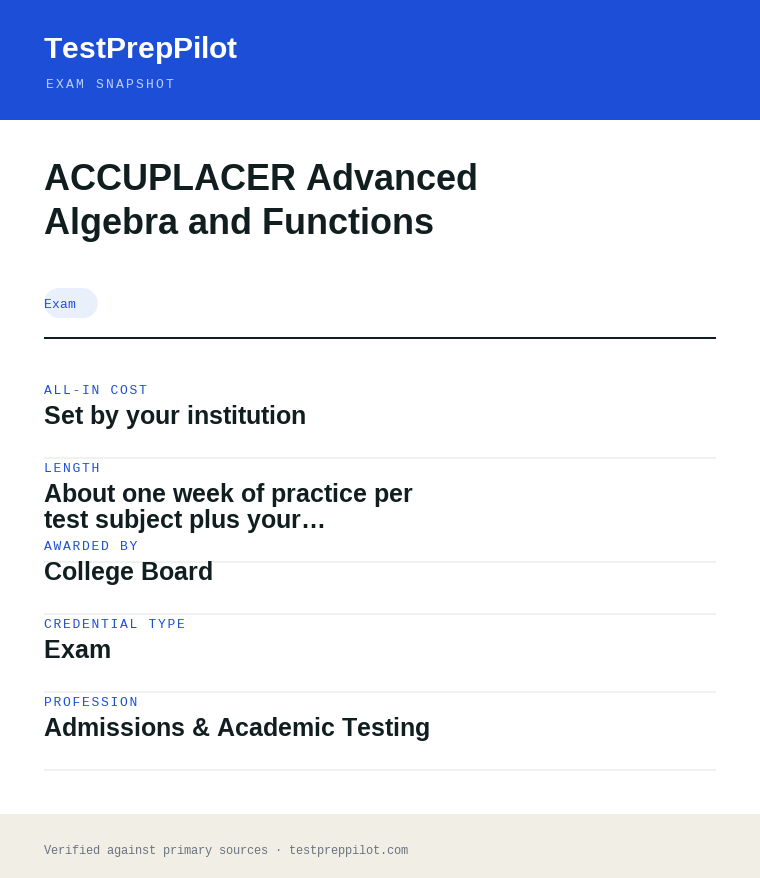
The short version
What is the ACCUPLACER Advanced Algebra and Functions and is it worth it?
ACCUPLACER Advanced Algebra and Functions is a 20-question computer-adaptive test scored 200-300 with no pass mark; your college sets the cut score for courses such as precalculus. It covers eleven categories from Linear Equations to Trigonometry. Book it through your college testing office, which also sets the student price and retest fee.
- Eleven official content categories are published, so you can study exactly what is tested, including Factoring, Quadratics, Functions and Trigonometry.
- Score bands are public: a 271-300 reflects fluency with function notation for transformations, trigonometric ratios in the unit circle, inverse functions and logarithmic expressions.
- An on-screen calculator is built into some questions, so you do not need to bring a handheld calculator.
- College Board lists no time limit and recommends a retest no sooner than 14 days after the first attempt.
What is it?
What exactly is the ACCUPLACER Advanced Algebra and Functions?
The top ACCUPLACER math test: factoring, functions, logarithms and trigonometry in 20 adaptive questions.
The ACCUPLACER Advanced Algebra and Functions test has 20 adaptive questions, no listed time limit and a 200-300 scaled score. It is the highest of the five ACCUPLACER placement tests and spans eleven published content categories, from Linear Equations and Factoring to Polynomial Equations, Exponential and Logarithmic Equations and Trigonometry. Colleges use the score to decide whether a student can start in precalculus-level or STEM-track math, and each college sets its own cut score because College Board publishes none. It sits above Quantitative Reasoning, Algebra, and Statistics and Arithmetic.
The path in brief
- Ask your college whether AAF is part of your placement
- Download the official practice materials and note your weak categories
- Book an in-person or remote session
- Take the 20-question adaptive test
- Compare your 200-300 score with the college placement table
Before you book
Who is eligible to sit the ACCUPLACER Advanced Algebra and Functions?
College Board sets no eligibility rules for ACCUPLACER tests. The institution that bought the test units decides who takes Advanced Algebra and Functions, how it is combined with the Quantitative Reasoning, Algebra, and Statistics result, and whether other measures such as high school grades can override a score.
Who it is for: Students headed for precalculus, calculus or other STEM-track math who need a college placement score.
The test itself
What is the format of the ACCUPLACER Advanced Algebra and Functions?
The ACCUPLACER Advanced Algebra and Functions is administered by ACCUPLACER (College Board), delivered by colleges, schools and approved test centers in person or by remote proctoring and runs No time limit listed by College Board; completed in one sitting or saved with Save and Finish Later and contains 20 multiple-choice questions in the standard adaptive form (College Board does not disclose how many pretest items are embedded; they do not affect your score) questions.
| Administered by | ACCUPLACER (College Board), delivered by colleges, schools and approved test centers in person or by remote proctoring |
|---|---|
| Questions | 20 multiple-choice questions in the standard adaptive form (College Board does not disclose how many pretest items are embedded; they do not affect your score) |
| Time limit | No time limit listed by College Board; completed in one sitting or saved with Save and Finish Later |
| Pass mark | No pass or fail score; scaled 200-300 and each college sets its own placement cut scores |
| Exam fee | Not published by College Board; your institution sets the student price and any retest fee |
| Format | Computer adaptive; all items are discrete multiple choice; on-screen calculators appear on some questions |
Content outline
What topics are on the ACCUPLACER Advanced Algebra and Functions?
The ACCUPLACER Advanced Algebra and Functions covers 11 content domains.
No percentage weights are listed for these domains here, so the outline is shown as structure only. Check the certifying body's published outline before allocating study time.
- Linear Equations
Creating and solving linear equations in one or two variables, inequalities and systems of two linear equations. Category weights are not published.
- Linear Applications and Graphs
Real-life linear models, elementary linear functions, graphing lines, parallel and perpendicular lines.
- Factoring
Factoring methods applied to quadratics, cubics and polynomials.
- Quadratics
Creating and solving quadratic equations by factoring or the quadratic formula, and systems that involve a quadratic.
- Functions
Function notation, evaluating linear and quadratic functions, graphing and interpreting functions in context.
- Radical and Rational Equations
Domain and range, graphing and simplifying radical and rational expressions.
- Polynomial Equations
Creating, solving and graphing polynomial equations and functions.
- Exponential and Logarithmic Equations
Creating, solving, graphing and interpreting exponential and logarithmic functions.
- Geometry Concepts for Algebra 1
Area, perimeter and volume expressions, distance formula, Pythagorean theorem and transformations.
- Geometry Concepts for Algebra 2
Volume of non-prism objects, intersecting line theorems, triangle similarity and congruency, circle equations.
- Trigonometry
Right-triangle trigonometry, radians and arc length, trigonometric equations, Law of Sines and Law of Cosines.
Study materials
Which study guide should you use for the ACCUPLACER Advanced Algebra and Functions?
Start with the exam sponsor's official content outline. If you also want one structured resource to work through, these are the Mometrix titles that match this exam.
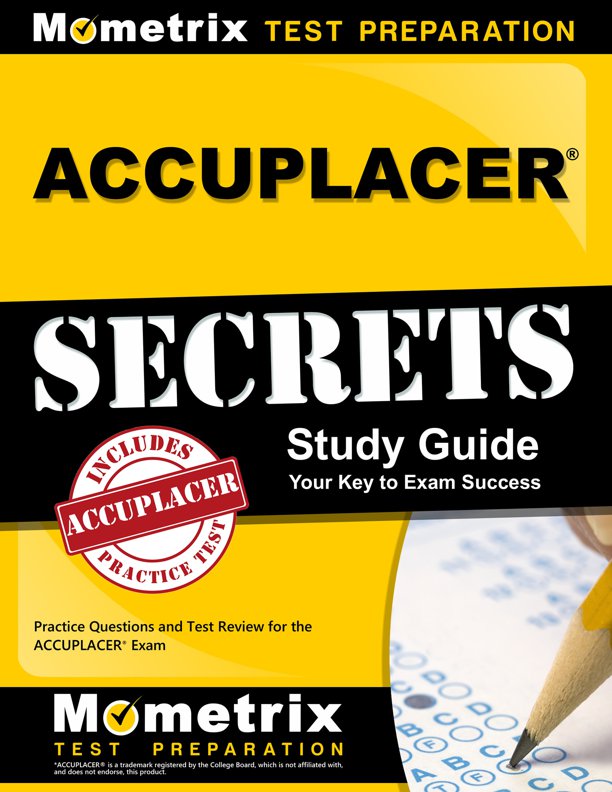
Affiliate links We may earn a commission if you buy through these links, at no extra cost to you. Mometrix has no say in what our exam guides cover. How we make money.
Money & time
How much does the ACCUPLACER Advanced Algebra and Functions cost?
For the ACCUPLACER Advanced Algebra and Functions, the exam fee is Not published by College Board; your institution sets the student price and any retest fee; the all-in cost is typically Set by your institution; most candidates spend About one week of practice per test subject plus your institution's scheduling time preparing.
Cost breakdown
| Test fee charged to the student | Set by your institution; College Board publishes no student price |
|---|---|
| Retest fee | Set by the institution; College Board recommends waiting 14 days before the first retest |
| Official practice materials from College Board | Downloadable from the ACCUPLACER site |
| Typical total | Set by your institution; College Board publishes no student price |
Institutions buy ACCUPLACER test units from College Board and decide whether to pass the cost to students, so confirm the price and retest fee with the testing office before you book.
Timeline
- Contact the testing office and book a session Days to a few weeks, set by the institution
- Review the eleven categories and practice with official materials College Board suggests at least one week of practice per test subject
- Take the adaptive test No time limit listed by College Board; one sitting
- Read the score report and ask about retest or multiple-measures review Retest earliest 14 days after the first attempt (College Board recommendation)
Typical prep: About one week of practice per test subject plus your institution's scheduling time
The path
How do you register for the ACCUPLACER Advanced Algebra and Functions?
- 1
Find out which College Board test your school or college requires
AP exams are ordered by your school, and ACCUPLACER tests are bought by the institution that will place you, so the first step is to ask your AP coordinator or the college testing office which test applies. ACCUPLACER placement tests are Reading, Writing, Arithmetic, Quantitative Reasoning, Algebra, and Statistics, Advanced Algebra and Functions, and the WritePlacer essay.
- Ask the admissions or testing office which ACCUPLACER tests your placement needs
- Ask your AP coordinator which AP exams your school orders
- Ask whether your institution accepts multiple measures such as high school GPA
College Board does not publish a student price for ACCUPLACER because institutions buy test units and set what students pay.
- 2
Sign in to a College Board account and, for AP, register through your schoolOrder by November 13, 2026 to avoid the late fee
AP students join their course sections with a College Board account and the school's AP coordinator orders the exams. For the 2026-27 year, the order deadline for full-year and fall courses is November 13, 2026, and orders placed from November 14, 2026 through March 12, 2027 add a $40 late-order fee per exam.
- Create or sign in to your College Board account
- Join your AP class section using the code from your teacher
- Confirm your exam order and payment with the AP coordinator before the deadline
Unused or canceled exams after the November 13 deadline carry a $40 per-exam fee.
- 3
Book an ACCUPLACER session with the institution or an approved proctor
ACCUPLACER can be given in person at a college or test center, remotely through an approved remote proctoring vendor, or through a video conference with a certified proctor. Remote testing requires a private quiet room, a stable internet connection, a computer and a webcam, and the proctor checks your ID next to your face and scans the room on camera.
- Choose in-person or remote testing with the institution
- Check that your computer, webcam and room meet the remote rules if testing at home
- Ask about any accommodation request deadline
- 4
Bring acceptable photo ID on test day
For ACCUPLACER, acceptable photo ID includes a driver's license, state or federal ID, military ID, middle school, high school or college ID, a U.S. or foreign passport with the name in the Western alphabet, a tribal ID, or a naturalization card or certificate of citizenship. Student IDs must show your name and a recognizable photo and must be validated before testing.
- Check the ID list on the Get Ready for Test Day page
- Leave phones, tablets, watches, food and drink outside the testing room
Physical calculators are not allowed on any ACCUPLACER math test unless an approved accommodation allows one; an on-screen calculator appears on some questions.
- 5
Test, then read your score report and plan any retest
Placement tests report a 200-300 scaled score and the essay reports a 1-8 holistic score. AP exams report a 1-5 score after the May exam window. For ACCUPLACER, College Board recommends a retest no sooner than 14 days after the first attempt and a third attempt only after 90 days, but your institution may set its own rule.
- Compare your score band with the college placement table
- Ask about multiple-measures review if you disagree with a placement
- Send AP scores to colleges through your College Board account
The fine print
What are the retake and renewal rules for the ACCUPLACER Advanced Algebra and Functions?
- Proctoring & delivery
- ACCUPLACER placement tests are computer adaptive and delivered online, in person or through approved remote proctoring or video-chat proctoring. AP Biology is a hybrid digital exam in which students answer multiple-choice questions and view free-response questions in the Bluebook app and handwrite free-response answers in paper booklets at school.
- Retake policy
- ACCUPLACER: College Board recommends a first retest 14 days after the initial test and a second retest only after 90 days, then 30-day gaps, but institutions may set their own policy, and the recommendation is mandatory for Ability to Benefit testing. AP: each exam is given once a year in May, so a retake means sitting the exam again the following year.
- Score reporting
- ACCUPLACER multiple-choice placement tests are scored on a 200-300 scale in seven bands (200-220, 221-230, 231-240, 241-250, 251-260, 261-270, 271-300). WritePlacer essays are scored 1-8. AP exams are scored 1-5, where 5 is extremely well qualified, 4 very well qualified, 3 qualified, 2 possibly qualified and 1 no recommendation.
- Recertification
- Neither ACCUPLACER scores nor AP scores expire as credentials, but colleges set how long they accept a placement score, and they decide which AP scores earn credit. There are no continuing education requirements. Use the AP credit policy search tool on the AP Students site to check a specific college.
- Refunds & rescheduling
- AP exam fees follow the school's order: the 2026-27 base fee is $99 per exam at U.S. schools (U.S. territories, Canada and DoDEA schools included) and $129 at other schools, with a $37 College Board fee reduction for eligible students. Exams canceled in AP Registration and Ordering after November 13 and by March 12 incur a $40 unused or canceled fee. ACCUPLACER refunds depend on the institution.
Context
College Board AP and ACCUPLACER compared
| Test family | Who arranges it | Fee | Score and use | Typical prep time | |
|---|---|---|---|---|---|
| AP exams (e.g. AP Biology) | School AP coordinator | $99 per exam (2026-27, U.S. schools); $129 elsewhere; $37 fee reduction for eligible students | 1-5; colleges decide credit and placement | A full school year of coursework | |
| ACCUPLACER placement tests | College, school or approved test center | Set by the institution; College Board publishes no student price | 200-300 scaled; colleges set cut scores | College Board suggests at least one week of practice per test subject |
What it pays
How much does this credential pay?
Placement outcome, not pay: your ACCUPLACER result decides whether you take credit-bearing or remedial math — the single strongest course-taking predictor of graduation
The direct answer is that ACCUPLACER does not lead to a salary the way a licensing exam does, and no BLS occupation corresponds to it — so the honest salary story is about what the placement result unlocks. The exam decides, usually before your first semester, whether you enroll directly in college-level mathematics or are assigned to a remedial (developmental) course sequence that carries no degree credit. That assignment matters enormously for earnings because it changes whether you graduate and how long it takes. Research published by the Community College Research Center (CCRC) has repeatedly found that a large share of community-college entrants are placed into developmental coursework — historically roughly two-thirds of students across the colleges CCRC studied — and that students who skip remediation are substantially more likely to complete a credential. The baseline for interpreting all of this is that the BLS reported a May 2024 median annual wage of $49,500 across all occupations, while workers with an associate degree earn meaningfully more than those with a high school diploma only. In practical terms: a student placed into one or two semesters of non-credit math is more likely to drop out before earning anything, while a student who tests into college-level math and clears an associate degree moves toward the higher half of the distribution. Colleges increasingly use multiple measures — high school GPA and course history alongside the placement score — precisely because a single cut score misplaces students at both margins. The practical takeaway for a candidate is to treat the test as a high-stakes placement decision, prepare deliberately, and if the first result assigns you to remediation, ask about retest policy and multiple-measures review rather than accepting the placement silently.
| Measure | Figure | Source / note |
|---|---|---|
| Reference: median wage, all occupations | $49,500 | BLS Occupational Outlook Handbook, May 2024 |
| Reference: associate degree holders, median weekly earnings | $1,059 | BLS Education Pays, 2023 data ($55,068/yr equivalent) |
| Reference: high school diploma only, median weekly earnings | $899 | BLS Education Pays, 2023 data ($46,748/yr equivalent) |
| The exam itself | No direct occupation | A placement test, not a credential of record for a job |
Job growth.BLS does not project growth for a placement test; relevant projections follow the occupations students are placed toward.
Your odds
What are the pass rates?
There is no official pass rate — ACCUPLACER is a scaled placement instrument, and the only numbers that matter are your college’s cut scores
The core fact to internalize is that ACCUPLACER has no pass/fail threshold at the national level, so any claim of a "pass rate" is describing something that does not exist. Each subtest is scored on a scale of 200 to 300, and every college sets its own cut scores that determine placement into developmental math, college-level math, or a specific course such as college algebra or precalculus. Two students can receive identical scores at different institutions and be placed differently, which is exactly why vendors of practice materials cannot quote a defensible pass rate. What is published is the score scale and, at many schools, the placement table that maps score bands onto course assignments; these tables are public on most college websites but differ by campus. The practical implication is that your preparation target must be defined locally: ask your specific institution for its placement chart and aim comfortably above the cut score for the course you want, not for an abstract passing line. Because the test is adaptive in the Advanced Algebra and Functions (AAF) subtest — the computer selects later items based on earlier answers — your score reflects a statistical estimate of ability rather than a simple percentage correct. Colleges also vary in retake policy: some allow immediate retests, others impose a waiting period or charge a retake fee, and some let you contest the placement through a multiple-measures review using high school GPA or course transcripts. Treat the official cut-score table from your own college as the only meaningful benchmark, and build your practice around exceeding the top of the band that gates you into credit-bearing coursework.
Read this before quoting the number.No official pass rate exists; only per-college cut scores are published, and they vary by institution.
Your schedule
How long should I study for it?
15-25 hours (AAF subtest) of focused study
Plan for two to four weeks of focused review and roughly 15 to 25 total study hours for the AAF subtest, which is the version of ACCUPLACER most commonly used for STEM- and math-track placement. The AAF is a 20-question adaptive test with no time limit by default (most colleges allow up to two hours), covering algebraic expressions, linear equations and inequalities, quadratics, geometry, and trigonometry. The dominant mistake students make is studying advanced topics they do not need: if your target is a college algebra or precalculus placement, most of the test rewards solid command of algebra fundamentals — fractions, exponents, factoring, linear functions, and word-problem setup — not calculus preview. Week one should be a diagnostic pass: take one official College Board practice test, record which question types you miss, and map each miss to a skill in the published AAF test description. Week two is targeted skill work on your weakest two or three areas, using the official practice question bank (which is free on the College Board site) and limiting drills to those topics. Week three, if you have it, is for full-length timed practice and stamina work — even without a clock on the real exam, practicing in 90-minute blocks keeps you fresh. Week four is a light taper: one more official practice test, review of error logs, and rest. Because the exam is adaptive, the single most useful habit is learning to move on quickly from items you cannot solve — time spent stuck on one item degrades the rest of the session. Budget the study hours in proportion to your diagnostic score: someone scoring near the bottom of the AAF scale should expect the full 25 hours, while a student already clearing college-algebra-level items may need only 8 to 12.
- Week 14
Diagnostic baseline
- Take the official College Board AAF practice test
- Log every missed item by skill
- Map misses to the published test description
- Week 28
Targeted skill repair
- Drill your 2-3 weakest skill areas from the official question bank
- Re-test those skills only
- Begin word-problem setup practice
- Week 38
Full-length stamina
- Two full-length practice sessions in one sitting
- Review error log patterns
- Confirm your college’s cut scores
- Week 44
Taper and confirm
- One final official practice test
- Light review of error log
- Check retest and multiple-measures policy at your school
Adjusting the pace
Quantitative Reasoning, Algebra & Statistics (QAS).A shorter 20-item adaptive subtest used for general placement; a lighter version of the same skill set with less trigonometry.
Reading & Writing (Next-Generation).Companion placement subtests for English; preparation focuses on comprehension and grammar, not math.
How to study
How do I prepare most effectively?
The strategy that reliably moves AAF scores is "skill-mapped practice on official items, followed by adaptive-order simulation," and the single highest-leverage move is obtaining your college’s placement table before you study. Most candidates waste hours reviewing material far above or below their actual band; the placement table tells you exactly which band you need to clear, so you can tune difficulty. Because the test is adaptive, practice in the same mode: use platforms that feed progressively harder items after correct answers, because the real exam punishes the habit of dwelling on items you have already answered. A second proven approach is translating word problems into algebraic setup language early — most AAF items are story problems, and candidates who practice writing equations from prose outperform those who jump straight to computation. Third, keep an error log organized by the official skill categories (expressions, equations, quadratics, geometry/trig) rather than by question number; patterns show up by category. Fourth, learn the arithmetic shortcuts that appear on every version — exponent rules, factoring special products, and unit handling — because these recur across adaptive branches. Fifth, treat the first five items as the most consequential: on an adaptive test, early answers set the difficulty ceiling, so slow down at the start. Finally, never leave preparation until the week of registration; placement happens at orientation and retakes are often limited, so the cost of under-preparing is a semester or more of non-credit coursework.
Get the placement table first
Obtain your college’s cut scores before studying so you calibrate difficulty to your actual target band.
Practise adaptively
Use adaptive-order practice so the pacing and difficulty progression match the live test experience.
Write the algebra out of word problems
Most items are story problems; drill translating prose into equations before computing.
Keep a skill-category error log
Log misses by published skill category, not question number, so patterns surface.
Protect the opening items
Adaptive tests set difficulty from early answers; slow down on the first several items.
What to buy
Which study resources are worth paying for?
The best-value ACCUPLACER preparation is almost entirely free, because College Board publishes official practice questions and a full sample test that mirror the adaptive engine better than any third-party bank. The comparison below separates official resources from commercial practice banks and live tutoring, with prices current as of this review. Note that College Board periodically updates subtest names and the adaptive interface, so always verify that a resource references the current "Advanced Algebra and Functions" naming rather than the retired "College-Level Math" subtest.
| Resource | Price | Format | Best for |
|---|---|---|---|
| College Board official practice questions & sample test | Free | Web-based practice + downloadable PDF | The closest match to the real adaptive engine |
| College Board Next-Generation sample questions | Free | PDF question sets | Skill-by-skill review |
| Khan Academy algebra & geometry courses | Free | Video + practice | Rebuilding weak fundamentals |
| ACCUPLACER prep books (e.g. Mometrix, Barron’s) | ~$25-45 | Printed book + online bank | Structured review for self-studiers |
| Commercial practice apps with adaptive mode | ~$10-30/mo | Mobile drills | Daily short practice sessions |
| College readiness tutors (local or online) | ~$40-90/hr | 1:1 sessions | Candidates stuck after self-study |
Prices are approximate and dated to this review; College Board official materials are free and updated with the current subtest set.
Avoid these
What mistakes do candidates most often make?
The most expensive mistake candidates make is studying the wrong difficulty level — drilling calculus-style content when their target band is solidly algebraic — and the second is ignoring their college’s cut scores entirely. A close third is treating ACCUPLACER like a knowledge test when it is an adaptive placement instrument: pacing matters, early items matter disproportionately, and dwelling on one hard item can cap the whole session. Candidates also routinely underestimate the word-problem share of AAF and arrive unprepared to translate prose into equations, which is the skill most rewarded on the exam. Another recurring error is registering at orientation cold, having done zero practice, and then accepting a developmental placement without asking about retake policy or multiple-measures review. Finally, many students fail to confirm whether their school even uses ACCUPLACER or a competing placement test, or whether the college has moved to GPA-based multiple measures — preparing for the wrong instrument is the most avoidable failure mode of all.
✕Studying the wrong difficulty band
✓Get your college’s placement table and drill exactly the skills in your target band before anything else.
✕Ignoring the adaptive nature
✓Practise with adaptive-order items and slow down on the opening questions, which set the difficulty ceiling.
✕Skipping word-problem translation practice
✓Drill writing equations from prose; most AAF items are story problems.
✕Registering cold at orientation
✓Take one official practice test at least two weeks before placement and log your misses.
✕Assuming every school uses ACCUPLACER
✓Confirm the actual placement instrument and whether the college uses multiple measures (GPA + scores).
What you'll face
What question types will I see?
The AAF subtest contains 20 adaptive multiple-choice questions with no default time limit, drawn from four skill categories in the published test description: algebraic expressions and equations, linear and quadratic functions, geometry and trigonometry, and word problems that require setting up and solving equations. Because the test is computer-adaptive, question difficulty adjusts to your performance: correct answers raise the difficulty of the next item, and incorrect answers lower it, so the question set each candidate sees is unique. College Board describes each item as a standard multiple-choice format with four options. The highest-yield preparation is knowing the four categories and the item style — calculation-light, reasoning-heavy items dominate the upper branch of the scale. The samples below are editor-written illustrations of the published blueprint, not live exam items.
Simplify expressions, solve linear and quadratic equations, apply exponent and factoring rules.
Interpret graphs, find intercepts and vertices, model real-world relationships.
Plane geometry, right-triangle ratios, basic trigonometric definitions.
Translate prose into equations and solve; the item type most candidates under-practise.
Try these
Q1If 3x + 7 = 22, what is the value of x?
Answer:B
Subtract 7 from both sides: 3x = 15, then divide by 3 to get x = 5.
Q2A rectangle has a length of (2x + 3) and a width of x. If the area is 65 square units, which equation could be used to find x?
Answer:A
Area is length times width: x(2x + 3) = 65, which expands to 2x² + 3x = 65.
Q3In a right triangle, one leg is 6 and the hypotenuse is 10. What is the length of the other leg?
Answer:B
By the Pythagorean theorem, the missing leg is √(10² − 6²) = √(100 − 36) = √64 = 8.
Samples are editor-written illustrations of the published blueprint, not live exam items.
The big day
What should I expect on exam day?
ACCUPLACER is administered at your college or a testing center, typically during orientation or at a scheduled placement session, and is untimed by default — most colleges allow up to two hours per subtest, so pacing pressure is minimal but stamina still matters. The core rules are straightforward: bring a government-issued photo ID and your college-issued registration information, leave calculators at home (an on-screen calculator is built into applicable math questions), and expect to be asked to store personal items. There is no essay on the AAF, no cost at most colleges (the test is typically free at the enrolling institution, though retakes may carry a fee), and you will usually see your placement result before you leave. The biggest behavioural trap is finishing in a rush out of habit — there is no clock advantage to speed on an untimed test, so work deliberately, especially on the opening adaptive items. After the session, your score report shows scaled scores and the placement recommendation; if the placement assigns you to developmental coursework and you believe it is wrong, immediately ask about the retest schedule and any multiple-measures review process using your high school record. The single most useful thing to bring is the placement table you studied against, so you can interpret your result on the spot.
Bring
- Government-issued photo ID
- College registration/confirmation info
- Confirmation of your target placement band
- Patience for an untimed, adaptive session
Leave at home
- Calculator (on-screen one is provided where applicable)
- Phone and smartwatch (stored with testing staff)
- Notes or study materials
How the day runs
Rules in the room
- Untimed by default — speed earns nothing
- Photo ID required
- Personal items and devices stored
- Retakes may require a waiting period or fee
Afterwards.Your scaled score maps to your college’s placement table; a low placement is not final — check retest windows and multiple-measures review, then re-take or appeal before enrolling in non-credit coursework.
Reference
What are the key facts about the ACCUPLACER Advanced Algebra and Functions?
ACCUPLACER Advanced Algebra and Functions is a exam credential; awarded by College Board; the exam fee is Not published by College Board; your institution sets the student price and any retest fee; typical preparation is About one week of practice per test subject plus your institution's scheduling time.
| Credential | ACCUPLACER Advanced Algebra and Functions |
|---|---|
| Abbreviation | AAF |
| Type | Exam |
| Profession | Admissions & Academic Testing |
| Specialty | College Placement |
| Awarded by | College Board |
| Difficulty | Challenging |
| Typical prep time | About one week of practice per test subject plus your institution's scheduling time |
| All-in cost | Set by your institution |
| Test length | 20 questions in the standard adaptive form; the COMPANION (non-adaptive) accommodated forms are longer |
| Score bands | 271-300 band adds evaluating inverse functions and logarithmic expressions; 221-230 starts with factoring quadratics |
| Score scale | Multiple-choice placement tests are scored 200-300 in seven bands; no one passes or fails, and colleges set their own cut scores |
| Time limit | College Board lists no time limit for ACCUPLACER tests; your test center confirms its session rules |
| Retest | College Board recommends 14 days before a first retest and 90 days before a second, then 30-day gaps; institutions may set their own rule |
| Delivery | Computer adaptive, in person or remotely proctored; students must answer every question |
| ID | Photo ID such as a driver's license, passport, military ID or school ID validated before testing |
| Scope | National / Multi-state |
Real questions
Frequently asked questions about the ACCUPLACER Advanced Algebra and Functions
How many questions are on the ACCUPLACER Advanced Algebra and Functions test?
The standard computer-adaptive form of ACCUPLACER Advanced Algebra and Functions has 20 multiple-choice questions, according to the 2025-26 ACCUPLACER Program Manual. College Board says new questions are pretested at undisclosed positions and do not affect your score, but it does not publish how many of the 20 are scored versus pretest items.
What is a good score on ACCUPLACER Advanced Algebra and Functions?
A good score is the one your college requires for the course you want, because College Board publishes no pass mark and each college sets its own cut score. Scores run 200-300 in seven bands. The 271-300 band reflects fluency with logarithms, inverse functions and unit-circle trigonometry, while 221-230 starts with factoring quadratics.
Is the ACCUPLACER Advanced Algebra and Functions test hard?
It is the most advanced ACCUPLACER math test, and it is adaptive, so correct answers lead to harder items on factoring, functions, logarithms and trigonometry. Difficulty depends on your preparation and on the course you are targeting. Practicing the eleven published categories with official materials is the most direct way to be ready for it.
Can I use a calculator on ACCUPLACER Advanced Algebra and Functions?
You cannot bring a handheld calculator, but some questions provide an on-screen calculator marked by an icon in the top-right corner of the screen. Physical calculators are not allowed on any ACCUPLACER math test unless an approved accommodation permits one. Practice with the calculator on the official student portal before test day.
How long do I have to finish ACCUPLACER Advanced Algebra and Functions?
College Board lists no time limit for ACCUPLACER tests, and the test-day page says most are untimed, but your test center confirms its own rules. Because the test is adaptive, you must answer every question, and you cannot skip ahead. Work carefully rather than fast, since there is no speed bonus.
Can I retake ACCUPLACER Advanced Algebra and Functions?
Yes, if your institution allows it. College Board recommends a retest at least 14 days after the first attempt and a second retest only after 90 days, then 30-day gaps. Institutions can set stricter or looser rules, so ask the testing office about its retest policy and fee before you register for another session.
How much does ACCUPLACER Advanced Algebra and Functions cost?
College Board does not publish a student price. Institutions buy ACCUPLACER test units and decide what, if anything, to charge students, including for retests. Ask your college testing office for the fee, whether remote proctoring costs extra, and whether a previous score from another college can be accepted.
Do College Board test scores expire?
College Board does not put an expiry date on ACCUPLACER or AP scores, but colleges decide how long they accept a placement score and which AP scores earn credit. Ask the testing office how recent an ACCUPLACER score must be, and use the AP credit policy search tool to see what each college grants for each AP score.
Who sets the passing score on an ACCUPLACER test?
No one passes or fails an ACCUPLACER test. College Board reports a 200-300 scaled score and each college sets its own cut scores for placing students into courses. The only College Board passing scores are the Ability to Benefit values for federal financial aid: Reading 233, Writing 235 and Arithmetic 230.
How much does an AP exam cost?
The base fee for 2026-27 is $99 per AP exam at schools in the U.S., U.S. territories, Canada and DoDEA schools, and $129 at schools elsewhere. Eligible students get a $37 College Board fee reduction. Schools can add their own charges, and late orders between November 14, 2026 and March 12, 2027 add a $40 fee.
In short
Is the ACCUPLACER Advanced Algebra and Functions worth it?
- ACCUPLACER Advanced Algebra and Functions has 20 adaptive multiple-choice questions and no time limit listed by College Board.
- Scores run 200-300 in seven bands, and there is no national pass mark; colleges set their own cut scores.
- The content outline has 11 categories, ending with Geometry Concepts for Algebra 2 and Trigonometry.
- College Board recommends waiting 14 days before a first retest and 90 days before a second.
- The student price is set by your institution, not by College Board.
Same awarding body
What other credentials does College Board award?
Worth comparing
How does the ACCUPLACER Advanced Algebra and Functions compare with similar credentials?
Trust
Where does this information come from?
Everything above is taken from the awarding body's own published material. Fees, question counts and domain weights are revised regularly — check the official page before you pay.
- College Board Awarding body
- Official ACCUPLACER Advanced Algebra and Functions exam page Exam page
- College Board certification programme Programme rules
Research confidence: medium · Last reviewed 2026-08