Admissions & Academic Testing • Exam
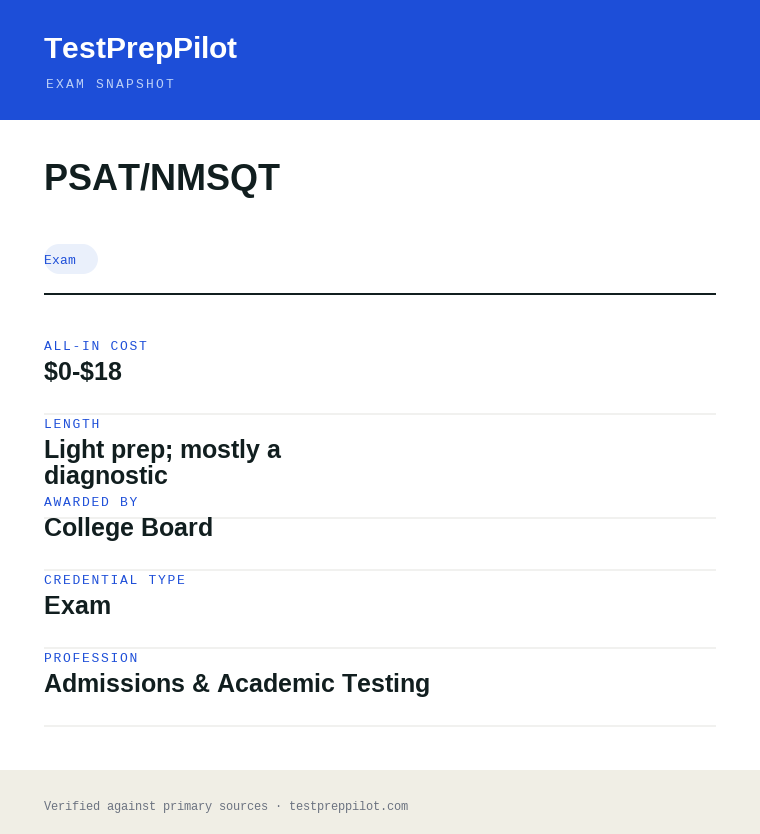
PSAT/NMSQT
The PSAT/NMSQT is the autumn junior-year SAT Suite test that also enters students into the National Merit Scholarship competition.
Researched and maintained by TestPrepPilot Editorial BoardCollege admissions & standardized-testing desk · Figures last verified August 2026
The short version
What is the PSAT/NMSQT and is it worth it?
The PSAT/NMSQT is the autumn SAT Suite test for grades 10 and 11, scored 320 to 1520, that doubles as the National Merit Scholarship qualifying exam; schools administer it, so you register through your counselor.
- The only route into the National Merit Scholarship competition
- Returns the same subscores as the SAT to guide senior-year prep
- Same digital, adaptive 2 hour 14 minute format as the SAT
- Low school price, often free for students through the counselor
What is it?
What exactly is the PSAT/NMSQT?
The PSAT/NMSQT is the autumn junior-year SAT Suite test that also enters students into the National Merit Scholarship competition.
The PSAT/NMSQT, or Preliminary SAT/National Merit Scholarship Qualifying Test, is the SAT Suite assessment taken each autumn by tenth and eleventh graders. It mirrors the digital SAT in format and content but is scored 320 to 1520, and the eleventh-grade sitting is the sole route into the National Merit Scholarship Program, where a high Selection Index can lead to recognition, semifinalist status and scholarship money. Schools order and administer the PSAT/NMSQT rather than students registering individually, and the score report returns the same subscores and cross-test scores as the SAT so students can target prep where it matters before senior year.
The path in brief
- Take the PSAT 10 or PSAT 8/9 earlier for a baseline
- Sit the PSAT/NMSQT in October of grade 11
- Receive your Selection Index and subscore report
- Pursue National Merit recognition if the index qualifies
- Use the report to plan SAT preparation
Before you book
Who is eligible to sit the PSAT/NMSQT?
Who it is for: Tenth and eleventh graders, especially juniors seeking National Merit
The test itself
What is the format of the PSAT/NMSQT?
The PSAT/NMSQT is administered by College Board and runs 2 hours 14 minutes and contains 98 (54 Reading and Writing, 44 Math) questions.
| Administered by | College Board |
|---|---|
| Questions | 98 (54 Reading and Writing, 44 Math) |
| Time limit | 2 hours 14 minutes |
| Pass mark | No pass mark; 320 to 1520 total |
| Exam fee | Set by the school; about $18 list price |
| Format | Digital, adaptive, two modules per section, on Bluebook |
Content outline
What topics are on the PSAT/NMSQT?
The PSAT/NMSQT is weighted across 8 domains; the largest are Math: Algebra (35%), Math: Advanced Math (35%), Reading and Writing: Craft and Structure (28%).
Weightings come from the official exam outline. Study time is best allocated in roughly these proportions rather than evenly across domains.
- Reading and Writing: Information and Ideas 26%
Central ideas, evidence and inference from short passages
- Reading and Writing: Craft and Structure 28%
Vocabulary in context, purpose and cross-text connections
- Reading and Writing: Expression of Ideas 20%
Transitions and rhetorical synthesis
- Reading and Writing: Standard English Conventions 26%
Sentence boundaries, punctuation, agreement
- Math: Algebra 35%
Linear equations, functions, systems and inequalities
- Math: Advanced Math 35%
Quadratics, polynomials, exponential and rational expressions
- Math: Problem-Solving and Data Analysis 15%
Ratios, percentages, statistics and probability
- Math: Geometry and Trigonometry 15%
Area, volume, triangles, circles and right-triangle trigonometry
Study materials
Which study guide should you use for the PSAT/NMSQT?
Start with the exam sponsor's official content outline. If you also want one structured resource to work through, these are the Mometrix titles that match this exam.
Affiliate links We may earn a commission if you buy through these links, at no extra cost to you. Mometrix has no say in what our exam guides cover. How we make money.
Money & time
How much does the PSAT/NMSQT cost?
For the PSAT/NMSQT, the exam fee is Set by the school; about $18 list price; the all-in cost is typically $0-$18; most candidates spend Light prep; mostly a diagnostic preparing.
Cost breakdown
| List price to schools, 2026-27 | $18 |
|---|---|
| Official Digital SAT Prep on Khan Academy | Free |
| Typical total | $0-$18 to the student |
Many schools and districts cover the full fee, so students often pay nothing.
Timeline
- School testing window October, grades 10 and 11
- Score release a few weeks later
- National Merit entry only the grade 11 sitting counts
Typical prep: Light prep; mostly a diagnostic
The path
How do you register for the PSAT/NMSQT?
- 1
Find out which College Board test your school or college requires
AP exams are ordered by your school, and ACCUPLACER tests are bought by the institution that will place you, so the first step is to ask your AP coordinator or the college testing office which test applies. ACCUPLACER placement tests are Reading, Writing, Arithmetic, Quantitative Reasoning, Algebra, and Statistics, Advanced Algebra and Functions, and the WritePlacer essay.
- Ask the admissions or testing office which ACCUPLACER tests your placement needs
- Ask your AP coordinator which AP exams your school orders
- Ask whether your institution accepts multiple measures such as high school GPA
College Board does not publish a student price for ACCUPLACER because institutions buy test units and set what students pay.
- 2
Sign in to a College Board account and, for AP, register through your schoolOrder by November 13, 2026 to avoid the late fee
AP students join their course sections with a College Board account and the school's AP coordinator orders the exams. For the 2026-27 year, the order deadline for full-year and fall courses is November 13, 2026, and orders placed from November 14, 2026 through March 12, 2027 add a $40 late-order fee per exam.
- Create or sign in to your College Board account
- Join your AP class section using the code from your teacher
- Confirm your exam order and payment with the AP coordinator before the deadline
Unused or canceled exams after the November 13 deadline carry a $40 per-exam fee.
- 3
Book an ACCUPLACER session with the institution or an approved proctor
ACCUPLACER can be given in person at a college or test center, remotely through an approved remote proctoring vendor, or through a video conference with a certified proctor. Remote testing requires a private quiet room, a stable internet connection, a computer and a webcam, and the proctor checks your ID next to your face and scans the room on camera.
- Choose in-person or remote testing with the institution
- Check that your computer, webcam and room meet the remote rules if testing at home
- Ask about any accommodation request deadline
- 4
Bring acceptable photo ID on test day
For ACCUPLACER, acceptable photo ID includes a driver's license, state or federal ID, military ID, middle school, high school or college ID, a U.S. or foreign passport with the name in the Western alphabet, a tribal ID, or a naturalization card or certificate of citizenship. Student IDs must show your name and a recognizable photo and must be validated before testing.
- Check the ID list on the Get Ready for Test Day page
- Leave phones, tablets, watches, food and drink outside the testing room
Physical calculators are not allowed on any ACCUPLACER math test unless an approved accommodation allows one; an on-screen calculator appears on some questions.
- 5
Test, then read your score report and plan any retest
Placement tests report a 200-300 scaled score and the essay reports a 1-8 holistic score. AP exams report a 1-5 score after the May exam window. For ACCUPLACER, College Board recommends a retest no sooner than 14 days after the first attempt and a third attempt only after 90 days, but your institution may set its own rule.
- Compare your score band with the college placement table
- Ask about multiple-measures review if you disagree with a placement
- Send AP scores to colleges through your College Board account
The fine print
What are the retake and renewal rules for the PSAT/NMSQT?
- Proctoring & delivery
- ACCUPLACER placement tests are computer adaptive and delivered online, in person or through approved remote proctoring or video-chat proctoring. AP Biology is a hybrid digital exam in which students answer multiple-choice questions and view free-response questions in the Bluebook app and handwrite free-response answers in paper booklets at school.
- Retake policy
- ACCUPLACER: College Board recommends a first retest 14 days after the initial test and a second retest only after 90 days, then 30-day gaps, but institutions may set their own policy, and the recommendation is mandatory for Ability to Benefit testing. AP: each exam is given once a year in May, so a retake means sitting the exam again the following year.
- Score reporting
- ACCUPLACER multiple-choice placement tests are scored on a 200-300 scale in seven bands (200-220, 221-230, 231-240, 241-250, 251-260, 261-270, 271-300). WritePlacer essays are scored 1-8. AP exams are scored 1-5, where 5 is extremely well qualified, 4 very well qualified, 3 qualified, 2 possibly qualified and 1 no recommendation.
- Recertification
- Neither ACCUPLACER scores nor AP scores expire as credentials, but colleges set how long they accept a placement score, and they decide which AP scores earn credit. There are no continuing education requirements. Use the AP credit policy search tool on the AP Students site to check a specific college.
- Refunds & rescheduling
- AP exam fees follow the school's order: the 2026-27 base fee is $99 per exam at U.S. schools (U.S. territories, Canada and DoDEA schools included) and $129 at other schools, with a $37 College Board fee reduction for eligible students. Exams canceled in AP Registration and Ordering after November 13 and by March 12 incur a $40 unused or canceled fee. ACCUPLACER refunds depend on the institution.
Context
College Board AP and ACCUPLACER compared
| Test family | Who arranges it | Fee | Score and use | Typical prep time | |
|---|---|---|---|---|---|
| AP exams (e.g. AP Biology) | School AP coordinator | $99 per exam (2026-27, U.S. schools); $129 elsewhere; $37 fee reduction for eligible students | 1-5; colleges decide credit and placement | A full school year of coursework | |
| ACCUPLACER placement tests | College, school or approved test center | Set by the institution; College Board publishes no student price | 200-300 scaled; colleges set cut scores | College Board suggests at least one week of practice per test subject |
What it pays
How much does this credential pay?
A strong NMSQT score is a scholarship gate: bachelor-degree median weekly earnings were $1,543 in 2024 (BLS)
The PSAT/NMSQT does not certify an occupation, so there is no BLS SOC code that a score directly unlocks. What the test does is sit at the very front of the college-admissions pipeline, and the earnings evidence for completing that pipeline is well documented by BLS. In its Education Pays-style comparisons, BLS reported that in 2024 full-time workers age 25 and older with a bachelor degree earned median weekly wages of $1,543, versus $1,109 for workers with an associate degree and $998 for workers with a high-school diploma alone. Annualized, the bachelor-level median is roughly $80,000, which is the benchmark families and counselors use when weighing the cost of four-year college against early employment. The PSAT/NMSQT itself is scored on a 320-1520 scale, and its most concrete payoff is entry into the National Merit Scholarship Program: roughly the top 1 percent of juniors by Selection Index become National Merit Semifinalists, a designation that many colleges use to award automatic or near-automatic merit scholarships. Because the stakes are scholarship eligibility rather than admission, the honest framing is that the test converts effort into measurable financial aid leverage, and the BLS data show that degree completion is the wage event that follows. BLS classifies workers by job duty and credential held, not by test scores, so no percentile table from College Board maps to a salary figure; the connection runs through college completion.
| Measure | Figure | Source / note |
|---|---|---|
| Bachelor-degree median weekly earnings, 2024 | $1,543 | BLS, workers 25+, full time (cited via BLS Education & earnings comparisons) |
| Associate-degree median weekly earnings, 2024 | $1,109 | BLS, workers 25+, full time |
| High-school diploma median weekly earnings, 2024 | $998 | BLS, workers 25+, full time |
| Median weekly earnings, all education levels, 2024 | $1,168 | BLS, workers 25+, full time |
Job growth.BLS projects overall employment growth of 3 percent from 2024 to 2034 across all occupations; earnings by education remain the relevant comparison for a college-admissions test.
Your odds
What are the pass rates?
The PSAT/NMSQT is not pass/fail; it is scored 320-1520 and used for National Merit eligibility
There is no official pass rate for the PSAT/NMSQT because there is no passing score. College Board reports a scale score from 320 to 1520, and different institutions, districts and scholarship programs use the result differently. The single most consequential use is the National Merit Scholarship Program: every October, roughly 1.5 million juniors take the test, and the top-scoring entrants by Selection Index (Reading + Writing and Language + Math scores, each on a 8-38 scale, doubled) are recognized. Around 50,000 students receive Letters of Commendation, about 16,000 become Semifinalists, and roughly 7,600 become Finalists, from which about 7,000 receive National Merit Scholarships each year. Because the qualifying bar is relative to the national cohort rather than an absolute percentage, no single pass-rate statistic is published or meaningful. For students and parents, the practical score targets come from two sources: the College Board’s percentile tables (a 1000 is roughly the 50th percentile, 1200 roughly the 83rd, 1400 roughly the 97th) and each state’s National Merit cutoff, which varies by roughly 20-30 Selection Index points from year to year. Scores are available to students within two to four weeks, and College Board has a score-reporting timeline that students should check rather than assume. The honest summary is that this test is scored, ranked and percentile-reported, and the National Merit cutoffs are the de facto thresholds students train toward.
Read this before quoting the number.College Board does not publish a pass rate; eligibility for National Merit is cohort-relative.
Source: College Board PSAT/NMSQT scoring and National Merit info
Your schedule
How long should I study for it?
30-40 hours over 8 weeks of focused study
Because the PSAT/NMSQT mirrors the digital SAT structure, the most efficient preparation is a compact version of SAT preparation. The test runs about 2 hours 14 minutes and contains 98 Reading and Writing questions across two 32-minute modules and 54 Math questions across two 35-minute modules, all delivered on the Bluebook app with adaptive section routing. Reading and Writing is worth roughly half the score and spans Information and Ideas, Craft and Structure, and Expression of Ideas, with vocabulary-in-context items carrying heavy weight. Math spans Algebra, Advanced Math, Problem-Solving and Data Analysis, and Geometry and Trigonometry, with a calculator allowed throughout and the Desmos graphing calculator built into Bluebook. A realistic plan is 30-40 hours across 8 weeks for a student starting from an 800-1000 baseline. Weeks 1-2 establish baseline: take the official full-length practice test in Bluebook, log every error by skill, and build a personal question bank. Weeks 3-5 drill the two highest-yield areas first (typically linear equations and standard English conventions), using the free Khan Academy Official Digital SAT Prep that College Board partners with. Weeks 6-7 shift to full timed sections and pacing drills, because adaptive routing punishes slow first modules. Week 8 is review: two full timed tests, error retakes, and sleep/warm-up routine practice. Students who will be juniors should time the October sitting; sophomores taking PSAT 10 or NMSQT are using it as a rehearsal, and College Board’s practice tests are the only materials that perfectly match the interface.
- Weeks 1-28
Baseline and diagnosis
- Take official Bluebook practice test
- Categorize errors by skill and module
- Create a targeted question list
- Weeks 3-514
High-yield skill drills
- Linear equations and word problems
- Standard English conventions
- Craft and Structure reading items
- Weeks 6-710
Timed sections and pacing
- Full Reading/Writing modules under time
- Full Math modules under time
- Review adaptive second-module difficulty
- Week 88
Full tests and review
- Two full timed practice tests
- Retake every missed item
- Plan October test-day logistics
Adjusting the pace
Sophomore rehearsal.Students taking the NMSQT as sophomores should treat it as interface practice; National Merit eligibility only applies to the junior-year October sitting.
Accommodations.Students with documented needs apply through the College Board SSD portal; requests must be submitted well before the registration deadline.
How to study
How do I prepare most effectively?
The single most effective preparation move for the PSAT/NMSQT is to use only official College Board materials, because the test is fully digital and adaptive, and third-party banks often misrepresent the adaptive routing. Strategy one: master the Bluebook interface before the first official practice test, including the annotation tool, the Desmos calculator, and the module timer, because interface friction costs real minutes. Strategy two: treat the first module of each subject as a gate. In the adaptive design, doing well on module 1 routes a student into the harder module 2, which caps the score; performance on the easier route has a hard ceiling around 1100 in a section. That makes accuracy in module 1 more valuable than speed in module 2. Strategy three: build a skill-tagged error log and re-test every missed item after a week, because College Board data shows most score growth comes from eliminating repeated error types, not from new content. Strategy four: practice vocabulary in context through reading rather than word lists, since Craft and Structure questions test usage in passages. Strategy five: for the National Merit cutoff specifically, train to the Selection Index by simulating the full 320-1520 test and computing the index from section scores, and compare against the prior year’s state cutoff. Finally, schedule the test for the junior-year October sitting with a backup plan: registration opens in spring, and October’s primary date has limited seats in some regions.
Learn Bluebook cold
Practice tests run in the same app as the real exam; interface speed is a score factor.
Win module 1
The adaptive routing means accuracy on the first module sets your ceiling.
Tag every error
Retake missed items after a week; repeated error types drive score growth.
Target the Selection Index
Compute your index after each practice test and compare with your state’s cutoff.
What to buy
Which study resources are worth paying for?
The PSAT/NMSQT prep market is unusually clean because College Board publishes the only authoritative materials and partners with one free platform. The official full-length practice tests in Bluebook are free and are the closest possible match to the real adaptive experience; students who take fewer than four official tests are leaving points on the table. Khan Academy’s Official Digital SAT Prep is free, tied to College Board, and includes skill-tagged practice and video explanations; it is the standard first resource. The official College Board PSAT/NMSQT Student Guide is a free PDF with one full test and scoring guidance. Among paid options, the major test-prep companies sell courses and books, but their value is coaching and schedule discipline rather than content, because the question pool is owned by College Board. A school counselor or a district partner often provides free practice tests; many high schools administer the PSAT/NMSQT on campus at a nominal fee, which also gives students their only guaranteed seat for the junior-year sitting. The honest ranking: start free and official, add paid coaching only if you need pacing help or accountability. Prices here are current as of the 2025-26 testing year and change annually.
| Resource | Price | Format | Best for |
|---|---|---|---|
| Official Bluebook practice tests | Free | Digital adaptive app | The true interface; use 4+ tests |
| Khan Academy Official Digital SAT Prep | Free | Web/mobile course | Skill-by-skill remediation |
| College Board Student Guide | Free PDF | Downloadable guide | Format overview and one test |
| Paid test-prep course | $300-$1,500 | Live/on-demand | Structure and accountability |
| School-administered sitting | ~$18 (varies by district) | In-person proctored | The real junior-year test |
Prices dated 2025-26 and vary; College Board is the only source of official items. No commission-based ranking.
Avoid these
What mistakes do candidates most often make?
The most common mistake students make on the PSAT/NMSQT is studying it as a generic "SAT-lite" and ignoring the adaptive structure. Mistake one: skipping official practice tests because the questions feel familiar. The digital format routes harder items after strong first modules, and students who have never seen the adaptive interface routinely lose points on module 2 that their skill level should have earned. Mistake two: drilling vocabulary lists instead of words in context; Craft and Structure items test usage, and memorized definitions misfire on nuance. Mistake three: treating Math and Reading as equal-time subjects when Reading and Writing carries 98 items and Math carries 54; pacing plans should mirror the item counts. Mistake four: taking the test without a calculator-warm-up; the built-in Desmos tool requires fluency, and fumbling with it during the exam is a silent score leak. Mistake five: ignoring the Selection Index. A student can focus on total score and still miss a National Merit cutoff by a few index points, because the index weights section scores in a specific way; knowing the formula changes strategy. Finally, sophomores often over-train for a test whose only formal payoff (National Merit) applies to juniors; the junior-year October sitting is the one that counts, and preparation should peak there.
✕Skipping official adaptive practice tests
✓Take 4+ Bluebook tests; the routing changes the experience.
✕Memorizing vocabulary lists
✓Read widely and practice context-based Craft and Structure items.
✕Splitting time evenly between subjects
✓Mirror the item ratio: 98 Reading/Writing vs 54 Math.
✕Never using the Desmos calculator
✓Warm up on the built-in tool in every practice session.
✕Ignoring the Selection Index
✓Compute the index after each test and compare with your state cutoff.
What you'll face
What question types will I see?
The PSAT/NMSQT uses two sections: Reading and Writing (98 questions, 64 minutes total, two 32-minute modules) and Math (54 questions, 70 minutes total, two 35-minute modules). All items are multiple choice with four answer choices, and every module is adaptive: performance on module 1 determines the difficulty of module 2. Reading and Writing items cluster into four skill domains: Information and Ideas (main idea, inference, evidence support), Craft and Structure (words in context, text structure, purpose), Expression of Ideas (transitions, rhetorical synthesis), and Standard English Conventions (grammar, punctuation, usage). Math spans Algebra (linear equations, systems, inequalities), Advanced Math (quadratics, exponentials, nonlinear functions), Problem-Solving and Data Analysis (ratios, percentages, statistics, probability), and Geometry and Trigonometry (angles, triangles, circles, right-triangle trig). The score range is 320-1520; each section is reported 160-760. Samples below are editor-written illustrations of the published skill domains, not live exam items.
Words in context and text-structure questions across passages.
Main idea, inference, and evidence-support items.
Grammar, punctuation, and usage corrections.
Linear equations, systems, and word problems.
Quadratics, exponentials, ratios, statistics.
Try these
Q1The author of the passage argues that urban farmers "reclaim" land not primarily to grow food but to change how a neighborhood sees itself. Which finding, if true, would most directly support the author’s argument?
Answer:B
The author claims the deeper effect is on neighborhood identity. Finding B directly tests that claim by measuring residents’ sense of ownership, which is an identity outcome rather than a food-output outcome.
Q2If 3x - 7 = 2x + 5, what is the value of x?
Answer:B
Subtract 2x from both sides to get x - 7 = 5, then add 7 to both sides: x = 12.
Q3The researchers expected the new drug to reduce symptoms, but the trial showed the opposite: patients on the drug reported ______ symptom severity than the placebo group. Which choice completes the text so that it conforms to the conventions of Standard English?
Answer:A
The sentence sets up a comparison between two groups, so the comparative form "greater" is correct; the other choices are either incorrect comparative forms or superlatives.
Samples are editor-written illustrations of the published skill domains, not live exam items.
The big day
What should I expect on exam day?
The PSAT/NMSQT is administered on a primary October date each year, most often in schools on a weekday morning; College Board also offers a Saturday administration and an alternate date in some states. Students should arrive with the admission ticket or school registration confirmation, a government- or school-issued photo ID if required by the site, and at least two sharpened No. 2 pencils or an approved pen; the exam runs on Bluebook, so the school provides a managed Chromebook or laptop. Bring a fully charged device only if the site instructs students to use personal devices (most sites provide them). No calculator is required because Desmos is built into Bluebook, but a permitted handheld calculator is allowed; phones, smartwatches, and all personal electronics must be in the student’s bag and powered off. The total test time is about 2 hours 14 minutes plus breaks, so plan for a full morning. Students with documented disabilities must have an approved College Board accommodation (SSD) in place; requests are processed on a fixed timeline, so apply months ahead. Scores post in the student’s College Board account roughly two to four weeks after the test date, and National Merit Semifinalist notifications go out through schools the following September. There is no pass/fail outcome; students receive a score report with section scores, percentiles, and readiness benchmarks. Juniors should immediately compare their Selection Index with their state’s cutoff history, and everyone should review the score report’s skill breakdown to plan SAT preparation, since the PSAT/NMSQT is deliberately a preview of the SAT.
Bring
- Admission ticket or school confirmation
- Photo ID if required by the test site
- Sharpened No. 2 pencils
- Approved calculator if desired (Desmos is built in)
Leave at home
- Phone, smartwatch, and any personal electronics
- Notes, books, or formula sheets
- Food and drink (offered at breaks only as the site allows)
How the day runs
Rules in the room
- All answers are entered in the Bluebook app; no paper bubbling.
- Personal electronics must be powered off and stowed.
- The built-in Desmos calculator is always available.
- Accommodations must be pre-approved through College Board SSD.
Afterwards.Scores post in 2-4 weeks with percentiles and benchmarks; juniors check National Merit eligibility via their Selection Index against their state cutoff, and all students use the skill breakdown to plan SAT prep.
Reference
What are the key facts about the PSAT/NMSQT?
PSAT/NMSQT is a exam credential; awarded by College Board; the exam fee is Set by the school; about $18 list price; typical preparation is Light prep; mostly a diagnostic.
| Credential | PSAT/NMSQT |
|---|---|
| Type | Exam |
| Profession | Admissions & Academic Testing |
| Specialty | College Admissions |
| Awarded by | College Board |
| Difficulty | Moderate to high |
| Typical prep time | Light prep; mostly a diagnostic |
| All-in cost | $0-$18 |
| Format | Digital and adaptive, delivered in Bluebook at school |
| Score scale | 320 to 1520 total; sections 160 to 760 |
| Selection Index | 48 to 228; used by National Merit |
| Admin | Ordered and administered by the school each autumn |
| Score release | About two to three weeks after testing |
| Scope | National / Multi-state |
| Also known as | Preliminary SAT, National Merit Scholarship Qualifying Test |
Real questions
Frequently asked questions about the PSAT/NMSQT
Does the PSAT/NMSQT affect college admission?
Not directly. Colleges do not see it as an admission factor, but a strong eleventh-grade result can bring National Merit recognition and scholarships, which strengthen your application.
How do I register for the PSAT/NMSQT?
Through your school. The test is ordered and administered by the school in October, so see your counselor to sign up rather than registering on the College Board site.
What is a good PSAT/NMSQT score for National Merit?
The cutoff varies by state and year, but a Selection Index near the top of the 48 to 228 range is needed. Semifinalist cutoffs typically land around 207 to 222 depending on the state.
Is the PSAT/NMSQT the same as the PSAT 10?
They share the format and content, but the PSAT 10 is given in the spring of tenth grade and does not enter the National Merit competition. The PSAT/NMSQT is the autumn test that does.
Should I prepare for the PSAT/NMSQT?
A little familiarity with Bluebook helps, but the main value is diagnostic. Many students who want National Merit still do focused prep, since the Selection Index is competitive.
Do College Board test scores expire?
College Board does not put an expiry date on ACCUPLACER or AP scores, but colleges decide how long they accept a placement score and which AP scores earn credit. Ask the testing office how recent an ACCUPLACER score must be, and use the AP credit policy search tool to see what each college grants for each AP score.
Who sets the passing score on an ACCUPLACER test?
No one passes or fails an ACCUPLACER test. College Board reports a 200-300 scaled score and each college sets its own cut scores for placing students into courses. The only College Board passing scores are the Ability to Benefit values for federal financial aid: Reading 233, Writing 235 and Arithmetic 230.
How much does an AP exam cost?
The base fee for 2026-27 is $99 per AP exam at schools in the U.S., U.S. territories, Canada and DoDEA schools, and $129 at schools elsewhere. Eligible students get a $37 College Board fee reduction. Schools can add their own charges, and late orders between November 14, 2026 and March 12, 2027 add a $40 fee.
In short
Is the PSAT/NMSQT worth it?
- Autumn SAT Suite test for grades 10 and 11, same 2h 14m format
- Scored 320 to 1520; the grade 11 sitting feeds National Merit
- School-administered; register through your counselor
- About 18 dollar list price, often free to the student
Same awarding body
What other credentials does College Board award?
Worth comparing
How does the PSAT/NMSQT compare with similar credentials?
Trust
Where does this information come from?
Everything above is taken from the awarding body's own published material. Fees, question counts and domain weights are revised regularly — check the official page before you pay.
- College Board Awarding body
- Official PSAT/NMSQT exam page Exam page
- College Board certification programme Programme rules
Research confidence: high · Last reviewed 2026-08