Admissions & Academic Testing • Exam
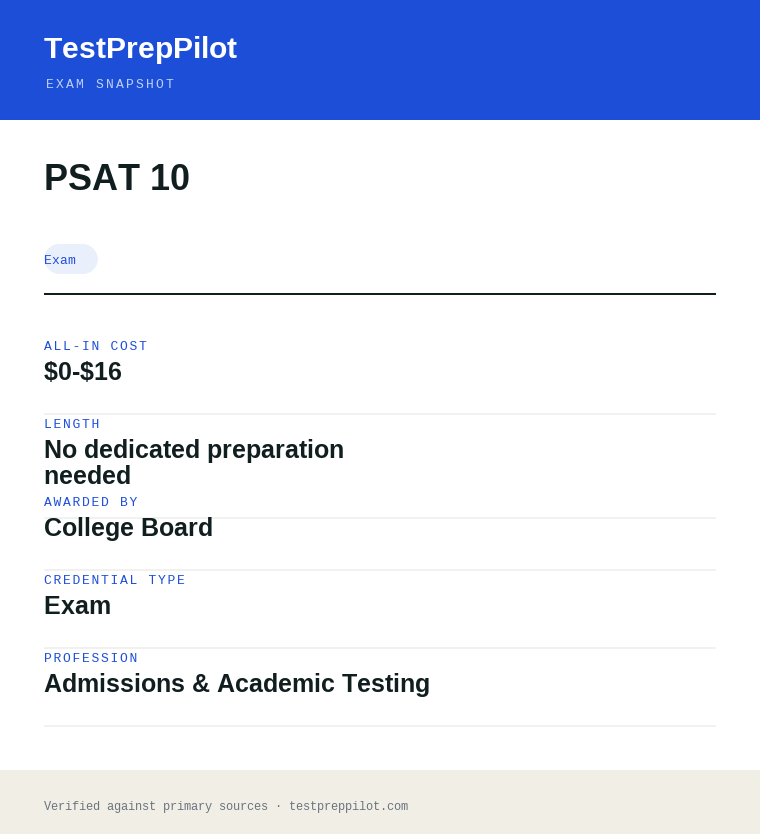
PSAT 10
The PSAT 10 is the spring tenth-grade SAT Suite test that gives a 320 to 1520 baseline without National Merit stakes.
Researched and maintained by TestPrepPilot Editorial BoardCollege admissions & standardized-testing desk · Figures last verified August 2026
The short version
What is the PSAT 10 and is it worth it?
The PSAT 10 is the spring test for tenth graders that mirrors the SAT format and 320 to 1520 scale but carries no National Merit stakes, giving a low-pressure baseline and SAT rehearsal; your school administers it.
- Same format and scale as the SAT for a true midpoint baseline
- No National Merit pressure, so it is a relaxed rehearsal
- Score report pinpoints strengths before junior-year testing
- Low school price, often free to the student
What is it?
What exactly is the PSAT 10?
The PSAT 10 is the spring tenth-grade SAT Suite test that gives a 320 to 1520 baseline without National Merit stakes.
The PSAT 10 is the SAT Suite assessment given in the spring of tenth grade. It uses the identical digital, adaptive 98-question blueprint as the SAT and the PSAT/NMSQT and shares the same 320 to 1520 score scale, which makes it a clean midpoint check on college readiness before junior year. Unlike the PSAT/NMSQT, the PSAT 10 does not enter the National Merit competition, so it carries no scholarship stakes and serves purely as a stress-free baseline and a preview of the SAT experience in Bluebook.
The path in brief
- Take the PSAT 8/9 in grade 8 or 9 for an earlier baseline
- Sit the PSAT 10 in the spring of grade 10
- Review the subscore report for skill gaps
- Next step: PSAT/NMSQT in autumn of grade 11
- Then the SAT itself in junior or senior year
Before you book
Who is eligible to sit the PSAT 10?
Who it is for: Tenth graders wanting a midpoint college-readiness baseline
The test itself
What is the format of the PSAT 10?
The PSAT 10 is administered by College Board and runs 2 hours 14 minutes and contains 98 (54 Reading and Writing, 44 Math) questions.
| Administered by | College Board |
|---|---|
| Questions | 98 (54 Reading and Writing, 44 Math) |
| Time limit | 2 hours 14 minutes |
| Pass mark | No pass mark; 320 to 1520 total |
| Exam fee | Set by the school; about $16 list price |
| Format | Digital, adaptive, two modules per section, on Bluebook |
Content outline
What topics are on the PSAT 10?
The PSAT 10 is weighted across 8 domains; the largest are Math: Algebra (35%), Math: Advanced Math (35%), Reading and Writing: Craft and Structure (28%).
Weightings come from the official exam outline. Study time is best allocated in roughly these proportions rather than evenly across domains.
- Reading and Writing: Information and Ideas 26%
Central ideas, evidence and inference
- Reading and Writing: Craft and Structure 28%
Vocabulary, purpose and cross-text connections
- Reading and Writing: Expression of Ideas 20%
Transitions and rhetorical synthesis
- Reading and Writing: Standard English Conventions 26%
Sentence boundaries, punctuation, agreement
- Math: Algebra 35%
Linear equations, functions, systems
- Math: Advanced Math 35%
Quadratics and nonlinear expressions
- Math: Problem-Solving and Data Analysis 15%
Ratios, percentages, statistics
- Math: Geometry and Trigonometry 15%
Area, volume, triangles, circles
Study materials
Which study guide should you use for the PSAT 10?
Start with the exam sponsor's official content outline. If you also want one structured resource to work through, these are the Mometrix titles that match this exam.
Affiliate links We may earn a commission if you buy through these links, at no extra cost to you. Mometrix has no say in what our exam guides cover. How we make money.
Money & time
How much does the PSAT 10 cost?
For the PSAT 10, the exam fee is Set by the school; about $16 list price; the all-in cost is typically $0-$16; most candidates spend No dedicated preparation needed preparing.
Cost breakdown
| List price to schools, 2026-27 | $16 |
|---|---|
| Official Digital SAT Prep on Khan Academy | Free |
| Typical total | $0-$16 to the student |
Schools and districts often absorb the fee, so students frequently pay nothing.
Timeline
- School testing window spring of grade 10
- Score release a few weeks later
- Next step PSAT/NMSQT in autumn of grade 11
Typical prep: No dedicated preparation needed
The path
How do you register for the PSAT 10?
- 1
Find out which College Board test your school or college requires
AP exams are ordered by your school, and ACCUPLACER tests are bought by the institution that will place you, so the first step is to ask your AP coordinator or the college testing office which test applies. ACCUPLACER placement tests are Reading, Writing, Arithmetic, Quantitative Reasoning, Algebra, and Statistics, Advanced Algebra and Functions, and the WritePlacer essay.
- Ask the admissions or testing office which ACCUPLACER tests your placement needs
- Ask your AP coordinator which AP exams your school orders
- Ask whether your institution accepts multiple measures such as high school GPA
College Board does not publish a student price for ACCUPLACER because institutions buy test units and set what students pay.
- 2
Sign in to a College Board account and, for AP, register through your schoolOrder by November 13, 2026 to avoid the late fee
AP students join their course sections with a College Board account and the school's AP coordinator orders the exams. For the 2026-27 year, the order deadline for full-year and fall courses is November 13, 2026, and orders placed from November 14, 2026 through March 12, 2027 add a $40 late-order fee per exam.
- Create or sign in to your College Board account
- Join your AP class section using the code from your teacher
- Confirm your exam order and payment with the AP coordinator before the deadline
Unused or canceled exams after the November 13 deadline carry a $40 per-exam fee.
- 3
Book an ACCUPLACER session with the institution or an approved proctor
ACCUPLACER can be given in person at a college or test center, remotely through an approved remote proctoring vendor, or through a video conference with a certified proctor. Remote testing requires a private quiet room, a stable internet connection, a computer and a webcam, and the proctor checks your ID next to your face and scans the room on camera.
- Choose in-person or remote testing with the institution
- Check that your computer, webcam and room meet the remote rules if testing at home
- Ask about any accommodation request deadline
- 4
Bring acceptable photo ID on test day
For ACCUPLACER, acceptable photo ID includes a driver's license, state or federal ID, military ID, middle school, high school or college ID, a U.S. or foreign passport with the name in the Western alphabet, a tribal ID, or a naturalization card or certificate of citizenship. Student IDs must show your name and a recognizable photo and must be validated before testing.
- Check the ID list on the Get Ready for Test Day page
- Leave phones, tablets, watches, food and drink outside the testing room
Physical calculators are not allowed on any ACCUPLACER math test unless an approved accommodation allows one; an on-screen calculator appears on some questions.
- 5
Test, then read your score report and plan any retest
Placement tests report a 200-300 scaled score and the essay reports a 1-8 holistic score. AP exams report a 1-5 score after the May exam window. For ACCUPLACER, College Board recommends a retest no sooner than 14 days after the first attempt and a third attempt only after 90 days, but your institution may set its own rule.
- Compare your score band with the college placement table
- Ask about multiple-measures review if you disagree with a placement
- Send AP scores to colleges through your College Board account
The fine print
What are the retake and renewal rules for the PSAT 10?
- Proctoring & delivery
- ACCUPLACER placement tests are computer adaptive and delivered online, in person or through approved remote proctoring or video-chat proctoring. AP Biology is a hybrid digital exam in which students answer multiple-choice questions and view free-response questions in the Bluebook app and handwrite free-response answers in paper booklets at school.
- Retake policy
- ACCUPLACER: College Board recommends a first retest 14 days after the initial test and a second retest only after 90 days, then 30-day gaps, but institutions may set their own policy, and the recommendation is mandatory for Ability to Benefit testing. AP: each exam is given once a year in May, so a retake means sitting the exam again the following year.
- Score reporting
- ACCUPLACER multiple-choice placement tests are scored on a 200-300 scale in seven bands (200-220, 221-230, 231-240, 241-250, 251-260, 261-270, 271-300). WritePlacer essays are scored 1-8. AP exams are scored 1-5, where 5 is extremely well qualified, 4 very well qualified, 3 qualified, 2 possibly qualified and 1 no recommendation.
- Recertification
- Neither ACCUPLACER scores nor AP scores expire as credentials, but colleges set how long they accept a placement score, and they decide which AP scores earn credit. There are no continuing education requirements. Use the AP credit policy search tool on the AP Students site to check a specific college.
- Refunds & rescheduling
- AP exam fees follow the school's order: the 2026-27 base fee is $99 per exam at U.S. schools (U.S. territories, Canada and DoDEA schools included) and $129 at other schools, with a $37 College Board fee reduction for eligible students. Exams canceled in AP Registration and Ordering after November 13 and by March 12 incur a $40 unused or canceled fee. ACCUPLACER refunds depend on the institution.
Context
College Board AP and ACCUPLACER compared
| Test family | Who arranges it | Fee | Score and use | Typical prep time | |
|---|---|---|---|---|---|
| AP exams (e.g. AP Biology) | School AP coordinator | $99 per exam (2026-27, U.S. schools); $129 elsewhere; $37 fee reduction for eligible students | 1-5; colleges decide credit and placement | A full school year of coursework | |
| ACCUPLACER placement tests | College, school or approved test center | Set by the institution; College Board publishes no student price | 200-300 scaled; colleges set cut scores | College Board suggests at least one week of practice per test subject |
What it pays
How much does this credential pay?
PSAT 10 is a rehearsal with no scholarship stakes: the payoff is readiness, and degree-level earnings remain the wage event (BLS, 2024)
PSAT 10 is administered to 10th-grade students in schools and is deliberately designed as a checkpoint on the path to the SAT and to college. Unlike the PSAT/NMSQT taken by juniors, PSAT 10 carries no National Merit Scholarship qualification and no direct admissions consequence; its official purpose, as College Board describes it, is to measure readiness for college-level work and to give students and schools a preview of the digital SAT format and scoring scale. Because it is an assessment rather than a credential, there is no BLS SOC code tied to it, and no score maps to a wage. The economic context that matters comes from BLS education data: in 2024, full-time workers age 25 and older with a bachelor degree earned median weekly wages of $1,543, versus $1,109 with an associate degree and $998 with a high-school diploma alone. PSAT 10 sits at the start of the pipeline that produces those outcomes: it identifies students who are on track, flags gaps that can be remediated while there is still time before the SAT and the college-application cycle, and unlocks free practice tools. For many students the practical value is early calibration - a tenth grader who sees an 1100 baseline with a weak Math subscore has a year of runway to fix it. BLS classifies workers by occupation, not test scores, so the honest statement is that PSAT 10 predicts readiness, not income; the income follows the college completion that readiness makes more likely.
| Measure | Figure | Source / note |
|---|---|---|
| Bachelor-degree median weekly earnings, 2024 | $1,543 | BLS, workers 25+, full time |
| Associate-degree median weekly earnings, 2024 | $1,109 | BLS, workers 25+, full time |
| High-school diploma median weekly earnings, 2024 | $998 | BLS, workers 25+, full time |
| PSAT 10 score range | 320-1520 | College Board, digital PSAT suite |
Job growth.BLS projects 3 percent overall employment growth from 2024 to 2034; the wage-by-education gradient is the relevant comparison.
Your odds
What are the pass rates?
PSAT 10 is not pass/fail; it is scored 320-1520 and reported with readiness benchmarks and percentiles
College Board publishes no pass rate for PSAT 10 because the test has no passing score. The digital PSAT 10 is scored on the same 320-1520 scale as the PSAT/NMSQT, with Reading and Writing and Math each reported 160-760. What students and families receive is a score report with section scores, national percentiles, and two kinds of benchmarks: grade-level readiness benchmarks (which estimate whether a student is on track for college-level work) and, for comparison, the SAT-suite benchmark bands. The test is adaptive: each section’s second module is routed by first-module performance, exactly like the digital SAT, which is why College Board positions PSAT 10 as a format rehearsal as much as a knowledge check. Because there is no cut score, no scholarship linkage, and no admissions use, the score report’s real value is diagnostic: the skill breakdown (Information and Ideas, Craft and Structure, Expression of Ideas, Standard English Conventions, Algebra, Advanced Math, Problem-Solving and Data Analysis, Geometry and Trigonometry) tells a 10th grader and their school exactly which domains to work on before the junior-year PSAT/NMSQT and the SAT. Schools receive aggregated reports for planning, and College Board links scores to free Khan Academy Official Digital SAT Prep, which generates a personalized practice plan from the score. The honest summary: treat PSAT 10 as a diagnostic with a score, not a pass/fail event; the score report is the deliverable, and the benchmark bands define "on track" for the student’s grade.
Read this before quoting the number.No pass rate exists; outcomes are scale scores, percentiles and readiness benchmarks.
Your schedule
How long should I study for it?
10-20 hours over 4-6 weeks of focused study
PSAT 10 preparation should be modest and diagnostic, because the test carries no scholarship or admissions consequence and its main job is to identify gaps. The digital PSAT 10 mirrors the SAT structure: about 2 hours 14 minutes, 98 Reading and Writing questions across two 32-minute modules, and 54 Math questions across two 35-minute modules, all in the Bluebook app with adaptive routing. For most 10th graders the right plan is 10-20 hours spread across 4-6 weeks, focused on the skill breakdown from a first official practice test. Week 1: take the official PSAT 10 practice test in Bluebook and record the per-domain breakdown. Weeks 2-4: work the two weakest domains using Khan Academy’s free Official Digital SAT Prep, which accepts the PSAT score and builds a personalized plan; the most common gaps at this stage are Standard English Conventions (punctuation and grammar) and linear-equation word problems, both of which are highly trainable. Weeks 5-6: one more full practice test under timed conditions and a focused retake of every missed item. Students should not over-prepare: because PSAT 10 does not count toward anything, the hours are better spent building the same skills through coursework and reading. The exception is students who will take the PSAT/NMSQT as juniors and want the National Merit pathway; for them, PSAT 10 is a free full-dress rehearsal, and they should treat the Bluebook interface, adaptive pacing and time pressure as the training target. Schools administer PSAT 10 in the spring (typically February-April) on a College Board testing window.
- Week 14
Baseline
- Official Bluebook PSAT 10 practice test
- Record per-domain breakdown
- Weeks 2-410
Two weakest domains
- Khan Academy Official Digital SAT Prep plan
- Grammar and algebra drills
- Weeks 5-66
Timed retest
- Full timed practice test
- Retake every missed item
Adjusting the pace
Future National Merit path.Juniors-to-be use PSAT 10 as a full-dress rehearsal for the NMSQT; practice interface and pacing seriously.
Accommodations.Students with documented needs use College Board SSD approvals; schools manage requests.
How to study
How do I prepare most effectively?
Because PSAT 10 is a no-stakes diagnostic, the smartest strategies are about extraction of information rather than maximum score. Strategy one: use the official Bluebook practice test first and let the skill breakdown set the agenda; students who study before testing spend hours on domains they already pass. Strategy two: learn the interface properly - annotation tools, the Desmos calculator, module timers, adaptive routing - because the format rehearsal is the test’s main purpose, and juniors who coast through PSAT 10 without mastering Bluebook carry that weakness into the NMSQT. Strategy three: fix the two most trainable weaknesses first: Standard English Conventions (fixed grammar rules, fastest gains) and linear-equation word problems (most common Math error source). Strategy four: use Khan Academy’s free personalized plan, which is built from the actual score report; it removes all planning effort. Strategy five: practice the reading passages the way the digital test demands - shorter passages with single questions - rather than the long-passage habits of older paper tests. Strategy six: debrief with the school counselor after scores arrive; the aggregated school report and the individual benchmark bands are the reason schools administer the test, and the follow-up conversation is where the value lands.
Test first, then study
The score report’s skill breakdown should set the agenda.
Master Bluebook now
The interface rehearsal is the test’s main purpose for future NMSQT takers.
Fix trainable gaps
Grammar conventions and linear-equation word problems first.
Feed the score into Khan Academy
The free personalized plan is built from the real report.
What to buy
Which study resources are worth paying for?
PSAT 10 preparation costs essentially nothing because the official resources dominate. Bluebook contains the official PSAT 10 practice test, which is free and is the only material that exactly matches the adaptive digital format. Khan Academy’s Official Digital SAT Prep is free, built with College Board, and generates a personalized practice plan from the PSAT score report, making it the primary instructional resource. The College Board website adds the PSAT 10 Student Guide (free PDF) and a practice-question bank. Because the test is diagnostic and no-stakes, commercial prep books and courses ($20-$2,000) are rarely justified for PSAT 10 itself; the exception is a student who is also training for the SAT or the National Merit pathway, in which case the SAT-oriented course serves both goals. Many schools provide free in-school preparation sessions and administer PSAT 10 at no charge or a nominal fee (typically about $18, set by the district). The honest ranking: Bluebook + Khan Academy free plan, the official guide, and paid resources only when they double as SAT or NMSQT preparation. Prices here are current as of the 2025-26 testing year and change annually.
| Resource | Price | Format | Best for |
|---|---|---|---|
| Bluebook PSAT 10 practice test | Free | Digital adaptive app | Exact format rehearsal |
| Khan Academy Official Digital SAT Prep | Free | Web/mobile | Personalized plan from the score report |
| College Board Student Guide | Free PDF | Downloadable | Format and benchmark explanation |
| Commercial prep book/course | $20-$2,000 | Print/online | Only if it doubles as SAT/NMSQT prep |
Prices dated 2025-26; official free resources are sufficient for most students. No commission-based ranking.
Avoid these
What mistakes do candidates most often make?
The most common PSAT 10 mistakes come from treating it as either trivial or high-stakes. Mistake one: skipping the official practice test and walking in cold; the adaptive digital format is unfamiliar to most 10th graders, and interface confusion costs points that the diagnostic should not miss. Mistake two: over-preparing. Because PSAT 10 has no scholarship or admissions stakes, hours spent on intensive test prep are usually better spent on coursework; the test is a snapshot, not a gate. Mistake three: ignoring the benchmark bands. The score report’s grade-level benchmarks (on-track versus below-track for college readiness) are the diagnostic heart of the test, and families who only look at the total score miss the signal that matters. Mistake four: not feeding the score into Khan Academy, which turns the report into a free personalized plan; skipping that step discards the main actionable output. Mistake five: using old paper-format practice materials; the digital test has shorter passages and adaptive routing, and paper practice teaches the wrong habits. Mistake six: for future NMSQT candidates, treating PSAT 10 as disposable; juniors who did not use it as a full-dress Bluebook rehearsal arrive at the NMSQT without interface fluency, and that costs real National Merit points.
✕Walking in without the practice test
✓Take the official Bluebook test first; learn the interface.
✕Over-preparing for a no-stakes test
✓Keep prep modest and diagnostic; spend hours on coursework.
✕Ignoring benchmark bands
✓Read the on-track benchmarks, not just the total score.
✕Skipping the Khan Academy plan
✓Feed the score report in; it generates the free study plan.
✕Practicing on paper format
✓Train on the digital adaptive format exclusively.
What you'll face
What question types will I see?
PSAT 10 uses the same two-section structure as the digital SAT. Reading and Writing: 98 questions in 64 minutes (two 32-minute modules), covering Information and Ideas, Craft and Structure, Expression of Ideas, and Standard English Conventions, with shorter passages and single-question items typical of the digital format. Math: 54 questions in 70 minutes (two 35-minute modules), spanning Algebra, Advanced Math, Problem-Solving and Data Analysis, and Geometry and Trigonometry; the Desmos calculator is built into Bluebook. All items are four-option multiple choice, sections are adaptive, and the score range is 320-1520. Samples below are editor-written illustrations of the published skill domains, not live exam items.
Information, Craft & Structure, Expression, Conventions.
Algebra, Advanced Math, Problem-Solving & Data, Geometry.
Try these
Q1The author of the passage argues that public libraries "purchase privacy" for patrons who cannot afford internet access. Which statement best captures the meaning of "purchase privacy" as it is used in the passage?
Answer:B
The phrase is used metaphorically: the library’s free services give low-income patrons a private internet environment that buying their own access would cost money to provide.
Q2A bakery sells muffins in boxes of 6. If the bakery produces 342 muffins in a day and fills as many full boxes as possible, how many muffins are left over?
Answer:A
342 divided by 6 equals 57 exactly, so 57 full boxes use all muffins and none are left over.
Q3Neither of the reports ______ been filed, so the committee cannot review the findings this week. Which choice completes the text so that it conforms to the conventions of Standard English?
Answer:B
The subject is "neither of the reports," which is singular, so the singular verb "has" is required.
Samples are editor-written illustrations of the published skill domains, not live exam items.
The big day
What should I expect on exam day?
PSAT 10 is administered in schools during the College Board testing window (typically February through April), on a weekday determined by the school, using the Bluebook app on school-provided or student-provided devices as the school directs. There is no individual registration fee for students in most districts; the district pays a per-test cost (typically about $18) and sets the administration date. On the day, students check in through their school’s process, bring a fully charged device if using their own, and follow the school’s electronics policy; phones and smartwatches are not permitted in the testing room. The total testing time is about 2 hours 14 minutes plus breaks and instructions, so students should expect a half-day commitment. No calculator is required because Desmos is built into Bluebook; a permitted handheld calculator is allowed if the school permits it. Students with documented disabilities must have College Board SSD accommodations arranged through the school, which handles the application. Scores post in the student’s College Board account typically within two to four weeks, and the school receives an aggregated report; families should review the skill breakdown and benchmark bands together. Afterwards, the student should feed the score into Khan Academy’s free personalized plan and, if they plan to pursue the National Merit pathway, schedule the junior-year PSAT/NMSQT sitting when registration opens in the spring of 11th grade.
Bring
- School-issued check-in information
- Fully charged device if using a personal one
- Sharpened pencils if the school requires them
- Approved calculator if desired (Desmos is built in)
Leave at home
- Phone, smartwatch, and personal electronics
- Notes or study materials
- Any food or drink beyond what the school allows
How the day runs
Rules in the room
- Administered in schools on the College Board testing window.
- The exam runs in Bluebook; answers are entered digitally.
- Personal electronics are not permitted in the testing room.
- Accommodations are arranged through the school via College Board SSD.
Afterwards.Scores post in 2-4 weeks with skill breakdowns and grade-level benchmarks; feed the score into Khan Academy’s free plan and schedule the junior-year NMSQT if pursuing National Merit.
Reference
What are the key facts about the PSAT 10?
PSAT 10 is a exam credential; awarded by College Board; the exam fee is Set by the school; about $16 list price; typical preparation is No dedicated preparation needed.
| Credential | PSAT 10 |
|---|---|
| Type | Exam |
| Profession | Admissions & Academic Testing |
| Specialty | College Admissions |
| Awarded by | College Board |
| Difficulty | Moderate |
| Typical prep time | No dedicated preparation needed |
| All-in cost | $0-$16 |
| Format | Digital and adaptive, delivered in Bluebook at school |
| Score scale | 320 to 1520 total; sections 160 to 760 |
| National Merit | Not eligible; diagnostic only |
| Admin | Ordered and administered by the school in spring |
| Score release | About two to three weeks after testing |
| Scope | National / Multi-state |
Real questions
Frequently asked questions about the PSAT 10
Does the PSAT 10 affect college admission?
No. Colleges never see PSAT 10 scores and it carries no scholarships. It is a baseline and a rehearsal for the SAT.
How is the PSAT 10 different from the PSAT/NMSQT?
Same format and 320 to 1520 scale, but the PSAT 10 is given in the spring of tenth grade and does not enter National Merit. The PSAT/NMSQT is the autumn junior-year test that does.
How do I sign up?
Through your school. The PSAT 10 is school-administered, so ask your counselor when your school offers it.
Should my child prepare for the PSAT 10?
Beyond a run through the Bluebook practice interface, no. The point is an honest baseline before junior year.
What comes after the PSAT 10?
Most students take the PSAT/NMSQT in eleventh grade for National Merit, then the SAT. Because all share one scale, progress is directly measurable.
Do College Board test scores expire?
College Board does not put an expiry date on ACCUPLACER or AP scores, but colleges decide how long they accept a placement score and which AP scores earn credit. Ask the testing office how recent an ACCUPLACER score must be, and use the AP credit policy search tool to see what each college grants for each AP score.
Who sets the passing score on an ACCUPLACER test?
No one passes or fails an ACCUPLACER test. College Board reports a 200-300 scaled score and each college sets its own cut scores for placing students into courses. The only College Board passing scores are the Ability to Benefit values for federal financial aid: Reading 233, Writing 235 and Arithmetic 230.
How much does an AP exam cost?
The base fee for 2026-27 is $99 per AP exam at schools in the U.S., U.S. territories, Canada and DoDEA schools, and $129 at schools elsewhere. Eligible students get a $37 College Board fee reduction. Schools can add their own charges, and late orders between November 14, 2026 and March 12, 2027 add a $40 fee.
In short
Is the PSAT 10 worth it?
- Spring tenth-grade SAT Suite test, same 2h 14m format
- Scored 320 to 1520, no National Merit stakes
- School-administered; register through your counselor
- About 16 dollar list price, often free to the student
Same awarding body
What other credentials does College Board award?
Worth comparing
How does the PSAT 10 compare with similar credentials?
Trust
Where does this information come from?
Everything above is taken from the awarding body's own published material. Fees, question counts and domain weights are revised regularly — check the official page before you pay.
- College Board Awarding body
- Official PSAT 10 exam page Exam page
- College Board certification programme Programme rules
Research confidence: high · Last reviewed 2026-08