Admissions & Academic Testing • Exam
ACCUPLACER Quantitative Reasoning, Algebra, and Statistics
The middle ACCUPLACER math test: ratios, linear equations, probability, statistics and geometry.
Researched and maintained by TestPrepPilot Editorial BoardCollege readiness & admissions assessments desk · Figures last verified August 2026
The short version
What is the ACCUPLACER Quantitative Reasoning, Algebra, and Statistics and is it worth it?
ACCUPLACER Quantitative Reasoning, Algebra, and Statistics is a 20-question adaptive test scored 200-300 across ten categories, including Probability and Sets and Descriptive Statistics. College Board publishes no pass mark; your college maps score bands to courses and sets the student price through its testing office.
- It is the only ACCUPLACER math test that covers Probability and Sets and Descriptive Statistics, so it suits statistics-track placement.
- All ten content categories are published, including two geometry categories.
- The 251-260 band is described as solving systems of linear equations and finding slope and y-intercept, which helps you set a target.
- On-screen calculators are available on some questions, so no handheld calculator is needed.
What is it?
What exactly is the ACCUPLACER Quantitative Reasoning, Algebra, and Statistics?
The middle ACCUPLACER math test: ratios, linear equations, probability, statistics and geometry.
The ACCUPLACER Quantitative Reasoning, Algebra, and Statistics test, known as QAS, has 20 adaptive questions across ten content categories. It is the middle math test: it begins with Rational Numbers and Ratio and Proportional Relationships, moves through Linear Equations, Exponents and Algebraic Expressions, and adds Probability and Sets, Descriptive Statistics and two geometry categories. Colleges use the 200-300 score to place students into college algebra, statistics or quantitative reasoning courses, and each college sets its own cut score. It sits between Arithmetic and Advanced Algebra and Functions.
The path in brief
- Check with your college which math test you are assigned
- Work through the ten categories with official practice items
- Book an in-person or remote session
- Take the 20-question adaptive test
- Use the score band to plan the next course or retest
Before you book
Who is eligible to sit the ACCUPLACER Quantitative Reasoning, Algebra, and Statistics?
College Board sets no eligibility rules. The institution chooses whether to assign QAS, Arithmetic or Advanced Algebra and Functions, and some colleges consider high school GPA or course history before or alongside the score.
Who it is for: Students placing into college algebra, statistics or quantitative reasoning courses.
The test itself
What is the format of the ACCUPLACER Quantitative Reasoning, Algebra, and Statistics?
The ACCUPLACER Quantitative Reasoning, Algebra, and Statistics is administered by ACCUPLACER (College Board), delivered by colleges, schools and approved test centers in person or by remote proctoring and runs No time limit listed by College Board; one sitting or Save and Finish Later and contains 20 multiple-choice questions in the standard adaptive form (pretest items do not affect scores; the split is not published) questions.
| Administered by | ACCUPLACER (College Board), delivered by colleges, schools and approved test centers in person or by remote proctoring |
|---|---|
| Questions | 20 multiple-choice questions in the standard adaptive form (pretest items do not affect scores; the split is not published) |
| Time limit | No time limit listed by College Board; one sitting or Save and Finish Later |
| Pass mark | No pass or fail score; scaled 200-300 and each college sets its own placement cut scores |
| Exam fee | Not published by College Board; your institution sets the student price and any retest fee |
| Format | Computer adaptive; stand-alone multiple-choice items, some with an on-screen calculator |
Content outline
What topics are on the ACCUPLACER Quantitative Reasoning, Algebra, and Statistics?
The ACCUPLACER Quantitative Reasoning, Algebra, and Statistics covers 10 content domains.
No percentage weights are listed for these domains here, so the outline is shown as structure only. Check the certifying body's published outline before allocating study time.
- Rational Numbers
Calculating and applying rational numbers, including absolute value. Category weights are not published.
- Ratio and Proportional Relationships
Rates, ratios, proportions and unit conversions.
- Exponents
Exponents, radicals, fractional exponents and scientific notation.
- Algebraic Expressions
Creating and evaluating expressions, combining like terms, identifying equivalent expressions.
- Linear Equations
Creating and solving linear equations and inequalities and systems of two linear equations.
- Linear Applications and Graphs
Linear models in real-life contexts, graphing lines and inequalities.
- Probability and Sets
Simple, compound and conditional probability and set notation.
- Descriptive Statistics
Histograms, box plots, scatterplots, shape, spread and measures of center.
- Geometry Concepts for Prealgebra
Area and perimeter, circle area and circumference, volume of prisms.
- Geometry Concepts for Algebra 1
Area, perimeter and volume expressions, distance formula, Pythagorean theorem, transformations.
Study materials
Which study guide should you use for the ACCUPLACER Quantitative Reasoning, Algebra, and Statistics?
Start with the exam sponsor's official content outline. If you also want one structured resource to work through, these are the Mometrix titles that match this exam.
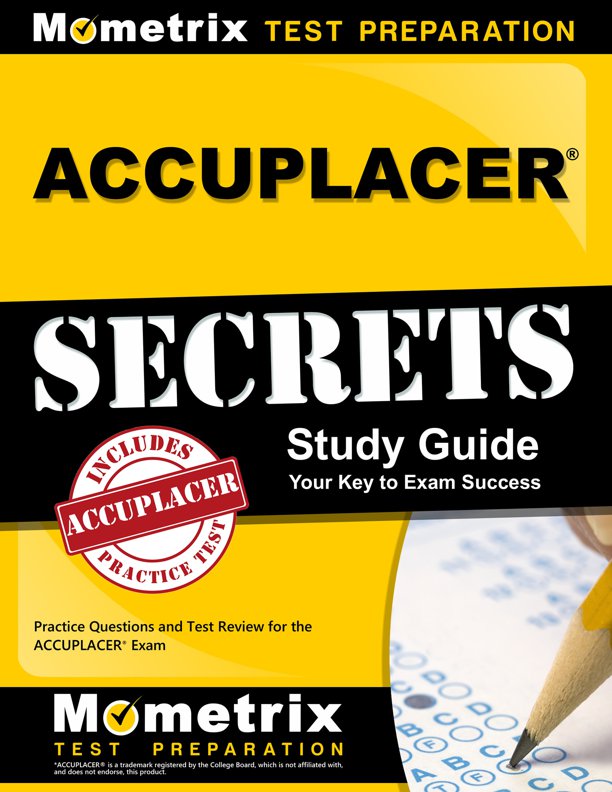
Affiliate links We may earn a commission if you buy through these links, at no extra cost to you. Mometrix has no say in what our exam guides cover. How we make money.
Money & time
How much does the ACCUPLACER Quantitative Reasoning, Algebra, and Statistics cost?
For the ACCUPLACER Quantitative Reasoning, Algebra, and Statistics, the exam fee is Not published by College Board; your institution sets the student price and any retest fee; the all-in cost is typically Set by your institution; most candidates spend About one week of practice per test subject plus your institution's scheduling time preparing.
Cost breakdown
| Test fee charged to the student | Set by your institution; College Board publishes no student price |
|---|---|
| Retest fee | Set by the institution; College Board recommends waiting 14 days before the first retest |
| Official practice materials from College Board | Downloadable from the ACCUPLACER site |
| Typical total | Set by your institution; College Board publishes no student price |
Institutions buy ACCUPLACER test units from College Board and decide whether to pass the cost to students, so confirm the price and retest fee with the testing office before you book.
Timeline
- Contact the testing office and book a session Days to a few weeks, set by the institution
- Review the ten categories and practice with official materials College Board suggests at least one week of practice per test subject
- Take the adaptive test No time limit listed by College Board; one sitting
- Read the score report and ask about retest or multiple-measures review Retest earliest 14 days after the first attempt (College Board recommendation)
Typical prep: About one week of practice per test subject plus your institution's scheduling time
The path
How do you register for the ACCUPLACER Quantitative Reasoning, Algebra, and Statistics?
- 1
Find out which College Board test your school or college requires
AP exams are ordered by your school, and ACCUPLACER tests are bought by the institution that will place you, so the first step is to ask your AP coordinator or the college testing office which test applies. ACCUPLACER placement tests are Reading, Writing, Arithmetic, Quantitative Reasoning, Algebra, and Statistics, Advanced Algebra and Functions, and the WritePlacer essay.
- Ask the admissions or testing office which ACCUPLACER tests your placement needs
- Ask your AP coordinator which AP exams your school orders
- Ask whether your institution accepts multiple measures such as high school GPA
College Board does not publish a student price for ACCUPLACER because institutions buy test units and set what students pay.
- 2
Sign in to a College Board account and, for AP, register through your schoolOrder by November 13, 2026 to avoid the late fee
AP students join their course sections with a College Board account and the school's AP coordinator orders the exams. For the 2026-27 year, the order deadline for full-year and fall courses is November 13, 2026, and orders placed from November 14, 2026 through March 12, 2027 add a $40 late-order fee per exam.
- Create or sign in to your College Board account
- Join your AP class section using the code from your teacher
- Confirm your exam order and payment with the AP coordinator before the deadline
Unused or canceled exams after the November 13 deadline carry a $40 per-exam fee.
- 3
Book an ACCUPLACER session with the institution or an approved proctor
ACCUPLACER can be given in person at a college or test center, remotely through an approved remote proctoring vendor, or through a video conference with a certified proctor. Remote testing requires a private quiet room, a stable internet connection, a computer and a webcam, and the proctor checks your ID next to your face and scans the room on camera.
- Choose in-person or remote testing with the institution
- Check that your computer, webcam and room meet the remote rules if testing at home
- Ask about any accommodation request deadline
- 4
Bring acceptable photo ID on test day
For ACCUPLACER, acceptable photo ID includes a driver's license, state or federal ID, military ID, middle school, high school or college ID, a U.S. or foreign passport with the name in the Western alphabet, a tribal ID, or a naturalization card or certificate of citizenship. Student IDs must show your name and a recognizable photo and must be validated before testing.
- Check the ID list on the Get Ready for Test Day page
- Leave phones, tablets, watches, food and drink outside the testing room
Physical calculators are not allowed on any ACCUPLACER math test unless an approved accommodation allows one; an on-screen calculator appears on some questions.
- 5
Test, then read your score report and plan any retest
Placement tests report a 200-300 scaled score and the essay reports a 1-8 holistic score. AP exams report a 1-5 score after the May exam window. For ACCUPLACER, College Board recommends a retest no sooner than 14 days after the first attempt and a third attempt only after 90 days, but your institution may set its own rule.
- Compare your score band with the college placement table
- Ask about multiple-measures review if you disagree with a placement
- Send AP scores to colleges through your College Board account
The fine print
What are the retake and renewal rules for the ACCUPLACER Quantitative Reasoning, Algebra, and Statistics?
- Proctoring & delivery
- ACCUPLACER placement tests are computer adaptive and delivered online, in person or through approved remote proctoring or video-chat proctoring. AP Biology is a hybrid digital exam in which students answer multiple-choice questions and view free-response questions in the Bluebook app and handwrite free-response answers in paper booklets at school.
- Retake policy
- ACCUPLACER: College Board recommends a first retest 14 days after the initial test and a second retest only after 90 days, then 30-day gaps, but institutions may set their own policy, and the recommendation is mandatory for Ability to Benefit testing. AP: each exam is given once a year in May, so a retake means sitting the exam again the following year.
- Score reporting
- ACCUPLACER multiple-choice placement tests are scored on a 200-300 scale in seven bands (200-220, 221-230, 231-240, 241-250, 251-260, 261-270, 271-300). WritePlacer essays are scored 1-8. AP exams are scored 1-5, where 5 is extremely well qualified, 4 very well qualified, 3 qualified, 2 possibly qualified and 1 no recommendation.
- Recertification
- Neither ACCUPLACER scores nor AP scores expire as credentials, but colleges set how long they accept a placement score, and they decide which AP scores earn credit. There are no continuing education requirements. Use the AP credit policy search tool on the AP Students site to check a specific college.
- Refunds & rescheduling
- AP exam fees follow the school's order: the 2026-27 base fee is $99 per exam at U.S. schools (U.S. territories, Canada and DoDEA schools included) and $129 at other schools, with a $37 College Board fee reduction for eligible students. Exams canceled in AP Registration and Ordering after November 13 and by March 12 incur a $40 unused or canceled fee. ACCUPLACER refunds depend on the institution.
Context
College Board AP and ACCUPLACER compared
| Test family | Who arranges it | Fee | Score and use | Typical prep time | |
|---|---|---|---|---|---|
| AP exams (e.g. AP Biology) | School AP coordinator | $99 per exam (2026-27, U.S. schools); $129 elsewhere; $37 fee reduction for eligible students | 1-5; colleges decide credit and placement | A full school year of coursework | |
| ACCUPLACER placement tests | College, school or approved test center | Set by the institution; College Board publishes no student price | 200-300 scaled; colleges set cut scores | College Board suggests at least one week of practice per test subject |
What it pays
How much does this credential pay?
Placement outcome, not pay: your QAS score decides whether you enter credit-bearing statistics-level math or developmental algebra — and remedial load is one of the strongest predictors of degree completion and lifetime earnings
The direct answer is that ACCUPLACER Quantitative Reasoning, Algebra, and Statistics (QAS) is a placement test, not a job credential, so no BLS occupation corresponds to it and the salary story is about what the placement result unlocks. The test decides, usually before your first semester, whether you place into college-level math such as statistics or college algebra, or into a developmental algebra sequence — and that assignment is one of the strongest predictors of whether you graduate. Research published by the Community College Research Center (CCRC) has repeatedly found that a large share of community-college entrants are placed into developmental coursework and that students who skip remediation complete credentials at substantially higher rates. The reference point for interpreting this is BLS: the May 2024 median wage across all occupations was $49,500, while workers with an associate degree earned a median weekly wage of about $1,059 (2023 data) versus about $899 for high-school-diploma-only workers. A student placed into one or two semesters of non-credit algebra is measurably more likely to drop out before earning any credential, while a student who clears the placement gate and completes a degree moves toward the higher half of the distribution. Colleges increasingly use multiple measures — high school GPA and course history alongside the placement score — precisely because a single cut score misplaces students at both margins. The practical takeaway: treat the QAS subtest as a high-stakes placement decision, prepare deliberately, and if the result assigns you to remediation, ask about retest policy and multiple-measures review rather than accepting the placement silently.
| Measure | Figure | Source / note |
|---|---|---|
| Reference: median wage, all occupations | $49,500 | BLS Occupational Outlook Handbook, May 2024 |
| Reference: associate degree, median weekly earnings | $1,059 | BLS Education Pays, 2023 ($55,068/yr equivalent) |
| Reference: high school diploma, median weekly earnings | $899 | BLS Education Pays, 2023 ($46,748/yr equivalent) |
| The exam itself | No direct occupation | A placement subtest, not a credential of record |
Job growth.BLS does not project growth for a placement test; relevant projections follow the occupations students are placed toward.
Source: BLS OOH — Pay overview
Your odds
What are the pass rates?
There is no official pass rate — ACCUPLACER QAS is a scaled placement instrument scored 200-300, and only your college’s cut scores matter
The core fact to internalize is that ACCUPLACER QAS has no pass/fail threshold at the national level, so any claim of a "pass rate" describes something that does not exist. Each subtest is scored on a 200-300 scale, and every college sets its own cut scores that determine placement into developmental algebra, college-level statistics, or a higher math course. Two students can receive identical scores at different institutions and be placed differently, which is exactly why practice vendors cannot quote a defensible pass rate. What is published is the score scale and, at many schools, the placement table that maps score bands onto course assignments. The QAS subtest is a 20-question computer-adaptive test with no time limit by default (most colleges allow up to two hours), covering four content areas: rational numbers and ratio/proportion, algebra (linear equations and inequalities, expressions, and functions), descriptive statistics, and geometry concepts. Because the test is adaptive, your score reflects a statistical estimate of ability rather than a simple percentage correct, and early answers set the difficulty ceiling. The practical implication is that your preparation target must be defined locally: ask your specific institution for its placement chart and aim comfortably above the cut score for the course you want. Colleges also vary in retake policy, and some let you contest the placement through a multiple-measures review.
Read this before quoting the number.No official pass rate exists; only per-college cut scores are published, and they vary by institution.
Your schedule
How long should I study for it?
15-25 hours (QAS subtest) of focused study
Plan for two to four weeks and roughly 15 to 25 hours of study for the QAS subtest, and expect the exam to reward fluent command of algebra fundamentals — linear equations, inequalities, expressions, and functions — plus ratio and proportion, basic statistics, and geometry. The QAS is a 20-question adaptive test with no default time limit (most colleges allow up to two hours), and it sits between the Arithmetic subtest and the Advanced Algebra and Functions (AAF) subtest on the placement ladder. Week one should be a diagnostic pass: take the official College Board practice test, log which question types you miss, and map each miss to a content area. Week two is targeted skill work on your weakest two or three areas, using the free official question bank and drilling linear-equation solving and word-problem setup. Week three, if you have it, is for full-length timed practice and stamina. Week four is a light taper: one more official practice test, review of the error log, and rest. The single most useful habit is learning to move on quickly from items you cannot solve, because on an adaptive test the time spent stuck on one item degrades the whole session. Budget hours in proportion to your diagnostic score: someone near the bottom should expect the full 25 hours, while a student already clearing algebra-level items may need only 8 to 10.
- Week 15
Diagnostic baseline
- Take the official College Board QAS practice test
- Log every missed item by content area
- Map misses to the published test description
- Week 28
Targeted skill repair
- Drill linear equations and inequalities
- Practise ratio/proportion and word-problem setup
- Re-test only the weak skills
- Week 38
Full-length stamina
- Two full-length practice sessions in one sitting
- Review statistics and geometry content
- Confirm your college’s cut scores
- Week 44
Taper and confirm
- One final official practice test
- Light review of the error log
- Check retest and multiple-measures policy
Adjusting the pace
Arithmetic subtest.The more fundamental placement subtest, for students at the bottom of the math ladder.
Advanced Algebra & Functions (AAF).The highest math placement subtest, used for STEM-track placement.
How to study
How do I prepare most effectively?
The strategy that reliably moves QAS scores is "skill-mapped practice on official items, then adaptive-order simulation," and the single highest-leverage move is obtaining your college’s placement table before you study. Because the test is adaptive, practise in the same mode: use platforms that feed progressively harder items after correct answers. A second proven approach is mastering linear-equation fluency — solving equations, interpreting graphs, and setting up word problems — since algebra carries the largest content share and the statistics and geometry items build on it. Third, drill the ratio-and-proportion items, which are dependable points and a common weak spot. Fourth, keep an error log organized by content area rather than question number; patterns show up by area. Fifth, treat the first five items as the most consequential: on an adaptive test, early answers set the difficulty ceiling, so slow down at the start. Finally, never leave preparation until the week of registration; placement happens at orientation and retakes are often limited.
Get the placement table first
Obtain your college’s cut scores before studying so you calibrate difficulty to your target band.
Master linear-equation fluency
Algebra carries the largest share; practise solving, graphing, and setup.
Drill ratio and proportion
A dependable content block and a common weak spot.
Practise adaptively
Use adaptive-order practice so the difficulty progression matches the live test.
Protect the opening items
Adaptive tests set difficulty from early answers; slow down at the start.
What to buy
Which study resources are worth paying for?
The best-value ACCUPLACER QAS preparation is almost entirely free, because College Board publishes official practice questions and a full sample test that mirror the adaptive engine better than any third-party bank. The comparison below separates official resources from commercial practice banks and live tutoring, with prices current to this review.
| Resource | Price | Format | Best for |
|---|---|---|---|
| College Board official practice questions & sample test | Free | Web-based practice + downloadable PDF | The closest match to the real adaptive engine |
| Khan Academy algebra & statistics courses | Free | Video + practice | Rebuilding weak fundamentals |
| ACCUPLACER prep books (e.g. Mometrix, Barron’s) | ~$25-45 | Printed book + online bank | Structured review for self-studiers |
| Commercial practice apps with adaptive mode | ~$10-30/mo | Mobile drills | Daily short practice sessions |
| College readiness tutors | ~$40-90/hr | 1:1 sessions | Candidates stuck after self-study |
Prices approximate and dated to this review; College Board official materials are free and updated with the current subtest set.
Avoid these
What mistakes do candidates most often make?
The most expensive mistake candidates make is studying the wrong difficulty level — drilling AAF-level trigonometry when the QAS band rewards algebra fundamentals — and the second is ignoring their college’s cut scores entirely. A close third is being rusty on linear-equation solving, the largest content share. Candidates also routinely skip the ratio-and-proportion items, treating them as easy, and then lose dependable points, and many under-practise word-problem setup. Another recurring error is registering at orientation cold and then accepting a developmental placement without asking about retake policy or multiple-measures review. Finally, some students fail to confirm whether their school even uses ACCUPLACER or a competing placement test.
✕Studying the wrong difficulty band
✓Get your college’s placement table and drill exactly the skills in your target band.
✕Rusty linear-equation solving
✓Drill solving, graphing, and word-problem setup for algebra items.
✕Skipping ratio and proportion
✓A dependable content block; give it study time.
✕Ignoring the adaptive nature
✓Practise with adaptive-order items and slow down on the opening questions.
✕Registering cold at orientation
✓Take one official practice test at least two weeks before placement.
What you'll face
What question types will I see?
The QAS subtest contains 20 adaptive multiple-choice questions with no default time limit, covering rational numbers and ratio/proportion, algebra (linear equations, inequalities, expressions, and functions), descriptive statistics, and geometry. Because the test is computer-adaptive, each candidate’s question set is unique. The samples below are editor-written illustrations of the published blueprint, not live exam items.
Rates, ratios, and proportional reasoning.
Linear equations, inequalities, and expressions.
Function concepts, graphs, and applications.
Data analysis and basic geometry concepts.
Try these
Q1If 3x + 5 = 20, what is the value of x?
Answer:A
Subtract 5 from both sides: 3x = 15, then divide by 3 to get x = 5.
Q2A recipe calls for 2 cups of flour for every 3 cups of sugar. If you use 9 cups of sugar, how many cups of flour are needed?
Answer:B
The ratio is 2:3, so 9 cups of sugar (3×3) requires 2×3 = 6 cups of flour.
Q3What is the median of the data set 4, 8, 3, 9, 6?
Answer:B
Sorted: 3, 4, 6, 8, 9 — the middle value is 6.
Samples are editor-written illustrations of the published blueprint, not live exam items.
The big day
What should I expect on exam day?
ACCUPLACER QAS is administered at your college or a testing center, typically during orientation or a scheduled placement session, and is untimed by default — most colleges allow up to two hours per subtest. The core rules: bring a government-issued photo ID and your registration information, leave calculators at home (an on-screen calculator is built into applicable questions), and expect to store personal items. There is no cost at most colleges, and you will usually see your placement result before you leave. The biggest behavioural trap is finishing in a rush out of habit — there is no clock advantage to speed on an untimed test, so work deliberately, especially on the opening adaptive items. After the session, your score report shows the scaled score and placement recommendation; if the placement assigns you to developmental coursework and you believe it is wrong, immediately ask about the retest schedule and any multiple-measures review process.
Bring
- Government-issued photo ID
- College registration/confirmation info
- Confirmation of your target placement band
- Patience for an untimed, adaptive session
Leave at home
- Calculator (on-screen one is provided where applicable)
- Phone and smartwatch (stored with testing staff)
- Notes or study materials
How the day runs
Rules in the room
- Untimed by default — speed earns nothing
- Photo ID required
- Personal items and devices stored
- Retakes may require a waiting period or fee
Afterwards.Your scaled score maps to your college’s placement table; a low placement is not final — check retest windows and multiple-measures review before enrolling in non-credit coursework.
Reference
What are the key facts about the ACCUPLACER Quantitative Reasoning, Algebra, and Statistics?
ACCUPLACER Quantitative Reasoning, Algebra, and Statistics is a exam credential; awarded by College Board; the exam fee is Not published by College Board; your institution sets the student price and any retest fee; typical preparation is About one week of practice per test subject plus your institution's scheduling time.
| Credential | ACCUPLACER Quantitative Reasoning, Algebra, and Statistics |
|---|---|
| Abbreviation | QAS |
| Type | Exam |
| Profession | Admissions & Academic Testing |
| Specialty | College Placement |
| Awarded by | College Board |
| Difficulty | Moderate |
| Typical prep time | About one week of practice per test subject plus your institution's scheduling time |
| All-in cost | Set by your institution |
| Test length | 20 questions in the standard adaptive form |
| Score bands | 231-240 adds one-step rate, ratio, proportion and unit conversion; 261-270 adds slope of parallel and perpendicular lines |
| Score scale | Multiple-choice placement tests are scored 200-300 in seven bands; no one passes or fails, and colleges set their own cut scores |
| Time limit | College Board lists no time limit for ACCUPLACER tests; your test center confirms its session rules |
| Retest | College Board recommends 14 days before a first retest and 90 days before a second, then 30-day gaps; institutions may set their own rule |
| Delivery | Computer adaptive, in person or remotely proctored; students must answer every question |
| ID | Photo ID such as a driver's license, passport, military ID or school ID validated before testing |
| Scope | National / Multi-state |
Real questions
Frequently asked questions about the ACCUPLACER Quantitative Reasoning, Algebra, and Statistics
How many questions are on ACCUPLACER Quantitative Reasoning, Algebra, and Statistics?
The standard adaptive form of ACCUPLACER Quantitative Reasoning, Algebra, and Statistics has 20 multiple-choice questions, according to the 2025-26 ACCUPLACER Program Manual. All items are stand-alone, drawn from ten categories. College Board does not disclose how many pretest items are mixed in, and those do not affect your score.
What does QAS stand for on ACCUPLACER?
QAS stands for Quantitative Reasoning, Algebra, and Statistics, the middle ACCUPLACER math test. It sits above Arithmetic and below Advanced Algebra and Functions and covers ten categories, including Linear Equations, Probability and Sets and Descriptive Statistics. Colleges often use it to place students into college algebra or statistics-level courses.
What is a good score on ACCUPLACER Quantitative Reasoning, Algebra, and Statistics?
A good score is the one that meets your college's cut score, because College Board publishes no pass mark. Scores run 200-300 in seven bands. The 251-260 band typically shows solving two-variable linear systems and finding slope and y-intercept, and 271-300 adds connecting nonlinear equations with graphs.
Is ACCUPLACER QAS harder than Arithmetic?
Yes, it adds algebra, exponents, probability, statistics and geometry that Arithmetic does not include. Both are 20-question adaptive tests. QAS is below Advanced Algebra and Functions, which adds factoring, logarithms and trigonometry. Your assigned test depends on your college and program, so confirm which one you need first.
Can I use a calculator on ACCUPLACER QAS?
Not a handheld one. ACCUPLACER math tests provide an on-screen calculator on some questions, marked by an icon in the top-right corner, and College Board bans physical calculators unless an approved accommodation allows one. A basic, square-root or graphing calculator may appear depending on the question, so learn to use the on-screen tools in the practice portal.
How soon can I retake ACCUPLACER Quantitative Reasoning, Algebra, and Statistics?
College Board recommends a first retest 14 days after the initial test, a second after 90 days, and later attempts every 30 days. Institutions may set their own policy, including limits or fees. Use the waiting period to work on your weakest categories rather than retesting immediately.
How much does ACCUPLACER QAS cost?
College Board does not publish a student price for ACCUPLACER QAS. The institution that administers it buys test units and decides what to charge, if anything, including for retests. Ask the testing office about the fee, remote-proctoring costs, and whether a score from another college is accepted.
Do College Board test scores expire?
College Board does not put an expiry date on ACCUPLACER or AP scores, but colleges decide how long they accept a placement score and which AP scores earn credit. Ask the testing office how recent an ACCUPLACER score must be, and use the AP credit policy search tool to see what each college grants for each AP score.
Who sets the passing score on an ACCUPLACER test?
No one passes or fails an ACCUPLACER test. College Board reports a 200-300 scaled score and each college sets its own cut scores for placing students into courses. The only College Board passing scores are the Ability to Benefit values for federal financial aid: Reading 233, Writing 235 and Arithmetic 230.
How much does an AP exam cost?
The base fee for 2026-27 is $99 per AP exam at schools in the U.S., U.S. territories, Canada and DoDEA schools, and $129 at schools elsewhere. Eligible students get a $37 College Board fee reduction. Schools can add their own charges, and late orders between November 14, 2026 and March 12, 2027 add a $40 fee.
In short
Is the ACCUPLACER Quantitative Reasoning, Algebra, and Statistics worth it?
- ACCUPLACER QAS has 20 adaptive multiple-choice questions across ten published content categories.
- It is the only ACCUPLACER math test with Probability and Sets and Descriptive Statistics.
- Scores run 200-300 in seven bands, with no national pass mark.
- Physical calculators are not allowed; some questions provide an on-screen calculator.
- College Board recommends waiting 14 days before the first retest.
Same awarding body
What other credentials does College Board award?
Worth comparing
How does the ACCUPLACER Quantitative Reasoning, Algebra, and Statistics compare with similar credentials?
Trust
Where does this information come from?
Everything above is taken from the awarding body's own published material. Fees, question counts and domain weights are revised regularly — check the official page before you pay.
- College Board Awarding body
- Official ACCUPLACER Quantitative Reasoning, Algebra, and Statistics exam page Exam page
- College Board certification programme Programme rules
Research confidence: medium · Last reviewed 2026-08