Admissions & Academic Testing • Exam
ACCUPLACER Writing
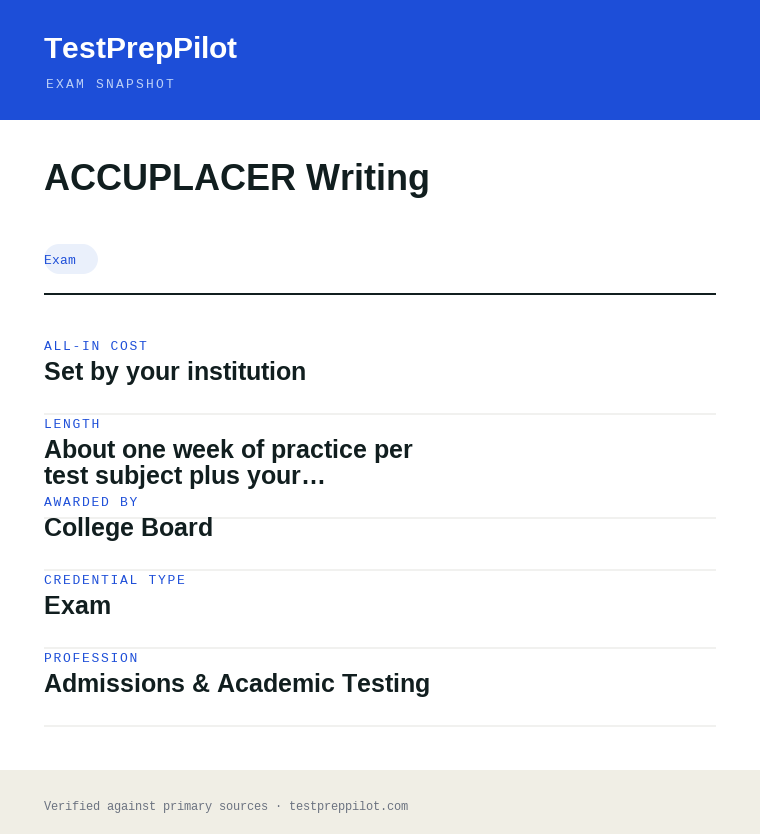
The ACCUPLACER revising and editing test: 25 adaptive questions on passages built to contain errors.
Researched and maintained by TestPrepPilot Editorial BoardCollege readiness & admissions assessments desk · Figures last verified August 2026
The short version
What is the ACCUPLACER Writing and is it worth it?
ACCUPLACER Writing is a 25-question computer-adaptive test scored 200-300, where every question follows an extended passage and asks for the best revision. It covers Expression of Ideas and Standard English Conventions. No national pass mark exists; the federal Ability to Benefit score is 235, and colleges set their own cut scores.
- It is the longest ACCUPLACER multiple-choice test at 25 questions, which gives a finer reading of your editing skill.
- Passages are all commissioned for the test, so errors are planted deliberately and rule knowledge pays off.
- Score bands are specific; the 221-230 band starts with correcting a simple sentence-structure or punctuation error.
- No calculator or outside knowledge of a topic is needed, and College Board lists no time limit.
What is it?
What exactly is the ACCUPLACER Writing?
The ACCUPLACER revising and editing test: 25 adaptive questions on passages built to contain errors.
The ACCUPLACER Writing test has 25 adaptive revision and editing questions and reports a 200-300 scaled score. Every question belongs to a set built around an extended commissioned passage, so there are no stand-alone grammar items; you choose the best revision or decide that no change is needed. It measures Expression of Ideas (development, organization, effective language use) and Standard English Conventions (sentence structure, usage, punctuation). Colleges use the score to place students into composition courses, and the federal Ability to Benefit passing score is 235. It is longer than the 20-question Reading and math tests.
The path in brief
- Ask whether your college uses Writing, WritePlacer or both
- Practice revising passages with official sample questions
- Book an in-person or remote session
- Answer all 25 adaptive questions
- Compare your score with the college table or the 235 Ability to Benefit score
Before you book
Who is eligible to sit the ACCUPLACER Writing?
College Board sets no eligibility rules. For Ability to Benefit financial aid, students taking ACCUPLACER for ATB purposes must take Reading, Writing and Arithmetic and the mandatory ATB retest policy applies. Some colleges use WritePlacer instead of this test.
Who it is for: Students and adult learners who need a multiple-choice writing placement score for composition courses.
The test itself
What is the format of the ACCUPLACER Writing?
The ACCUPLACER Writing is administered by ACCUPLACER (College Board), delivered by colleges, schools and approved test centers in person or by remote proctoring and runs No time limit listed by College Board; one sitting or Save and Finish Later and contains 25 multiple-choice questions in the standard adaptive form, all in sets built around extended passages (pretest items do not affect scores) questions.
| Administered by | ACCUPLACER (College Board), delivered by colleges, schools and approved test centers in person or by remote proctoring |
|---|---|
| Questions | 25 multiple-choice questions in the standard adaptive form, all in sets built around extended passages (pretest items do not affect scores) |
| Time limit | No time limit listed by College Board; one sitting or Save and Finish Later |
| Pass mark | No pass or fail score; scaled 200-300 and each college sets its own placement cut scores |
| Exam fee | Not published by College Board; your institution sets the student price and any retest fee |
| Format | Computer adaptive; passage-based revision and editing questions, with a no-change option |
Content outline
What topics are on the ACCUPLACER Writing?
The ACCUPLACER Writing covers 6 content domains.
No percentage weights are listed for these domains here, so the outline is shown as structure only. Check the certifying body's published outline before allocating study time.
- Development
Expression of Ideas: revising proposition, support and focus in relation to rhetorical purpose. Category weights are not published.
- Organization
Expression of Ideas: logical sequence, introductions, conclusions and transitions.
- Effective Language Use
Expression of Ideas: precision, concision, style and tone, and syntax.
- Sentence Structure
Standard English Conventions: sentence boundaries, subordination and coordination, parallel structure, modifier placement, shifts in verb tense, voice and mood.
- Conventions of Usage
Standard English Conventions: pronoun clarity, agreement, frequently confused words and logical comparison.
- Conventions of Punctuation
Standard English Conventions: end-of-sentence and within-sentence punctuation.
Study materials
Which study guide should you use for the ACCUPLACER Writing?
Start with the exam sponsor's official content outline. If you also want one structured resource to work through, these are the Mometrix titles that match this exam.
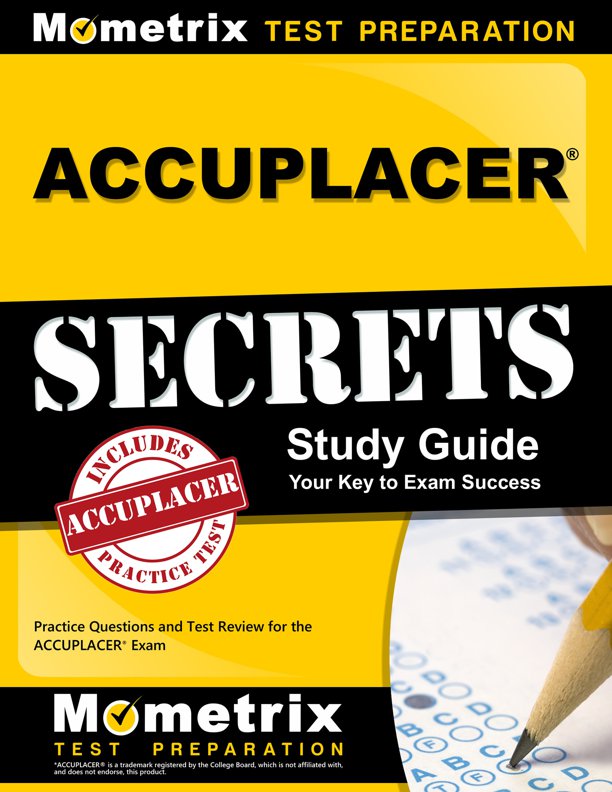
Affiliate links We may earn a commission if you buy through these links, at no extra cost to you. Mometrix has no say in what our exam guides cover. How we make money.
Money & time
How much does the ACCUPLACER Writing cost?
For the ACCUPLACER Writing, the exam fee is Not published by College Board; your institution sets the student price and any retest fee; the all-in cost is typically Set by your institution; most candidates spend About one week of practice per test subject plus your institution's scheduling time preparing.
Cost breakdown
| Test fee charged to the student | Set by your institution; College Board publishes no student price |
|---|---|
| Retest fee | Set by the institution; College Board recommends waiting 14 days before the first retest |
| Official practice materials from College Board | Downloadable from the ACCUPLACER site |
| Ability to Benefit testing | Test price set by the institution; ATB retest policy is mandatory |
| Typical total | Set by your institution; College Board publishes no student price |
Institutions buy ACCUPLACER test units from College Board and decide whether to pass the cost to students, so confirm the price and retest fee with the testing office before you book.
Timeline
- Contact the testing office and book a session Days to a few weeks, set by the institution
- Practice revising passages and review grammar conventions College Board suggests at least one week of practice per test subject
- Take the adaptive test No time limit listed by College Board; one sitting
- Read the score report and ask about retest or multiple-measures review Retest earliest 14 days after the first attempt (College Board recommendation)
Typical prep: About one week of practice per test subject plus your institution's scheduling time
The path
How do you register for the ACCUPLACER Writing?
- 1
Find out which College Board test your school or college requires
AP exams are ordered by your school, and ACCUPLACER tests are bought by the institution that will place you, so the first step is to ask your AP coordinator or the college testing office which test applies. ACCUPLACER placement tests are Reading, Writing, Arithmetic, Quantitative Reasoning, Algebra, and Statistics, Advanced Algebra and Functions, and the WritePlacer essay.
- Ask the admissions or testing office which ACCUPLACER tests your placement needs
- Ask your AP coordinator which AP exams your school orders
- Ask whether your institution accepts multiple measures such as high school GPA
College Board does not publish a student price for ACCUPLACER because institutions buy test units and set what students pay.
- 2
Sign in to a College Board account and, for AP, register through your schoolOrder by November 13, 2026 to avoid the late fee
AP students join their course sections with a College Board account and the school's AP coordinator orders the exams. For the 2026-27 year, the order deadline for full-year and fall courses is November 13, 2026, and orders placed from November 14, 2026 through March 12, 2027 add a $40 late-order fee per exam.
- Create or sign in to your College Board account
- Join your AP class section using the code from your teacher
- Confirm your exam order and payment with the AP coordinator before the deadline
Unused or canceled exams after the November 13 deadline carry a $40 per-exam fee.
- 3
Book an ACCUPLACER session with the institution or an approved proctor
ACCUPLACER can be given in person at a college or test center, remotely through an approved remote proctoring vendor, or through a video conference with a certified proctor. Remote testing requires a private quiet room, a stable internet connection, a computer and a webcam, and the proctor checks your ID next to your face and scans the room on camera.
- Choose in-person or remote testing with the institution
- Check that your computer, webcam and room meet the remote rules if testing at home
- Ask about any accommodation request deadline
- 4
Bring acceptable photo ID on test day
For ACCUPLACER, acceptable photo ID includes a driver's license, state or federal ID, military ID, middle school, high school or college ID, a U.S. or foreign passport with the name in the Western alphabet, a tribal ID, or a naturalization card or certificate of citizenship. Student IDs must show your name and a recognizable photo and must be validated before testing.
- Check the ID list on the Get Ready for Test Day page
- Leave phones, tablets, watches, food and drink outside the testing room
Physical calculators are not allowed on any ACCUPLACER math test unless an approved accommodation allows one; an on-screen calculator appears on some questions.
- 5
Test, then read your score report and plan any retest
Placement tests report a 200-300 scaled score and the essay reports a 1-8 holistic score. AP exams report a 1-5 score after the May exam window. For ACCUPLACER, College Board recommends a retest no sooner than 14 days after the first attempt and a third attempt only after 90 days, but your institution may set its own rule.
- Compare your score band with the college placement table
- Ask about multiple-measures review if you disagree with a placement
- Send AP scores to colleges through your College Board account
The fine print
What are the retake and renewal rules for the ACCUPLACER Writing?
- Proctoring & delivery
- ACCUPLACER placement tests are computer adaptive and delivered online, in person or through approved remote proctoring or video-chat proctoring. AP Biology is a hybrid digital exam in which students answer multiple-choice questions and view free-response questions in the Bluebook app and handwrite free-response answers in paper booklets at school.
- Retake policy
- ACCUPLACER: College Board recommends a first retest 14 days after the initial test and a second retest only after 90 days, then 30-day gaps, but institutions may set their own policy, and the recommendation is mandatory for Ability to Benefit testing. AP: each exam is given once a year in May, so a retake means sitting the exam again the following year.
- Score reporting
- ACCUPLACER multiple-choice placement tests are scored on a 200-300 scale in seven bands (200-220, 221-230, 231-240, 241-250, 251-260, 261-270, 271-300). WritePlacer essays are scored 1-8. AP exams are scored 1-5, where 5 is extremely well qualified, 4 very well qualified, 3 qualified, 2 possibly qualified and 1 no recommendation.
- Recertification
- Neither ACCUPLACER scores nor AP scores expire as credentials, but colleges set how long they accept a placement score, and they decide which AP scores earn credit. There are no continuing education requirements. Use the AP credit policy search tool on the AP Students site to check a specific college.
- Refunds & rescheduling
- AP exam fees follow the school's order: the 2026-27 base fee is $99 per exam at U.S. schools (U.S. territories, Canada and DoDEA schools included) and $129 at other schools, with a $37 College Board fee reduction for eligible students. Exams canceled in AP Registration and Ordering after November 13 and by March 12 incur a $40 unused or canceled fee. ACCUPLACER refunds depend on the institution.
Context
College Board AP and ACCUPLACER compared
| Test family | Who arranges it | Fee | Score and use | Typical prep time | |
|---|---|---|---|---|---|
| AP exams (e.g. AP Biology) | School AP coordinator | $99 per exam (2026-27, U.S. schools); $129 elsewhere; $37 fee reduction for eligible students | 1-5; colleges decide credit and placement | A full school year of coursework | |
| ACCUPLACER placement tests | College, school or approved test center | Set by the institution; College Board publishes no student price | 200-300 scaled; colleges set cut scores | College Board suggests at least one week of practice per test subject |
What it pays
How much does this credential pay?
Placement outcome, not pay: your Writing score decides whether you enter credit-bearing composition or developmental writing — and remedial load is one of the strongest predictors of degree completion and lifetime earnings
The direct answer is that ACCUPLACER Writing is a placement test, not a job credential, so no BLS occupation corresponds to it and the salary story is about what the placement result unlocks. The multiple-choice test decides, usually before your first semester, whether you place into college-level English or a developmental writing course — and that assignment is one of the strongest predictors of whether you graduate. Research published by the Community College Research Center (CCRC) has repeatedly found that a large share of community-college entrants are placed into developmental coursework and that students who skip remediation complete credentials at substantially higher rates. The reference point for interpreting this is BLS: the May 2024 median wage across all occupations was $49,500, while workers with an associate degree earned a median weekly wage of about $1,059 (2023 data) versus about $899 for high-school-diploma-only workers. A student placed into one or two semesters of non-credit writing is measurably more likely to drop out before earning any credential, while a student who clears the placement gate and completes a degree moves toward the higher half of the distribution. Colleges increasingly use multiple measures — high school GPA and course history alongside the placement score — precisely because a single cut score misplaces students at both margins. The practical takeaway: treat the Writing subtest as a high-stakes placement decision, prepare deliberately, and if the result assigns you to remediation, ask about retest policy and multiple-measures review rather than accepting the placement silently.
| Measure | Figure | Source / note |
|---|---|---|
| Reference: median wage, all occupations | $49,500 | BLS Occupational Outlook Handbook, May 2024 |
| Reference: associate degree, median weekly earnings | $1,059 | BLS Education Pays, 2023 ($55,068/yr equivalent) |
| Reference: high school diploma, median weekly earnings | $899 | BLS Education Pays, 2023 ($46,748/yr equivalent) |
| The exam itself | No direct occupation | A placement subtest, not a credential of record |
Job growth.BLS does not project growth for a placement test; relevant projections follow the occupations students are placed toward.
Source: BLS OOH — Pay overview
Your odds
What are the pass rates?
There is no official pass rate — ACCUPLACER Writing is a scaled placement instrument scored 200-300, and only your college’s cut scores matter
The core fact to internalize is that ACCUPLACER Writing has no pass/fail threshold at the national level, so any claim of a "pass rate" describes something that does not exist. The subtest is scored on a 200-300 scale, and every college sets its own cut scores that determine placement into developmental writing, college-level composition, or a higher course. Two students can receive identical scores at different institutions and be placed differently, which is exactly why practice vendors cannot quote a defensible pass rate. What is published is the score scale and, at many schools, the placement table that maps score bands onto course assignments. The Writing subtest is a 25-question computer-adaptive test with no time limit by default (most colleges allow up to two hours), and it measures standard written English: sentence logic, organization, development, and mechanical conventions, presented as passage-edit and sentence-choice items. Because the test is adaptive, your score reflects a statistical estimate of ability rather than a simple percentage correct, and early answers set the difficulty ceiling. The practical implication is that your preparation target must be defined locally: ask your specific institution for its placement chart and aim comfortably above the cut score for the course you want. Colleges also vary in retake policy, and some let you contest the placement through a multiple-measures review using high school GPA or transcripts.
Read this before quoting the number.No official pass rate exists; only per-college cut scores are published, and they vary by institution.
Your schedule
How long should I study for it?
12-20 hours (Writing subtest) of focused study
Plan for two to four weeks and roughly 12 to 20 hours of study for the Writing subtest, and expect the exam to reward command of standard written English — sentence logic, organization, development, and conventions — rather than memorized grammar rules alone. The Writing subtest is a 25-question adaptive test with no default time limit (most colleges allow up to two hours), presented largely as passage-edit items where you choose the best revision. Week one should be a diagnostic pass: take the official College Board practice test, log which item types you miss, and map each miss to a skill (sentence logic, organization, development, conventions). Week two is targeted skill work on your weakest two or three areas, using the free official question bank and drilling the passage-edit format. Week three, if you have it, is for full-length timed practice and stamina. Week four is a light taper: one more official practice test, review of the error log, and rest. The single most useful habit is learning to read each passage-edit item as a revision decision: identify what the sentence is trying to say, then choose the option that says it most clearly and correctly. Budget hours in proportion to your diagnostic score: someone near the bottom should expect the full 20 hours, while a student already writing at college level may need only 6 to 8.
- Week 14
Diagnostic baseline
- Take the official College Board Writing practice test
- Log every missed item by skill
- Map misses to the published test description
- Week 27
Targeted skill repair
- Drill sentence-logic and revision items
- Practise the passage-edit format
- Review mechanical conventions
- Week 36
Full-length stamina
- Two full-length practice sessions in one sitting
- Review the error log patterns
- Confirm your college’s cut scores
- Week 43
Taper and confirm
- One final official practice test
- Light review of the error log
- Check retest and multiple-measures policy
Adjusting the pace
WritePlacer.The essay-based English placement test, scored 1-8 with a rubric.
ESL Language Use.A companion subtest for English-language learners.
How to study
How do I prepare most effectively?
The strategy that reliably moves Writing scores is "practise the revision-decision mindset on official items, then rehearse adaptive-order simulation," and the single highest-leverage move is obtaining your college’s placement table before you study. A second proven approach is mastering the passage-edit format, which dominates the exam: each item presents a sentence or short passage and asks which revision is best, so practise reading for clarity and correctness before looking at the options. Third, drill sentence-logic items specifically — fragments, run-ons, modifier placement, and parallelism are the highest-frequency categories. Fourth, review mechanical conventions — punctuation, agreement, and verb tense — since they are dependable points and the most fixable. Fifth, keep an error log organized by skill category; patterns show up by category. Finally, never leave preparation until the week of registration; placement happens at orientation and retakes are often limited.
Get the placement table first
Obtain your college’s cut scores before studying so you calibrate difficulty to your target band.
Master the passage-edit format
Read for clarity and correctness before choosing the best revision.
Drill sentence-logic items
Fragments, run-ons, modifiers, and parallelism are the highest-frequency categories.
Review mechanical conventions
Punctuation, agreement, and verb tense are dependable points.
Protect the opening items
Adaptive tests set difficulty from early answers; slow down at the start.
What to buy
Which study resources are worth paying for?
The best-value ACCUPLACER Writing preparation is almost entirely free, because College Board publishes official practice questions and a full sample test that mirror the adaptive engine better than any third-party bank. The comparison below separates official resources from commercial practice banks and live tutoring, with prices current to this review.
| Resource | Price | Format | Best for |
|---|---|---|---|
| College Board official practice questions & sample test | Free | Web-based practice + downloadable PDF | The closest match to the real adaptive engine |
| Khan Academy SAT Writing & Language | Free | Video + practice | Grammar and convention review |
| ACCUPLACER prep books (e.g. Mometrix, Barron’s) | ~$25-45 | Printed book + online bank | Structured review for self-studiers |
| Commercial practice apps with adaptive mode | ~$10-30/mo | Mobile drills | Daily short practice sessions |
| Writing tutors | ~$40-90/hr | 1:1 sessions | Candidates stuck after self-study |
Prices approximate and dated to this review; College Board official materials are free and updated with the current subtest set.
Avoid these
What mistakes do candidates most often make?
The most expensive mistake candidates make is treating the Writing subtest as a grammar-trivia test and memorizing rule names instead of practising the revision-decision format; the second is ignoring their college’s cut scores entirely. A close third is missing sentence-logic items — fragments, run-ons, and modifier errors — which are the highest-frequency categories. Candidates also routinely rush the passage-edit items, choosing the option that "sounds right" instead of reading for clarity and correctness, and many neglect mechanical conventions as too basic, losing dependable points. Another recurring error is registering at orientation cold and accepting a developmental placement without asking about retake policy or multiple-measures review. Finally, some students fail to confirm whether their school even uses ACCUPLACER or a competing placement test.
✕Grammar-trivia study
✓Practise the revision-decision format; the exam tests application.
✕Missing sentence-logic items
✓Drill fragments, run-ons, modifiers, and parallelism.
✕Choosing what sounds right
✓Read for clarity and correctness before picking the revision.
✕Neglecting conventions
✓Punctuation and agreement are dependable points.
✕Registering cold at orientation
✓Take one official practice test at least two weeks before placement.
What you'll face
What question types will I see?
The Writing subtest contains 25 adaptive multiple-choice questions with no default time limit, measuring standard written English through sentence-choice and passage-edit items across sentence logic, organization, development, and mechanical conventions. Because the test is computer-adaptive, each candidate’s question set is unique. The samples below are editor-written illustrations of the published blueprint, not live exam items.
Fragments, run-ons, modifier placement, and parallelism.
Sentence order, transitions, and logical flow.
Punctuation, agreement, and verb tense.
Word choice, clarity, and concision.
Try these
Q1Which revision best corrects the sentence: "The committee approved the budget, they then adjourned."?
Answer:A
A semicolon correctly joins the two independent clauses, fixing the comma splice.
Q2Which sentence is most clearly written?
Answer:B
The modifier "running late" correctly attaches to the student, the sentence’s subject.
Q3Choose the best revision for clarity: "The reason why the meeting was postponed is because the room was unavailable."?
Answer:A
The revision removes the redundant "reason why...because" construction for clarity and concision.
Samples are editor-written illustrations of the published blueprint, not live exam items.
The big day
What should I expect on exam day?
ACCUPLACER Writing is administered at your college or a testing center, typically during orientation or a scheduled placement session, and is untimed by default — most colleges allow up to two hours per subtest. The core rules: bring a government-issued photo ID and your registration information, leave calculators at home (none are needed for Writing), and expect to store personal items. There is no cost at most colleges, and you will usually see your placement result before you leave. The biggest behavioural trap is rushing through the passage-edit items; instead, read each sentence for what it is trying to say, then choose the revision that says it most clearly and correctly. After the session, your score report shows the scaled score and placement recommendation; if the placement assigns you to developmental coursework and you believe it is wrong, immediately ask about the retest schedule and any multiple-measures review process.
Bring
- Government-issued photo ID
- College registration/confirmation info
- Confirmation of your target placement band
- Patience for an untimed, adaptive session
Leave at home
- Phone and smartwatch (stored with testing staff)
- Notes or study materials
How the day runs
Rules in the room
- Untimed by default — speed earns nothing
- Photo ID required
- Personal items and devices stored
- Retakes may require a waiting period or fee
Afterwards.Your scaled score maps to your college’s placement table; a low placement is not final — check retest windows and multiple-measures review before enrolling in non-credit coursework.
Reference
What are the key facts about the ACCUPLACER Writing?
ACCUPLACER Writing is a exam credential; awarded by College Board; the exam fee is Not published by College Board; your institution sets the student price and any retest fee; typical preparation is About one week of practice per test subject plus your institution's scheduling time.
| Credential | ACCUPLACER Writing |
|---|---|
| Type | Exam |
| Profession | Admissions & Academic Testing |
| Specialty | College Placement |
| Awarded by | College Board |
| Difficulty | Moderate |
| Typical prep time | About one week of practice per test subject plus your institution's scheduling time |
| All-in cost | Set by your institution |
| Test length | 25 questions in the standard adaptive form, longer than the 20-question Reading and math tests |
| Ability to Benefit | Federal passing score on Writing is 235 per the College Board ATB Overview; the mandatory ATB retest policy applies |
| Question design | All passages are commissioned and every question is part of a passage set; there are no stand-alone items |
| Score scale | Multiple-choice placement tests are scored 200-300 in seven bands; no one passes or fails, and colleges set their own cut scores |
| Time limit | College Board lists no time limit for ACCUPLACER tests; your test center confirms its session rules |
| Retest | College Board recommends 14 days before a first retest and 90 days before a second, then 30-day gaps; institutions may set their own rule |
| Delivery | Computer adaptive, in person or remotely proctored; students must answer every question |
| ID | Photo ID such as a driver's license, passport, military ID or school ID validated before testing |
| Scope | National / Multi-state |
Real questions
Frequently asked questions about the ACCUPLACER Writing
How many questions are on the ACCUPLACER Writing test?
The standard computer-adaptive ACCUPLACER Writing test has 25 multiple-choice questions, five more than the 20 on Reading and the math tests, according to the 2025-26 ACCUPLACER Program Manual. Every question is part of a set built around an extended passage. College Board does not publish how many items are pretest questions.
What is a passing score on ACCUPLACER Writing?
There is no general passing score; College Board says no one passes or fails ACCUPLACER, and colleges set their own cut scores on the 200-300 scale. For federal Ability to Benefit financial aid, the passing Writing score is 235. Ask your college for its placement table to see the score you need.
Is ACCUPLACER Writing hard?
It tests revising and editing rather than essay writing, so strong grammar and clear-writing habits matter most. The test is adaptive, and the 261-270 band includes eliminating redundancy and wordiness and correcting subtle errors such as nonrestrictive clause punctuation. Practicing with passage-based questions helps you spot errors faster.
What is on the ACCUPLACER Writing test?
ACCUPLACER Writing measures Expression of Ideas, covering development, organization and effective language use, and Standard English Conventions, covering sentence structure, usage and punctuation. You read an extended passage and choose the best revision or editing decision, or decide that no change is needed. Passages cover literary nonfiction, social studies, humanities and science.
Is ACCUPLACER Writing timed?
College Board lists no time limit for ACCUPLACER tests, and the test-day page says most are untimed, but your test center confirms its session rules. You must answer every question, and Save and Finish Later lets you pause and resume. Read each passage fully before choosing a revision.
Do I need WritePlacer if I take ACCUPLACER Writing?
That depends on your college. ACCUPLACER Writing is a multiple-choice revising test scored 200-300, while WritePlacer is a single essay scored 1-8. Some colleges require one, some use both, and some accept either. Ask your testing office which score your composition placement uses before you register.
How much does ACCUPLACER Writing cost?
College Board does not publish a student price. Institutions buy ACCUPLACER test units and decide what, if anything, to charge, including for retests, which College Board recommends waiting at least 14 days to take. Contact your testing office for the exact fee and any remote-proctoring cost.
Do College Board test scores expire?
College Board does not put an expiry date on ACCUPLACER or AP scores, but colleges decide how long they accept a placement score and which AP scores earn credit. Ask the testing office how recent an ACCUPLACER score must be, and use the AP credit policy search tool to see what each college grants for each AP score.
Who sets the passing score on an ACCUPLACER test?
No one passes or fails an ACCUPLACER test. College Board reports a 200-300 scaled score and each college sets its own cut scores for placing students into courses. The only College Board passing scores are the Ability to Benefit values for federal financial aid: Reading 233, Writing 235 and Arithmetic 230.
How much does an AP exam cost?
The base fee for 2026-27 is $99 per AP exam at schools in the U.S., U.S. territories, Canada and DoDEA schools, and $129 at schools elsewhere. Eligible students get a $37 College Board fee reduction. Schools can add their own charges, and late orders between November 14, 2026 and March 12, 2027 add a $40 fee.
In short
Is the ACCUPLACER Writing worth it?
- ACCUPLACER Writing has 25 adaptive questions, all in passage sets built around commissioned passages.
- It measures Expression of Ideas and Standard English Conventions.
- Scores run 200-300; the federal Ability to Benefit passing score is 235, and placement cut scores are set by colleges.
- College Board recommends waiting 14 days before a first retest.
- Some colleges require WritePlacer instead of or in addition to this test.
Same awarding body
What other credentials does College Board award?
Worth comparing
How does the ACCUPLACER Writing compare with similar credentials?
Trust
Where does this information come from?
Everything above is taken from the awarding body's own published material. Fees, question counts and domain weights are revised regularly — check the official page before you pay.
- College Board Awarding body
- Official ACCUPLACER Writing exam page Exam page
- College Board certification programme Programme rules
Research confidence: medium · Last reviewed 2026-08