Admissions & Academic Testing • Exam
AP United States History
Cover U.S. history from 1491 to today for college history credit.
Researched and maintained by TestPrepPilot Editorial BoardCollege admissions & AP assessments desk · Figures last verified August 2026
The short version
What is the AP United States History and is it worth it?
AP United States History is a fully digital exam: 55 multiple-choice questions, three short-answer questions, a document-based question, and a long essay. Scored 1-5, a 3 generally earns U.S. history credit.
- Equivalent to a college U.S. history survey
- Builds document analysis and essay skills
- Fully digital in Bluebook
- Strong humanities and pre-law preparation
What is it?
What exactly is the AP United States History?
Cover U.S. history from 1491 to today for college history credit.
AP United States History is a fully digital exam covering U.S. history from 1491 to the present, organized in nine periods. It pairs 55 multiple-choice questions and three short-answer questions with a document-based question and a long essay that test historical reasoning. A 3 typically earns credit for a U.S. history survey at public universities.
The path in brief
- Join APUSH via My AP
- Study the 9 periods chronologically
- Practice DBQ and LEQ essays
- Use AP Classroom progress checks
- Sit the fully digital exam in May
Before you book
Who is eligible to sit the AP United States History?
Who it is for: High-school students interested in U.S. history and the humanities
The test itself
What is the format of the AP United States History?
The AP United States History is administered by School-administered via Bluebook and runs 3 hours 15 minutes, contains 55 MCQ + 3 SAQ + DBQ + LEQ questions and requires 3 (1-5 scale) to pass.
| Administered by | School-administered via Bluebook |
|---|---|
| Questions | 55 MCQ + 3 SAQ + DBQ + LEQ |
| Time limit | 3 hours 15 minutes |
| Pass mark | 3 (1-5 scale) |
| Exam fee | $99 (US) / $129 (intl) |
| Format | Fully digital |
Content outline
What topics are on the AP United States History?
The AP United States History is weighted across 9 domains; the largest are Period 3: 1754-1800 (10-17%), Period 4: 1800-1848 (10-17%), Period 5: 1844-1877 (10-17%).
Weightings come from the official exam outline. Study time is best allocated in roughly these proportions rather than evenly across domains.
- Period 1: 1491-1607 4-6%
Indigenous Americas, contact
- Period 2: 1607-1754 6-8%
Colonies
- Period 3: 1754-1800 10-17%
Revolution, early republic
- Period 4: 1800-1848 10-17%
Expansion, sectionalism
- Period 5: 1844-1877 10-17%
Civil War, Reconstruction
- Period 6: 1865-1898 10-17%
Industrialization
- Period 7: 1890-1945 10-17%
Empire, depression, war
- Period 8: 1945-1980 10-17%
Cold War, civil rights
- Period 9: 1980-present 4-6%
Contemporary US
Study materials
Which study guide should you use for the AP United States History?
Start with the exam sponsor's official content outline. If you also want one structured resource to work through, these are the Mometrix titles that match this exam.
This links to Mometrix's AP range rather than a single AP United States History title. Check that it lists an edition for AP United States History before you buy.
Affiliate links We may earn a commission if you buy through these links, at no extra cost to you. Mometrix has no say in what our exam guides cover. How we make money.
Money & time
How much does the AP United States History cost?
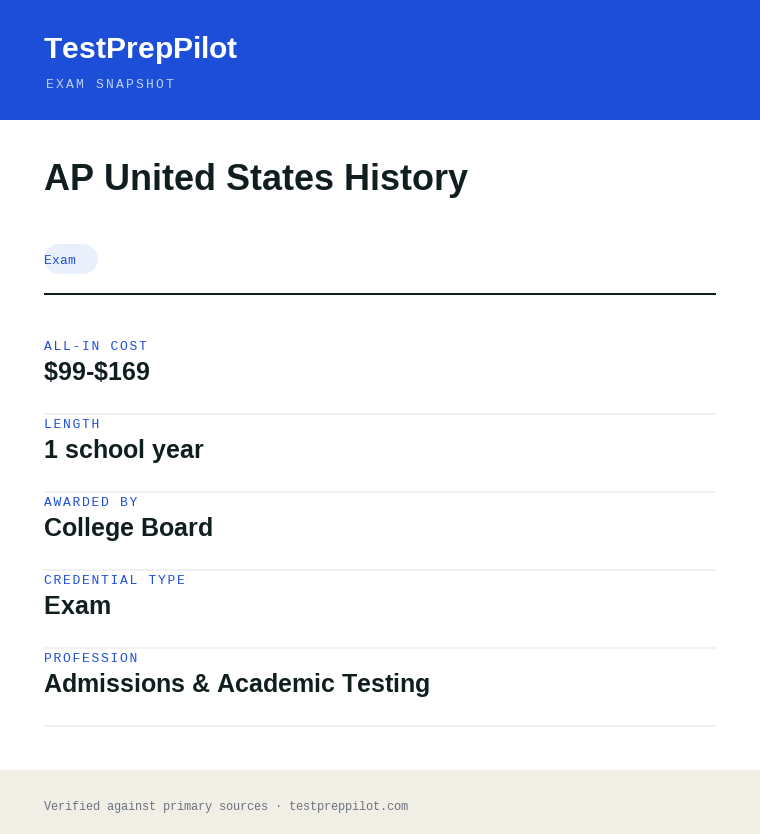
For the AP United States History, the exam fee is $99 (US) / $129 (intl); the all-in cost is typically $99-$169; most candidates spend 1 school year preparing.
Cost breakdown
| AP exam fee (US, territories, Canada, DoDEA) | $99 |
|---|---|
| AP exam fee (international) | $129 |
| Late order or unused/canceled exam | $40 |
| Fee reduction for eligible students | -$37 |
| Prep materials (optional) | $0-$40 |
| Typical total | $99 US / $129 intl (eligible students pay ~$53 / ~$83); late or canceled adds $40 |
Fees are the 2025-26 AP charges. Schools may add a local administrative fee; the College Board fee reduction lowers the base by $37.
Timeline
- Enroll in the AP course Fall
- Study the nine periods in order Aug-May
- Practice DBQ and LEQ essays 2-3 months
- Take the digital exam May
- Receive scores Early July
Typical prep: 1 school year
The path
How do you register for the AP United States History?
- 1
Find out which College Board test your school or college requires
AP exams are ordered by your school, and ACCUPLACER tests are bought by the institution that will place you, so the first step is to ask your AP coordinator or the college testing office which test applies. ACCUPLACER placement tests are Reading, Writing, Arithmetic, Quantitative Reasoning, Algebra, and Statistics, Advanced Algebra and Functions, and the WritePlacer essay.
- Ask the admissions or testing office which ACCUPLACER tests your placement needs
- Ask your AP coordinator which AP exams your school orders
- Ask whether your institution accepts multiple measures such as high school GPA
College Board does not publish a student price for ACCUPLACER because institutions buy test units and set what students pay.
- 2
Sign in to a College Board account and, for AP, register through your schoolOrder by November 13, 2026 to avoid the late fee
AP students join their course sections with a College Board account and the school's AP coordinator orders the exams. For the 2026-27 year, the order deadline for full-year and fall courses is November 13, 2026, and orders placed from November 14, 2026 through March 12, 2027 add a $40 late-order fee per exam.
- Create or sign in to your College Board account
- Join your AP class section using the code from your teacher
- Confirm your exam order and payment with the AP coordinator before the deadline
Unused or canceled exams after the November 13 deadline carry a $40 per-exam fee.
- 3
Book an ACCUPLACER session with the institution or an approved proctor
ACCUPLACER can be given in person at a college or test center, remotely through an approved remote proctoring vendor, or through a video conference with a certified proctor. Remote testing requires a private quiet room, a stable internet connection, a computer and a webcam, and the proctor checks your ID next to your face and scans the room on camera.
- Choose in-person or remote testing with the institution
- Check that your computer, webcam and room meet the remote rules if testing at home
- Ask about any accommodation request deadline
- 4
Bring acceptable photo ID on test day
For ACCUPLACER, acceptable photo ID includes a driver's license, state or federal ID, military ID, middle school, high school or college ID, a U.S. or foreign passport with the name in the Western alphabet, a tribal ID, or a naturalization card or certificate of citizenship. Student IDs must show your name and a recognizable photo and must be validated before testing.
- Check the ID list on the Get Ready for Test Day page
- Leave phones, tablets, watches, food and drink outside the testing room
Physical calculators are not allowed on any ACCUPLACER math test unless an approved accommodation allows one; an on-screen calculator appears on some questions.
- 5
Test, then read your score report and plan any retest
Placement tests report a 200-300 scaled score and the essay reports a 1-8 holistic score. AP exams report a 1-5 score after the May exam window. For ACCUPLACER, College Board recommends a retest no sooner than 14 days after the first attempt and a third attempt only after 90 days, but your institution may set its own rule.
- Compare your score band with the college placement table
- Ask about multiple-measures review if you disagree with a placement
- Send AP scores to colleges through your College Board account
The fine print
What are the retake and renewal rules for the AP United States History?
- Proctoring & delivery
- ACCUPLACER placement tests are computer adaptive and delivered online, in person or through approved remote proctoring or video-chat proctoring. AP Biology is a hybrid digital exam in which students answer multiple-choice questions and view free-response questions in the Bluebook app and handwrite free-response answers in paper booklets at school.
- Retake policy
- ACCUPLACER: College Board recommends a first retest 14 days after the initial test and a second retest only after 90 days, then 30-day gaps, but institutions may set their own policy, and the recommendation is mandatory for Ability to Benefit testing. AP: each exam is given once a year in May, so a retake means sitting the exam again the following year.
- Score reporting
- ACCUPLACER multiple-choice placement tests are scored on a 200-300 scale in seven bands (200-220, 221-230, 231-240, 241-250, 251-260, 261-270, 271-300). WritePlacer essays are scored 1-8. AP exams are scored 1-5, where 5 is extremely well qualified, 4 very well qualified, 3 qualified, 2 possibly qualified and 1 no recommendation.
- Recertification
- Neither ACCUPLACER scores nor AP scores expire as credentials, but colleges set how long they accept a placement score, and they decide which AP scores earn credit. There are no continuing education requirements. Use the AP credit policy search tool on the AP Students site to check a specific college.
- Refunds & rescheduling
- AP exam fees follow the school's order: the 2026-27 base fee is $99 per exam at U.S. schools (U.S. territories, Canada and DoDEA schools included) and $129 at other schools, with a $37 College Board fee reduction for eligible students. Exams canceled in AP Registration and Ordering after November 13 and by March 12 incur a $40 unused or canceled fee. ACCUPLACER refunds depend on the institution.
Context
College Board AP and ACCUPLACER compared
| Test family | Who arranges it | Fee | Score and use | Typical prep time | |
|---|---|---|---|---|---|
| AP exams (e.g. AP Biology) | School AP coordinator | $99 per exam (2026-27, U.S. schools); $129 elsewhere; $37 fee reduction for eligible students | 1-5; colleges decide credit and placement | A full school year of coursework | |
| ACCUPLACER placement tests | College, school or approved test center | Set by the institution; College Board publishes no student price | 200-300 scaled; colleges set cut scores | College Board suggests at least one week of practice per test subject |
What it pays
How much does this credential pay?
No direct occupation — AP U.S. History scores earn college credit and strengthen admissions, and the payoff is the degree-completion premium: bachelor’s-degree holders earned a median of $1,493/week vs $899 for high-school-only workers (BLS, 2023)
The direct answer is that the AP United States History exam has no BLS occupation of its own — it is a college-level assessment whose scores can earn college credit and strengthen admission applications — so the salary story is the education-return premium that AP credit accelerates. The relevant reference points from BLS: the May 2024 median wage across all occupations was $49,500; workers with a bachelor’s degree earned a median weekly wage of about $1,493 in 2023, versus about $899 for workers with only a high school diploma; and associate-degree holders sat between them at about $1,059. A score of 3 or higher on an AP exam is accepted for credit by the vast majority of four-year colleges, which can shorten time-to-degree and reduce tuition — the practical financial value of AP U.S. History is the credit hours it buys and the admissions signal it sends. AP U.S. History is one of the most-taken AP exams in the country, with hundreds of thousands of administrations each year, and its skills — reading primary and secondary sources, weighing evidence, constructing a written argument under time pressure — transfer directly to college humanities and social-science courses and to careers in law, government, journalism, and education, occupations whose earnings are generally above the all-occupation median, though no single BLS code corresponds to the exam. The honest framing is that AP’s value is twofold: the admissions signal colleges reward for demonstrated college-level rigor, and the credit each qualifying score earns, often replacing a 3-credit introductory survey course. For students deciding whether to take the exam, the investment is the exam fee and preparation time, and the payoff is measured in credits, admissions advantage, and the analytical writing skills that carry into college and career.
| Measure | Figure | Source / note |
|---|---|---|
| Reference: median wage, all occupations | $49,500 | BLS Occupational Outlook Handbook, May 2024 |
| Reference: bachelor’s degree, median weekly earnings | $1,493 | BLS Education Pays, 2023 ($77,636/yr equivalent) |
| Reference: high school diploma only, median weekly earnings | $899 | BLS Education Pays, 2023 |
| Reference: associate degree, median weekly earnings | $1,059 | BLS Education Pays, 2023 ($55,068/yr equivalent) |
| The exam itself | No direct occupation | A college-level credit exam, not a credential of record |
Job growth.BLS does not project growth for an AP exam; relevant projections follow the occupations the skills feed into.
Source: BLS Education Pays
Your odds
What are the pass rates?
College Board publishes annual score distributions — about 72% of AP U.S. History candidates scored 3 or higher in 2024, and the exam is scored 1-5 with 3 considered qualifying at most colleges
The core fact is that AP score data is published: the College Board reports annual score distributions for every AP subject, and the 2024 administration of AP United States History saw roughly 72 percent of candidates score 3 or higher, with about 13 percent scoring 5, 33 percent scoring 4, and 26 percent scoring 3. The exam is scored on a 1-5 scale, and a score of 3 or higher is considered "qualified" and accepted for credit by the majority of four-year institutions, though each college sets its own credit and placement policy — many require a 4 or 5, and credit amounts vary. The exam itself is 3 hours 15 minutes, delivered fully digital in the College Board Bluebook app: Section I Part A has 55 multiple-choice questions in 55 minutes (40 percent), Section I Part B has 3 short-answer questions in 40 minutes (20 percent), and Section II has the document-based question (DBQ) in 60 minutes including a 15-minute reading period (25 percent) plus the long essay in 40 minutes (15 percent). The published distributions are useful for planning: candidates who complete the AP course and a structured review with full-length timed practice sit within the range of the published qualifying rates. The honest advice is to treat the written sections as the differentiator — the DBQ and long essay together carry 40 percent of the score, and candidates who practise building evidence-based arguments from primary and secondary sources outperform those who focus on multiple choice alone. Exams are offered once per year in May, and scores arrive in July.
Read this before quoting the number.College Board publishes annual score distributions; the figures above are the 2024 administration and change each year.
Your schedule
How long should I study for it?
60-100 study hours over 8-12 weeks (or 4-6 week review after the AP course) of focused study
Plan for 8 to 12 weeks and 60 to 100 hours of study if the exam is outside an AP course, or a 4-to-6-week structured review if you are taking the AP course, weighted to the DBQ and long essay — they carry 40 percent of the score. The exam is 3 hours 15 minutes, fully digital in the Bluebook app: 55 multiple-choice questions in 55 minutes (40 percent), 3 short-answer questions in 40 minutes (20 percent), the document-based question in 60 minutes including a 15-minute reading period (25 percent), and one long essay in 40 minutes (15 percent). The most effective sequence is: first, take a full-length practice exam to baseline; second, master source analysis — reading primary and secondary texts, images, charts, and maps for point of view, purpose, and reliability; third, drill the DBQ structure, since it is the single highest-weighted item on the paper; fourth, practise the long essay with the three-option choice and the 40-minute clock; and fifth, take two more full-length timed practice exams in the final two weeks. The highest-yield habit is timed DBQ practice: the rubric rewards a clear thesis, the use of at least six of the seven documents as evidence, an additional outside piece of evidence, and sustained sourcing analysis. Budget the written sections the most time, because candidates who rehearse them score measurably higher. Note that the College Board has announced an update to the short-answer and long-essay questions of the AP history exams starting with the May 2027 administration — the course content will not change, but the question formats will, so confirm the blueprint for your exam year. The exam is offered once per year in May, so plan the review backward from the exam date and confirm your target colleges’ credit policies so you know the score you need.
- Weeks 1-220
Baseline + source analysis
- Take a full-length practice exam
- Master reading primary and secondary sources for point of view and purpose
- Log weak time periods by unit
- Weeks 3-535
Chronological content sweep
- Work the nine course units from 1491 to the present in order
- Build a timeline of themes: identity, work and exchange, politics, migration
- Learn the document-based question rubric and practise one DBQ per week
- Weeks 6-830
DBQ and long essay mastery
- Drill the DBQ: thesis, six-document use, outside evidence, sourcing analysis
- Practise the long essay with the 3-option choice under 40-minute timing
- Review scoring guidelines and Chief Reader feedback
- Weeks 9-1015
Timed full exams
- Take two full-length 3h15m practice exams in the Bluebook-style interface
- Re-study only the units and question types where you missed points
- Taper with light review of rubrics and essay planning
Adjusting the pace
AP World History: Modern.The parallel world-history exam with the identical 3h15m structure (55 MC, 3 SAQs, DBQ, LEQ), covering developments from c. 1200 to the present.
College credit policies.Each college sets its own AP credit and placement policy; check your target schools’ published AP charts.
How to study
How do I prepare most effectively?
The strategy that reliably moves AP U.S. History scores is "weight the two essays, master source analysis, and run full-length timed exams," and the single biggest error is memorising facts while the written sections carry 40 percent of the score. A second proven approach is learning the published rubrics for the document-based question and the long essay: the DBQ rewards a clear thesis, use of the documents as evidence, at least one outside piece of evidence, and sustained sourcing analysis of point of view or purpose, while the long essay rewards a defensible thesis supported by concrete historical evidence. Third, practise reading sources actively — when you meet a primary or secondary text, an image, a chart, or a map, name who produced it, why, and what it can and cannot tell you, because the multiple-choice section is built around exactly that skill. Fourth, use the full-length practice exam as the calibration tool: the 3-hour-15-minute format is a stamina test, and practice scores are the honest readiness signal. Fifth, master the pacing: roughly a minute per multiple-choice question, about 13 minutes per short answer, 60 minutes for the DBQ (including the 15-minute reading period), and 40 minutes for the long essay. Finally, confirm your target colleges’ credit policies early so you know whether you need a 3, 4, or 5, and remember that candidates who practise writing full essays from blank are the ones who finish both essays with developed arguments.
Weight the DBQ and long essay
The written sections carry 40 percent of the score; drill both essay formats every week.
Learn the published rubrics
The DBQ rubric rewards thesis, document use, outside evidence, and sourcing analysis; the LEQ rewards a defensible thesis with concrete evidence.
Read sources actively
Name the producer, purpose, and limits of every primary and secondary source you meet — that is the multiple-choice skill.
Run full-length timed exams
The 3h15m format is a stamina test; rehearse it at least twice in the final weeks.
Master essay pacing
60 minutes on the DBQ including reading time, 40 minutes on the long essay; finish both.
Know your credit target
Some colleges require a 4 or 5 for credit; confirm your target schools’ AP charts before the exam.
What to buy
Which study resources are worth paying for?
AP U.S. History preparation is dominated by free official resources — the College Board exam page, the Course and Exam Description, past free-response questions with scoring guidelines, and released stimulus material — with the exam fee (about $98, with fee reductions available for qualifying students) as the main cost. The comparison below separates official and commercial resources, with prices current to this review. The buying rule is to use the free official resources first, especially the released DBQs and their scoring guidelines, and treat commercial review books as structured supplements for chronological content rather than as the syllabus itself.
| Resource | Price | Format | Best for |
|---|---|---|---|
| College Board exam page & Course and Exam Description | Free | Official PDFs and sample questions | The authoritative syllabus and rubric definitions |
| College Board past free-response questions & scoring guidelines | Free | PDF archive | DBQ and long-essay practice with official scoring |
| AP exam registration | ~$98 | May exam administration | The exam itself |
| Review books (e.g. AMSCO, Princeton Review, Barron’s) | ~$20-35 | Printed book + online | Chronological content review and drill sets |
| Full-length practice exams | ~$10-40 | Online or book | Format calibration under real timing |
| Heimler’s History or similar video reviews | Free tier; ~$20-30 for courses | Video + downloadable notes | Unit-by-unit review near the exam |
Prices approximate and dated to this review (2026-08); the exam is offered once per year in May, with fee reductions available for qualifying students. The College Board has announced updates to the short-answer and long-essay formats starting May 2027.
Avoid these
What mistakes do candidates most often make?
The most common mistake is memorising names and dates while the DBQ and long essay carry 40 percent of the score; the second is writing essays without practising the published rubrics, losing points on thesis and evidence requirements. A third recurring error is mismanaging the 3-hour-15-minute clock — spending the whole DBQ time on reading and running out of writing time, or rushing the long essay. Candidates also routinely use documents without sourcing them, treating the DBQ as a summary exercise rather than an argument, and many skip the full-length practice exams and fail on stamina. Finally, some students ignore their target colleges’ credit policies and aim for a 3 when their schools require a 4 or 5.
✕Memorising facts instead of practising writing
✓The DBQ and long essay carry 40 percent of the score; weight practice accordingly.
✕Writing essays without the rubrics
✓Learn what each rubric rewards: thesis, document use, outside evidence, and sourcing analysis.
✕Poor essay pacing
✓60 minutes for the DBQ including the reading period, 40 minutes for the long essay; finish both.
✕Using documents without sourcing them
✓In the DBQ, analyse point of view, purpose, and limits rather than merely citing the documents.
✕Skipping full-length practice exams
✓The 3h15m format is a stamina test; take at least two timed full exams.
✕Ignoring college credit policies
✓Check target schools; some require 4 or 5 for credit or award more credits for higher scores.
What you'll face
What question types will I see?
The AP United States History exam is 3 hours 15 minutes, delivered fully digital in the College Board Bluebook app, and scored on the 1-5 scale with 3 considered qualifying at most colleges. Section I Part A is 55 multiple-choice questions in 55 minutes (40 percent), mostly grouped in sets of 3-4 questions built around a primary or secondary source, an image, a chart, or a map; Section I Part B is 3 short-answer questions in 40 minutes (20 percent) asking for brief written analysis of sources or general propositions; and Section II (40 percent) is the document-based question in 60 minutes including a 15-minute reading period (25 percent) plus one long essay in 40 minutes (15 percent), chosen from three options. The samples below are editor-written illustrations of the published question styles, not live exam items. Because the exam is fully digital, every section is answered in the Bluebook app, and there is no penalty for wrong answers on the multiple-choice questions, so answer everything.
Sets of 3-4 questions tied to a primary or secondary text, image, chart, or map; rewards analysis of point of view, purpose, and historical context.
Three brief written responses, often source-based; the first two are required and the third is chosen from two options.
A 60-minute essay built on seven documents; rewarded for thesis, six-document use, one outside piece of evidence, and sourcing analysis.
A 40-minute essay chosen from three options on a common reasoning process; rewarded for a defensible thesis and concrete evidence.
Try these
Q1An AP U.S. History multiple-choice set includes a political cartoon from the 1890s and a contemporary editorial. Which analytical move best demonstrates historical reasoning about both sources together?
Answer:B
The multiple-choice section rewards historical thinking skills: placing sources in context, identifying point of view, and making connections. B is the only option that analyses both sources analytically. A is description, C imports a modern judgment the exam does not reward, and D is summary, which earns no credit for analysis.
Q2In the document-based question, which of the following earns credit for "sourcing" a document?
Answer:B
The DBQ rubric awards a sourcing point for explaining the significance of a document’s point of view, purpose, audience, or historical context. B names the move directly. A is quotation without analysis, C is unused evidence, and D is summary, which helps build an argument but does not itself earn the sourcing point.
Q3A long-essay prompt asks you to explain the causes of the Civil War. The strongest thesis would:
Answer:B
The long-essay rubric rewards a defensible thesis that responds to the prompt and is supported with specific evidence. B builds the roadmap the rubric wants. A is a list without an argument, C avoids the claim the prompt demands, and D provides too little scope for a 40-minute essay.
Samples are editor-written illustrations of the published question styles, not live exam items.
The big day
What should I expect on exam day?
The AP United States History exam is administered once per year in May and is now fully digital, delivered in the College Board Bluebook app, either on a school-issued device at your school or through the digital administration process. The total time is 3 hours 15 minutes, split into Section I Part A (55 multiple-choice questions in 55 minutes), Section I Part B (3 short-answer questions in 40 minutes), and Section II (the DBQ in 60 minutes including a 15-minute reading period, plus the long essay in 40 minutes), with a short break between the sections. The core rules: bring a photo ID and your admission ticket; a calculator is not needed for this exam. Scores are released in July on the 1-5 scale, and you will see your score in your College Board account. The most useful exam-day habits: pace the multiple choice at about a minute per question, spend about 13 minutes per short answer, give the DBQ the full hour including planning and reading time, and hold the long essay to 40 minutes — the two essay sections are where the highest-scoring candidates separate themselves. If you are aiming for credit, confirm your target schools’ policies before the exam so you know the score you need, and note that AP scores can be sent to colleges through your College Board account after the July release.
Bring
- Photo ID
- Admission ticket
- A charged school-issued device with the Bluebook app installed (per your school’s digital administration policy)
- Water and snacks for the break (per school policy)
Leave at home
- Phone and smartwatch (per testing rules)
- Study materials (not allowed in the testing room)
How the day runs
Rules in the room
- Once per year in May
- 3 hours 15 minutes total
- Fully digital in the College Board Bluebook app
- Scored 1-5; 3 considered qualifying at most colleges
- No penalty for wrong answers on multiple choice
Afterwards.Your AP score can earn college credit and strengthen applications; send scores to colleges through your College Board account after the July release. Note that the short-answer and long-essay formats of the AP history exams are being updated starting with the May 2027 administration.
Reference
What are the key facts about the AP United States History?
AP United States History is a exam credential; awarded by College Board; the exam fee is $99 (US) / $129 (intl); typical preparation is 1 school year.
| Credential | AP United States History |
|---|---|
| Abbreviation | APUSH |
| Type | Exam |
| Profession | Admissions & Academic Testing |
| Specialty | Advanced Placement |
| Awarded by | College Board |
| Difficulty | Moderate |
| Typical prep time | 1 school year |
| All-in cost | $99-$169 |
| Score scale | 1 to 5 |
| Credit | 3+ typically earns U.S. history credit |
| Essays | DBQ and long essay (LEQ) |
| Delivery | Fully digital in Bluebook |
| Exam timing | Early May |
| Scope | National / Multi-state |
Real questions
Frequently asked questions about the AP United States History
How many credits is APUSH worth?
Most colleges grant three to six credits for a 3 or higher toward a U.S. history requirement. Selective schools may require 4 or 5.
Is AP U.S. History hard?
The content volume is large, but the essay rubrics are consistent. Students who practice the DBQ and LEQ formats do well.
What is the DBQ?
The document-based question gives you seven sources and asks you to build an argument using them, demonstrating historical reasoning under a time limit.
What score do I need for credit?
A 3 is the typical threshold; many universities want 4 or 5 for placement out of introductory history.
Can I self-study?
Yes, with a timeline-based review book and past DBQ/LEQ practice. Register for the exam through a school.
Do College Board test scores expire?
College Board does not put an expiry date on ACCUPLACER or AP scores, but colleges decide how long they accept a placement score and which AP scores earn credit. Ask the testing office how recent an ACCUPLACER score must be, and use the AP credit policy search tool to see what each college grants for each AP score.
Who sets the passing score on an ACCUPLACER test?
No one passes or fails an ACCUPLACER test. College Board reports a 200-300 scaled score and each college sets its own cut scores for placing students into courses. The only College Board passing scores are the Ability to Benefit values for federal financial aid: Reading 233, Writing 235 and Arithmetic 230.
How much does an AP exam cost?
The base fee for 2026-27 is $99 per AP exam at schools in the U.S., U.S. territories, Canada and DoDEA schools, and $129 at schools elsewhere. Eligible students get a $37 College Board fee reduction. Schools can add their own charges, and late orders between November 14, 2026 and March 12, 2027 add a $40 fee.
In short
Is the AP United States History worth it?
- College survey of U.S. history since 1491
- 55 MCQ, 3 SAQ, a DBQ, and a long essay
- Fully digital in Bluebook
- Scored 1-5; a 3 generally earns credit
Same awarding body
What other credentials does College Board award?
Worth comparing
How does the AP United States History compare with similar credentials?
Trust
Where does this information come from?
Everything above is taken from the awarding body's own published material. Fees, question counts and domain weights are revised regularly — check the official page before you pay.
- College Board Awarding body
- Official AP United States History exam page Exam page
- College Board certification programme Programme rules
Research confidence: high · Last reviewed 2026-08