Admissions & Academic Testing • Exam
AP Macroeconomics
Earn intro macroeconomics credit with national income and policy.
Researched and maintained by TestPrepPilot Editorial BoardAdvanced Placement & college-credit desk · Figures last verified August 2026
The short version
What is the AP Macroeconomics and is it worth it?
AP Macroeconomics is a hybrid digital exam: 60 multiple-choice questions in 70 minutes and three free-response questions in 60 minutes. Scored 1-5, a 3 generally earns introductory macroeconomics credit.
- Equivalent to a first-semester college macro course
- Graph-driven free-response rewards clear models
- Hybrid digital (Bluebook MCQ, paper FRQ)
- Pairs naturally with AP Microeconomics
What is it?
What exactly is the AP Macroeconomics?
Earn intro macroeconomics credit with national income and policy.
AP Macroeconomics is a hybrid digital exam covering national income, inflation, unemployment, fiscal and monetary policy, and international trade at the introductory college level. It pairs 60 multiple-choice questions with three free-response questions that often include graphs. A 3 typically earns credit for a first-semester macroeconomics course at public universities.
The path in brief
- Join AP Macro via My AP
- Study the 6 CED units
- Practice graph-based FRQs
- Use AP Classroom progress checks
- Sit the hybrid digital exam in May
Before you book
Who is eligible to sit the AP Macroeconomics?
Who it is for: High-school students needing economics or business credit
The test itself
What is the format of the AP Macroeconomics?
The AP Macroeconomics is administered by School-administered, Bluebook + paper FRQ and runs 2 hours 10 minutes, contains 60 multiple choice + 3 free response questions and requires 3 (1-5 scale) to pass.
| Administered by | School-administered, Bluebook + paper FRQ |
|---|---|
| Questions | 60 multiple choice + 3 free response |
| Time limit | 2 hours 10 minutes |
| Pass mark | 3 (1-5 scale) |
| Exam fee | $99 (US) / $129 (intl) |
| Format | Hybrid digital |
Content outline
What topics are on the AP Macroeconomics?
The AP Macroeconomics is weighted across 6 domains; the largest are Unit 5: Stabilization (20-30%), Unit 4: Financial Sector (18-23%), Unit 3: National Income and Price (17-27%).
Weightings come from the official exam outline. Study time is best allocated in roughly these proportions rather than evenly across domains.
- Unit 1: Basic Economic Concepts 5-10%
Scarcity, opportunity cost
- Unit 2: Economic Indicators 12-17%
GDP, inflation, unemployment
- Unit 3: National Income and Price 17-27%
AD/AS model
- Unit 4: Financial Sector 18-23%
Money, banking, monetary policy
- Unit 5: Stabilization 20-30%
Fiscal policy, multipliers
- Unit 6: Open Economy 10-13%
Trade, exchange rates
Study materials
Which study guide should you use for the AP Macroeconomics?
Start with the exam sponsor's official content outline. If you also want one structured resource to work through, these are the Mometrix titles that match this exam.
This links to Mometrix's AP range rather than a single AP Macroeconomics title. Check that it lists an edition for AP Macroeconomics before you buy.
Affiliate links We may earn a commission if you buy through these links, at no extra cost to you. Mometrix has no say in what our exam guides cover. How we make money.
Money & time
How much does the AP Macroeconomics cost?
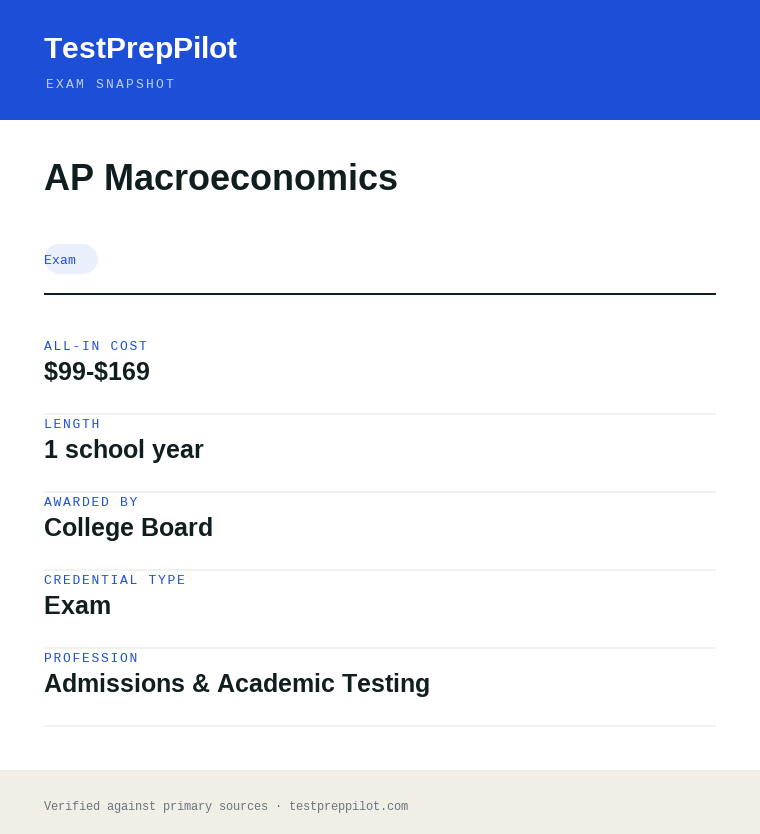
For the AP Macroeconomics, the exam fee is $99 (US) / $129 (intl); the all-in cost is typically $99-$169; most candidates spend 1 school year preparing.
Cost breakdown
| AP exam fee (US, territories, Canada, DoDEA) | $99 |
|---|---|
| AP exam fee (international) | $129 |
| Late order or unused/canceled exam | $40 |
| Fee reduction for eligible students | -$37 |
| Prep materials (optional) | $0-$40 |
| Typical total | $99 US / $129 intl (eligible students pay ~$53 / ~$83); late or canceled adds $40 |
Fees are the 2025-26 AP charges. Schools may add a local administrative fee; the College Board fee reduction lowers the base by $37.
Timeline
- Enroll in the AP course Fall
- Study the six units Aug-May
- Practice graph FRQs 2-3 months
- Take the hybrid exam May
- Receive scores Early July
Typical prep: 1 school year
The path
How do you register for the AP Macroeconomics?
- 1
Find out which College Board test your school or college requires
AP exams are ordered by your school, and ACCUPLACER tests are bought by the institution that will place you, so the first step is to ask your AP coordinator or the college testing office which test applies. ACCUPLACER placement tests are Reading, Writing, Arithmetic, Quantitative Reasoning, Algebra, and Statistics, Advanced Algebra and Functions, and the WritePlacer essay.
- Ask the admissions or testing office which ACCUPLACER tests your placement needs
- Ask your AP coordinator which AP exams your school orders
- Ask whether your institution accepts multiple measures such as high school GPA
College Board does not publish a student price for ACCUPLACER because institutions buy test units and set what students pay.
- 2
Sign in to a College Board account and, for AP, register through your schoolOrder by November 13, 2026 to avoid the late fee
AP students join their course sections with a College Board account and the school's AP coordinator orders the exams. For the 2026-27 year, the order deadline for full-year and fall courses is November 13, 2026, and orders placed from November 14, 2026 through March 12, 2027 add a $40 late-order fee per exam.
- Create or sign in to your College Board account
- Join your AP class section using the code from your teacher
- Confirm your exam order and payment with the AP coordinator before the deadline
Unused or canceled exams after the November 13 deadline carry a $40 per-exam fee.
- 3
Book an ACCUPLACER session with the institution or an approved proctor
ACCUPLACER can be given in person at a college or test center, remotely through an approved remote proctoring vendor, or through a video conference with a certified proctor. Remote testing requires a private quiet room, a stable internet connection, a computer and a webcam, and the proctor checks your ID next to your face and scans the room on camera.
- Choose in-person or remote testing with the institution
- Check that your computer, webcam and room meet the remote rules if testing at home
- Ask about any accommodation request deadline
- 4
Bring acceptable photo ID on test day
For ACCUPLACER, acceptable photo ID includes a driver's license, state or federal ID, military ID, middle school, high school or college ID, a U.S. or foreign passport with the name in the Western alphabet, a tribal ID, or a naturalization card or certificate of citizenship. Student IDs must show your name and a recognizable photo and must be validated before testing.
- Check the ID list on the Get Ready for Test Day page
- Leave phones, tablets, watches, food and drink outside the testing room
Physical calculators are not allowed on any ACCUPLACER math test unless an approved accommodation allows one; an on-screen calculator appears on some questions.
- 5
Test, then read your score report and plan any retest
Placement tests report a 200-300 scaled score and the essay reports a 1-8 holistic score. AP exams report a 1-5 score after the May exam window. For ACCUPLACER, College Board recommends a retest no sooner than 14 days after the first attempt and a third attempt only after 90 days, but your institution may set its own rule.
- Compare your score band with the college placement table
- Ask about multiple-measures review if you disagree with a placement
- Send AP scores to colleges through your College Board account
The fine print
What are the retake and renewal rules for the AP Macroeconomics?
- Proctoring & delivery
- ACCUPLACER placement tests are computer adaptive and delivered online, in person or through approved remote proctoring or video-chat proctoring. AP Biology is a hybrid digital exam in which students answer multiple-choice questions and view free-response questions in the Bluebook app and handwrite free-response answers in paper booklets at school.
- Retake policy
- ACCUPLACER: College Board recommends a first retest 14 days after the initial test and a second retest only after 90 days, then 30-day gaps, but institutions may set their own policy, and the recommendation is mandatory for Ability to Benefit testing. AP: each exam is given once a year in May, so a retake means sitting the exam again the following year.
- Score reporting
- ACCUPLACER multiple-choice placement tests are scored on a 200-300 scale in seven bands (200-220, 221-230, 231-240, 241-250, 251-260, 261-270, 271-300). WritePlacer essays are scored 1-8. AP exams are scored 1-5, where 5 is extremely well qualified, 4 very well qualified, 3 qualified, 2 possibly qualified and 1 no recommendation.
- Recertification
- Neither ACCUPLACER scores nor AP scores expire as credentials, but colleges set how long they accept a placement score, and they decide which AP scores earn credit. There are no continuing education requirements. Use the AP credit policy search tool on the AP Students site to check a specific college.
- Refunds & rescheduling
- AP exam fees follow the school's order: the 2026-27 base fee is $99 per exam at U.S. schools (U.S. territories, Canada and DoDEA schools included) and $129 at other schools, with a $37 College Board fee reduction for eligible students. Exams canceled in AP Registration and Ordering after November 13 and by March 12 incur a $40 unused or canceled fee. ACCUPLACER refunds depend on the institution.
Context
College Board AP and ACCUPLACER compared
| Test family | Who arranges it | Fee | Score and use | Typical prep time | |
|---|---|---|---|---|---|
| AP exams (e.g. AP Biology) | School AP coordinator | $99 per exam (2026-27, U.S. schools); $129 elsewhere; $37 fee reduction for eligible students | 1-5; colleges decide credit and placement | A full school year of coursework | |
| ACCUPLACER placement tests | College, school or approved test center | Set by the institution; College Board publishes no student price | 200-300 scaled; colleges set cut scores | College Board suggests at least one week of practice per test subject |
What it pays
How much does this credential pay?
AP Macroeconomics has no direct salary outcome — its value is college credit and placement, and the earnings impact flows through the bachelor’s-degree wage premium.
AP Macroeconomics has no direct salary outcome, because the AP program is a college-credit and placement system rather than a job certification, so the BLS publishes no wage for an AP score; the earnings story runs through the credit it earns and the degree it accelerates. A qualifying score (3 or higher at most colleges, 4 or 5 at selective schools) can satisfy an introductory economics requirement — usually the macro half of a two-term principles sequence — and the real wage context is the BLS college-earnings premium: workers with a bachelor’s degree earn substantially more over a career than workers with a high-school diploma alone, and economics graduates are among the higher-earning bachelor’s fields BLS tracks in its field-of-degree data. That context matters for a subject like macroeconomics, because the credit it buys is usually the macroeconomics principles course that business, finance, economics, and many pre-professional programs require, and clearing it before enrolling shortens time to degree and tuition cost. The practical value is concrete — at a school charging $30,000-60,000 in annual tuition, skipping a general-education or business-core course can be worth thousands of dollars — but the honest caveat is that credit policy varies by college. Some business schools grant credit only for a 4 or 5, some require both AP Macro and AP Micro together to place out of the two-term principles sequence, and some majors prefer to take the course in-house for grade-point purposes. The other caveat is that macroeconomics content — GDP, inflation, unemployment, monetary and fiscal policy, and international trade — is abstract compared with the microeconomics side, and the exam rewards model-based reasoning rather than memorisation of facts. So the direct answer for a candidate asking whether AP Macro pays is: it pays through credit and placement at colleges that accept it, and it is a strategically useful exam for business and finance track students; check the target school’s AP credit table before treating any score as a guarantee.
| Measure | Figure | Source / note |
|---|---|---|
| Annual test-takers | ~190,000 | One of the most-taken AP exams; May 2025 administration (College Board) |
| Score scale | 1-5 | 3+ typically qualifies for credit; 4-5 at selective schools |
| Exam length | 2h 10m | 60 MC (70 min) + 3 FRQs (60 min including a 10-min reading period) |
| Exam fee | ~$99 | Standard College Board fee in U.S. schools; $129 international |
| Salary impact | Indirect | College credit and placement; economics is a higher-earning bachelor’s field |
Job growth.AP Macroeconomics volume tracks the growth of the AP program and consistently ranks among the most-taken AP social-science exams; the College Board reports multi-million total AP administrations per year.
Your odds
What are the pass rates?
The College Board publishes score distributions, not pass rates; 67.3% of the May 2025 test-takers scored 3 or higher, up modestly from 65.1% in 2024 and 64.7% in 2023.
The direct answer on pass rates requires precision: the College Board does not publish a "pass rate" for AP Macroeconomics because scores are reported on a 1-5 scale and each college decides what qualifies for credit, but the College Board does publish the annual score distribution for every AP subject, which is the closest published statistic. For AP Macroeconomics in May 2025, 67.3 percent of test-takers scored 3 or higher — 20.4 percent earned a 5, 22.9 percent a 4, and 24.0 percent a 3 — up from 65.1 percent in 2024 and 64.7 percent in 2023; the qualifying share has been remarkably stable in the mid-60s for the past three cycles. The exam structure is fixed and published: Section I has 60 multiple-choice questions in 70 minutes (roughly 66 percent of the score), and Section II has 3 free-response questions in 60 minutes, including a 10-minute reading period (roughly 33 percent) — one long FRQ worth 10 points and two short FRQs worth 5 points each, with the point values multiplied by 1.5 in the composite. A four-function calculator is permitted on the exam. The practical read on difficulty: AP Macro rewards model-based reasoning — shifting the aggregate demand and supply curves, the money market, the loanable funds market, and the Phillips curve — and the free-response section is where the 3-to-5 distinction is made, because graders award points part by part for correctly labelled graphs and causal explanations. Candidates who master the fixed set of models and practise the FRQ formats score higher than candidates who only drill multiple choice, and because the credit value depends on the college’s policy, the smart approach is to check the target colleges’ AP credit tables before deciding whether a 3 is enough or a 5 is required.
Read this before quoting the number.The College Board publishes score distributions, not pass rates; whether a 3, 4, or 5 "passes" depends on each college’s AP credit policy.
Source: College Board AP Macroeconomics score distribution report
Your schedule
How long should I study for it?
40-60 hours over 8-10 weeks of focused study
A realistic AP Macroeconomics study plan runs 40-60 hours over 8-10 weeks, because the exam tests a fixed set of economic models and the fastest score gains come from mastering the models and drilling the graph-based free responses that carry roughly a third of the score. The College Board course and exam description is the scope map: the course is organized around six units — Basic Economic Concepts; Economic Indicators and the Business Cycle; National Income and Price Determination; Financial Sector; Long-Run Consequences of Stabilization Policies; and Open Economy — International Trade and Finance — with the multiple-choice section (60 questions, 70 minutes, about 66 percent) and the free-response section (3 questions, 60 minutes including a 10-minute reading period, about 33 percent). The study window should split into model coverage (weeks 1-6) and free-response and multiple-choice drilling (weeks 7-8), followed by full practice exams (weeks 9-10): the core models — aggregate demand and aggregate supply, the money market, the loanable funds market, the Phillips curve, and the foreign exchange market — are a fixed, testable set, and candidates who can shift each curve and explain the causal chain in words answer both section types faster. Students taking the course in school should budget the lower end; self-studying candidates should budget the upper end and add a review book or course to structure the content. The final two weeks should be full practice exams at the real format — 60 multiple-choice in 70 minutes and 3 free-response in 60 minutes — because the graph-labelling discipline and the causal-language habit are the two things candidates underestimate, and the score ceiling on AP Macro comes from the free-response section.
- Weeks 1-210 hrs
Foundations and indicators
- Study Basic Economic Concepts: scarcity, opportunity cost, PPC, comparative advantage
- Cover Economic Indicators: GDP, unemployment, inflation, the business cycle
- Practise calculating nominal and real GDP and the CPI
- Weeks 3-411-12 hrs
Aggregate demand and supply
- Study National Income and Price Determination: AD-AS model, fiscal policy
- Master the multiplier effect and automatic stabilisers
- Practise shifting AD and AS curves and predicting equilibrium changes
- Weeks 5-611-12 hrs
Financial sector and policy
- Cover the Financial Sector: money, banking, the money market, monetary policy
- Study Long-Run Consequences: Phillips curve, crowding out, economic growth
- Do timed sets on the money market and loanable funds graphs
- Week 7-812 hrs/week
Free-response drilling
- Drill the long FRQ: graphs plus multi-part causal explanations
- Practise the two short FRQs, including the open-economy foreign exchange market
- Take two full 60-MC + 3-FRQ practice exams and score by rubric
- Weeks 9-1010-11 hrs
Full exams and readiness
- Take two more full practice exams, targeting 4+ then 5
- Re-drill missed models, prioritising AD-AS shifts and the money market
- Confirm registration logistics, calculator rules, and the exam-day format
Adjusting the pace
Taking the course in school.Budget the lower end and weight time toward graph-labelling and free-response formats; the course covers the six units.
Self-study.Budget the upper end and add a structured review book or course; macro models are abstract, so a second source helps.
How to study
How do I prepare most effectively?
The dominant prep strategy for AP Macroeconomics is to master the fixed set of economic models and practise the graph-labelling and causal-explanation habits that the free-response section rewards, because roughly a third of the score comes from three free responses graded part by part. First, get the College Board course and exam description and use it as the checklist: the six units, the exam formats, and the fact that a four-function calculator is permitted are all published, and studying the models in unit order is the highest-yield plan. Second, learn to shift each core curve correctly — aggregate demand and supply, the money market, the loanable funds market, the Phillips curve, and the foreign exchange market — because the multiple-choice section and the long FRQ both test whether you can predict the direction and magnitude of a shift and its effect on the equilibrium. Third, drill the free-response format deliberately: the long FRQ asks for labelled graphs plus multi-part explanations, and graders award points part by part, so a complete answer to an easier part is worth more than a partial answer to a harder one, and every graph needs labelled axes, labelled curves, and a marked equilibrium. Fourth, practise writing causal explanations in the graders’ language: "AD increases because government spending rises, shifting the curve right, raising the price level and real GDP" earns the point, while "AD shifts" alone does not. Fifth, run full practice exams at the real timing — 60 MC in 70 minutes and 3 FRQs in 60 minutes including the reading period — because the pacing is the constraint most candidates underestimate. Finally, confirm the target colleges’ AP credit policies, because the value of a 3 versus a 5 depends on where the score is being sent. A further high-yield tactic is to build a one-page model map that shows each model, its axes, and its key shifters, and to re-drill the two or three models where you most often mislabel a curve.
Use the course and exam description as the checklist
Six units, both section formats, and the calculator rule are published; study the models in unit order.
Master shifting the core curves
AD-AS, money market, loanable funds, Phillips curve, and foreign exchange; predict the direction and the new equilibrium.
Drill the graph-labelling discipline
Every graph needs labelled axes, labelled curves, and a marked equilibrium; points are awarded part by part.
Write causal explanations in grader language
State the direction of change and the reason; "AD increases because government spending rises" earns points, "AD shifts" does not.
Build a one-page model map
Each model, its axes, and its key shifters on one sheet; re-drill the models where you mislabel a curve.
What to buy
Which study resources are worth paying for?
AP Macroeconomics prep resources split into the College Board official set, review books, online courses, and practice-exam question banks, and the buying logic is anchored by the official materials because the College Board publishes the course and exam description, past free-response questions, scoring guidelines, and sample questions for free. The official free set — the CED plus past FRQs with scoring guidelines — defines the content and the scoring standards precisely, and the past FRQs are especially valuable for macro because they show exactly how the graph-labelling and causal-explanation points are awarded. Review books from major publishers, roughly $15-35, add structured unit coverage and practice exams, which helps both course-takers and self-studiers; the well-regarded options are those that track the current six-unit framework. Online courses and question banks, roughly $40-120, add video instruction and drilling, which helps self-studying candidates who want structure and pacing. The footnote that anchors the comparison: prices below are approximate list prices as of mid-2026 and change frequently, and we rank nothing by commission. The exam fee is about $99 per AP exam (plus any school or state fees), with fee reductions available for eligible students, so the total cost of AP Macro is modest relative to the tuition value of earned credit. A cheap readiness check is the free sample questions and one past FRQ set from the College Board before buying anything, because candidates who already took the course often need only the review book plus full practice exams. Candidates should also verify the school’s AP exam registration process and deadline, because late registration fees and missed windows are the most common avoidable costs in this program.
| Resource | Price | Format | Best for |
|---|---|---|---|
| College Board official materials | Free | CED + past FRQs + scoring guidelines | The authoritative content and scoring standards |
| AP Macroeconomics review book | $15-35 | Book with unit reviews and practice | Structured coverage for any candidate |
| Online course / question bank | $40-120 | Video + drilling | Self-studiers wanting structure and pacing |
| AP exam registration | ~$99 | School / College Board | The real exam; fee reductions available |
| College Board sample questions | Free | Online practice items | Cheap readiness check before buying anything |
| AP Classroom (enrolled students) | Free with the course | Online progress checks and FRQ practice | Course-takers whose teacher assigns the work |
Prices are approximate list prices as of mid-2026 and change frequently; we rank nothing by commission. The AP exam fee is ~$99 with reductions for eligible students.
Avoid these
What mistakes do candidates most often make?
The most common mistake on AP Macroeconomics is learning the models at the level of "what shifts" without mastering "which direction and why", because the multiple-choice section and the long free response both test whether you can predict the direction of a curve shift and its effect on the equilibrium, and half an understanding produces confident wrong answers. The second is sloppy graph labelling: the free-response graders award points part by part, and a graph with unlabelled axes, an unlabelled curve, or no marked equilibrium loses points even when the shift direction is correct. A third recurring error is writing causal explanations without the causal chain — "AD shifts" or "the interest rate changes" — when the scoring guidelines reward statements of the direction of change and the reason, such as "government spending rises, shifting AD right, raising the price level and real GDP". Candidates also routinely neglect the short free responses in favour of the long one, when the two short FRQs are each worth a meaningful share and their formats — often one model-focused question and one open-economy question — are fully drillable. Another pattern is never running a full practice exam, so the 70-minute multiple-choice pace and the 60-minute three-question free-response block surprise them on test day. Finally, some candidates confuse macro and micro models, for example drawing a firm-level supply curve where the aggregate supply curve belongs, or applying the money market logic to the loanable funds market; a one-page model map fixes most of these.
✕Learning "what shifts" without "which direction and why"
✓Practise predicting the direction of each shift and its effect on the equilibrium until it is automatic.
✕Sloppy graph labelling
✓Label every axis, every curve, and the equilibrium point on every practice graph; points are awarded part by part.
✕Writing explanations without the causal chain
✓State the direction of change and the reason, using the scoring-guideline language, on every practice FRQ.
✕Neglecting the two short FRQs
✓Each short FRQ is fully drillable; practise the model-focused and open-economy formats as deliberately as the long one.
✕Never running a full practice exam
✓The 70-minute MC pace and the 3-FRQ block need full-length rehearsal, not just section drills.
✕Confusing macro and micro models
✓Keep a one-page model map with each model, its axes, and its shifters, and re-drill the models you mislabel.
What you'll face
What question types will I see?
The AP Macroeconomics exam is 2 hours 10 minutes: 60 multiple-choice questions in 70 minutes (roughly 66 percent of the score) and 3 free-response questions in 60 minutes, including a 10-minute reading period (roughly 33 percent), scored on the 1-5 scale, with a four-function calculator permitted. The multiple-choice section draws on all six course units through discrete items and graph-based items that test model shifts, equilibrium changes, and policy effects; the free-response section has a fixed shape — one long question worth 10 points and two short questions worth 5 points each, with point values multiplied by 1.5 in the composite — covering the AD-AS model, the money market, the loanable funds market, the Phillips curve, and the open-economy foreign exchange market, and requiring labelled graphs plus causal explanations. Because the exam is hybrid digital, the multiple-choice answers are entered in the Bluebook app while the free-response answers are handwritten in a paper booklet. Section I counts roughly 66 percent of the composite and Section II roughly 33 percent, with the composite converted to the 1-5 scale; the long FRQ is worth 10 points and each short FRQ 5 points, with the point values multiplied by 1.5 in the composite. The exam is hybrid digital — multiple choice in the Bluebook app, free response handwritten in the paper booklet — and a four-function calculator is permitted; pacing in the multiple-choice block runs about 70 seconds per item, and the free-response section includes a 10-minute reading period to plan graphs and answers. The samples below illustrate three of the recurring formats — a model-shift item, a policy-effect item, and a graph-reading item. The sample items are editor-written illustrations of the published blueprint, not live test items.
Describe a policy or event and ask for the curve that shifts, the direction, and the new equilibrium; the core of the multiple-choice section.
GDP, inflation, unemployment, and multiplier calculations, plus vocabulary; a four-function calculator is permitted.
Multi-part AD-AS and policy analysis with labelled graphs and step-by-step causal explanations.
Model-focused items, often the money or loanable funds market, plus an open-economy foreign exchange item.
Try these
Q1The central bank buys government bonds in the open market. Which sequence best describes the likely effects in the short run?
Answer:B
An open-market purchase injects reserves, increasing the money supply, which lowers the interest rate in the money market; lower rates encourage investment, which shifts aggregate demand right and raises real GDP in the short run. Option A describes contractionary policy (selling bonds), and options C and D mix up the directions. This item tests the monetary-policy transmission chain that appears throughout the exam.
Q2An economy is producing at a level below full employment. According to the AD-AS model, which policy would move the economy closest to full employment?
Answer:C
Below full employment means the economy is in a recessionary gap, and expansionary fiscal policy — increasing government spending or lowering taxes — shifts aggregate demand right toward full employment. Options A, B, and D are all contractionary and would widen the gap. This item tests the fiscal-policy tools in the AD-AS context, one of the most frequently examined relationships.
Q3In the market for loanable funds, the government begins running a budget deficit and increases its borrowing. What is the most likely effect in this market?
Answer:C
Government borrowing to finance a deficit adds to the demand for loanable funds, shifting the demand curve right and raising the equilibrium interest rate; the higher rate reduces private investment, which is the crowding-out effect. Option A gets the direction backwards, option B confuses deficit borrowing with saving, and option D ignores the loanable funds market entirely. The crowding-out result is a standard exam item.
Samples are editor-written illustrations of the published blueprint, not live exam items.
The big day
What should I expect on exam day?
The AP Macroeconomics exam is 2 hours 10 minutes, delivered in the College Board’s hybrid digital format: the 60-question multiple-choice section is answered in the Bluebook app on a school-provided device, and the 3 free-response questions are handwritten in a paper exam booklet, with scores released in July. Bring your school-issued AP admission ticket and a government-issued or school photo ID, and use the permitted materials: a four-function calculator is allowed, and no notes, phones, or other electronic devices are permitted. The exam begins with the multiple-choice section in Bluebook (70 minutes), then a break, then the free-response section (60 minutes, including a 10-minute reading period) in the paper booklet; the proctor enforces strict timing, and free-response answers must include labelled graphs and causal explanations because points are awarded part by part. Use the 10-minute reading period deliberately: read all three questions, identify which graphs each part requires, and decide where to start writing — a complete answer to an easier part is worth more than a partial answer to a harder one. In the multiple-choice section, pace to roughly 70 seconds per item and flag multi-step items to return to; in the free-response section, budget roughly 30 minutes for the long question and 10 minutes each for the two short ones, and never leave a lettered part blank. Expect a controlled testing environment with other AP candidates, and follow the proctor’s instructions exactly, because the College Board’s security rules are strict and any violation can invalidate the score. Scores are released online in July through the College Board account, and the score report can be sent to colleges. If the score falls short of the target colleges’ credit policy, the exam can be retaken the following year — AP exams are offered once per year — so the retake timeline is a full academic year.
Bring
- School-issued AP admission ticket
- Government-issued or school photo ID
- Approved four-function calculator (check the College Board calculator policy)
- Approved glasses or hearing aids if used
Leave at home
- Notes, phones, smartwatches, and earbuds (prohibited)
- Personal stationery — the exam booklet and materials are provided
- Any item on the College Board prohibited list
How the day runs
Rules in the room
- No notes, phones, or unapproved electronic devices; a four-function calculator is permitted
- Multiple choice answered in Bluebook; free response handwritten in the paper booklet
- The free-response section includes a 10-minute reading period — use it to plan graphs and answers
- Every graph must have labelled axes, labelled curves, and a marked equilibrium point
- Strict proctor-enforced timing; College Board security rules; violations can invalidate the score
Afterwards.Receive the 1-5 score in July, send it to colleges through the College Board, and check each college’s AP credit policy — some business schools require a 4 or 5, and some require both AP Macro and AP Micro for the full principles sequence. The exam can be retaken the following year if the score falls short.
Reference
What are the key facts about the AP Macroeconomics?
AP Macroeconomics is a exam credential; awarded by College Board; the exam fee is $99 (US) / $129 (intl); typical preparation is 1 school year.
| Credential | AP Macroeconomics |
|---|---|
| Abbreviation | AP Macro |
| Type | Exam |
| Profession | Admissions & Academic Testing |
| Specialty | Advanced Placement |
| Awarded by | College Board |
| Difficulty | Moderate |
| Typical prep time | 1 school year |
| All-in cost | $99-$169 |
| Score scale | 1 to 5 |
| Credit | 3+ typically earns intro macro credit |
| Delivery | Hybrid digital (Bluebook MCQ, paper FRQ) |
| Graphs | Expected on free response |
| Exam timing | Early May |
| Scope | National / Multi-state |
Real questions
Frequently asked questions about the AP Macroeconomics
How many credits is AP Macroeconomics worth?
Most colleges grant three credits for a 3 or higher toward an introductory macroeconomics requirement. Selective schools may require 4 or 5.
Should I take Macro or Micro?
They are separate half-year courses and exams. Many students take both; Macro covers the whole economy while Micro covers firms and markets.
Is AP Macro hard?
The concepts are logical and graph-based. Students who practice drawing AD/AS and loanable-funds graphs do well on the free-response section.
What score do I need for credit?
A 3 is the typical threshold; economics programs often want 4 or 5.
Can I self-study?
Yes, the content is well-defined. Use the CED, practice FRQs, and a review book, then register through a school.
Do College Board test scores expire?
College Board does not put an expiry date on ACCUPLACER or AP scores, but colleges decide how long they accept a placement score and which AP scores earn credit. Ask the testing office how recent an ACCUPLACER score must be, and use the AP credit policy search tool to see what each college grants for each AP score.
Who sets the passing score on an ACCUPLACER test?
No one passes or fails an ACCUPLACER test. College Board reports a 200-300 scaled score and each college sets its own cut scores for placing students into courses. The only College Board passing scores are the Ability to Benefit values for federal financial aid: Reading 233, Writing 235 and Arithmetic 230.
How much does an AP exam cost?
The base fee for 2026-27 is $99 per AP exam at schools in the U.S., U.S. territories, Canada and DoDEA schools, and $129 at schools elsewhere. Eligible students get a $37 College Board fee reduction. Schools can add their own charges, and late orders between November 14, 2026 and March 12, 2027 add a $40 fee.
In short
Is the AP Macroeconomics worth it?
- Introductory college macroeconomics
- 60 multiple-choice plus three free-response questions
- Hybrid digital: Bluebook for multiple choice, paper for free response
- Scored 1-5; a 3 generally earns credit
Same awarding body
What other credentials does College Board award?
Worth comparing
How does the AP Macroeconomics compare with similar credentials?
Trust
Where does this information come from?
Everything above is taken from the awarding body's own published material. Fees, question counts and domain weights are revised regularly — check the official page before you pay.
- College Board Awarding body
- Official AP Macroeconomics exam page Exam page
- College Board certification programme Programme rules
Research confidence: high · Last reviewed 2026-08